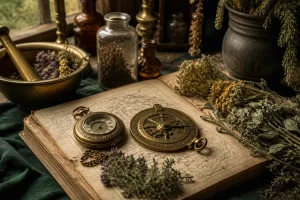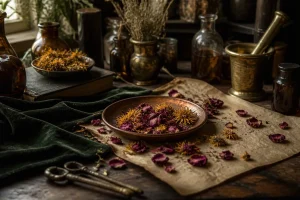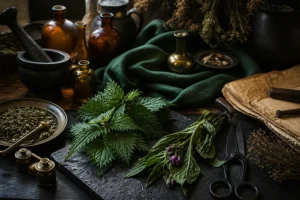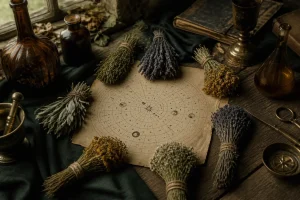
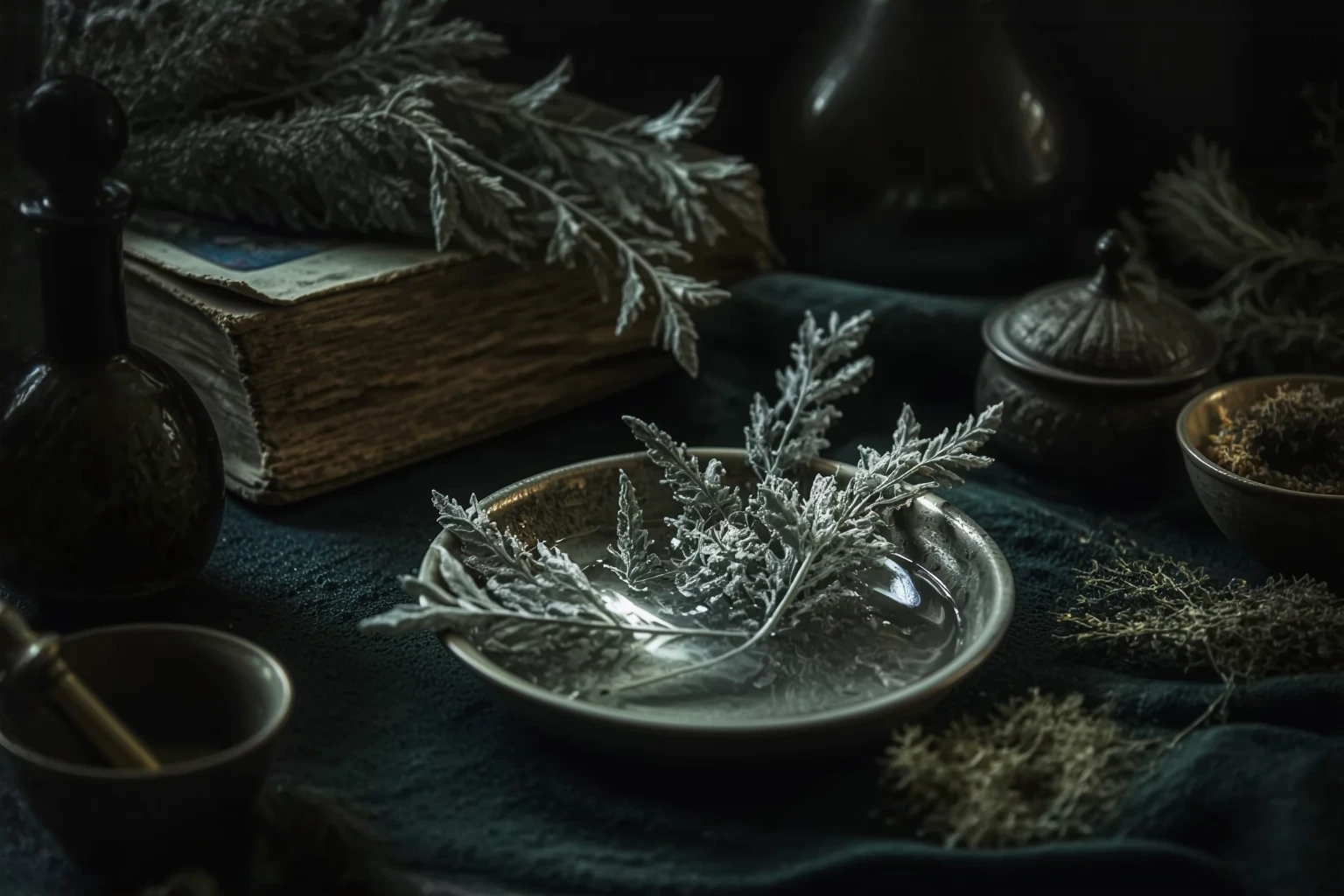
Go outside on a August night and run your hand along a stand of mugwort. Not the top, where the leaves are silver and fine. Lower down, where the stems are thick and the foliage crowds together in the dark. Brush the undersides of the leaves with your palm. That pale, felt-like surface — that’s the stellate hair structure the old herbalists were looking at when they reached for the word lunar. Hold your hand to your face. What you smell is something between sage and turpentine, bitter and green at once, with a back-note of something that does not quite translate to language. The plant is nocturnal in its logic: silver-backed, night-scented, bittersweet. It does not perform for the daylight hours.
This is why the Renaissance physician-astrologers categorized it as they did. Lunar plants, in the old system, were not assigned their planet arbitrarily or by whim. There was a doctrine — the Doctrine of Signatures, codified by Paracelsus in the early sixteenth century and later formalized by Oswald Croll in Basilica Chymica (1609) — which held that a plant’s form, color, habit, and habitat were legible signs of its affinities and actions. Silvery color was Moon. Watery habitat was Moon. Night-blooming and night-fragrant were Moon. Influence over the body’s liquids — the menses, the lymph, the tidal rhythms of fluid in flesh — was Moon. This was not primitive thinking. It was a systematic hermeneutics of the natural world, attempting to read matter as a coherent text.
We have largely lost that reading practice. This post tries to recover a piece of it — not as a medical system to follow, but as a tradition to understand. These are plants with real histories, real chemistries, and real edges. Handle them with corresponding seriousness.
The Moon’s Herbal Grammar
Before naming the specific plants, it’s worth dwelling on what “lunar” actually meant inside the hermetic-spagyric framework. Culpeper’s Complete Herbal (1653) is the version most English readers encounter, but Culpeper was drawing on a much older body of planetary medicine that ran through Galen, through the Arabic physicians — Ibn Sina’s Canon of Medicine, completed around 1025, is explicit on planetary temperaments — and back to the Pseudo-Apuleian herbals of late antiquity. The Moon governed cold and moist qualities, what Galenic medicine called the phlegmatic temperament. It governed water in the body: menstrual blood, mucus, lymph, the oceanic fluid that bathes tissues.
This cold-moist correspondence shaped which plants were assigned to the Moon. Look at the roster across multiple texts and certain features recur. The plants tend toward bitterness, which in pre-modern pharmaceutical theory indicated a capacity to move and clear. They frequently have association with sleep, dreaming, or altered states of consciousness. They grow in wet ground, or near water, or they look wet — their leaves are thick and succulent, or pale and reflective. And they often have documented historical relationships with women’s health, fertility cycles, and the monthly body.
Two plants anchor this tradition for the Western spagyrist more than any others: Artemisia vulgaris, mugwort, and Lactuca virosa, wild lettuce. Both are bitter. Both have long records in dream and sleep medicine. Both carry genuine safety considerations that the wellness world consistently soft-pedals. We will not do that here.
Mugwort: The Artemisian Plant
The genus name says everything. Artemisia honors Artemis — goddess of the moon, the hunt, the wilderness, and the protection of women in childbirth. The medieval Latin name was mater herbarum, mother of herbs, and that title appears in manuscripts as early as the ninth-century Herbarium of Pseudo-Apuleius. Hildegard von Bingen, writing in the twelfth century in Physica, discusses mugwort’s relationship to the feminine body and to the heating of cold, stagnant constitutions. It shows up in the Anglo-Saxon Lacnunga, a medical miscellany from roughly the tenth or eleventh century, as the first of the Nine Herbs — a status that suggests deep pre-Christian significance that the manuscript’s Christian overlay could not entirely erase.
The plant’s relationship to dreaming is documented across cultures and centuries with the kind of consistency that demands attention from the serious researcher. In Japanese and Chinese traditional medicine, dried mugwort — moxa — is burned in moxibustion, a practice attested in texts going back at least to the Han dynasty. In European folk tradition, stuffing a pillow with dried mugwort was a common recipe for vivid or prophetic dreams, a practice described in John Gerard’s Herball of 1597. Whether these effects are pharmacological, placebo-driven, or something more subtle in mechanism is an open question. What is not open is the historical record of the association.
Chemically, mugwort contains sesquiterpene lactones, flavonoids, and volatile oils including camphor, cineole, and thujone. Thujone is the compound that made absinthe notorious: it is psychoactive at sufficient doses, and toxic at higher ones. Mugwort does not contain the concentrated levels found in wormwood (Artemisia absinthium), but the thujone content is not nothing, and it concentrates in preparations that extract volatile fractions — tinctures, essential oils, extracts made by the spagyric process of distillation.
A plain safety note: Mugwort is a uterine stimulant. This is precisely why it appears in historical texts on amenorrhea and difficult menstruation — it was used precisely because it acts on uterine tissue. For the same reason, it is contraindicated in pregnancy, and this is not a minor caveat. It is the primary safety concern, stated clearly in contemporary clinical herbalism and in the older texts alike. Anyone who is pregnant, trying to conceive, or breastfeeding should not use mugwort in any internal preparation. Consult a qualified practitioner before working with this plant internally in any form.
Wild Lettuce: The Bitter Waters
Break the stem of Lactuca virosa — wild lettuce, sometimes called opium lettuce — and white latex bleeds out from the wound. That milky sap, called lactucarium, was once a commodity serious enough to be traded on the European market as a mild sedative. Victorian-era physicians used it as a milder, legal alternative when opium was not available or appropriate: it appears in the 1898 edition of the British Pharmacopoeia and in John King’s American Eclectic Dispensatory of 1854, which describes its effects on the respiratory system and its role in calming restlessness and sleeplessness.
Lactucarium contains lactucin and lactucopicrin, sesquiterpene bitter compounds. There is actual published research, including a study in the Journal of Ethnopharmacology in 2006 by Wesołowska and colleagues, examining these compounds for analgesic and sedative effects in animal models. The findings were not trivial, though they were limited in scope. What matters here is that this plant’s historical reputation rests on identifiable chemistry — it is not purely doctrinal. The Moon’s cold, narcotic, sleep-inducing signature, in this case, has molecular correlates.
The Doctrine of Signatures, here, holds up in an interesting way. The milky sap — white as moonlight, as the planet’s reflected face — was precisely what the old physicians pointed to as the sign of lunar affinity. The plant likes disturbed ground, roadsides, waste places. It grows tall, up to two meters, and the leaves clasp the stem with distinctive ear-like auricles. In the late afternoon it can close its leaves to face the sun, which gave it another old name: compass plant. A lunar plant that knows where the light is.
Internally, wild lettuce carries its own cautions. The latex is irritating to mucous membranes. High doses of lactucarium were historically associated with nausea, dizziness, and in extreme cases, more serious effects. As with all plants discussed on this site: this is history and craft, not prescription. Do not ingest wild lettuce or any preparation from it without consulting a qualified practitioner.
Working with Lunar Plants in the Spagyric Frame
From a spagyric standpoint, the Moon’s plants call for specific processing choices. The spagyric tradition — derived from Paracelsus’s union of Greek spao (to draw out) and ageiro (to gather) — holds that a plant preparation reaches its fullest power only when sulphur, mercury, and salt are separated, purified, and recombined. For a lunar plant, the mercury — the volatile, living spirit extracted by distillation — is often where the most characteristic compounds concentrate. The volatile oils of mugwort, with their camphor and thujone fractions, are a mercury extraction problem. The bitter principles of wild lettuce, less volatile, concentrate in the tincture and ferment work.
Traditional timing mattered too. Paracelsus and his followers argued that plants should be harvested under the planetary hour of their ruling planet. For lunar plants, this meant harvesting at night, or at the Monday hour of the Moon — both of which, interestingly, coincide with the actual biological behavior of these plants. Mugwort’s volatile fraction is highest in the flowering tips; those compounds peak in cool evening air when evaporation slows. Whether the timing is astrological or simply agronomically sound is a question worth sitting with rather than rushing to answer.
- Harvest mugwort before it fully flowers, when volatile oils peak in the upper leaf clusters
- Wild lettuce lactucarium is best collected from mature stems in summer, scoring the stem and collecting the dried latex — a labor-intensive process the old pharmacopoeias documented in detail
- Both plants reward a slow maceration in high-proof alcohol for tincture work; neither should be rushed
- External use — dream pillows, smoke bundles, bath preparations — sidesteps many of the internal safety considerations, though not all
The lunar herbs are a good entry point into planetary medicine precisely because the tradition around them is so rich and so long. You are not walking into a void when you pick up a stem of mugwort. You are entering a conversation that runs through Hildegard’s monastery, through Culpeper’s apothecary, through the Han dynasty’s burning of moxa over points on bodies that still ache and need tending. That conversation is worth joining carefully, seriously, and with your eyes open in the dark.
Frequently Asked Questions
What does the Doctrine of Signatures say about lunar plants?
The Doctrine of Signatures, codified by Paracelsus in the early sixteenth century and formalized by Oswald Croll in Basilica Chymica (1609), held that a plant’s form, color, habit, and habitat were legible signs of its affinities. Silvery color, watery habitat, night-blooming, and influence over the body’s liquids—menses, lymph, fluid rhythms—all marked a plant as lunar.
Why is mugwort considered a lunar plant?
Mugwort displays the classical lunar signatures: its stellate hair structure creates a pale, silver-backed undersides on the lower leaves; it is nocturnal in logic and scent, releasing its fragrance at night; and historically it was associated with the feminine body and menstrual cycles, linking it to the Moon’s governance of bodily waters and the menses.
What is lactucarium and where does it come from?
Lactucarium is the white latex that bleeds from broken stems of Lactuca virosa, wild lettuce. It was traded on the European market as a mild sedative and appears in the 1898 British Pharmacopoeia and John King’s American Eclectic Dispensatory of 1854 as a milder alternative to opium for calming restlessness and sleeplessness.
What safety concerns does mugwort carry internally?
Mugwort is a uterine stimulant and is contraindicated in pregnancy. Anyone who is pregnant, trying to conceive, or breastfeeding should not use mugwort in any internal preparation. Consult a qualified practitioner before working with this plant internally in any form.
About This Article

Written by Kyle Bamboo. Kyle Bamboo has spent twelve years following the hermetic tradition of herbalism out of dusty reprints and into a home apothecary — spagyrics, planetary correspondences, and the strange internal logic of plant alchemy. Muddle and Mend takes its name from solve et coagula, dissolve and combine. He writes about the actual tradition, with its history, its vocabulary, and its genuine strangeness, not the Instagram version. More about this site.
Scope and limits. Kyle writes from a personal practice in traditional herbalism, not clinical training. Herbs interact with prescription medications and are not regulated as drugs — check interactions and talk to a pharmacist or clinician before taking anything.
Verify this against a primary source
Specifics change, and your situation may differ from the one described here. These are the authorities worth checking directly:
- NCCIH — herb safety, evidence and known interactions
- MedlinePlus Herbs and Supplements — documented interactions and cautions
- FDA Dietary Supplements — regulatory status and safety alerts