Picture a man in the middle of a Basel street, June 1527, holding a bonfire. Not metaphorically. An actual fire. And into it he throws the Canon of Medicine — Ibn Sina’s eleventh-century masterwork, the text every physician in Europe had sworn their career upon. Students and faculty of the newly founded University of Basel watch from a careful distance. Some are furious. Some are secretly delighted. The man feeding the flames is their new professor of medicine, and he has already announced, in writing, that he considers the entire received tradition of Galenic and Arabic medicine to be, essentially, garbage. His name — the one he gave himself — is Paracelsus. And he is about to change everything.
He was born Philippus Aureolus Theophrastus Bombastus von Hohenheim, probably in 1493, in Einsiedeln, in what is now Switzerland. The name alone tells you something: he was a man who believed in elaboration. He took the Latinate pen name Paracelsus later — meaning, more or less, “beyond Celsus,” beyond the great Roman medical encyclopedist — with the exact degree of arrogance you would expect from someone who burned books in the street. He learned mining chemistry from his father, a physician and metallurgist. He wandered. He studied at Ferrara. He traveled through the German states, Hungary, Russia, possibly the Ottoman Empire, learning from miners and surgeons and midwives and anyone who would talk to him. He despised men who learned medicine only from books written by other men who had learned medicine from books.
The Bonfire at Basel
The Basel appointment came in 1527, arranged partly through the influence of his friend the printer Johannes Froben, whom Paracelsus had treated successfully for a leg condition that other physicians had recommended amputating. It was a prestigious chair. He destroyed it almost immediately — and magnificently. He lectured in German rather than Latin, which was a deliberate provocation. He invited barber-surgeons and apothecaries to attend, people the university considered tradesmen, not scholars. He told his students that a physician who followed only classical authority without observing nature directly was not a physician at all. He called Galen and Avicenna “high asses.” This is not paraphrase. The man had a particular gift for invective that has rarely been equaled in the history of medicine.
He stayed in Basel less than two years. A dispute with a magistrate — Paracelsus had sued on behalf of a patient overcharged by a physician, lost, and responded by publicly insulting the judge — ended his tenure abruptly. He fled the city in 1528 and spent the rest of his life wandering: Colmar, Nuremberg, St. Gallen, Augsburg, Innsbruck, Salzburg, where he died in 1541. He published almost nothing in his lifetime. The works for which he is known — Opus Paramirum, Astronomia Magna, Archidoxis — circulated in manuscript and were published posthumously by editors whose relationship to his original words is not always clear. He was difficult, probably alcoholic, almost certainly bipolar by modern reckoning, and ferociously, productively, impossibly brilliant.
Spagyria: The Word He Made
Paracelsus coined the word spagyria — from the Greek spao (to separate, to draw out) and ageiro (to gather, to combine). Solve et coagula in Greek clothing. The idea is precise: you cannot heal with a plant until you understand what in the plant actually heals. And you cannot understand that without taking the plant apart. This was a radical departure from the Galenic tradition, which classified plants by their qualities — hot, cold, dry, moist — and prescribed them whole. Paracelsus insisted that within every plant there is an active principle, a specific power, and that the physician’s task is to isolate it, purify it, and recombine it in a form the body can use. This is, roughly speaking, the founding logic of pharmaceutical chemistry. He got there in the 1520s.
His framework for understanding what those active principles were is the tria prima: the three primes. Every material thing, Paracelsus argued, is composed of three philosophical principles — not elements in the modern sense, but dynamic qualities expressed through material form. Salt. Sulfur. Mercury. Not the literal substances (though he sometimes slid between the literal and the philosophical in ways that drive historians of science quietly mad), but what those substances represent:
- Salt — the body, the fixed, the mineral, that which remains after burning
- Sulfur — the soul, the combustible, the oily volatile essence that carries smell and flavor and heat
- Mercury — the spirit, the fluid mediator, the watery principle that moves between fixed and volatile
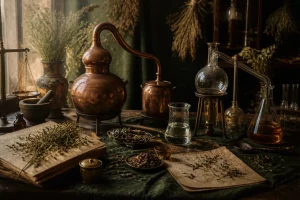
In spagyric practice, this maps onto physical process: the sulfur fraction is your essential oil, your alcohol-soluble aromatics; the mercury fraction is your alcohol and water-soluble components; the salt fraction is your mineral ash, your calcined plant body. You separate them. You purify each. You recombine them. The result, in theory, is something more coherent and potent than the raw plant — a medicine that carries all three principles of the plant in a form your body recognizes. Whether this is chemistry or philosophy or both is a question that will not be settled here. But it is not nothing. It structured serious laboratory work for over two centuries.
The Dose Makes the Poison
His most durable contribution is a sentence. It appears in his Dritte Defensio, written around 1538: Alle Ding sind Gift und nichts ohn Gift; allein die Dosis macht, daß ein Ding kein Gift ist. All things are poison and nothing is without poison; only the dose makes a thing not a poison. You know this sentence. You have heard it quoted — usually without attribution — in every serious conversation about toxicology, pharmacology, and food safety since the sixteenth century. He wrote it. It is perhaps the most consequential single sentence in the history of medicine.
The context matters. Paracelsus was defending his use of minerals — mercury, antimony, arsenic, lead — as medicines, at doses calibrated carefully, at a time when the Galenic establishment considered such things unfit for internal use. He was right that the dose is what separates medicine from poison. He was right that minerals could be medicines. He was also working with mercury at a time when no one understood cumulative heavy metal toxicity, and some of his treatments almost certainly killed people. This is worth saying plainly. Historical admiration should not be the same as uncritical reverence. He demanded better medicine. He also practiced within the limits of what the sixteenth century could know, and those limits were steep.
The same principle applies to plant work today. Many of the herbs the spagyric tradition handles — wormwood, henbane, aconite, foxglove — have real and serious toxicological profiles. The dose makes the poison, which also means the dose can make the poison. Anyone working with potent botanical material should know their plants, know their chemistry, and consult a qualified professional before ingesting anything they have prepared themselves. This is not a caveat inserted from legal anxiety. It is the tradition’s own insistence: know the substance before you use it.
What He Actually Built
Paracelsus did not win in his lifetime. He died largely unpublished, probably broke, certainly obscure outside a circle of devoted students. But the Paracelsian movement — Paracelsianism — became one of the defining intellectual forces of late sixteenth and early seventeenth century Europe. Figures like Oswald Croll, whose Basilica Chymica appeared in 1609, formalized his spagyric methods into teachable practice. The iatrochemists — physician-chemists — of the 1600s built directly on his framework. Jan Baptist van Helmont refined his ideas about chemical physiology. Robert Boyle, whom we teach as a founding figure of modern chemistry, was working within a tradition that Paracelsus had helped to shape, however antagonistically.
The pharmaceutical industry, which Paracelsus would have loathed on general principle, is also his descendant. The logic that a plant contains an isolable active principle — that you can extract it, purify it, standardize it — is the logic of aspirin from willow bark, morphine from opium, digoxin from foxglove. He got the philosophy right even when he got the specifics catastrophically wrong. That is what genuine innovation looks like: not clean successes, but a new way of framing the question that turns out to be productive for centuries.
The bonfire at Basel was not a tantrum, though it looked like one. It was a statement about epistemology: that authority is not the same as truth, that a text is not the same as a body, that knowledge must be pressed out of matter directly — the way you press a leaf between your fingers and smell what was locked inside. Paracelsus was insufferable. He was also, on the questions that mattered most, correct. The tradition we work in here begins, in no small part, with that fire.
Frequently Asked Questions
What did Paracelsus mean by the word spagyria?
Paracelsus coined spagyria from Greek roots meaning to separate and to gather, expressing the principle of solve et coagula. In this tradition, the physician must take a plant apart to isolate its active principle, then purify and recombine it into a form the body can use—a radical departure from Galenic medicine, which prescribed whole plants classified by their qualities.
What are the tria prima in Paracelsian medicine?
The tria prima—salt, sulfur, and mercury—are three philosophical principles Paracelsus held compose all material things. In spagyric practice, sulfur represents the volatile aromatic essence, mercury the fluid mediator of alcohol and water-soluble components, and salt the fixed mineral ash remaining after burning. Together they form a complete medicine.
Who was Paracelsus and why did he burn books?
Paracelsus, born Philippus Aureolus Theophrastus Bombastus von Hohenheim around 1493, was appointed professor of medicine at Basel in 1527. He publicly burned Ibn Sina’s Canon of Medicine to reject the entire Galenic and Arabic medical tradition he considered false, declaring that physicians must observe nature directly rather than follow classical authority alone.
What is Paracelsus’s most famous contribution to medicine?
Paracelsus’s most consequential contribution is the principle stated in his Dritte Defensio: all things are poison and nothing is without poison; only the dose makes a thing not a poison. This sentence, written around 1538, remains foundational to toxicology, pharmacology, and food safety, though it was then used to defend his controversial use of minerals as medicines.
About This Article

Written by Kyle Bamboo. Kyle Bamboo has spent twelve years following the hermetic tradition of herbalism out of dusty reprints and into a home apothecary — spagyrics, planetary correspondences, and the strange internal logic of plant alchemy. Muddle and Mend takes its name from solve et coagula, dissolve and combine. He writes about the actual tradition, with its history, its vocabulary, and its genuine strangeness, not the Instagram version. More about this site.
Scope and limits. Kyle writes from a personal practice in traditional herbalism, not clinical training. Herbs interact with prescription medications and are not regulated as drugs — check interactions and talk to a pharmacist or clinician before taking anything.
Verify this against a primary source
Specifics change, and your situation may differ from the one described here. These are the authorities worth checking directly:
- NCCIH — herb safety, evidence and known interactions
- MedlinePlus Herbs and Supplements — documented interactions and cautions
- FDA Dietary Supplements — regulatory status and safety alerts