Hold a piece of vitriol in your hand. Not the word — the substance. A blue-green crystal of copper sulfate, cold and dense, leaving a faint metallic stain on your palm. Now drop it into water and watch what happens. The crystal doesn’t just dissolve. It bleeds. The water goes turquoise, then deepens. Something that was locked in a solid lattice has released itself into solution, and the solution is now something neither component was alone. The alchemists called this solve — dissolution, the first half of their central operation. And they watched it with the same intensity you’d bring to surgery. Because for them, what happened in the flask was not separate from what happened in the operator. The interior and the exterior were coupled systems.
That coupling is what chemistry eventually cut away. The cut was necessary. It was also costly. Understanding what was lost — and why it was discarded in the first place — is one of the more important exercises a serious student of the herbal tradition can undertake. Because the loss was not theft. It was a bargain, made deliberately, and we are still living inside its terms.
The Workshop That Alchemy Actually Was
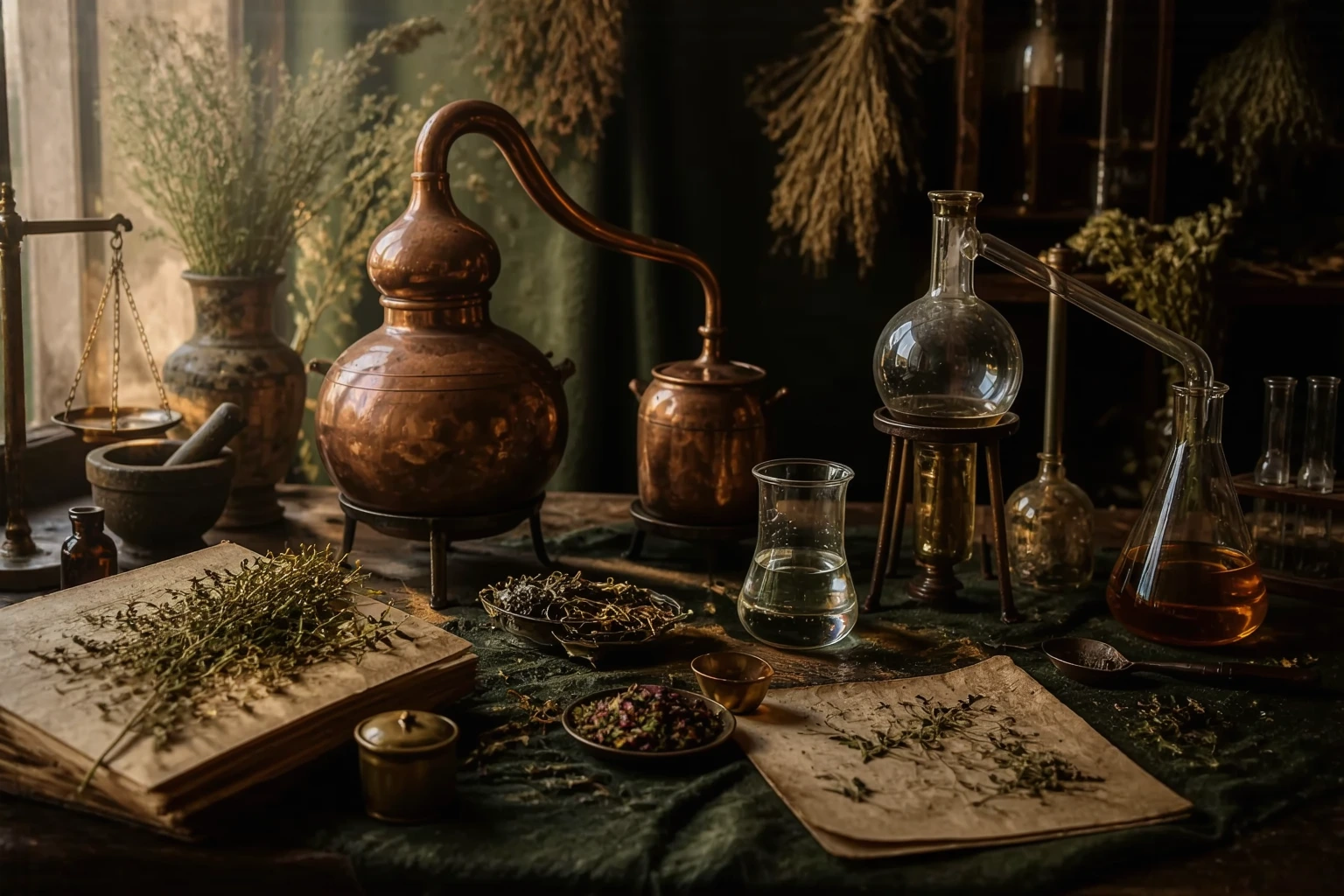
Strip away the gilded allegory for a moment and look at what an alchemical laboratory in the sixteenth century actually contained: furnaces, retorts, pelicans, cucurbits, alembics — an entire vocabulary of glassware purpose-built for distillation, circulation, and calcination. The practitioners were not dreamers. Paracelsus, working in the early 1500s, introduced mercury, sulfur, and salt as the three philosophical principles of matter — his tria prima — and used them to understand how medicinal preparations acted on the body. His Archidoxis and the broader Paracelsian corpus were fiercely practical texts, written in a combative vernacular that scandalized the Galenic establishment. He burned the Canon of Avicenna in public. He was not gentle about it.
The spagyric tradition that grew from Paracelsian roots took the solve et coagula operation and applied it specifically to plants. You separate the plant’s constituents — through fermentation, distillation, calcination — purify each fraction, and recombine them. The essential oil carries the Sulfur principle: the volatile, the aromatic, the specific virtue. The alcohol carries the Mercury: the universal solvent, the mediating spirit. The mineral salts from the calcined plant body carry the Salt: the fixed, the structural, the earthy. The theory is philosophical. But the operations are real chemistry, and the products — genuine spagyric tinctures — are chemically distinct from a simple maceration.
Boyle’s Hammer
In 1661, Robert Boyle published The Sceptical Chymist. The title tells you everything about the mood. Boyle was not interested in dismantling practical chemistry — he was deeply interested in experimental practice. What he attacked was the untestable theoretical scaffolding: the four Aristotelian elements, the three Paracelsian principles, the assumption that philosophical categories described physical reality. He argued that matter was composed of corpuscles — small particles whose arrangement and motion produced the properties we observe — and that the only valid path to knowledge was repeatable experiment with measurable outcomes.
This was not anti-spiritual in intent. Boyle was a sincere and serious Christian who wrote theological tracts alongside his chemistry. But the methodological move he made had consequences beyond his intentions. By insisting that the operator’s interior state was irrelevant to the experiment’s outcome — that a good experiment produced the same result whether the experimenter was devout or dissolute — he severed the coupling the alchemists had taken for granted. The flask and the soul were henceforth separate departments.
For rigor, this was a tremendous gain. For the tradition of intentional plant work, it was the beginning of a long amputation.
Lavoisier and the Language of Loss
A century later, Antoine Lavoisier finished what Boyle had started. By 1789, his Traité Élémentaire de Chimie had established the conservation of mass as a chemical law, demolished the phlogiston theory, and provided the first systematic chemical nomenclature. Elements were now defined operationally: a substance that could not be further decomposed by analysis. The list was finite, measurable, reproducible across any laboratory in Europe. Chemistry became, for the first time, a genuinely international language.
What disappeared from that language was not small. Consider what the alchemists called the quinta essentia — the quintessence, the fifth essence, extracted through repeated distillation and understood as the concentrated vital principle of a plant. This was not merely essential oil. It was the plant’s specific virtue, understood as something that bore a relationship to the operator who extracted it, to the time and season of harvest, to the quality of attention brought to the work. Lavoisier’s system had no column for that. It was not that chemistry disproved the quintessence. It was that chemistry could not see it — the methodology was not built to detect relational or intentional variables. So those variables were reclassified as superstition and quietly dropped from the table.
What the Translation Actually Cost
Be fair about this. Modern phytochemistry has given us things the alchemists genuinely lacked. We know that Hypericum perforatum — St. John’s Wort — contains hypericin, pseudohypericin, and hyperforin, and we know with precision how those compounds interact with neurotransmitter reuptake. We know that Atropa belladonna contains tropane alkaloids that will kill you at a dose that is not very far above any therapeutic range, and we can measure that dose. The spagyrist who advised belladonna preparations without this knowledge was working dangerously in the dark, regardless of the beauty of their cosmological framework. If you are working with any plant that has serious toxicological concerns — and several of the most historically interesting ones do — you need modern phytochemical knowledge, and you need to consult a qualified practitioner before any ingestion. This is not a disclaimer. It is the tradition being honest about its own limits.
But precision about constituents is not the same as understanding of wholeness. The spagyric critique of simple extraction — the argument that the whole prepared plant, with its mineral salts reintegrated, works differently than isolated fractions — is a genuinely interesting hypothesis that modern chemistry has barely begun to investigate through the lens of synergy research. The alchemical insistence that the operator’s state matters is harder to test, but not therefore worthless as a practical discipline. A distillation conducted with full attention and careful timing produces a different product than one run carelessly. That is not mysticism. That is craft.
Running Both Systems at Once
The serious student of spagyrics does not have to choose between Lavoisier and Paracelsus. They have to run both operating systems simultaneously, and know which one is talking at any given moment. Chemistry tells you the constitution of your plant — the alkaloids, the glycosides, the volatile terpenes, the mineral profile of the ash. The alchemical framework tells you how to think about the relationship between those constituents, how to structure your operations, and what you are trying to preserve or transform in each phase of the work.
When you calcine the spent marc of your plant body — burning it to white ash in a crucible, then dissolving and filtering those salts back into your tincture — you are doing something no standard tincture preparation does. You are reincorporating the mineral skeleton of the plant into the preparation. Whether that is meaningful in a bioavailability sense is a legitimate research question. Whether it is meaningful in a philosophical and craft sense is not in question at all. The operation connects you to four centuries of careful workers who believed that wholeness was not a feeling but a technical requirement.
The translation from alchemy to chemistry gained us a universal language and a method that could be checked by strangers. What it lost was the insistence that the one doing the checking was part of the experiment. Getting both back at once — that is the work this tradition is still doing. Solve. Then coagula. Muddle it apart. Mend it back together.
Frequently Asked Questions
What did Paracelsus mean by the tria prima?
Paracelsus introduced mercury, sulfur, and salt as the three philosophical principles of matter in the early 1500s. In spagyric practice, the essential oil carries the Sulfur principle (volatile and aromatic), alcohol carries the Mercury (universal solvent and mediating spirit), and mineral salts from calcined plant body carry the Salt (fixed and structural).
How did Robert Boyle change alchemical thinking?
In 1661, Boyle published The Sceptical Chymist, attacking untestable theoretical scaffolding like the four Aristotelian elements and three Paracelsian principles. He argued that matter was composed of corpuscles and that only repeatable experiment with measurable outcomes revealed knowledge. This severed the alchemists’ coupling of the operator’s interior state to the experiment’s outcome.
What is the quinta essentia in spagyric tradition?
The quinta essentia, or quintessence, was the fifth essence extracted through repeated distillation and understood as the concentrated vital principle of a plant. It was not merely essential oil but the plant’s specific virtue, understood as bearing a relationship to the operator, harvest season, and quality of attention brought to the work.
Why is modern phytochemistry essential for plant work today?
Modern phytochemistry identifies specific compounds and their toxicological profiles. For example, Atropa belladonna contains tropane alkaloids that will kill you at a dose not very far above any therapeutic range. Anyone working with plants having serious toxicological concerns must consult a qualified practitioner and have modern phytochemical knowledge before any ingestion.
About This Article

Written by Kyle Bamboo. Kyle Bamboo has spent twelve years following the hermetic tradition of herbalism out of dusty reprints and into a home apothecary — spagyrics, planetary correspondences, and the strange internal logic of plant alchemy. Muddle and Mend takes its name from solve et coagula, dissolve and combine. He writes about the actual tradition, with its history, its vocabulary, and its genuine strangeness, not the Instagram version. More about this site.
Scope and limits. Kyle writes from a personal practice in traditional herbalism, not clinical training. Herbs interact with prescription medications and are not regulated as drugs — check interactions and talk to a pharmacist or clinician before taking anything.
Verify this against a primary source
Specifics change, and your situation may differ from the one described here. These are the authorities worth checking directly:
- NCCIH — herb safety, evidence and known interactions
- MedlinePlus Herbs and Supplements — documented interactions and cautions
- FDA Dietary Supplements — regulatory status and safety alerts