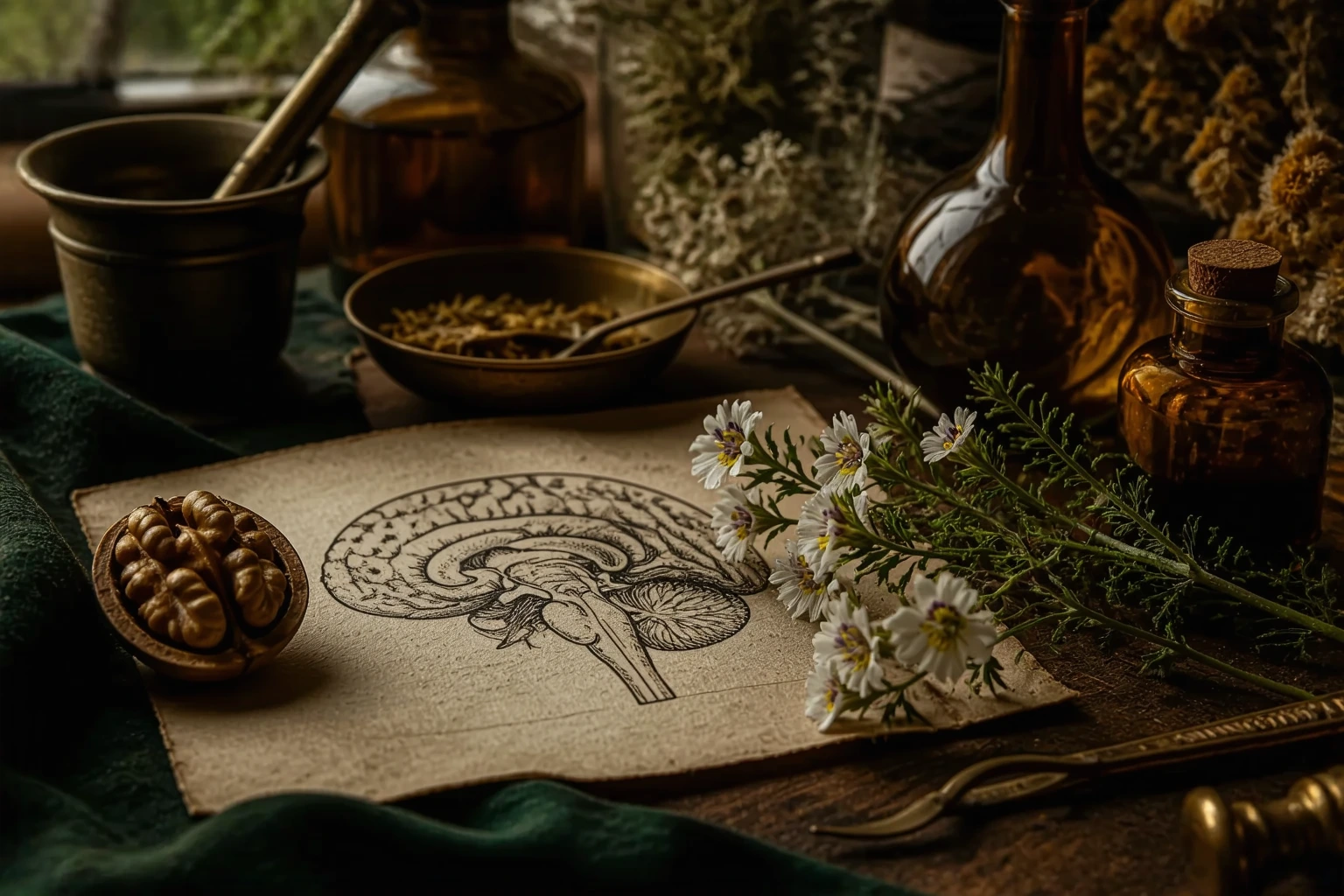
Split a walnut open. Not with a nutcracker — with something blunt, something that takes effort. Let the shell crack apart and look at what’s inside. Two lobes. A wrinkled, folded surface. A thin papery membrane running down the center like a longitudinal fissure. If you’ve ever seen a diagram of the human brain in cross-section, the recognition is instant and a little unsettling. Someone, centuries ago, looked at that walnut and felt the same jolt. They did not dismiss it. They built a philosophy around it.
That philosophy is the Doctrine of Signatures. And before you file it under “folk superstition” and move on, understand what it actually was: a working taxonomy developed by serious, learned men at a moment when botany, medicine, and theology were not yet separated into their tidy professional boxes. It was an attempt to read the world as a text. Whether you believe the Author exists is a separate question from whether the reading practice is interesting. It is very interesting.
The Doctrine, Before It Had a Name
The idea that a plant’s appearance signals its virtue is ancient and runs through traditions that never spoke to each other. Dioscorides, writing his De Materia Medica in the first century CE, noted correspondences between plant morphology and application without theorizing them into a system. The medieval herbalists absorbed this casually, practically. But the doctrine as doctrine — articulate, defended, metaphysically grounded — belongs primarily to two men: Paracelsus and Jakob Böhme.
Theophrastus Bombastus von Hohenheim, who named himself Paracelsus, was working in the early sixteenth century. He was not a gentle man. He burned the works of Galen and Avicenna at a St. John’s Day bonfire in Basel in 1527, which tells you something about his temperament and his seriousness. His concept of signatura rerum — the signature of things — held that the Creator had marked each plant with an outward sign indicating its inward virtue. This was not decorative theology. For Paracelsus, the physician who could not read signatures was like a man who could not read letters: functionally illiterate in the language of nature.
Böhme came later and from a different direction. A German cobbler who had mystical visions beginning around 1600, he wrote Signatura Rerum in 1621 — a dense, extraordinary text that treats signatures as the fundamental grammar of all created things, not just plants. For Böhme, the signature was the way the inner essence of a thing pressed itself outward into visible form. The doctrine, in his hands, became fully cosmological.
The version most herbalists actually encounter, though, is the one popularized by William Coles in The Art of Simpling (1656) and Robert Turner’s Botanologia (1664) — English writers working in a vernacular tradition, presenting the doctrine as practical guidance for the working herbalist. By then it was already being challenged. But it was everywhere.
The Examples: What They Got Right, What They Got Wrong
Let’s be specific, because the doctrine lives or dies on its examples.
The walnut-and-brain correspondence is the famous one. The walnut’s shell resembles the skull; the inner membrane resembles the dura mater; the lobed kernel resembles the cerebral hemispheres. Coles argued it was therefore good for head ailments and for the brain. Walnuts do contain omega-3 fatty acids, polyphenols, and compounds associated with neuroprotection in modern research — but the route from visual resemblance to biochemical mechanism is not a straight road. The correspondence got something right. The reasoning behind it was wrong. That distinction matters enormously.
Eyebright (Euphrasia officinalis) has a small white flower with a dark purple center and yellow marking — it looks, loosely, like an iris and pupil. It was used extensively for eye complaints. There is some evidence of mild anti-inflammatory activity in the plant. There is no evidence that the visual resemblance caused this activity. Again: a partial hit, for the wrong reasons.
Then there are the misses. Liverwort (Hepatica nobilis) has three-lobed leaves that vaguely resemble the liver’s shape, so it was prescribed for liver complaints. Its actual hepatic activity is negligible. Yellow plants were sometimes assigned to the treatment of jaundice because jaundice is yellow — celandine (Chelidonium majus) being a vivid example, its stems bleeding bright orange-yellow sap. Celandine does have real pharmacological activity, including alkaloids with genuine effects on bile production, but it is also hepatotoxic in significant doses. The signature here led practitioners toward a plant with real liver-related effects — and toward a plant that can damage the liver. The reading was blunt where the chemistry is precise. That is exactly the problem.
A plain note: Celandine is not a plant to experiment with casually. Its alkaloid content makes it genuinely dangerous without proper knowledge of preparation and dose. Consult a qualified professional before working with any medicinal plant.
Mnemonic Taxonomy: The Real Function
Mnemonic Taxonomy: The Real Function
Here is what tends to get lost in both the enthusiastic and the dismissive accounts of the doctrine: it worked as a memory system in a world without printed field guides, standardized nomenclature, or reliable literacy.
If you are a sixteenth-century herbalist who needs to remember several hundred plants and their applications, you need hooks. The doctrine of signatures provided hooks. The walnut looks like a brain — you don’t forget that. The spotted leaves of lungwort (Pulmonaria officinalis) resemble diseased lung tissue — the association sticks. Whether or not the resemblance is therapeutically meaningful, it is mnemonically powerful. It organizes knowledge into the one filing system that requires no external technology: the human visual imagination.
This is the function that Paracelsus’s theology obscures and that modern debunking misses entirely. The doctrine was doing two jobs simultaneously. It was making a metaphysical claim — that God had labeled his pharmacy — and it was providing a working mnemonic system for pre-literate and semi-literate practitioners. Separating these two functions is necessary if you want to understand why the doctrine persisted long after its philosophical underpinning was abandoned.
Agnes Arber, in her magisterial Herbals: Their Origin and Evolution (first published 1912, still essential reading), traces exactly this dual function without fully naming it as such. The herbals she surveys use signature language casually, practically, as a sorting mechanism. The theology is present but often perfunctory. The memory-system function is primary.
Where It Fails, and Why That Matters to a Practitioner
The doctrine fails precisely where medicine needs it to succeed: at the level of mechanism and dose.
Visual morphology does not predict alkaloid content. Leaf shape does not determine whether a compound is water-soluble or alcohol-soluble, and that matters enormously when you’re deciding how to prepare a plant. A red plant is not necessarily high in iron. A bitter-tasting plant is not necessarily a liver herb. The signature reads the surface. Chemistry reads deeper.
The spagyric tradition — which this site exists to explore — insists on taking matter seriously on its own terms. That means distillation. Separation. Analysis. The alchemical solve et coagula is not a metaphor for sympathetic correspondence; it is a physical process that produces observable changes in physical materials. When you run a plant through a proper spagyric preparation, you are separating its sulphur (volatile aromatics), its mercury (the fluid menstruum), and its salt (the mineral-rich ash after calcination). These are not signatures. These are fractions. They behave differently. They do different things.
A practitioner who relies on signatures alone will sometimes be right. The doctrine has enough genuine hits, accumulated over enough centuries, to give it a surface plausibility that is hard to argue with quickly. But a practitioner who understands both the signature tradition and the actual chemistry of what they’re working with is operating at a different level of precision entirely. The doctrine is a beginning, not a method.
Why It Persists: The Doctrine as a Way of Seeing
And yet. Strip out the bad medicine and the doctrine leaves something behind that is genuinely worth keeping: a habit of attention.
When you learn to look at a plant the way the signature-readers looked — slowly, with the expectation that its form is communicating something — you begin to see things you would otherwise miss. The texture of a leaf. The color distribution in a flower. The way a root grows, whether it goes straight or spirals or spreads laterally. These observations are not sufficient to determine medicinal action. But they are the beginning of real botanical knowledge, which starts with the senses and moves toward analysis, not the other way around.
Paracelsus was wrong about the mechanism. He was not wrong that nature is legible. The language turns out to be chemistry and evolution rather than divine inscription, but the injunction — look closely, read carefully, nothing is arbitrary — translates perfectly into a modern framework. Plants look the way they look because of selection pressures, pollinator relationships, competitive strategies, and biochemical pathways that shaped their morphology over millions of years. Form and function are connected. Not by God’s label-maker. By deeper processes that are, if anything, more astonishing.
So split the walnut open again. Look at it for longer than you think you need to. You’re not looking for proof of the doctrine. You’re practicing the first and most fundamental skill of the herbal tradition: the willingness to actually see what’s in front of you, instead of what you expected to find.
That’s where the real work starts.
Frequently Asked Questions
What is the Doctrine of Signatures in herbalism?
The Doctrine of Signatures holds that a plant’s outward appearance signals its inward virtue. Paracelsus formalized this in the early sixteenth century as signatura rerum — the signature of things — arguing the Creator marked each plant with a sign indicating its use. Böhme later expanded it into a fully cosmological principle about how inner essence presses outward into visible form.
Did the walnut-brain correspondence actually work?
Partially. The walnut’s lobed kernel does resemble cerebral hemispheres, and Coles argued this indicated use for brain ailments. Walnuts contain omega-3 fatty acids and polyphenols with neuroprotective associations in modern research. However, the visual resemblance did not cause the biochemical activity — the correspondence got something right, but the reasoning behind it was wrong.
Why did herbalists use the Doctrine of Signatures practically?
In a world without printed field guides or standardized nomenclature, the doctrine functioned as a powerful mnemonic system. Visual associations — like lungwort’s spotted leaves resembling diseased lung tissue — provided memory hooks for hundreds of plants and their applications. The doctrine organized knowledge into a filing system requiring no external technology: the human visual imagination.
Where does signature reading fail in herbal practice?
The doctrine fails at mechanism and dose. Visual morphology does not predict alkaloid content, leaf shape does not determine solubility, and a red plant is not necessarily high in iron. Spagyric practice insists on taking matter seriously through distillation, separation, and analysis — dividing plants into sulphur, mercury, and salt fractions that behave differently than signatures suggest.
About This Article

Written by Kyle Bamboo. Kyle Bamboo has spent twelve years following the hermetic tradition of herbalism out of dusty reprints and into a home apothecary — spagyrics, planetary correspondences, and the strange internal logic of plant alchemy. Muddle and Mend takes its name from solve et coagula, dissolve and combine. He writes about the actual tradition, with its history, its vocabulary, and its genuine strangeness, not the Instagram version. More about this site.
Scope and limits. Kyle writes from a personal practice in traditional herbalism, not clinical training. Herbs interact with prescription medications and are not regulated as drugs — check interactions and talk to a pharmacist or clinician before taking anything.
Verify this against a primary source
Specifics change, and your situation may differ from the one described here. These are the authorities worth checking directly:
- NCCIH — herb safety, evidence and known interactions
- MedlinePlus Herbs and Supplements — documented interactions and cautions
- FDA Dietary Supplements — regulatory status and safety alerts