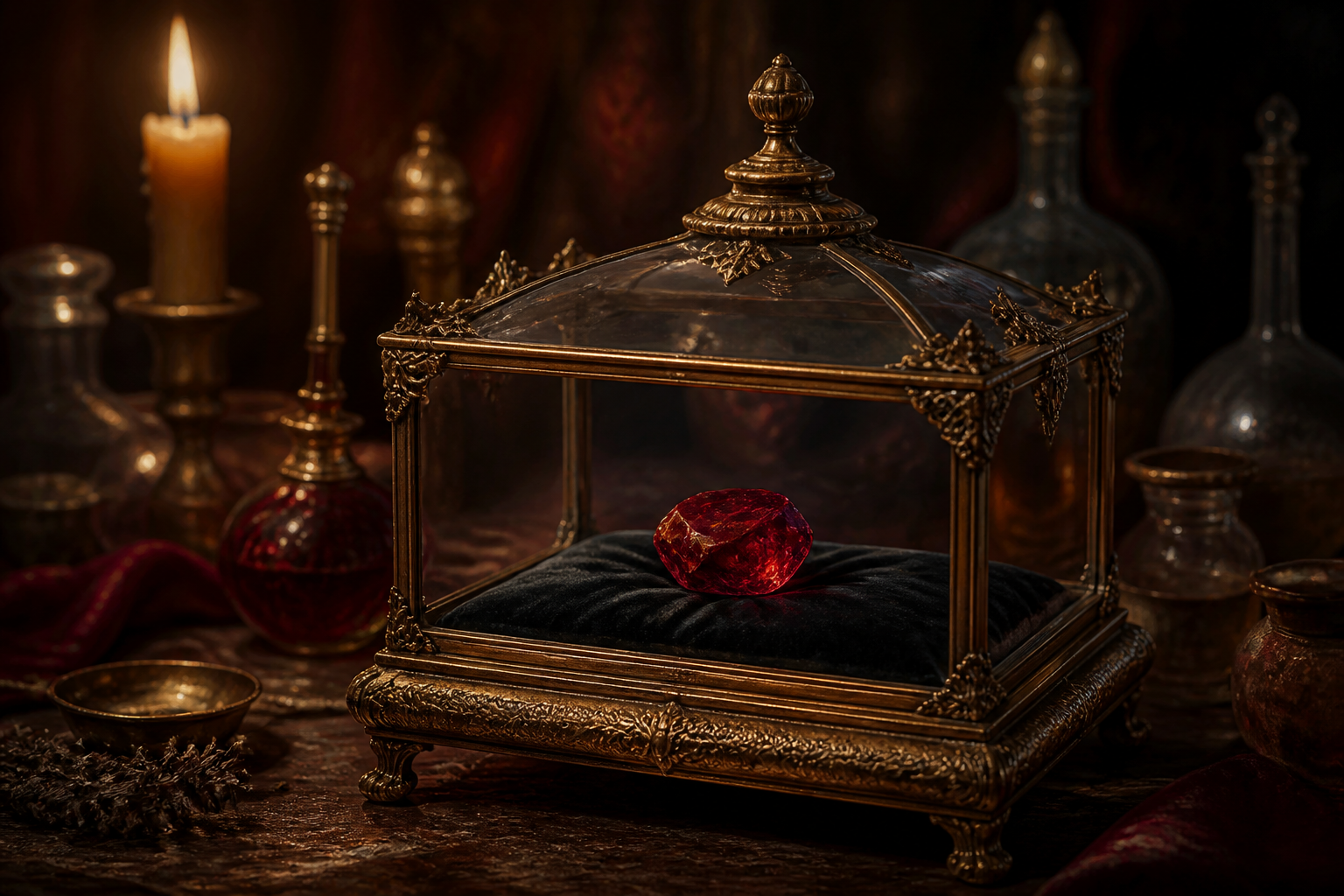
The Philosopher’s Stone (Latin: lapis philosophorum) was the legendary end product of the Great Work—a substance believed capable of “perfecting” imperfect matter, most famously by transmuting base metals into gold, and in its medical application, of healing and prolonging life. It was never believed to be an actual rock. The word “stone” is a technical term for a fixed, solid, stable substance, not a description of appearance.
If you know the Stone only from Harry Potter or cartoon alchemy jokes, you’ve been fed the flattened version. This entry corrects it.
What “Stone” Actually Meant
In alchemical vocabulary, “stone” (lapis) signals fixity—a substance that has achieved permanent, stable form, incombustible and unchanging, as opposed to the volatile, unstable intermediate substances of the earlier Work stages. Think of it as the opposite of “vapor” or “salt that dissolves in water.” It means fixed.
Descriptions of the Stone’s actual appearance vary wildly across sources: a red powder, a waxy solid, a crystalline substance. Some texts describe it as heavier than gold; others as light as ash. This inconsistency itself is telling. Most serious alchemical writers treated it as much a philosophical endpoint as a literal recipe—a symbol of perfected matter, not a precise chemical formula waiting to be reverse-engineered from old manuscripts.
Two Powers: Metal and Medicine
Metallic Transmutation
The Stone was said to possess the power to convert base metals (lead, tin, copper) into gold or silver. The method described most often is projection: a tiny quantity of the Stone, thrown onto a large quantity of molten base metal, would supposedly transmute the entire mass. The Stone acted catalytically—a seed crystal of perfection awakening the latent perfection in imperfect matter.
The Elixir of Life
The second power matters more in the spagyric and Paracelsian traditions: the Stone dissolved in wine or otherwise prepared was held to cure disease and radically extend life. This is where the term “stone” gets applied by extension to any maximally purified, maximally potent medicinal preparation—not only to a literal metallic agent. A finished spagyric tincture of your own making is, in this sense, a small stone.
The Magnum Opus: How It Was Made
The classical alchemical process unfolded in four stages, corresponding to colors and inner states:
- Nigredo (blackening)—the dissolution and reduction to prima materia; the darkest, most chaotic phase
- Albedo (whitening)—purification and illumination; the work begins to stabilize
- Citrinitas (yellowing)—sometimes included, sometimes omitted in later traditions
- Rubedo (reddening)—completion; the Stone itself, red being the color of perfected work
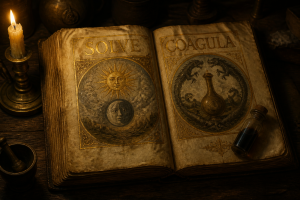
This is solve et coagula (dissolve and coagulate) carried through its full cycle. Not a single pass. A complete death and resurrection of matter.
Did They Actually Believe This?
Here’s where the tradition fractures into honesty. Some practitioners clearly did attempt literal metallic transmutation—this is documented, funded by kings, and occasionally prosecuted as fraud. But a strong current within the tradition, especially from Paracelsus onward, treated gold and the Stone as symbols for perfected, incorruptible matter generally.
In this reading, the “gold” that mattered most was a purified medicine or a purified soul, not bullion. This interpretation lets the tradition make sense as something other than failed proto-chemistry: it was pursuing a general theory of perfecting substance, tested most visibly (and most fraudulently, by the era’s many con artists) on metals because metals were the most measurable, most undeniable proof. You can fake a lot of claims. You cannot fake gold.
At the Mortar
No home spagyrist is making the literal Philosopher’s Stone. We are not transmuting lead into gold in basement laboratories. But the logic survives in miniature, and it survives intact.
A properly finished spagyric tincture—Salt, Sulfur, and Mercury separated, purified, and recombined—is understood in this tradition as a small-scale stone: raw herb matter carried through the full cycle of dissolution and reformation to a fixed, potent, more perfected form. The red tincture of a rose hip or hawthorn berry, concentrated and stable and alive, is your stone. Not symbolic. Actual.
This is why spagyrics works. You are not doing alchemy. You are doing alchemy’s surviving child—its honest branch.
Related Terms
- Prima Materia — the raw starting state the Work begins from
- Solve et Coagula — the operating method behind every stage of the Magnum Opus
- Quintessence — the vegetable-kingdom parallel to the Stone in spagyric medicine
- Magnum Opus — the complete alchemical process of which the Stone is the endpoint
Nothing in this glossary entry constitutes medical advice. Spagyric preparations are experimental products; consult a qualified medical professional before using any plant preparation described here.
Nothing in this glossary entry constitutes medical advice. Spagyric preparations are experimental products; consult a qualified medical professional before using any plant preparation described here.
Frequently Asked Questions
What did alchemists mean by the word stone in lapis philosophorum?
In alchemical vocabulary, “stone” signals fixity—a substance that has achieved permanent, stable form, incombustible and unchanging, as opposed to volatile, unstable intermediate substances. It is a technical term for a fixed, solid, stable substance, not a description of literal appearance or material.
What were the two main powers attributed to the Philosopher’s Stone?
The Stone was said to possess metallic transmutation—converting base metals into gold or silver through projection—and medical power as an Elixir of Life that could cure disease and radically extend life when dissolved in wine or otherwise prepared, especially valued in spagyric and Paracelsian traditions.
What are the four stages of the Magnum Opus in classical alchemy?
The classical process unfolds as nigredo (blackening, dissolution to prima materia), albedo (whitening, purification), citrinitas (yellowing, sometimes omitted in later traditions), and rubedo (reddening, completion and the Stone itself). This cycle of solve et coagula represents complete death and resurrection of matter.
How does the Philosopher’s Stone concept apply to modern spagyric practice?
In this tradition, a properly finished spagyric tincture—Salt, Sulfur, and Mercury separated, purified, and recombined—is understood as a small-scale stone: raw herb matter carried through dissolution and reformation to a fixed, potent, more perfected form, such as a concentrated red tincture of rose hip or hawthorn berry.
About This Article

Written by Kyle Bamboo. Kyle Bamboo has spent twelve years following the hermetic tradition of herbalism out of dusty reprints and into a home apothecary — spagyrics, planetary correspondences, and the strange internal logic of plant alchemy. Muddle and Mend takes its name from solve et coagula, dissolve and combine. He writes about the actual tradition, with its history, its vocabulary, and its genuine strangeness, not the Instagram version. More about this site.
Scope and limits. Kyle writes from a personal practice in traditional herbalism, not clinical training. Herbs interact with prescription medications and are not regulated as drugs — check interactions and talk to a pharmacist or clinician before taking anything.
Verify this against a primary source
Specifics change, and your situation may differ from the one described here. These are the authorities worth checking directly:
- NCCIH — herb safety, evidence and known interactions
- MedlinePlus Herbs and Supplements — documented interactions and cautions
- FDA Dietary Supplements — regulatory status and safety alerts