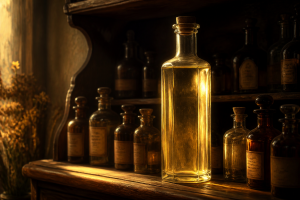

VITRIOL is both a real chemical substance—the alchemists’ name for various metal sulfates, especially sulfuric acid and its salts—and a Latin acronym: Visita Interiora Terrae, Rectificando Invenies Occultum Lapidem, meaning “Visit the interior of the earth; by rectifying, you will find the hidden stone.” The double meaning was entirely deliberate. Alchemists encoded a spiritual instruction inside the name of a genuine laboratory reagent, turning a jar label into a working manual.
Vitriol as Real Chemistry
“Oil of vitriol” was the historical name for concentrated sulfuric acid—one of the most important reagents in any alchemist’s actual toolkit. Green vitriol (ferrous sulfate) and blue vitriol (copper sulfate) were common, genuinely useful laboratory substances: powerful, corrosive, capable of dissolving metals that resisted weaker acids. They could bleach, etch, transform base materials. A chemist scrawling “VITRIOL” on a jar would raise no eyebrows among colleagues; nobody outside the tradition needed to know the name carried a secret.
This is precisely why vitriol made such an effective vehicle for encoded instruction. The best hermetic ciphers hide in plain sight, nested inside genuine work. The acid does what it says on the label. The acronym does something else entirely.
Breaking Down the Acronym
Visita—”visit”; Interiora Terrae—”the interiors of the earth”; Rectificando—”by rectifying” (rectification being the distillation term for repeated, fractional purification); Invenies—”you will find”; Occultum Lapidem—”the hidden stone.”
Read in sequence, it’s a complete instruction set. Descend into the earth—or the self. Submit what you find to repeated purification. Through that process of rectification, the hidden stone reveals itself. Not a destination you arrive at, but something you uncover through systematic refinement.
Origins and Historical Life
The acronym circulates widely through Rosicrucian and Christian-hermetic alchemical texts from the 17th century forward. Its exact origin remains contested among historians, but earliest clear appearances cluster around the Rosicrucian manifestos and the broader esoteric ferment of the early modern period. By the 19th and 20th centuries, VITRIOL had migrated into Masonic lodges, Tarot correspondences, and general Western occult practice—often detached entirely from its grounding in actual laboratory work.
That later symbolic afterlife matters. It shows how powerful the acronym was: it survived translation from chemist’s shorthand into pure metaphor and still held its shape. But the original force lay in the collision—in reading a real substance and finding a real instruction wearing the same seven letters.
Who Actually Wrote the Acronym?
Tradition credits it to Basil Valentine, a fifteenth-century Benedictine canon of Erfurt. In practice, almost certainly not.
No Benedictine records mention such a man. The earliest printed works attributed to Valentine appeared between 1599 and 1604, published by Johann Thölde, a salt-boiler from Frankenhausen, who claimed to have discovered old manuscripts. Scholars now generally treat Thölde as the actual author or compiler, with “Basil Valentine” serving as either a pseudonym or a composite figure. A fifteenth-century monk made for better marketing than a seventeenth-century tradesman—that much is clear.
The acronym itself surfaces in L’Azoth des Philosophes (full title: Azoth, sive Aureliae occultae philosophorum), published in 1613 under Valentine’s name. The full Latin reads: Visita Interiora Terrae, Rectificando Invenies Occultum Lapidem—”Visit the interior of the earth; by rectifying, you will find the hidden stone.” An extended variant adds Veram Medicinam (the true medicine), producing VITRIOLUM.
From the eighteenth century onward, the acronym entered Masonic use, most visibly inscribed on the wall of the Chamber of Reflection. The honest summary: the phrase is genuinely old and genuinely alchemical, but the attributed author almost certainly did not exist, and the earliest verifiable evidence is a printed book from 1613—not a medieval manuscript.
The tradition endures. The evidence, however, points elsewhere.
The Descent as Operative Instruction
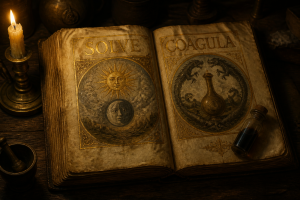
This is where VITRIOL connects to the living tradition. “Visit the interior of the earth” reads, in the same operative language as solve et coagula, as an instruction to descend and darken before anything clean can emerge. The nigredo—the blackening—is not a failure. It is the necessary precondition.
VITRIOL and solve et coagula describe the same movement from two angles. One names the seeking journey: visit, descend, rectify, find. The other names the operation itself: dissolve, then combine. Both point to the same axiom encoded in the Emerald Tablet—”as above, so below”—because descending into the earth to find what is hidden is a literal, material enactment of that principle.
The Vitriols: Green, Blue, White, and Roman
The word “vitriol” itself comes from the Latin vitriolum, rooted in vitrum—glass. The name is literal: these crystals looked like coloured glass, and that resemblance is the whole of the etymology.
But vitriol was never one substance. It was a family of metal sulfates, and the colour word in front told you which metal you held. The organising logic was straightforward: know the colour, know the chemical cargo. Three vitriols dominated the apothecary shelf and the dyer’s workshop.
- Green vitriol (iron(II) sulfate, also called copperas) appeared as pale-green crystals and served the ink-maker and the dyer—it mordanted fabrics and formed the basis of iron gall ink, the black that wrote medieval manuscripts.
- Blue vitriol (copper(II) sulfate, also called Roman vitriol or bluestone) supplied its deep blue colour to the dyer’s vat and sat in the alchemist’s cupboard as one of the classical reagents. Roman vitriol and blue vitriol named the same thing under two names.
- White vitriol (zinc sulfate) was the palest of the three, less common in the workshop but present in the German mining towns where it crystallised out naturally as goslarite.
Two other names appear in the old texts: black vitriol and purple vitriol. These were not chemically defined compounds. They were trade names for crude, impure ore—iron and copper sulfates mixed together and darkened by whatever else the rock contained. Anyone searching the literature for a fixed “black vitriol formula” is chasing a phantom; the honest answer is that no such formula ever existed. The ore itself varied.
This material reality is why the acronym worked at all. V.I.T.R.I.O.L. was not a poetic conceit grafted onto blank air. It was a cipher written over an actual shelf of jars—each one a named, knowable substance, used daily in real work. The alchemists were not confused. They knew exactly what they had.
Spirit, Oil, and Elixir of Vitriol
Three names circle through the old receipts: spirit of vitriol, oil of vitriol, and elixir of vitriol. These are not three different substances. They are three positions in a single distillation process, each naming what came out at a different stage of the heating.
When green vitriol was heated hard enough, vapours rose. The first fraction over—lighter, more volatile—was called the spirit. What remained behind in the vessel was the heavy oil. The distinction was purely one of heating intensity and what drove off, not two different chemicals. Both were sulfuric acid — the same substance arriving at different strengths and states of purity. Oil of vitriol was the commercial name that survived longest, used in laboratories well into the modern period. The historical production route—heating green vitriol strongly and collecting what condensed—is exactly how it was made, though that is now history rather than a method anyone should follow.
The elixir was different in purpose, though not in its starting material. Elixir vitrioli Mynsichti—credited to Adrian von Mynsicht and published in his 1631 Thesaurus et armamentarium medico-chymicum—was a carefully diluted and sweetened preparation of vitriol, aromatised with herbs and intended for the medicine chest. It lived on in pharmacopoeias under the name aromatic sulphuric acid into the twentieth century, prescribed as a tonic and an astringent. That a sweetened acid became a restorative tonic tells you something about the era’s medicine: the bitterness and heat were read as strength. The preparation itself should remain historical; concentrated sulfuric acid demands respect even now.
At the Mortar
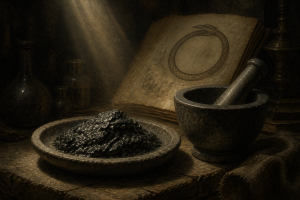
The instruction scales down without losing its force. Any real spagyric working requires patience with the unglamorous middle—the marc in the mortar, the first cloudy strain, the material that looks like failure before it becomes medicine. VITRIOL, at its core, is a five-hundred-year-old reminder that this stage is not to be rushed.
You visit the interior. You rectify. You find. But only if you actually stay in the dark part long enough.
Related Terms
- Solve et Coagula—the operative twin of VITRIOL’s descent-and-return instruction
- The Philosopher’s Stone—the “hidden stone” the acronym promises to those who complete the work
- Reading the Emerald Tablet as a Practical Manual—the “as above, so below” principle VITRIOL enacts in material form
Nothing in this glossary entry constitutes medical advice. Spagyric preparations are experimental products; consult a qualified medical professional before using any plant preparation described here.
Cet article existe aussi en français : Vitriol : signification de l’acronyme et de la substance.
Frequently Asked Questions
What does the VITRIOL acronym actually mean in Latin?
VITRIOL stands for Visita Interiora Terrae, Rectificando Invenies Occultum Lapidem, meaning “Visit the interior of the earth; by rectifying, you will find the hidden stone.” Alchemists deliberately encoded this spiritual instruction inside the name of a genuine laboratory reagent—a jar label that functioned as a working manual.
Why did alchemists use vitriol as a chemical substance?
Vitriol referred to various metal sulfates—especially sulfuric acid and its salts—that were genuinely useful laboratory reagents. Green vitriol, blue vitriol, and white vitriol were powerful, corrosive substances capable of dissolving metals, bleaching, and etching. They were essential tools in actual alchemical work, making the acronym’s double meaning possible.
Who originally wrote the VITRIOL acronym and when?
Tradition credits it to Basil Valentine, a fifteenth-century Benedictine, but scholars now treat this as a pseudonym or composite figure. The acronym surfaces earliest in L’Azoth des Philosophes, published in 1613 under Valentine’s name, likely compiled by Johann Thölde, a salt-boiler from Frankenhausen.
What are green vitriol, blue vitriol, and white vitriol?
These were three metal sulfates distinguished by color. Green vitriol was iron(II) sulfate, used in ink and dyeing. Blue vitriol was copper(II) sulfate, also called Roman vitriol or bluestone, used by dyers and alchemists. White vitriol was zinc sulfate, less common but found crystallised naturally as goslarite in German mining towns.
About This Article

Written by Kyle Bamboo. Kyle Bamboo has spent twelve years following the hermetic tradition of herbalism out of dusty reprints and into a home apothecary — spagyrics, planetary correspondences, and the strange internal logic of plant alchemy. Muddle and Mend takes its name from solve et coagula, dissolve and combine. He writes about the actual tradition, with its history, its vocabulary, and its genuine strangeness, not the Instagram version. More about this site.
Scope and limits. Kyle writes from a personal practice in traditional herbalism, not clinical training. Herbs interact with prescription medications and are not regulated as drugs — check interactions and talk to a pharmacist or clinician before taking anything.
Verify this against a primary source
Specifics change, and your situation may differ from the one described here. These are the authorities worth checking directly:
- NCCIH — herb safety, evidence and known interactions
- MedlinePlus Herbs and Supplements — documented interactions and cautions
- FDA Dietary Supplements — regulatory status and safety alerts