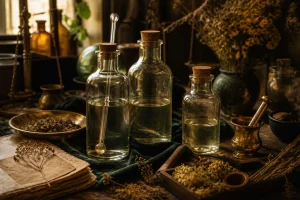
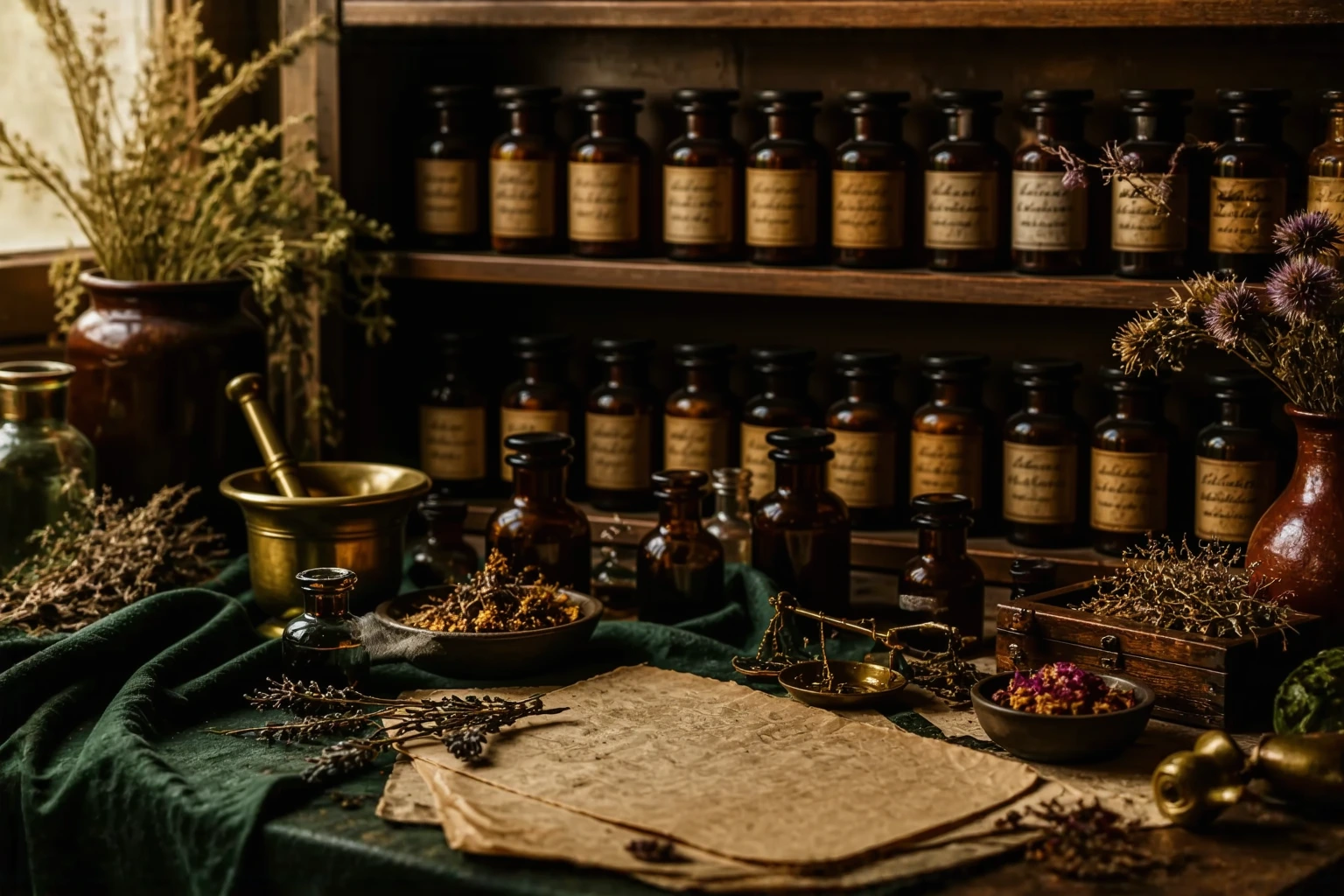
Pick up an unlabeled bottle. Brown glass, cork stopper, maybe two inches of dark liquid at the bottom. Hold it to the light. You cannot tell if it is a tincture or a vinegar. You cannot tell if it is six weeks old or six years. You cannot tell if the menstruum was 40% ethanol or 70%. You do not know whether you macerated the root or the leaf, whether you harvested in August or November, whether the plant came from your garden or a supplier who could not tell you where it was grown. That bottle is useless. Worse than useless, actually — it is a hazard. Because at some point you will convince yourself you remember what it was, and you will be wrong.
This is the unglamorous center of the spagyric practice. Not the calcination, not the planetary hours, not the philosophical mercury. The label. The journal entry. The archive. Every serious alchemical practitioner from the medieval *pharmacopoeiae* forward understood that the work lives or dies in the record. Paracelsus was famously volcanic, a wanderer, a burner of bridges — but his surviving manuscripts show meticulous notations on preparation methods and materia. The apothecaries of seventeenth-century London were legally required under the Society of Apothecaries to keep dispensing records. The discipline is not bureaucracy. It is memory made physical.
What Goes on a Label, and Why Every Field Matters
A spagyric label is not the same as a grocery label. You are not communicating to a customer. You are communicating to your future self, who will have made forty other preparations by the time this bottle comes back into your hands. That future self needs specific information, and sentiment does not count.
At minimum, a label carries: the common name of the plant, the Latin binomial, the plant part used, the menstruum and its approximate proof or percentage, the maceration start date, the press or filter date, and the source of the plant material. That last one matters more than people admit. A cultivated Valeriana officinalis root from your garden in clay soil has a different chemical signature than a wild-harvested root from alkaline mountain ground. You need to know which one you used, because your next batch may behave differently if the source changes.
If you work within the hermetic or astrological framework — and not everyone does, which is fine — you add the moon phase at commencement and the planetary day. This is not decoration. It is data, at least within the system’s own logic. If you run the system long enough and record honestly, patterns either emerge or they do not. You cannot evaluate what you do not track.
Optional but useful fields:
- Harvest date and location (distinct from purchase or receipt date)
- Drying method and duration, if the plant was dried before maceration
- Ratio by weight: plant material to menstruum (1:5, 1:3, and so on)
- Any spagyric additions — whether the plant’s own salt was returned, and at what stage
- Batch number cross-referenced to your lab journal
Write small if you need to. Use a label maker if your handwriting degrades under stress. Use waterproof ink. Brown glass sweats. Condensation will destroy a paper label written in ballpoint within a season.
Shelf Life Is Not a Suggestion
The folk herbalism world has a loose and optimistic relationship with shelf life. “Tinctures last forever” is something people say. It is not true. What is true is that high-proof alcohol tinctures are among the most stable preparations you can make — a well-made tincture in 60% or higher ethanol, stored properly in amber glass away from heat and light, will remain viable for many years. Some practitioners cite five years as a working standard. Some push to ten for roots and barks. But “viable” is doing a lot of work in that sentence. Volatile aromatic compounds degrade. Oxidation creeps in every time you open the bottle. What you have at year eight is not what you pressed at year one.
Vinegar-based preparations are different and shorter-lived. A good apple cider vinegar at 5% acidity provides reasonable preservation, but flower and leaf preparations in vinegar begin to lose character after twelve to eighteen months. Keep them colder. Use them sooner. Glycerites — preparations in vegetable glycerin — are generally considered viable for one to three years under good conditions, but glycerin is hygroscopic: it pulls moisture from the air, and moisture opens the door to microbial activity. They are the least forgiving of poor storage.
Spagyric salts — the calcined plant ash that is filtered, recrystallized, and returned to the preparation — are the most stable fraction of the work. Dry salt in a sealed container does not expire in any meaningful chemical sense. The threat is moisture and contamination. Store salts in glass, desiccated, separate from your liquid preparations. Label them with the same discipline as everything else. A jar of white powder with no label is not mysterious. It is garbage.
Storage Conditions: The Physical Realities
Light degrades. Heat degrades. Fluctuation degrades faster than either. A preparation stored at a steady 60°F in total darkness will outlast the same preparation stored at 72°F with occasional afternoon sun by years, not months. This is not folk wisdom — it is the standard reasoning behind pharmaceutical cold-chain logistics and the consistent guidance of the major early modern pharmacopoeias, including the first Pharmacopoeia Londinensis of 1618, which specified storage conditions for its listed preparations in terms of cool, dark, dry environments.
Amber glass is the working standard because it filters ultraviolet and visible blue light, which carry enough energy to catalyze photodegradation of organic compounds. Clear glass is not acceptable for long-term storage. Green glass is marginal. Brown amber is the floor; dark cobalt or black glass is better still for light-sensitive preparations like those made from flowers with delicate volatile chemistry.
Do not store preparations near heat sources — not above a stove, not in a cabinet that shares a wall with the water heater, not on a shelf that catches western sun through a window in August. A dedicated cupboard, cool and dark, with consistent temperature, is not a luxury. It is the minimum condition for work that is meant to last.
Keep your preparations upright. Corks and certain rubber stoppers are degraded by prolonged contact with high-proof alcohol. If you use cork, store upright. If you use screw-top amber bottles with plastic-lined lids, verify the liner is rated for alcohol contact. Some are not.
The Lab Journal as Alchemical Text
The alchemical tradition has always been a written tradition. The Rosarium Philosophorum, the works of Ramon Llull, the notebooks of Johann Rudolf Glauber — these were not published for public inspiration. They were working documents. The act of writing was the act of crystallizing understanding, of separating what you actually did from what you thought you did or meant to do. The journal is not supplemental to the practice. It is the practice’s skeleton.
Your lab journal should have a dated entry for every preparation you begin. That entry records the batch number, the plant material (weighed), the menstruum (measured by volume and proof), the vessel, the location of maceration, the ambient temperature if you track it, and any observations — color of the fresh plant, unusual smell, condition of the dried material. When you press or filter, you record the yield and your sensory observations: color, clarity, aroma, taste if you are working with non-toxic material. When you return the salt, you record the weight of salt returned and the method. When you bottle, you record the final volume and assign the shelf-life horizon based on menstruum type.
Then you cross-reference the journal number to the bottle label. The label carries the essential data. The journal carries the full story. One without the other is incomplete.
A final note on safety, and it is not optional: some plants carry real risks — hepatotoxicity, drug interactions, phototoxicity, narrow therapeutic windows. Symphytum officinale, comfrey, contains pyrrolizidine alkaloids. Tussilago farfara likewise. Members of the Apiaceae with furanocoumarins can cause severe photosensitization. None of this knowledge belongs locked inside a label. It belongs in your journal, in your head, and in a conversation with a qualified practitioner before anything you make is ingested. The archive exists to preserve knowledge. The first knowledge it should preserve is what can cause harm.
Label everything. Date everything. Write it down. The work is not real until it is recorded.
Frequently Asked Questions
What information must go on a spagyric label?
At minimum: the common name and Latin binomial of the plant, the plant part used, the menstruum and its proof or percentage, the maceration start date, the press or filter date, and the source of the plant material. If working within a hermetic or astrological framework, add the moon phase at commencement and the planetary day. Use waterproof ink on amber glass bottles, as brown glass sweats and condensation destroys paper labels written in ballpoint.
How long do tinctures actually last?
A well-made tincture in 60% or higher ethanol, stored properly in amber glass away from heat and light, remains viable for many years—some practitioners cite five years as a working standard, others push to ten for roots and barks. However, volatile aromatic compounds degrade and oxidation increases with each opening. What you have at year eight is not what you pressed at year one.
What storage conditions preserve preparations longest?
Cool, dark, consistent temperature is essential. A preparation stored at steady 60°F in total darkness outlasts the same preparation at 72°F with occasional afternoon sun by years, not months. Store upright in amber glass or better (dark cobalt or black glass for light-sensitive preparations). Avoid heat sources—stoves, water heaters, western-facing windows. This reasoning underlies pharmaceutical cold-chain logistics and guidance in the Pharmacopoeia Londinensis of 1618.
Why does the source of plant material need to be recorded?
A cultivated Valeriana officinalis root from your garden in clay soil has a different chemical signature than wild-harvested root from alkaline mountain ground. Your next batch may behave differently if the source changes. Knowing which source you used allows you to track and evaluate patterns in your work over time.
About This Article

Written by Kyle Bamboo. Kyle Bamboo has spent twelve years following the hermetic tradition of herbalism out of dusty reprints and into a home apothecary — spagyrics, planetary correspondences, and the strange internal logic of plant alchemy. Muddle and Mend takes its name from solve et coagula, dissolve and combine. He writes about the actual tradition, with its history, its vocabulary, and its genuine strangeness, not the Instagram version. More about this site.
Scope and limits. Kyle writes from a personal practice in traditional herbalism, not clinical training. Herbs interact with prescription medications and are not regulated as drugs — check interactions and talk to a pharmacist or clinician before taking anything.
Verify this against a primary source
Specifics change, and your situation may differ from the one described here. These are the authorities worth checking directly:
- NCCIH — herb safety, evidence and known interactions
- MedlinePlus Herbs and Supplements — documented interactions and cautions
- FDA Dietary Supplements — regulatory status and safety alerts