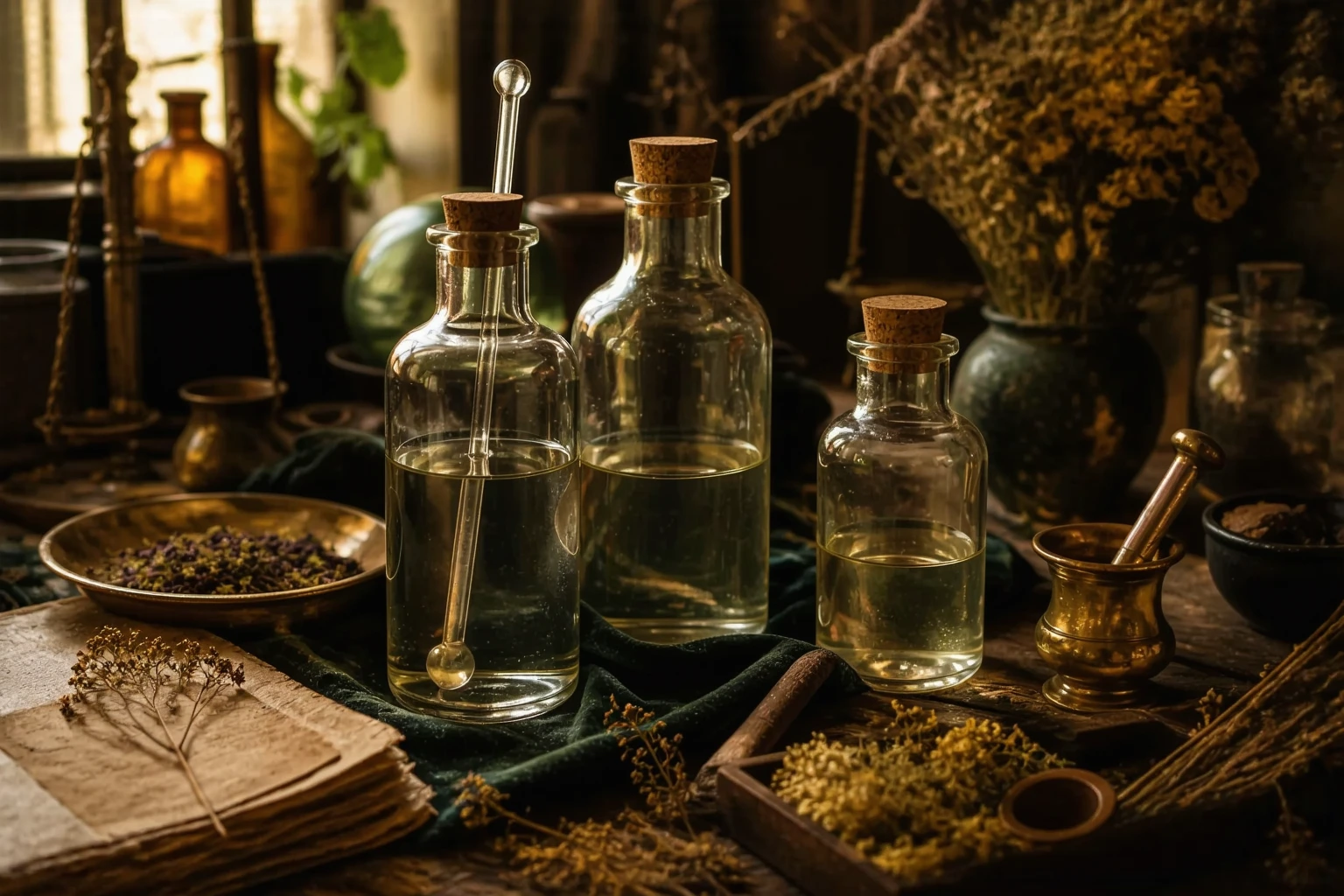
Pour a shot of cheap vodka over dried rosemary and leave it a week. You’ll get something. Color, a little scent, a faint resinous bite on the tongue. Now do the same thing with a lump of raw benzoin resin. Come back in a week. You’ll have pale, slightly fragrant water with a lump of resin sitting at the bottom, unchanged, indifferent, mocking you. Same solvent. Different result. The plant — or rather, the chemistry locked inside the plant — didn’t care what you wanted. It only responded to what you gave it.
This is the central problem of extraction, and it has a central term: the menstruum. The word comes from Latin — menstruus, monthly — and the alchemists borrowed it from Paracelsus and before him from the Arabic and Alexandrian traditions. The menstruum is the solvent, the carrier, the medium that reaches into plant matter and pulls constituents out of it. But calling it just a “solvent” misses something. In the old language, the menstruum had almost animate qualities. It dissolved the fixed, liquefied what was solid, prepared matter to be reconstituted. In hermetic terms it was the mercury of the operation — the fluid, mediating principle between the sulfur (the soul, the volatiles) and the salt (the body, the fixed mineral residue). You cannot do real spagyric work without understanding what your menstruum actually does. And it all starts with water and alcohol, and the precise relationship between them.
The Spectrum: From Water to Pure Alcohol
Ethanol and water are not interchangeable. They mix in any ratio, but their extractive behavior shifts radically across that range, and different plant constituents choose sides. This is not mysticism — it is polarity chemistry. Water is highly polar. It pulls out polar molecules: sugars, mucilages, tannins, most alkaloids (when they’re in their salt form), glycosides, proteins, pectins, some minerals. Alcohol is comparatively nonpolar. It reaches what water cannot: resins, essential-oil components, waxes, chlorophyll, most alkaloids in their free-base form, many anthraquinones, oleoresins. A menstruum is always a negotiation between these two tendencies, and the ratio you choose determines who wins.
The alchemists didn’t have a refractometer, but they were not working blind. Paracelsus — Theophrastus von Hohenheim, writing in the early sixteenth century — insisted that each plant had its own inner nature, its arcanum, and that the philosopher’s task was to find the medium most capable of liberating it. The practical distillers working in his tradition quickly learned that light wines pulled different virtues than rectified spirits. By the time Johann Rudolf Glauber published Furni Novi Philosophici in 1648, the understanding that solvent strength was a variable to be deliberately chosen — not merely accepted — was embedded in alchemical practice. They were working empirically, at the bench, with fire and glass, and they were right about the principle even when they couldn’t name the mechanism.
Three Working Ranges and What They Reach
For practical work, think in three broad zones. These are guidelines for craft, not pharmaceutical specifications. Actual optimal percentages vary by plant, plant part, freshness, and intended use. But these zones will keep you from making the mistake with the benzoin.
Low (25–45% alcohol by volume)
This is the range of a standard vodka or brandy, or a deliberately diluted higher-proof spirit. Water dominates. You are primarily extracting water-soluble material: mucilaginous compounds (think marshmallow root, slippery elm), most tannins, many glycosides, some alkaloid salts. Dried aromatic leaf herbs — peppermint, lemon balm, chamomile flowers — work acceptably here because their essential oil content is low, and most of what you want from them is in their polar fractions. A traditional glycerite occupies a similar space: glycerin is a polar, viscous solvent with decent affinity for water-soluble material and almost none for resins. Low-alcohol macerations also spoil more readily. Without sufficient alcohol to act as preservative — generally considered effective above roughly 25% — microbial growth becomes a real concern. Make smaller batches. Use them.
Mid (50–70% alcohol by volume)
This is the sweet spot for most dried plant material, and it is the range recommended in the American Herbal Pharmacopoeia monographs for the majority of their tincture specifications. Enough water is present to keep alkaloid salts and glycosides in solution; enough alcohol is present to pull some resinous and aromatic material. Fresh plant tinctures — where the plant itself contributes a significant water load as you macerate — often start here or slightly higher to account for dilution from the plant’s own moisture content. Valerian root, echinacea, hawthorn berry, ashwagandha: these and dozens of others give up most of what they have in this range. It is not glamorous. It is, however, accurate.
High (90–95%+ alcohol by volume)
Now you are in resin territory. Benzoin, frankincense (olibanum), propolis, galbanum, myrrh — these are predominantly nonpolar materials. Terpene resins, polymerized essential-oil fractions, waxes. Water will not touch them. At 90% and above, the alcohol is working almost alone, and it reaches deep into oleoresinous structure. High-proof menstrua also preserve plant pigments with unusual intensity: a high-proof St. John’s Wort extraction runs a blood red that lower proofs cannot achieve, because the hypericin and pseudohypericin are hydrophobic enough to require it. Note carefully: extracting certain plants at high proof also concentrates certain constituents that have real safety implications. Aconite, for example, is not something to play with at any proof. Work with high-proof spirits with attention, keep records, and consult a professional before ingesting anything made this way.
The Dilution Math (And Why You Can’t Avoid It)
You can buy food-grade ethanol at 95% and build whatever menstruum you need. The math is not difficult. The formula is simple dilution: C₁V₁ = C₂V₂. Concentration one times volume one equals concentration two times volume two. You want 500 milliliters of 60% alcohol. You have 95% ethanol. How much do you need?
95 × V₁ = 60 × 500. V₁ = 30,000 ÷ 95. V₁ = 315.8 milliliters of 95% ethanol. Make it to 500 milliliters total with distilled water. You now have 60% menstruum. Write it down. The spagyric tradition kept laboratory notebooks — the adversaria — for exactly this reason. Memory is not a record.
Fresh plants complicate this. A freshly harvested herb that is 75% water by weight will dilute your menstruum significantly during maceration. If you’re tincturing fresh lemon balm in 60% alcohol, you are not finishing at 60%. The standard correction is to start higher — often 10–15 percentage points above target — and account for the plant’s water content in your calculation. The American Herbal Pharmacopoeia and the older dispensatories address this directly. King’s American Dispensatory of 1898 already distinguishes fresh-plant and dry-plant preparations and gives guidance on menstruum selection by plant type. These texts are available. Use them.
The Mercury of the Work
Here is why the old alchemists called it mercury, and why that name deserves more than a moment’s thought. In the three-principles framework — sulfur, mercury, salt — mercury is the go-between. It is neither fully volatile nor fully fixed. It moves between states. It carries. The menstruum does exactly this: it is inert enough to not destroy what it carries, active enough to liberate it from the plant’s physical structure. Choose it wrong and you get either nothing (resin sitting in vodka) or a distorted extraction that pulls the wrong constituents in the wrong ratios. Choose it right and the plant opens. Solve et coagula: first the dissolution, the pulling apart, the menstruum doing its dissolving work. Then — in the spagyric sense — the recombination, the extraction refined, the plant salts added back, the tincture rebuilt into something the raw maceration never was.
The menstruum is not a background decision. It is the first real choice of the work, and it determines everything downstream. Get it wrong at the beginning and no amount of careful maceration time or lunar timing or intention will fix it. Chemistry doesn’t negotiate on this. Press it right, and what was locked inside comes flooding out — just like that mint leaf, except now you planned it.
Frequently Asked Questions
What does menstruum mean and why do alchemists use that word?
The menstruum is the solvent or carrier that extracts plant constituents. The word comes from Latin menstruus, meaning monthly, and was borrowed by alchemists from Paracelsus and earlier Arabic and Alexandrian traditions. In hermetic terms, the menstruum functions as mercury—the fluid mediating principle between sulfur and salt in spagyric work.
Why won’t benzoin resin dissolve in vodka?
Benzoin is a predominantly nonpolar oleoresinous material, while vodka is low-alcohol and water-dominated. Water cannot reach resinous compounds; you need high-proof alcohol (90–95%+) to extract such materials. Vodka lacks the alcohol strength necessary to dissolve benzoin’s terpene resins and waxes.
What’s the difference between polarity in water and alcohol extraction?
Water is highly polar and extracts polar molecules: sugars, mucilages, tannins, alkaloid salts, glycosides, and proteins. Alcohol is comparatively nonpolar and reaches what water cannot: resins, essential-oil components, waxes, chlorophyll, and free-base alkaloids. A menstruum’s ratio determines which constituents predominate.
How do I calculate the right alcohol strength for my menstruum?
Use the simple dilution formula C₁V₁ = C₂V₂. If you have 95% ethanol and want 500 milliliters of 60% alcohol, solve: 95 × V₁ = 60 × 500, giving 315.8 milliliters of ethanol diluted to 500 milliliters total with distilled water. Record your calculations in a laboratory notebook, as the spagyric tradition recommends.
About This Article

Written by Kyle Bamboo. Kyle Bamboo has spent twelve years following the hermetic tradition of herbalism out of dusty reprints and into a home apothecary — spagyrics, planetary correspondences, and the strange internal logic of plant alchemy. Muddle and Mend takes its name from solve et coagula, dissolve and combine. He writes about the actual tradition, with its history, its vocabulary, and its genuine strangeness, not the Instagram version. More about this site.
Scope and limits. Kyle writes from a personal practice in traditional herbalism, not clinical training. Herbs interact with prescription medications and are not regulated as drugs — check interactions and talk to a pharmacist or clinician before taking anything.
Verify this against a primary source
Specifics change, and your situation may differ from the one described here. These are the authorities worth checking directly:
- NCCIH — herb safety, evidence and known interactions
- MedlinePlus Herbs and Supplements — documented interactions and cautions
- FDA Dietary Supplements — regulatory status and safety alerts