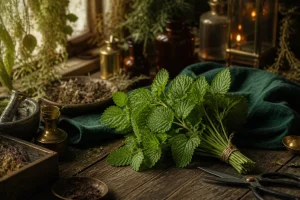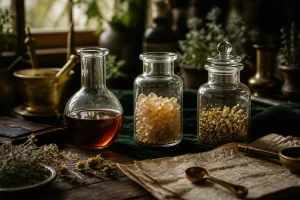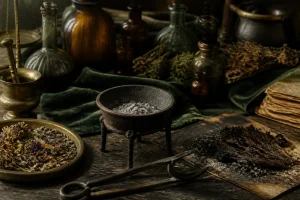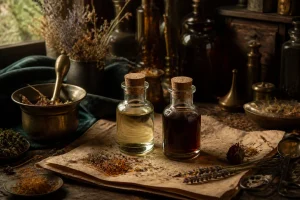
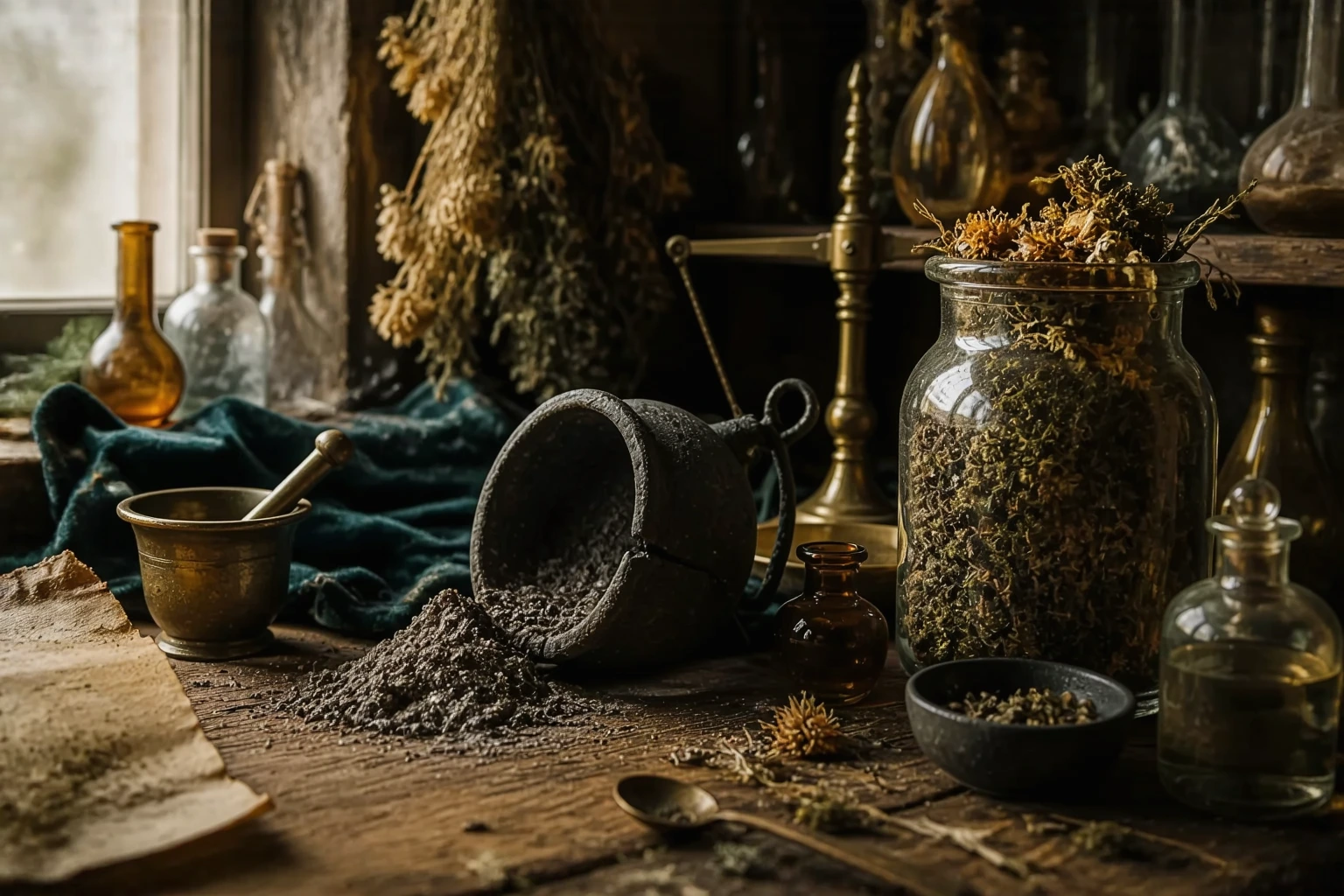
Pick up the jar. Look at it. The plant matter inside should be completely submerged, pressed down under the menstruum, every leaf and stem and root fragment wetted through. If there is plant matter riding above the liquid — brown and dry at the top, exposed to air — you have already made your first mistake, and you made it on day one.
Spagyrics is a precise art. That word — spagyric — comes from the Greek spao (to draw out, to separate) and ageiro (to gather, to reunite). Paracelsus used it in the sixteenth century to describe a philosophy of working: separate the three essentials from a plant — its Mercury, its Sulphur, its Salt — purify each, then recombine them into something more coherent than what you started with. Solve et coagula enacted at a laboratory level. The tradition is rigorous. It does not forgive carelessness, and it does not reward shortcuts. Every mistake you make in a spagyric teaches you something the old texts were already trying to tell you. You just have to be paying attention when it fails.
Here are five failures I have watched beginners make — failures I have made myself — and what the tradition already knew about each one.
| Stage | Common Mistake | Correct Approach |
|---|---|---|
| Maceration | Stop after 2 weeks | Full lunar cycle minimum (29.5 days); roots/barks extended to 3+ cycles |
| Calcination | Grey, carbon-streaked ash | White or pale mineral powder, water-soluble, via sustained even heat |
| Menstruum | Wine or 40% ABV spirits | High-proof spirits above 60% ABV; rectified spirit (90%+) preferred |
| Preparation | Water not distilled; vessels not dry | Distilled water; all glass vessels and tools completely dry |
| Documentation | Unmarked or unlabeled jar | Record plant name, menstruum proof, start date, plant part, fresh/dried status |
Mistake One: Impatient Maceration
The most common error, and the most seductive. You pack your herb into a jar, cover it with your menstruum, seal the lid, and after two weeks you decide it is done. It smells good. It looks dark. You press it out and move forward. What you have extracted is a surface impression — the outermost soluble compounds, the easy resins, some volatile aromatics. You have not done the work.
Traditional maceration times in the European herbal-alchemical tradition were tied to planetary cycles, not because the operators were naive astrologers, but because those cycles — particularly the lunar month — gave a minimum time frame that turned out, pragmatically, to produce better extracts. A full lunar cycle, roughly 29.5 days, was standard. Some preparations, particularly those working roots or barks with dense cell structures, were extended to three lunar cycles or more. Jean Beguin’s Tyrocinium Chymicum of 1610, one of the first practical chemistry texts in the Western canon, describes extended digestion periods as essential rather than optional. The word used repeatedly in that tradition is digestion — the slow, warm, patient dissolution of matter into menstruum — and you cannot rush digestion.
The lesson: time is an ingredient. Seal the jar. Note the date. Walk away. Come back in thirty days at minimum, and even then examine the marc before you press. Is it pale, exhausted, visually wrung out? Good. If it still looks like plant matter with color and structure, it is not finished.
Mistake Two: Grey Ash Is Not Calcined Salt
You burn the marc. This is correct — calcination of the spent plant matter is how you recover the Salt, the mineral body of the plant, which you will later dissolve in water, filter, and reintroduce to the finished tincture. The calcination stage is what makes a spagyric different from a simple tincture. But then you open the vessel and find grey, carbon-streaked powder that smells faintly of smoke, and you assume this is done. It is not done.
Grey ash is incompletely calcined material. It still contains carbon — residual organic matter that was not fully oxidized. The Salt you want is white. Truly white, or close to it — a pale mineral powder, water-soluble, sharp and alkaline on the tongue. To get there requires sustained, even heat, often over multiple hours, with the material spread thin and stirred periodically so every particle reaches full oxidation. A crucible in a muffle furnace at sustained temperature works. A cast iron pan over a high flame for two to three hours, stirring frequently, can work in a pinch. A baking sheet in a domestic oven at maximum temperature, held for several hours with the door cracked to allow carbon dioxide to escape, is the slow route but it is viable.
Paracelsus and those who followed him — Andreas Libavius, whose Alchemia of 1597 remains one of the most systematic early modern chemistry texts — were emphatic on this point: incomplete calcination produces an adulterated Salt, and an adulterated Salt contaminates the recombination. You have done the hardest part of the work. Do not stop ten minutes short of a usable product.
Mistake Three: A Weak Menstruum Cannot Do the Work
If you are macerating plant material in wine — or in something labeled “grain alcohol” that turns out to be 40% ABV — you are working with a menstruum that cannot adequately extract certain constituents, will promote microbial growth during long macerations, and will not hold a stable product once complete. The spagyric tradition was built around high-proof spirits for reasons that are chemical, not arbitrary.
The Mercury of the plant — its volatile aromatic principle, carried in the spirit — requires a menstruum capable of holding it in solution. Alcohol above 60% ABV will extract resins, alkaloids, and volatile oils that lower-proof spirits cannot touch. It will also preserve the maceration against spoilage during the extended time periods the tradition demands. Reinholdus Glauber in the seventeenth century and later practitioners in the German chemical tradition were explicit: rectified spirit — spiritus vini rectificatus, essentially ethanol above 90% — was the preferred menstruum for preparations intended for long shelf life and complete extraction.
For plants with significant safety concerns — members of the Aconitum genus, for instance, or Digitalis, which appear in old alchemical plant lists — the strength of the menstruum matters not just for extraction quality but because concentration directly affects risk. This is not a detour into therapeutic territory: it is craft reality. Anyone working with such plants should consult a qualified professional before proceeding with any stage of preparation or use.
Use the right tool. If you cannot source pharmaceutical-grade ethanol in your jurisdiction, high-proof grain spirits above 75% are an acceptable compromise. Anything lower is not a menstruum for this work — it is flavored water.
Mistake Four: Contamination You Cannot See
The jar was not dry when you filled it. The plant material was not fully dry before maceration. There was residual water in the press cloth. The calcined Salt was dissolved in tap water containing chlorine, fluoride, and trace minerals that will not filter out and will alter the final product’s chemistry. Any one of these is sufficient to introduce contamination that you will not detect until weeks later — a cloudiness in the tincture, an off note in the smell, a Salt that will not dissolve cleanly and leaves a grey precipitate.
The alchemical tradition had a word for water that was appropriate for this work: aqua pura, sometimes philosophical water — distilled water, collected rainwater, spring water tested for purity. The practitioners who wrote in the sixteenth and seventeenth centuries were not making poetic gestures when they specified water sources. They were describing equipment requirements. Use distilled water for dissolving and washing your Salt. Ensure every vessel, every cloth, every utensil is clean and completely dry before contact with your materials.
This is also why glass matters. Residues in porous clay vessels, reactions with metal containers, leaching from plastic — these were concerns the tradition addressed through the insistence on glass and sealed ceramic. It is not mysticism. It is materials science arrived at through centuries of watching preparations fail.
Mistake Five: The Unlabeled Jar
This sounds like housekeeping. It is not housekeeping. It is epistemology.
Three months from now you will pick up that dark, unmarked jar and you will not know what is in it. You will not remember whether you used dried or fresh material, which menstruum, what starting date, whether you salted the menstruum, whether the marc was fully calcined or whether you got impatient. You will have a product you cannot trust because you have no record of its process. The alchemical laboratory notebooks that survive — the working documents of figures like John Dee and Edward Kelley, the practical notebooks associated with the Rosicrucian tradition of the early seventeenth century — are obsessive in their detail not because their authors were bureaucratic, but because the work demands accountability to its own procedure.
Label every jar: plant name (common and Latin), plant part, fresh or dried, menstruum proof, start date, any notes on harvest or source. Date the label when you press and when you complete calcination. When you recombine, note the ratios. Keep a dedicated notebook for nothing else.
If you cannot repeat your process, you have not learned anything — you have only gotten lucky or unlucky once. The tradition’s insistence on record-keeping is the same impulse that drives modern chemistry’s emphasis on reproducibility. These are not different values wearing different costumes. They are the same value expressed across four centuries of continuous practical work.
Every failure in a spagyric is a point of instruction. The grey ash tells you that heat takes longer than you think. The cloudy tincture tells you that water carries its history into your work. The unlabeled jar tells you that memory is not a laboratory instrument. The tradition anticipated all of it — not in the sense of being able to prevent every failure, but in the sense of having been through every failure already, and leaving the notes. Read the notes. Then muddle. Then mend.
Frequently Asked Questions
How long should a spagyric maceration actually take?
Traditional maceration in the European herbal-alchemical tradition was tied to planetary cycles, with a full lunar cycle of roughly 29.5 days as standard minimum. Some preparations, particularly those working roots or barks with dense cell structures, extended to three lunar cycles or more. Jean Beguin’s Tyrocinium Chymicum of 1610 describes extended digestion periods as essential rather than optional.
What proof should my menstruum be for spagyric work?
The spagyric tradition was built around high-proof spirits for chemical reasons. Alcohol above 60% ABV extracts resins, alkaloids, and volatile oils that lower-proof spirits cannot. Rectified spirit—spiritus vini rectificatus, essentially ethanol above 90%—was preferred by practitioners like Reinholdus Glauber in the seventeenth century for complete extraction and shelf stability.
How do I know when calcination is truly complete?
Grey, carbon-streaked ash is incompletely calcined material still containing residual organic matter. The Salt you want is white or pale mineral powder, water-soluble and sharp on the tongue. Sustained, even heat over multiple hours with material spread thin and stirred periodically achieves full oxidation. Paracelsus and Andreas Libavius emphasized that incomplete calcination produces an adulterated Salt that contaminates recombination.
Why does the alchemical tradition insist on detailed laboratory notes?
Surviving laboratory notebooks—those of John Dee, Edward Kelley, and practitioners associated with the early seventeenth-century Rosicrucian tradition—are obsessive in detail because the work demands accountability to its own procedure. Without recording plant name, menstruum proof, start date, and other specifics, you cannot repeat your process and have only gotten lucky or unlucky once, not learned anything.
About This Article

Written by Kyle Bamboo. Kyle Bamboo has spent twelve years following the hermetic tradition of herbalism out of dusty reprints and into a home apothecary — spagyrics, planetary correspondences, and the strange internal logic of plant alchemy. Muddle and Mend takes its name from solve et coagula, dissolve and combine. He writes about the actual tradition, with its history, its vocabulary, and its genuine strangeness, not the Instagram version. More about this site.
Scope and limits. Kyle writes from a personal practice in traditional herbalism, not clinical training. Herbs interact with prescription medications and are not regulated as drugs — check interactions and talk to a pharmacist or clinician before taking anything.
Verify this against a primary source
Specifics change, and your situation may differ from the one described here. These are the authorities worth checking directly:
- NCCIH — herb safety, evidence and known interactions
- MedlinePlus Herbs and Supplements — documented interactions and cautions
- FDA Dietary Supplements — regulatory status and safety alerts