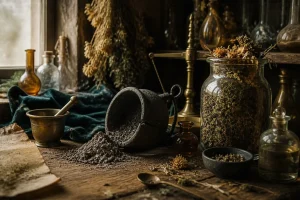
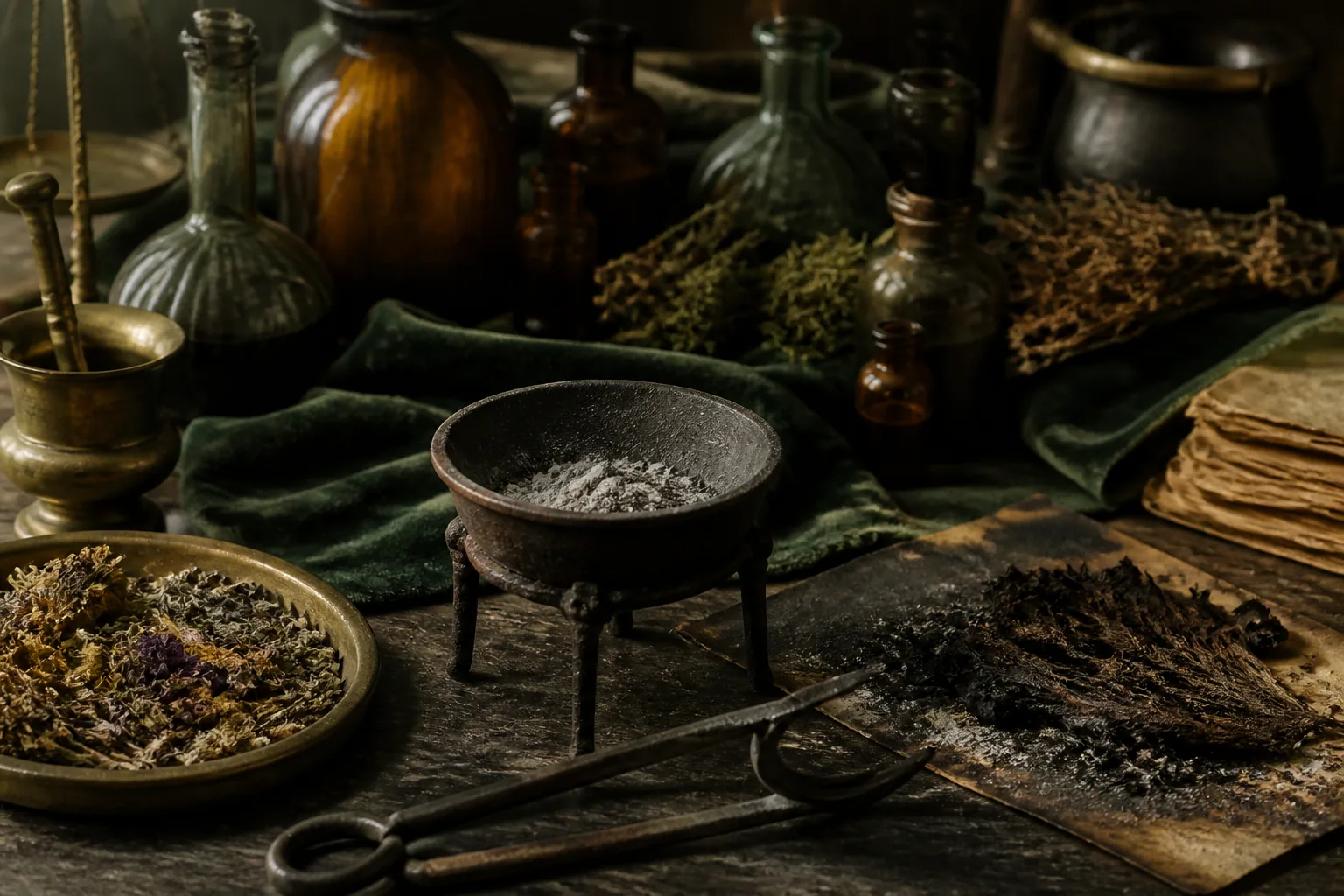
Take the spent marc from your last tincture — the pressed, exhausted mass of herb left after you’ve strained the alcohol off — and hold it in your hand. It smells faintly of what it was. Lavender, maybe, or rosemary. But most of what made it useful is gone. The volatiles have evaporated. The resins and alkaloids have dissolved into your menstrum. What you’re holding is a husk. Cellular structure. Fiber. And locked inside that fiber, bound into the very skeleton of the plant: salts. Minerals the plant pulled from the earth across its whole growing life. Calcium, potassium, silica — the fixed, incombustible body of the plant, invisible until you do the one thing that feels most wrong.
You burn it.
This is calcination. The first major operation in spagyric pharmacy, and in many ways the most violent. The word comes from the Latin calcinare, to burn lime — to reduce a substance by fire until nothing combustible remains. What you are left with is called the caput mortuum in older texts: the dead head. The gray-black char that most herbalists would throw in the compost bin. Alchemists did not throw it away. They understood that the fire doesn’t destroy. It separates. It strips away everything impure and impermanent, and what refuses to burn — what survives — is the most essential mineral nature of the plant. The salt. The body. The fixed principle.
In the three-principles framework that runs through Paracelsian and spagyric thought, every substance contains Sulfur (the soul, volatile and aromatic), Mercury (the spirit, fluid and penetrating), and Salt (the body, fixed and mineral). Your tincture captured the first two. Calcination goes after the third. And without the salt, your spagyric preparation is incomplete — a soul and spirit with no body to inhabit.
A Brief History of Burning Things Carefully
Calcination is not an invention of Renaissance herbalists. It runs straight back through the Arabic alchemical tradition — through Jabir ibn Hayyan in the eighth century, who described calcination as a foundational operation in his systematic taxonomy of alchemical processes — and further back still into Hellenistic Egypt, where the practical metallurgical arts that would become alchemy were already concerned with reducing metals to calx through sustained fire. When the tradition hit European soil through the great translation movement of the twelfth century, calcination arrived with it intact.
It was Paracelsus, working in the early sixteenth century and determined to drag medicine out of Galenic stagnation, who gave calcination its most important context for plant workers. In texts like the Archidoxis, he insisted that the physician who did not understand the fire was no physician at all. Fire, for Paracelsus, was not merely destructive. It was the great separator — scheidung, he called it in German — the process by which the pure was divided from the impure. A plant burned intelligently was not a plant destroyed. It was a plant opened.
His successors elaborated this obsessively. Joseph Du Chesne, writing in 1605 in his Pharmacopoeia of Chymical and Galenical Medicines, gave practical instructions for plant calcinations that would be recognizable to any spagyricist today. Oswald Croll’s Basilica Chymica of 1609 described the process in terms that blur the practical and the philosophical in a way that is very characteristic of the period — and very useful, if you learn to read it on both registers at once.
The Method: Heat, Time, and Not Burning Your House Down
Here is what actually happens in the crucible. First, the marc must be dry. Thoroughly dry. If you’re starting from pressed, alcohol-extracted marc, spread it thin on a baking sheet and leave it somewhere warm for several days, or dry it in an oven at the lowest temperature your oven will hold. Wet material in a crucible spits and steams and prolongs everything. Patience here saves grief later.
You need a proper calcination vessel — a ceramic or clay crucible rated for high heat, or a cast iron vessel if you don’t mind slower, less even results. Do not use glass. Do not use anything you are not certain can handle sustained temperatures of 500°C and above. This is not candle-work. This is sustained, open fire or a muffle furnace if you have access to one. A muffle furnace gives you the most control and the cleanest results, and if you are serious about this work, it is worth investing in a small one.
The burn happens in stages. The marc will first smoke heavily — thick, acrid smoke carrying the last volatile compounds away. This stage requires ventilation. Do this outdoors, or in a space with serious airflow. The smoke from some plants is genuinely irritating. Do not stand over it. After the smoking phase, the material blackens fully: this is carbon. True calcination means taking that carbon all the way to ash — pale gray, or ideally white. Black char is not finished. Black char still contains carbon and organic material that needs to be burned away. You are after a clean, almost powdery, pale ash.
Depending on your heat source and the density of your marc, this can take anywhere from two hours to most of a day. Stir periodically if your vessel allows. The goal is even, total combustion.
Leaching the Salt: Dissolution and the Return
When the ash is cool — and let it cool fully, do not rush this — you begin the purification. This is where calcination moves from destruction toward reconstruction, which is the whole point. Solve et coagula. You have solved the body into ash. Now you refine it.
Add the ash to distilled water. Warm, if you like — it accelerates dissolution. Stir thoroughly, then filter through filter paper or very fine cloth. What passes through is your salt solution: a pale, slightly alkaline water carrying the water-soluble mineral salts of the plant in ionic form. What remains in the filter is silica and other insoluble mineral matter. You can discard that residue or keep it, depending on your tradition and your intentions.
The filtered liquid is then evaporated slowly — a low heat, open vessel, watching it reduce — until the salts crystallize or dry to a powder. This is your purified plant salt. In spagyric work, this gets recombined with the tincture in the final cohobation stage, returning the salt to the sulfur and mercury it was separated from. The three principles reunited. The plant, in a new form, made whole again.
A note that must be made plainly: plant ashes are strongly alkaline. Some plants accumulate compounds that concentrate in ash in ways that are not benign. This is craft chemistry, not casual kitchen work. Nothing produced by this process should be ingested without serious research, experience, and ideally the guidance of someone who has done this work for years. Consult a qualified professional before consuming any preparation derived from these methods.
What the Fire Knows That You Don’t
There is a reason alchemists returned to calcination as a symbol over and over, in text after text, century after century. It is the operation that forces the question: what, exactly, is essential? What survives when everything temporary is stripped away?
The answer the fire gives is not metaphorical. It is chemical. The volatile compounds — the ones we’re most seduced by, the aromatics and the alkaloids and the resins — are not the whole plant. They are not even the most permanent part of the plant. The most permanent part is the mineral skeleton. The slow accumulation of earth in vegetable form over a whole season of growth. That is what the fire reveals. It is harder to work with than a tincture, less immediately dramatic, and almost impossible to romanticize. Which is perhaps exactly why it teaches something the other operations don’t.
The alchemists who wrote about the caput mortuum — the dead head, the blackened residue — usually did so with a kind of grim respect. It looked like waste. It was the opposite of waste. It was what remained after all pretense had burned away. In the spagyric tradition, working with the salt means working with what is most stubbornly, irreducibly real about a plant. Not its perfume. Not its color. Its bones.
Burn what you love carefully. Work in good ventilation. Take your time with the ash. And when you add those reconstituted salts back to your tincture — when you watch them dissolve back into the preparation they were separated from — pay attention to what that moment feels like. That is not just chemistry. That is the whole argument of this tradition, made visible in a jar.
Worth having on hand: a proper heat-rated ceramic calcination crucible — the post is explicit that improvised glass or kitchenware won’t survive the sustained heat this operation needs.
Frequently Asked Questions
What are the three principles in spagyric work?
In the three-principles framework of Paracelsian and spagyric thought, every substance contains Sulfur (the soul, volatile and aromatic), Mercury (the spirit, fluid and penetrating), and Salt (the body, fixed and mineral). A complete spagyric preparation reunites all three after they have been separated through the major operations.
Why do alchemists burn plant material in calcination?
Alchemists understood that fire separates rather than destroys. Calcination strips away everything impermanent and combustible, leaving behind the mineral salts—the fixed, essential skeleton of the plant. This reveals what the tradition holds to be the most stubbornly real and permanent part of the plant matter.
How hot does a calcination crucible need to get?
A calcination vessel must be rated for sustained temperatures of 500°C and above. The article specifies using ceramic or clay crucibles rated for high heat, or cast iron if slower results are acceptable, and explicitly warns against glass or any vessel you cannot be certain will handle these sustained temperatures.
What should you do with the ash after calcination finishes?
Once the ash cools fully, add it to distilled water and stir thoroughly, then filter through filter paper or fine cloth. The filtered liquid carries water-soluble mineral salts in ionic form. Evaporate this slowly at low heat until the salts crystallize or dry to powder, creating your purified plant salt for spagyric work.
About This Article

Written by Kyle Bamboo. Kyle Bamboo has spent twelve years following the hermetic tradition of herbalism out of dusty reprints and into a home apothecary — spagyrics, planetary correspondences, and the strange internal logic of plant alchemy. Muddle and Mend takes its name from solve et coagula, dissolve and combine. He writes about the actual tradition, with its history, its vocabulary, and its genuine strangeness, not the Instagram version. More about this site.
Scope and limits. Kyle writes from a personal practice in traditional herbalism, not clinical training. Herbs interact with prescription medications and are not regulated as drugs — check interactions and talk to a pharmacist or clinician before taking anything.
Verify this against a primary source
Specifics change, and your situation may differ from the one described here. These are the authorities worth checking directly:
- NCCIH — herb safety, evidence and known interactions
- MedlinePlus Herbs and Supplements — documented interactions and cautions
- FDA Dietary Supplements — regulatory status and safety alerts