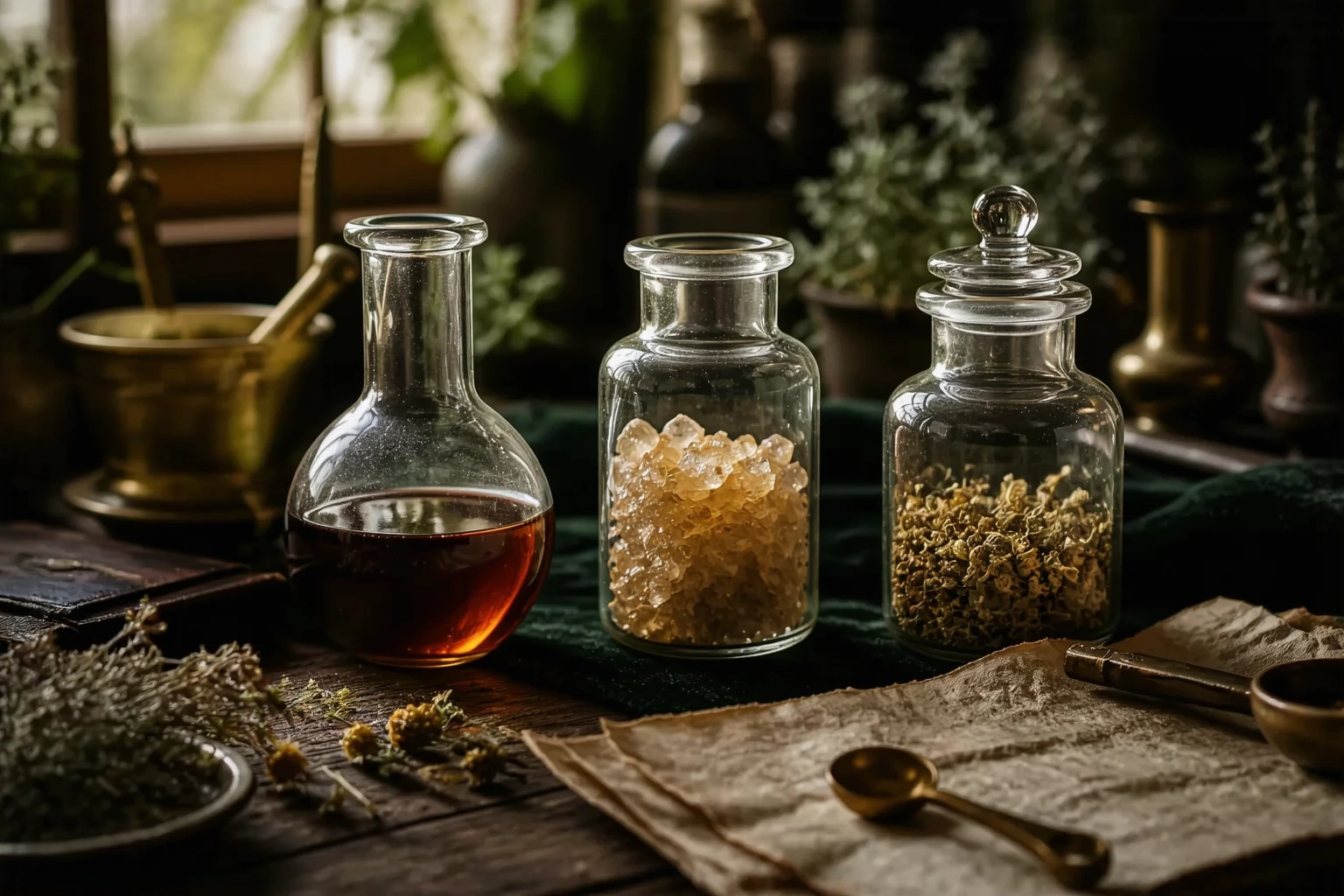
Take a handful of fresh rosemary and drop it into a flask of wine spirit. Watch what happens over the next few days. The liquid turns gold, then amber, then something approaching copper. The herb pales. A transfer is occurring — something is moving from the plant body into the menstruum, crossing the boundary between solid matter and liquid. You didn’t command this. You only provided the conditions. The chemistry is doing what chemistry does, and it has been doing it since before the word “chemistry” existed.
That movement — from locked to released, from bound to dissolved, from one state to another — is the first gesture of spagyric work. And it has two more gestures that follow it. The tradition names this entire arc with a single word: spagyria. The word itself contains the method. Paracelsus coined it — or at least formalized it — in the sixteenth century, building it from two Greek roots: spao, to separate, to tear apart; and ageiro, to gather, to collect, to bring together again. The name is the instruction. Separate. Gather. And implied in the gathering: a purification that happens in between.
This is not a metaphor dressed up in Greek. It is a technical description of a three-part physical process that maps directly onto concrete laboratory work, and that the tradition also reads as a cosmological structure. Solve et coagula — the maxim of this site, the motto carved into the arm of Lévi’s famous Baphomet image — points at the same thing. Dissolve. Coagulate. But the full spagyric schema adds the crucial middle term. You don’t go straight from dissolution to recombination. You purify what you’ve dissolved before you bring it back. That middle step is where the real work happens, and where most modern interpreters quietly skip ahead.
| Principle | Nature | Purification Method | Separation Stage |
|---|---|---|---|
| Mercury | Volatile fraction; spirit | Repeated distillation | First to leave in still |
| Sulfur | Oil-rich, resinous, chemically active fraction; soul | Filtering, precipitation, selective re-extraction | Dissolved in alcohol extract |
| Salt | Mineral residue; body | Dissolve ash in distilled water, filter, evaporate slowly | Remains after calcination of marc |
The First Movement: Separation
Separation is violent work, even when it looks gentle. You are forcing open what is closed. In practice, this means fermentation, distillation, maceration in alcohol — any process that breaks down the cellular architecture of the plant and releases its constituents into a medium you can work with. The goal in this first movement is extraction and differentiation: getting the plant’s components apart from one another so they can be handled individually.
The tradition maps this onto two of the three principles. The volatile fraction — the aromatics, the alcoholic distillate, the steam-carried essences — corresponds to Mercury. This is the spirit of the plant: quick, penetrating, evasive. In practical terms, your Mercury is what comes over in the still’s neck. It is the first thing to leave when you apply heat. The oil-rich, resinous, chemically active fraction — the bitters, the alkaloids where present, the things that give a plant its character and its danger — corresponds to Sulfur. This is the soul of the plant. In a straightforward alcohol extraction, it comes with the Mercury, dissolved in the spirit, and you will separate them further in the second movement.
What remains after you’ve distilled off the volatile fraction and exhausted the marc — the spent plant matter, the solid residue — this is where the third principle waits. The Salt is the body, and it is not done with you yet. Calcine the marc. Burn it to ash in a crucible. Then burn it again. The organic matter chars away. What remains is mineral: calcium, potassium, silica, the actual inorganic skeleton of the plant. This is the Salt. It is not nothing. It is, in fact, the part most people discard, and its recovery is one of the things that distinguishes genuine spagyric work from ordinary herbal extraction.
The Second Movement: Purification
Now you have your fractions separated: volatile distillate, alcohol-extracted tincture, calcined ash. The second movement is about cleaning each one — removing what is gross, what is impure, what would muddy the final recombination. This is where the spagyrist slows down, and where the gap between spagyric work and ordinary tincture-making becomes impossible to ignore.
The Mercury fraction — your distillate — is purified through repeated distillation. Each pass removes heavier fractions, concentrates the volatile aromatics, and clarifies the spirit. Paracelsus and his successors, particularly the German iatrochemist Johann Rudolf Glauber writing in the seventeenth century, were specific about this: a spirit insufficiently rectified would carry impurities into the final medicine and compromise the work. Whether you read this strictly chemically or within the larger hermetic framework, the practical point holds.
The Sulfur fraction — the resinous and active constituents dissolved in your tincture — can be purified by filtering, by careful precipitation, by selective re-extraction into a purer menstruum. The goal is a concentrated, clarified essence. The Salt fraction, the calcined ash, is purified by dissolving it in distilled water and filtering through paper to remove the water-insoluble carbon residues that survive the calcination. You then evaporate the water slowly and collect the purified mineral salts as a white or pale powder. Under the right conditions, they crystallize.
This is not ceremonial. The purification has direct chemical consequences for what happens in the third movement. Mineral salts alter the solubility of organic constituents. They affect pH. They interact with aromatic compounds in ways that a simple tincture — which contains none of the plant’s mineral fraction at all — cannot replicate. Whether those interactions produce effects of significance is a question for researchers; the craft point is that you are working with a chemically different product when all three principles are present and purified.
The Third Movement: Recombination
This is the coagula. This is the mend. You take what you have separated and cleaned and you bring it back together — but what returns is not what you started with. The plant you began with was a biological object, alive and organized in ways you had no access to. What you have now is a deliberate construction: three purified principles recombined by intention and craft.
In practice, recombination means adding the purified mineral salts back into the rectified tincture. The addition is typically done slowly, with gentle warmth, allowing the salts to dissolve fully into the alcohol-and-water medium. Some practitioners then seal the preparation and subject it to the slow cycling of warmth and cool — a putrefaction or digestion phase — for days or weeks before considering the work finished. The preparation made this way bears all three principles of the plant. It is, by the logic of the tradition, a more complete representation of the plant than anything achievable by extraction alone.
The language of the tradition here reaches back to Paracelsus’s Archidoxis, written around 1526, and further still to the pseudo-Lullian alchemical corpus of the fourteenth and fifteenth centuries. The idea that a substance could be dissolved, its components elevated and purified, and then reassembled into something more potent than the original is not merely mystical wishfulness. It is, structurally, something like what happens in modern pharmaceutical extraction and reformulation — though no chemist would use those terms, and the hermetic tradition would not recognize modern chemistry’s frame either. The two traditions evolved independently toward similar process structures and drew very different conclusions. That tension is worth sitting with.
The Structure Beneath the Structure
What the three movements describe, taken together, is not just a laboratory procedure. They describe a theory of transformation: that to improve a thing, you must first break it down completely, clean each part, and rebuild. This is solve et coagula as a repeating structure rather than a single event. And it is the reason the tradition insists on all three principles. Salt without Mercury and Sulfur is just mineral matter. Mercury without Salt and Sulfur is just volatile spirit. Sulfur alone is just resin, just oil. None of them, isolated, carries the full story of the plant. The recombination is what creates the spagyric preparation — and what distinguishes this tradition from both folk herbalism on one side and industrial extraction on the other.
A note before you start: some plants that appear in the historical spagyric literature — black henbane, monkshood, thornapple — are acutely toxic. Even plants considered mild carry contraindications for pregnancy, medication interactions, or individual sensitivities. The Salt fraction concentrates the plant’s minerals, which are not always benign in quantity. This craft has a history of practitioners who killed themselves by working carelessly or ignoring what their plants actually contained. Consult a qualified professional before ingesting anything you’ve made. Understanding the process and applying it safely are separate skills, and the tradition has always known this.
The three movements — separate, purify, recombine — are not steps you finish. They are a grammar. Once you have the grammar, you can read everything the tradition ever wrote about plant work, and the sentences will finally make sense. The flask on your bench, the amber liquid turning slowly in the light: that is a text. Learn to read it.
Frequently Asked Questions
What does the word spagyria mean and where does it come from?
Paracelsus formalized the term in the sixteenth century from two Greek roots: spao, meaning to separate or tear apart, and ageiro, meaning to gather or collect and bring together again. The word itself contains the method: separate, gather, and purify in between.
What are Mercury, Sulfur, and Salt in spagyric work?
In the tradition, these correspond to the three principles of the plant. Mercury is the volatile fraction — aromatics and distillate, the spirit. Sulfur is the oil-rich, resinous, chemically active fraction — the soul. Salt is the mineral residue left after calcining the spent plant matter to ash — the body.
How do you purify the Mercury fraction in spagyrics?
The Mercury fraction is purified through repeated distillation. Each pass removes heavier fractions, concentrates the volatile aromatics, and clarifies the spirit. Paracelsus and later practitioners like the seventeenth-century iatrochemist Johann Rudolf Glauber emphasized that insufficiently rectified spirit would carry impurities into the final medicine.
Why does spagyric work require all three principles together?
In this tradition’s logic, Salt without Mercury and Sulfur is merely mineral matter; Mercury alone is just volatile spirit; Sulfur is only resin. None isolated carries the full story of the plant. Recombining all three purified principles creates a preparation more complete than extraction alone could achieve.
About This Article

Written by Kyle Bamboo. Kyle Bamboo has spent twelve years following the hermetic tradition of herbalism out of dusty reprints and into a home apothecary — spagyrics, planetary correspondences, and the strange internal logic of plant alchemy. Muddle and Mend takes its name from solve et coagula, dissolve and combine. He writes about the actual tradition, with its history, its vocabulary, and its genuine strangeness, not the Instagram version. More about this site.
Scope and limits. Kyle writes from a personal practice in traditional herbalism, not clinical training. Herbs interact with prescription medications and are not regulated as drugs — check interactions and talk to a pharmacist or clinician before taking anything.
Verify this against a primary source
Specifics change, and your situation may differ from the one described here. These are the authorities worth checking directly:
- NCCIH — herb safety, evidence and known interactions
- MedlinePlus Herbs and Supplements — documented interactions and cautions
- FDA Dietary Supplements — regulatory status and safety alerts