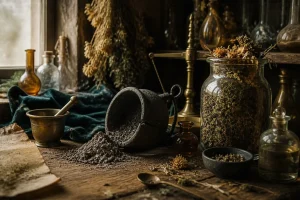
Hold a handful of dried rosemary marc — the spent, pressed-out herb left after maceration — and light it on fire. Watch it go. It blackens, it curls, it resists, then it surrenders completely. What’s left in the dish is a grey-white ash so fine it floats when you breathe near it. That ash is not garbage. That ash is salt: the fixed, mineral body of the plant, the skeleton that held the whole living architecture together. Most herbalists throw it away. Spagyrists put it back in.
That reversal — the decision to reclaim what common practice discards — is the entire argument of spagyrics in one gesture. The word itself comes from the Greek spao (to separate) and ageiro (to gather). Separate and gather. Muddle and mend. The tradition was codified by Paracelsus in the sixteenth century, most systematically in his Archidoxis (c. 1526) and scattered across the Opus Paramirum, though its roots reach back into Arabic alchemy and the hermetic corpus. What Paracelsus contributed was a medical framework — tria prima — the doctrine that every substance in nature is composed of three philosophical principles: Sulfur (the soul, volatile, aromatic), Mercury (the spirit, fluid, animating), and Salt (the body, fixed, mineral). His argument was that medicine made from the whole of these three principles was categorically more complete than medicine made from any subset. A conventional tincture extracts Mercury and Sulfur and throws the Salt in the bin. A spagyric tincture does not.
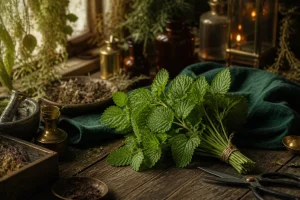
This walkthrough takes you through the complete process with a single plant. I’m using lemon balm (Melissa officinalis) because it’s gentle, inexpensive, widely available fresh, and its aromatic volatiles make the Mercury/Sulfur stages vividly legible. If you use something else, do your own research. Some plants carry real toxicity at concentration; comfrey root, for instance, contains pyrrolizidine alkaloids and should not be made into anything you plan to ingest without serious study. Lemon balm is not that. But I’m not your doctor, I’m a writer with a mortar and a lot of books, and you should consult a qualified professional before consuming any preparation you make.
| Philosophical Principle | Nature | Source in Process | Chemical Composition |
|---|---|---|---|
| Sulfur | Soul; volatile, aromatic | Maceration (Mercury/Sulfur stage) | Essential oils, rosmarinic acid, volatile terpenoids |
| Mercury | Spirit; fluid, animating | Maceration (Mercury/Sulfur stage) | Alcohol medium and fluid carrier |
| Salt | Body; fixed, mineral | Calcination (second burning) | Potassium carbonates, calcium, magnesium, mineral matrix |
What You Need Before You Begin
The equipment is modest. A mason jar with a tight lid. A ceramic or glass mortar and pestle. A cast-iron or stainless steel pan you don’t cook food in. A fine-mesh strainer and some cheesecloth. A small glass funnel. Dark glass bottles for storage. And alcohol: you want a high-proof grain spirit, ideally 60–75% ABV. In the United States, Everclear at 151-proof (75.5%) is standard for this work. Lower-proof vodka will pull a different ratio of constituents and leave more water-soluble compounds in the marc; fine for some purposes, but we want range here.
For the plant material: fresh lemon balm, enough to loosely fill your mason jar once chopped. Fresh herb matters. The aromatic sulfurous principles — the essential oil fraction, the rosmarinic acid, the volatile terpenoids — are present in living tissue at concentrations they will never reach again once the plant dries. Harvest in the morning after the dew has lifted, before the sun has driven the volatiles off. If you must use dried herb, use it, but know you’re working with a diminished palette.
Stage One: The Maceration (Extracting Mercury and Sulfur)
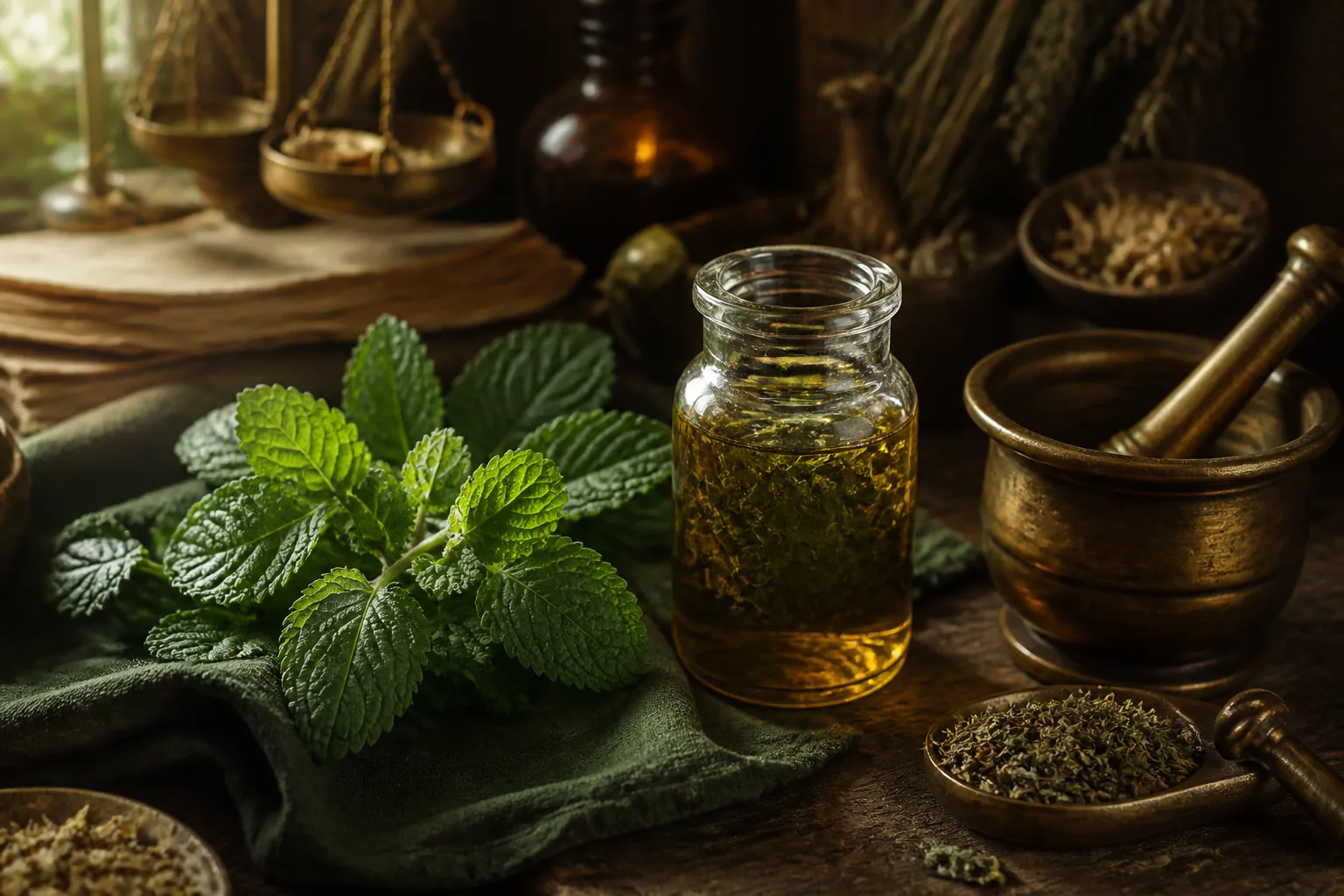
Chop your fresh lemon balm roughly and muddle it in the mortar. Don’t be polite. You want cellular rupture — the same physical violence that releases mint’s oils onto your fingers. The smell will be immediate and intense: that green-citrus sharpness is the sulfurous aromatic principle vacating its cellular housing. Pack the bruised herb into your clean mason jar until it’s three-quarters full. Pour your grain alcohol over it until all the plant matter is submerged with an inch or so of fluid above. Cap the jar tightly.
Now wait. The traditional period is one lunar cycle — roughly twenty-eight days — and there’s nothing merely ceremonial about the timeframe. The alcohol is dissolving cell membranes progressively. In the first week it hits the easy aromatics. By the second and third weeks it’s pulling heavier phenolic compounds and more complex glycosides. Shake the jar once daily; this is not ritual for its own sake but agitation that prevents stratification and keeps fresh solvent in contact with undepleted plant tissue. Store it somewhere dark and cool. After twenty-eight days, strain the liquid through cheesecloth, pressing the marc firmly to recover every drop of tincture. Set the liquid aside in a sealed dark bottle. Keep the marc. Do not discard the marc.
What You Have Now
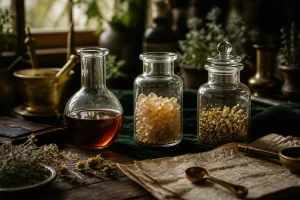
That dark amber liquid in the bottle is a conventional tincture. It contains the Mercury (the alcohol medium itself, the fluid carrier) and the Sulfur (the aromatic, volatile, and semi-volatile organic constituents). It is a real thing with real depth. But in the spagyric framework, it is incomplete. The Salt — the mineral skeleton, the alkaline earth left behind after biological combustion — is sitting wet in your cheesecloth. The work is half done.
Stage Two: Calcination (Releasing the Salt)
Spread your spent marc in a thin layer on your dedicated pan and let it dry completely. This takes a day or two in a warm kitchen, or a few hours in an oven on its lowest setting with the door cracked. Dried marc is brown and crisp, essentially compost. Now you’re going to burn it. Work outdoors or with strong ventilation. Set the dried marc alight carefully — a long lighter works — and let it burn. It will flame briefly, then smoulder, then go to black char. The first burning gets you charcoal. Stop here, let it cool, and grind that charcoal to a fine powder in your mortar.
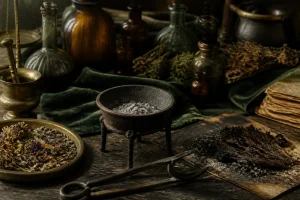
The second burning — calcination proper — turns black carbon to white ash. Return the powdered charcoal to your pan and apply sustained heat. A gas burner works. A small butane torch works better. You’re aiming for a white or pale grey powder with no black remaining. This is the plant’s Salt: the potassium carbonates, calcium, magnesium, and trace mineral matrix that the living plant pulled from the soil over its entire life. In the alchemical literature going back to Johann Rudolf Glauber’s Furni Novi Philosophici (1646), plant ash was understood as the most fixed and stable portion of any vegetable substance — the part that neither volatilized nor dissolved until you specifically invited it to.
Let the ash cool fully before handling it. It is strongly alkaline. Don’t inhale it. Keep it dry until you’re ready for the final stage.
Stage Three: Cohobation (The Recombination)
This is the coagula. The mend. You’re going to reintroduce the Salt to the tincture. The classic method: weigh your white ash. Add it to your tincture in the dark glass bottle, seal it, and shake it vigorously once daily for seven to fourteen days. The alkaline ash will interact with the acidic and neutral constituents of the tincture — there will be a visible change, often a slight darkening or subtle shift in the liquid’s texture. After the cohobation period, you have two options. Some traditions filter the ash back out, arguing that its mineral compounds have ionized into the solution and the physical ash is exhausted. Others leave it undisturbed and decant carefully, allowing the remaining sediment to settle. I filter through fine cheesecloth lined with unbleached coffee filter paper. What pours through is your finished spagyric tincture.
Label It Properly
- Plant name (Latin and common)
- Part used (aerial, root, etc.) and whether fresh or dried
- Date of maceration start
- Date of calcination
- Date of cohobation completion
- Alcohol proof used
Keep it in the dark. High-proof alcohol preparations are stable for years if stored correctly.
Why This Matters Beyond the Recipe
The spagyric method compels you to treat the plant as a complete entity — nothing wasted, every fraction accounted for and returned. Whether you hold the tria prima framework as literally true chemistry or as a generative metaphor for thoroughness, the practice changes how you work. You learn that the marc you’ve been discarding contains a mineral signature unique to that plant grown in that soil. You learn that calcination requires patience and attention — you cannot rush white ash from black char without a mess. You learn that recombination is not passive; it takes time and repeated agitation before the salt yields into solution.
Paracelsus was difficult, cantankerous, and frequently wrong about specifics. He was also correct about this: the part of the plant you ignore is almost certainly part of its power. The ash that floats when you breathe near it is not nothing. It is the fixed residue of a living thing that spent months pulling minerals from the dark and organizing them into a form that could think and grow and flower and smell like lemon in the morning. You dissolved it. You burned it. Now you put it back. That’s not sentiment. That’s the whole process.
Worth having on hand: a proper granite mortar and pestle set — the muddling step that opens this whole process deserves better than the back of a spoon.
Frequently Asked Questions
What does spagyric mean and where does it come from?
The word comes from Greek spao (to separate) and ageiro (to gather). The tradition was codified by Paracelsus in the sixteenth century, most systematically in his Archidoxis (c. 1526), though its roots reach back into Arabic alchemy and the hermetic corpus. The core practice is separation and recombination — taking apart and putting back together.
Why shouldn’t I use dried herbs for a spagyric tincture?
Fresh herb matters because aromatic sulfurous principles — essential oils, rosmarinic acid, volatile terpenoids — are present in living tissue at concentrations they will never reach again once the plant dries. If you must use dried herb, know you’re working with a diminished palette. Harvest in the morning after dew has lifted, before sun drives volatiles off.
What proof alcohol should I use for maceration?
You want a high-proof grain spirit, ideally sixty to seventy-five percent ABV. In the United States, Everclear at one hundred fifty-one proof (75.5%) is standard for this work. Lower-proof vodka will pull a different ratio of constituents and leave more water-soluble compounds in the marc.
How long does the maceration stage take?
The traditional period is one lunar cycle — roughly twenty-eight days. The alcohol progressively dissolves cell membranes: in the first week it hits easy aromatics, by weeks two and three it pulls heavier phenolic compounds and complex glycosides. Shake the jar once daily to prevent stratification and keep fresh solvent in contact with plant tissue.
What is calcination in spagyrics?
Calcination is the second burning that turns black charcoal to white ash. You apply sustained heat — a gas burner or butane torch work well — aiming for a white or pale grey powder with no black remaining. This reveals the plant’s Salt: potassium carbonates, calcium, magnesium, and the mineral matrix the living plant pulled from soil.
How do I recombine salt back into the tincture?
In cohobation, weigh your white ash and add it to your tincture in a dark glass bottle, seal it, and shake vigorously once daily for seven to fourteen days. The alkaline ash will interact with acidic and neutral constituents — you’ll see visible change, often slight darkening. Then filter or decant carefully to remove the sediment.
About This Article

Written by Kyle Bamboo. Kyle Bamboo has spent twelve years following the hermetic tradition of herbalism out of dusty reprints and into a home apothecary — spagyrics, planetary correspondences, and the strange internal logic of plant alchemy. Muddle and Mend takes its name from solve et coagula, dissolve and combine. He writes about the actual tradition, with its history, its vocabulary, and its genuine strangeness, not the Instagram version. More about this site.
Scope and limits. Kyle writes from a personal practice in traditional herbalism, not clinical training. Herbs interact with prescription medications and are not regulated as drugs — check interactions and talk to a pharmacist or clinician before taking anything.
Verify this against a primary source
Specifics change, and your situation may differ from the one described here. These are the authorities worth checking directly:
- NCCIH — herb safety, evidence and known interactions
- MedlinePlus Herbs and Supplements — documented interactions and cautions
- FDA Dietary Supplements — regulatory status and safety alerts