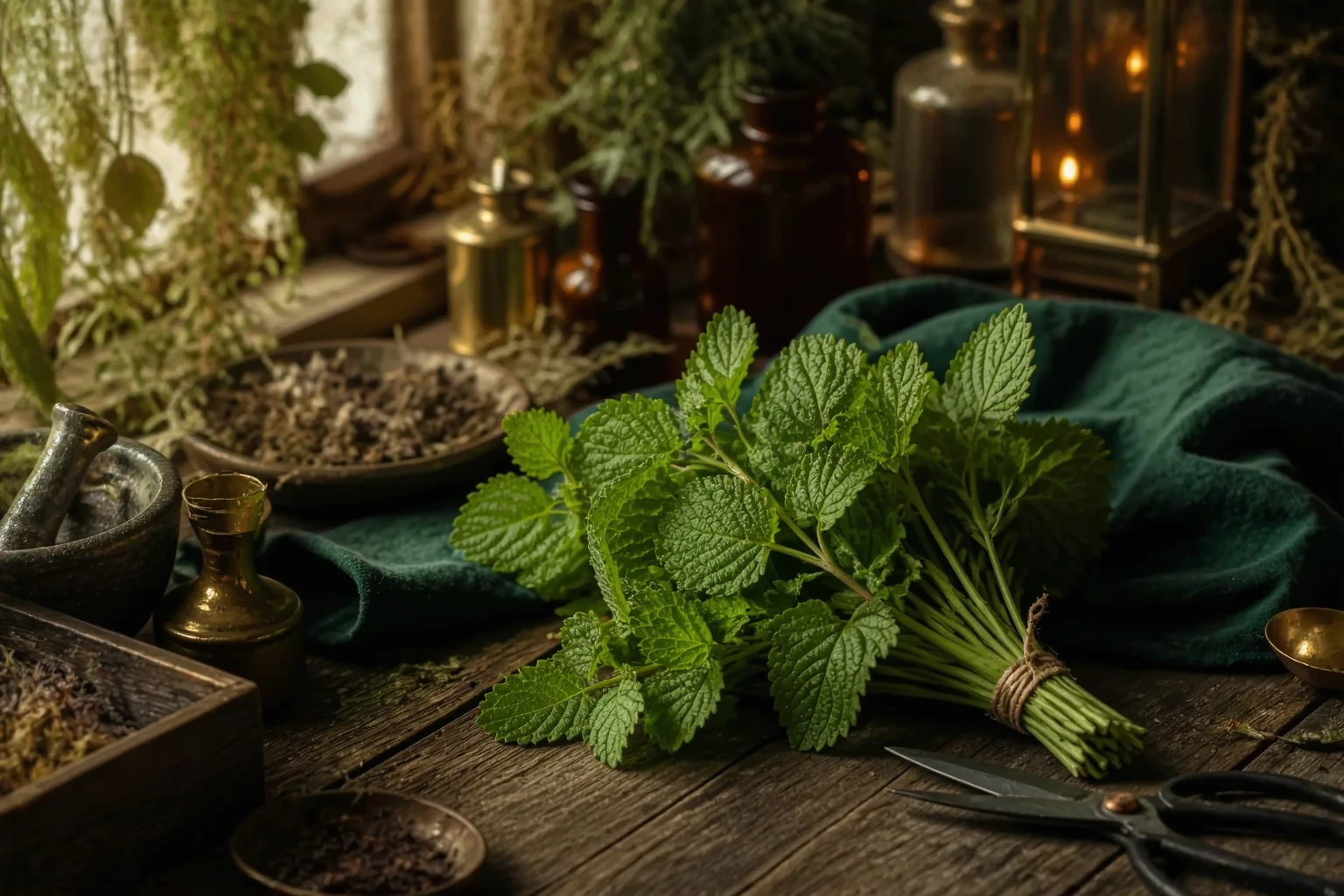
Go outside and find a stem of lemon balm. If you don’t have any growing, stop reading and plant some. I’ll wait.
When you have it, do what you did with the mint. Don’t sniff it politely. Crush the leaf hard between your thumb and forefinger until your skin is wet and green-stained and the air around you smells like a lemon that has decided to become a forest. Hold that smell. That explosion — sharp, citrusy, faintly resinous, gone at the edges into something almost honeyed — is a mixture of volatile compounds: citral, citronellal, linalool, geraniol. They were locked inside the plant’s secretory cells a moment ago. Now they’re on your fingers and in your lungs, and the plant is permanently changed. You’ve muddled it. You have, in the oldest sense of the word, begun.
This is not a post about what lemon balm does to your nervous system. That’s a conversation for a qualified herbalist or a physician, and I am neither. This is a post about what lemon balm does in a flask — and why, for four centuries of spagyric practitioners, it kept being the plant that teachers handed to students first.
What Makes a Good First Plant
Spagyric work — the preparation of plant medicines according to the alchemical triad of Sulphur, Mercury, and Salt — asks you to do things that most herbal traditions don’t. You will ferment. You will distill. You will calcine, which means burning your plant matter to white ash and then dissolving that ash back into what you distilled. The whole operation can take weeks. You will make mistakes. Whatever plant you choose for this first attempt is going to be the plant you watch fail at least once.
So the criteria for a first plant are specific, and they are practical before they are philosophical:
- Safety profile. You will be working with the plant intensively — fermenting it, concentrating it, distilling it. A plant with serious toxicity concerns is not where you start. You want something with a long, well-documented history of low-risk use, so that any error in your process doesn’t become a health crisis.
- Aromatic richness. The volatile fraction — what the old alchemists called the Sulphur of the plant, its essential quality — needs to be abundant enough to actually distill. A plant with almost no essential oil is going to give you almost nothing to work with in your alembic. You need fragrant material, the kind that announces itself when you open the jar.
- Accessibility and abundance. You need a lot of plant matter. Spagyrics is not a conservative tradition when it comes to raw material. Being able to walk outside and harvest fresh, known-clean herb from your own garden changes everything about your relationship to the work.
- Forgiveness. Some plants demand precision. Others are more tolerant of the beginner who misjudges a fermentation temperature or pushes a distillation too fast. You want the forgiving kind first.
Lemon balm — Melissa officinalis, a member of the mint family native to the eastern Mediterranean — meets every single one of these criteria. And it does so in a way that isn’t accidental. Its reputation in the alchemical tradition is too consistent to be coincidence.
Melissa in the Paracelsian Tradition
Paracelsus — Theophrastus Bombastus von Hohenheim, if you want the full absurd name, writing and teaching in the early sixteenth century — called lemon balm the best of all herbs for the heart and held it central to his thinking about vital spirits. His follower and interpreter Oswald Croll, in the Basilica Chymica of 1609, included Melissa preparations among the core examples of spagyric method. The plant appears repeatedly in the literature not because it was fashionable but because it worked well as a teaching medium: it was abundant in central European gardens, it distilled cleanly, and its spirit — the aromatic volatile fraction — was strong enough to demonstrate the separation process without demanding a highly refined still.
Even earlier, the School of Salerno was working with Melissa in the eleventh and twelfth centuries. And the Carmelite monks who produced Eau de Mélisse des Carmes — a famous polypharmaceutical distillate containing lemon balm as its primary ingredient — were preparing versions of it from at least the fourteenth century onward. That’s a long, serious institutional track record. When the same plant keeps appearing in the hands of people doing careful distillation work across multiple centuries and cultures, you pay attention.
What Paracelsus and his successors recognized was that Melissa had a strong but not overwhelming Sulphur. The volatile oil is real and workable. But it’s also forgiving in distillation: it doesn’t require extreme temperatures, it doesn’t scorch easily, and the aromatic yield is good enough to be encouraging for a student who is still learning to read a still. The fermentation of fresh lemon balm is similarly straightforward — it proceeds reliably, doesn’t produce off-notes that confuse the operator, and gives a clean hydrosol and moderate alcohol that are easy to redistill when you move into the rectification stage.
The Calcination Problem and Why Melissa Handles It Well
Every spagyric process ends — or should end — with the calcination and reintegration of the plant’s Salt. This means burning the marc, the spent plant material, to ash in a crucible. Then you dissolve that ash in purified water, filter it, and evaporate it down to a white crystalline salt. Then you recombine that salt with your distillate. Solve et coagula: the dissolution and the rejoining.
This step trips people up. The ash of some plants is difficult — dark, resistant to further calcination, contaminated by carbonized material that won’t fully whiten even with repeated heating. You end up with a grayish, impure product that undermines the whole preparation. It’s discouraging, and it raises legitimate questions about what you’re actually extracting.
Melissa calcines relatively cleanly. With patience and a consistent heat source, the ash whitens well, and the resulting mineral salt — primarily potassium carbonate, with the full complex of mineral constituents the plant accumulated in its tissues — dissolves clearly. It’s not magic. It’s chemistry. But it’s satisfying chemistry, the kind that makes you feel like the tradition actually knows what it’s talking about. For a beginner, that moment of watching the salt crystals form in the evaporating dish is formative. Don’t underestimate what it means to have your first attempt actually work.
Three Honest Alternatives
Lemon balm is the recommendation, but it isn’t the only good one. Here are three alternatives worth considering, with honest notes on what each demands.
Rosemary (Salvia rosmarinus)
High essential oil content. Calcines reasonably well. Has a strong presence in the alchemical literature — Ramon Llull is associated with early rosemary distillation in the thirteenth and fourteenth centuries, though some of those attributions are disputed by historians. The oil is camphoraceous and distinct, which makes it easy to track through your process. One honest caveat: rosemary is contraindicated for people with certain health conditions, and its concentrated preparations are more potent than its culinary use implies. Approach it with appropriate respect and, again, consult a professional before ingesting any preparation you make.
Chamomile (Matricaria chamomilla)
The azure blue essential oil — produced by the steam distillation process itself, from a precursor called matricine — is one of the most dramatic demonstrations of chemical transformation available to a beginner. The plant goes in yellow-green and the distillate contains an oil the color of the deep ocean. It’s a remarkable teaching moment. The downside is that chamomile is a low-yielding plant; you need a serious quantity to get a meaningful essential oil fraction, and growing or sourcing enough can be a genuine obstacle.
Peppermint (Mentha × piperita)
Aggressive aromatic yield. Very easy to source. You already know what it smells like, which helps you track your fractions during distillation. The problem is that peppermint is a hybrid species — it doesn’t breed true from seed and spreads by runners — which means you’ll buy or divide it rather than grow from scratch. Not a dealbreaker, but worth noting for those who want the full garden-to-flask relationship. Menthol crystallizes beautifully in a cold trap, which is either a useful demonstration or an annoying blockage depending on your equipment.
Start with the Plant, Not the Theory
Every alchemical text tells you to know your material. Not to know about it — to know it. That means growing it, harvesting it at the right moment, crushing it in your hand and paying attention to what happens. The theory of Sulphur, Mercury, and Salt is a lens; the plant is the thing itself. Get the plant right and the theory will stop being abstract.
Lemon balm grows like it wants to be used. It self-seeds aggressively, comes back hard every spring, and rewards neglect with abundance. Put it in a container if you don’t want it colonizing your garden. Harvest it in the morning before the heat drives off the volatiles. Cut down to the second or third node and it will grow back twice as bushy. By midsummer in most temperate climates you will have more than you can work with, which is exactly the position you want to be in when you’re learning.
The tradition didn’t choose this plant carelessly. Four hundred years of practitioners had the same options you do, and they kept coming back to Melissa. That’s not sentiment. That’s data. Start here, do the work properly, and by the time you’ve completed your first full spagyric cycle — fermentation, distillation, calcination, reintegration — you will understand more about plant alchemy from the inside than you can get from reading any text, including this one.
Nothing in this post constitutes medical advice. Spagyric preparations are experimental products; consult a qualified medical professional before ingesting any plant preparation you produce.
Frequently Asked Questions
What volatile compounds does lemon balm contain?
Lemon balm’s crushed leaves release a mixture of volatile compounds: citral, citronellal, linalool, and geraniol. These aromatic compounds were locked inside the plant’s secretory cells and are released when the leaf is damaged, creating the characteristic sharp, citrusy, faintly resinous scent with honeyed edges.
Why does lemon balm calcine more cleanly than other plants?
In the spagyric tradition, lemon balm’s ash whitens well with patience and consistent heat, and the resulting mineral salt dissolves clearly. Other plants often produce grayish, impure ash contaminated by carbonized material that resists whitening, making melissa’s clean calcination particularly valuable for beginners.
What historical figures used lemon balm in alchemy?
Paracelsus called lemon balm the best of all herbs for the heart in the early sixteenth century. His follower Oswald Croll included Melissa preparations in the Basilica Chymica of 1609. The School of Salerno worked with it in the eleventh and twelfth centuries, and Carmelite monks produced Eau de Mélisse des Carmes from at least the fourteenth century onward.
Is peppermint a good first spagyric plant?
Peppermint has aggressive aromatic yield and is easy to source, making it practical for beginners. However, as a hybrid species that doesn’t breed true from seed, you must buy or divide it rather than grow from scratch. Menthol also crystallizes in cold traps, which can be either useful or problematic depending on your equipment.
About This Article

Written by Kyle Bamboo. Kyle Bamboo has spent twelve years following the hermetic tradition of herbalism out of dusty reprints and into a home apothecary — spagyrics, planetary correspondences, and the strange internal logic of plant alchemy. Muddle and Mend takes its name from solve et coagula, dissolve and combine. He writes about the actual tradition, with its history, its vocabulary, and its genuine strangeness, not the Instagram version. More about this site.
Scope and limits. Kyle writes from a personal practice in traditional herbalism, not clinical training. Herbs interact with prescription medications and are not regulated as drugs — check interactions and talk to a pharmacist or clinician before taking anything.
Verify this against a primary source
Specifics change, and your situation may differ from the one described here. These are the authorities worth checking directly:
- NCCIH — herb safety, evidence and known interactions
- MedlinePlus Herbs and Supplements — documented interactions and cautions
- FDA Dietary Supplements — regulatory status and safety alerts