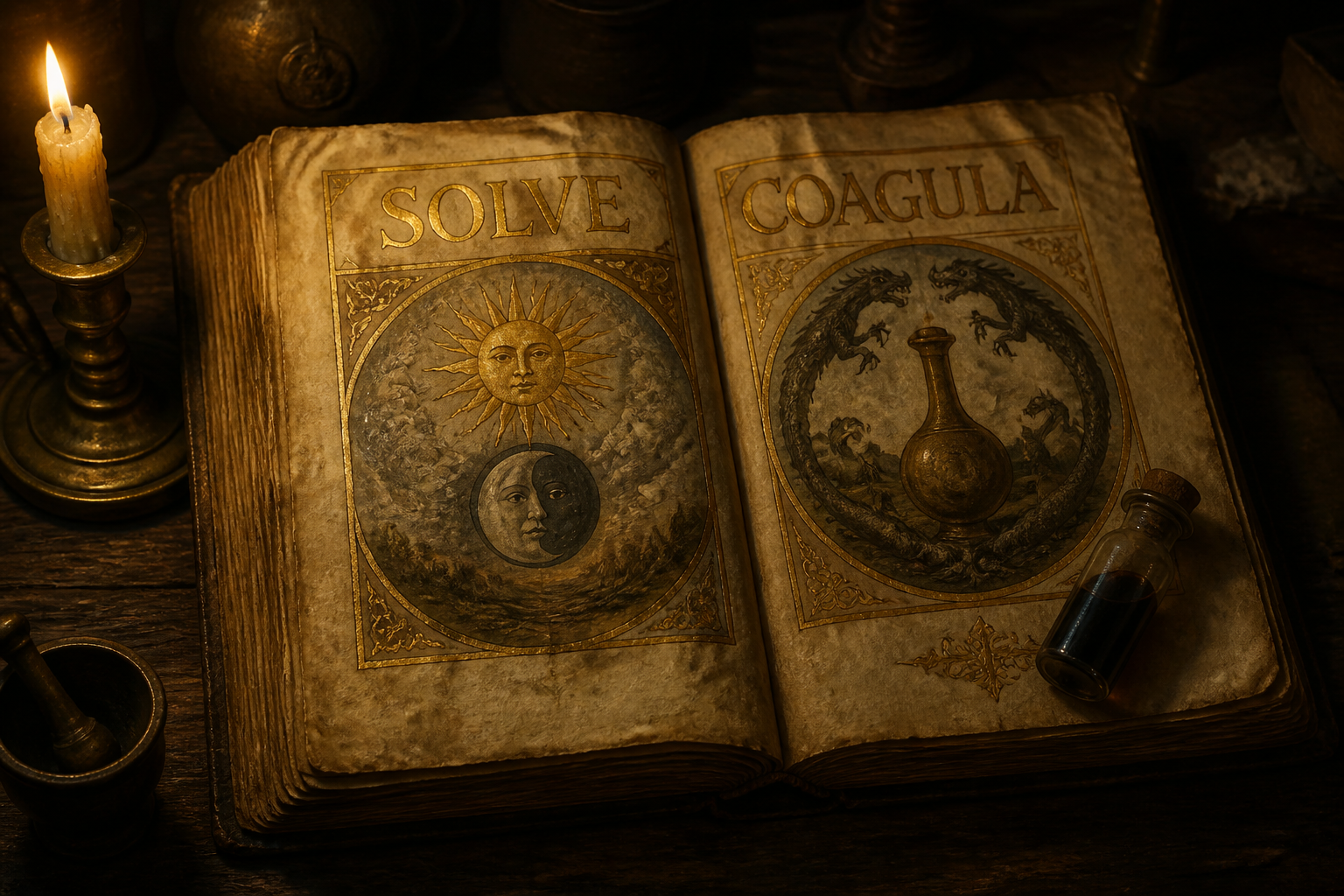
Solve et coagula is Latin for “dissolve and coagulate” — the two-word operational motto of Western alchemy, describing the cyclical process of breaking a substance down to its raw components (solve) and then recombining those components into something more refined and potent (coagula). It is not merely a slogan or philosophical principle; it is the core instruction set of the entire alchemical tradition, the method underlying every major transformation claimed by the art.
The Translation: Dissolve and Coagulate
Solve derives from the Latin solvere: to loosen, to release, to break apart. Coagula comes from coagulare: to curdle, to congeal, to bind together. The pairing is imperative — a command, not a description. You are being told what to do: dissolve, and then coagulate.
Modern practitioners sometimes render it “analyze and synthesize” for clarity in English. Both versions are accurate. The literal translation, however, keeps you honest: you are not merely thinking about breaking things apart and putting them back; you are physically dissolving and recombining actual substances. The command form matters. It keeps the focus on action, not abstraction.
Variants, Word Order, and Why You See COAGVLA
If you’ve found the phrase spelled three different ways in three different books, you haven’t discovered something new—you’ve found the same instruction in different clothes. The core meaning survives every variant you’re likely to encounter.
The most striking form is SOLVE ET COAGVLA in all capitals. That V doing double duty for both U and V is not a typo. In Latin inscriptions and early printed books, a single letter served both sounds. Anything carved or set in capitals therefore reads COAGVLA. The same convention produced VITRIOLVM. Once you know this, the phrase stops looking like a corruption and starts looking like an artifact.
You’ll also see the connecting et (and) dropped entirely: solve coagula works just as well. The pair can appear reversed too—coagula solve—without changing what the instruction means. What matters is the pairing itself, not the order.
A hybrid form sneaks in often: dissolve et coagula. This happens because English speakers know the phrase best as “dissolve and coagulate,” and the English verb gets swapped in for the Latin solve. It reads smoothly but mixes languages. The actual Latin imperative is solve.
One variant to set aside: solve e coagula. That’s a straightforward slip. In Latin, e means “from” or “out of,” which breaks the grammar and leaves you with two commands that don’t quite connect.
English translations that hold the meaning:
- Dissolve and coagulate
- Dissolve and combine
- Separate and join
- Analyse and synthesise
Origins in the Alchemical Canon
The phrase does not appear verbatim in the Emerald Tablet, though that foundational text’s principle — “that which is below is like that which is above” — contains the seed of the idea. What we recognize as solve et coagula crystallizes as a fixed formula in the late medieval and Renaissance alchemical literature, most closely associated with Paracelsus (1493–1541).
Paracelsus built his entire program of chemical medicine on this logic. Disease, he argued, could be treated by first reducing a substance — plant, mineral, or metal — into its constituent principles (the tria prima: Salt, Sulfur, Mercury), separating the pure from the corrupt, and then recombining only the purified essence into a remedy of far greater potency than the crude material ever possessed. Solve et coagula was not philosophy for Paracelsus; it was the operational backbone of medicine.
The phrase later gained wider occult currency in 19th-century esoteric imagery — notably inscribed on the Baphomet figure illustrated by Eliphas Lévi. Worth noting: the Renaissance alchemical/medical meaning and the later esoteric/ceremonial afterlife of the term are distinct, though rooted in the same principle. You may encounter both depending on your sources.
In the Laboratory: What It Actually Meant
Solve was not metaphor. It was calcination, distillation, dissolution in acid or spirit — the reduction of a substance to its prima materia, its raw undifferentiated first matter. You carbonized, you boiled away, you dissolved until nothing remained recognizable of the original form. The crude plant or metal was unmade.
Coagula was the return: precipitation, crystallization, cohobation — the reassembly of the separated, purified parts into a new substance, refined and more potent than before. In spagyric practice specifically, a plant’s crude dried form was believed to carry both virtue and impurity bound inseparably together. Solve et coagula was the only method to separate them and restore the virtue alone in concentrated form.
This is why spagyric preparation existed at all. The theory behind it — the tria prima of Salt, Sulfur, and Mercury — was not abstract philosophy. It was a working model for what happens in the mortar, the retort, and the vial. Solve et coagula was the instruction manual written into matter itself.
Beyond the Laboratory
The alchemists recognized that this pattern — dissolution followed by recombination — was not confined to the laboratory. It appeared everywhere: the seed rotting in soil before sprouting, the breaking of old certainties before genuine understanding could form, the crucible-breaking of grief preceding renewal.
This is why solve et coagula survived long after alchemy’s chemical laboratory applications were absorbed into modern chemistry and pharmacology. Carl Jung wrote extensively on solve et coagula as a central symbol for psychological integration — the breaking down of the ego’s rigid defenses and the reassembly of the psyche at a higher level of wholeness. The phrase outgrew its retort because the pattern it describes is archetypal.
At the Mortar
Muddle and Mend are solve et coagula in miniature. To muddle is to crush, to break down — a small, focused dissolving. To mend is to restore something useful from what was broken — a recombination toward purpose. Every tincture made on this workbench, every maceration and decanting and recombination, is a literal enactment of the two-word formula.
Not metaphorically. Not symbolically. The cycle is real in the mortar, the jar, and the finished remedy. This is why the site carries the name it does — not as poetry, but as direct description of the work.
Related Entries
- Prima Materia — the raw first matter solve reduces substances to
- V.I.T.R.I.O.L. — an alchemical acronym encoding the same descent-and-return pattern
- Solve et Coagula: The Alchemy in a Muddle — a longer reflection on why this site bears its name
Want to see the two-word formula in action? Read Solve et Coagula: The Alchemical Process Behind the Phrase for a simple, hands-on demonstration.
Nothing in this glossary entry constitutes medical advice. Spagyric preparations are experimental products; consult a qualified medical professional before using any plant preparation described here.
Nothing in this glossary entry constitutes medical advice. Spagyric preparations are experimental products; consult a qualified medical professional before using any plant preparation described here.
Cet article existe aussi en français : Solve et Coagula : signification, traduction et origine.
Frequently Asked Questions
What does solve et coagula literally mean in Latin?
Solve et coagula is Latin for “dissolve and coagulate.” Solve derives from solvere, meaning to loosen or break apart. Coagula comes from coagulare, meaning to curdle or bind together. Both words are imperatives—commands to physically dissolve and recombine actual substances, not merely abstract concepts.
Why is COAGVLA spelled with a V instead of U?
In Latin inscriptions and early printed books, a single letter served both the U and V sounds. Any phrase set in capitals therefore reads COAGVLA. This convention also produced VITRIOLVM. Once you recognize this pattern, the spelling stops looking like a corruption and appears as an authentic artifact.
How did Paracelsus use solve et coagula in his work?
Paracelsus (1493–1541) built his entire program of chemical medicine on this logic. He argued that disease could be treated by reducing a substance into its constituent principles—the tria prima of Salt, Sulfur, and Mercury—separating the pure from the corrupt, then recombining only the purified essence into a more potent remedy.
What does solve et coagula mean in spagyric plant preparation?
In spagyric practice, solve et coagula describes the method of separating a plant’s virtue from its impurity through processes like calcination, distillation, and dissolution, then reassembling the purified parts into a concentrated form. The crude dried plant was believed to carry both virtue and impurity bound together inseparably.
About This Article

Written by Kyle Bamboo. Kyle Bamboo has spent twelve years following the hermetic tradition of herbalism out of dusty reprints and into a home apothecary — spagyrics, planetary correspondences, and the strange internal logic of plant alchemy. Muddle and Mend takes its name from solve et coagula, dissolve and combine. He writes about the actual tradition, with its history, its vocabulary, and its genuine strangeness, not the Instagram version. More about this site.
Scope and limits. Kyle writes from a personal practice in traditional herbalism, not clinical training. Herbs interact with prescription medications and are not regulated as drugs — check interactions and talk to a pharmacist or clinician before taking anything.
Verify this against a primary source
Specifics change, and your situation may differ from the one described here. These are the authorities worth checking directly:
- NCCIH — herb safety, evidence and known interactions
- MedlinePlus Herbs and Supplements — documented interactions and cautions
- FDA Dietary Supplements — regulatory status and safety alerts