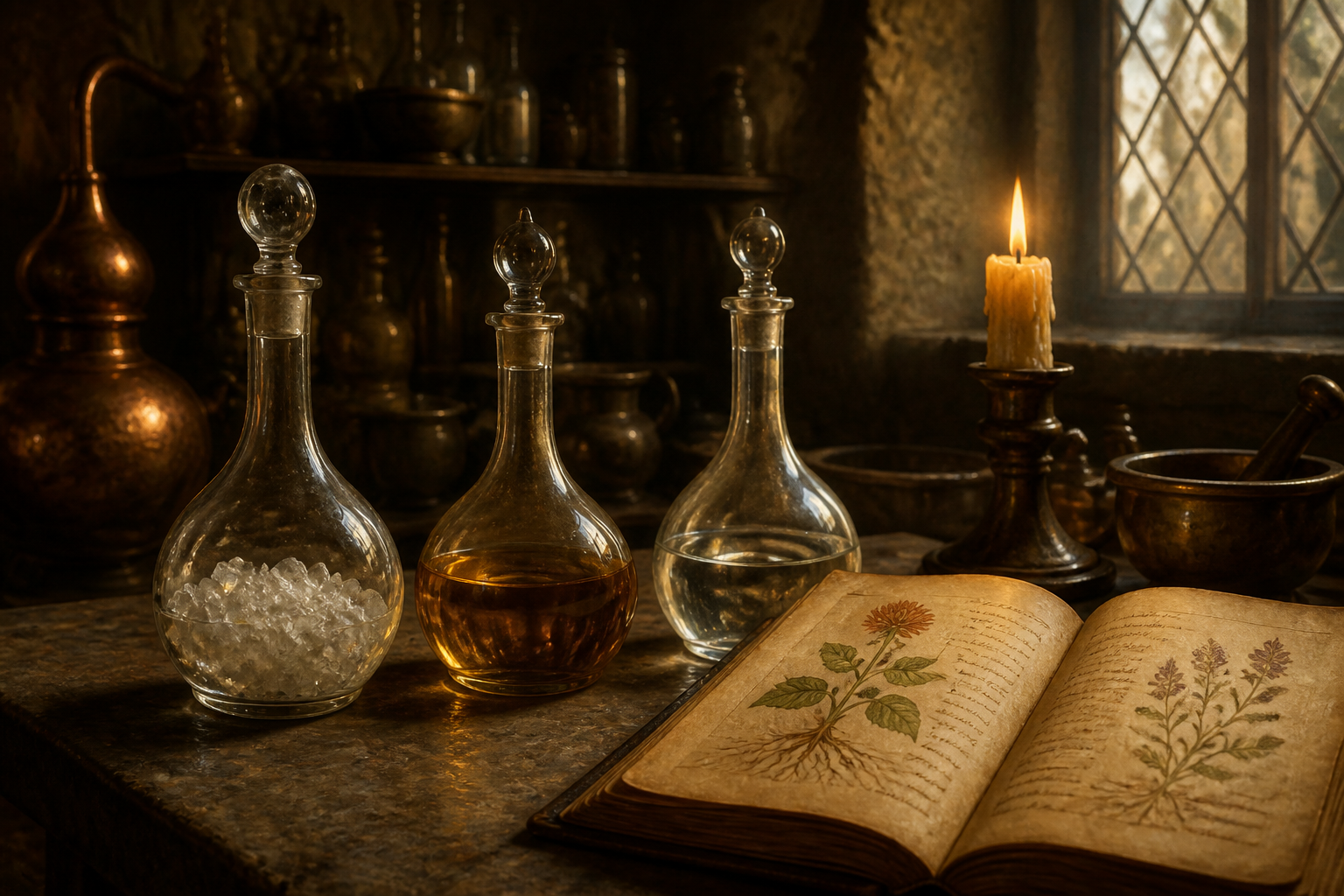
When Theophrastus Bombastus von Hohenheim walked into a lecture hall in 16th-century Europe calling himself Paracelsus—”beyond Celsus,” a direct insult to the Roman medical authority—he wasn’t just being arrogant. He was announcing a complete overthrow of how Western medicine understood the material world.
For a thousand years, Galenic medicine had ruled. Everything in the body, Galen said, was composed of four humors: blood, phlegm, yellow bile, and black bile. Disease was imbalance. Treatment was bloodletting, purging, and prayer. Paracelsus rejected it wholesale. Not just the applications—the entire framework.
In its place, he proposed something that would seem just as revolutionary in his time as heliocentrism did: the doctrine of the tria prima—the three principles. Salt, Sulfur, and Mercury. Not the substances known by those names, but the universal principles those substances embodied. This was the foundation of spagyrics, the art of separation and recombination that remains, five centuries later, the most coherent and historically serious approach to plant medicine transformation.
Paracelsus: The Revolutionary Physician Who Burned Galen’s Books
Paracelsus (1493–1541) was born in Switzerland during the Renaissance, at a moment when the old medieval authorities were beginning to crack. He studied alchemy, mining chemistry, and practical medicine under real practitioners—not just in university libraries. This hands-on approach shaped everything. When he looked at an herb, he didn’t see a “hot and dry” humor-balancer. He saw a complex substance made of distinguishable parts, each with its own character and purpose.
The break came publicly in 1527 when Paracelsus, then teaching at Basel University, publicly burned the works of Galen and Avicenna—the foundations of medieval medicine. He replaced them with a new text: the created world itself, studied through careful observation and alchemy. Nature was the real physician, he argued. Our job was to understand how substances worked and to refine them, not to apply dogma.
This wasn’t mysticism. This was empiricism, centuries before the scientific method had a name. Paracelsus traveled, observed miners, studied metalwork and distillation, and conducted experiments. When he proposed the tria prima, he wasn’t making philosophy—he was describing what happened when you actually worked with plants at the bench.
Tria Prima: Salt, Sulfur, and Mercury Explained
Before we go further, let’s be clear: Paracelsus’s Salt, Sulfur, and Mercury are not the chemical elements or compounds of those names. They are principles—ways of categorizing how matter behaves and what role it plays in nature. Think of them less as nouns and more as verbs.
Tria Prima — Salt: The Fixed Body and Mineral Structure
Salt represents everything solid, fixed, structural, and earthy. It is the principle of consolidation. In a plant, Salt is the mineral matrix—the calcium, potassium, silica, and trace elements that build the cell walls, the bones of the plant’s architecture.
When you burn a plant completely, what remains is white ash. This is the most visible form of Salt—the mineral skeleton of the plant revealed. But Salt is not just ash; it is the principle that governs fixation. In the human body, Salt corresponds to bones, teeth, flesh, the solid substrate that holds us upright. Without Salt, there is no form. Without form, there is no medicine—only vapor.
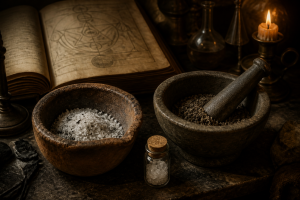
In spagyric practice, capturing the Salt is the most labor-intensive step. After the plant material has been processed and distilled, what remains—the exhausted marc—is placed in a crucible and heated at high temperature until it turns white. This calcination breaks down the remaining organic matter and leaves only the mineral core. The resulting salts are then dissolved back into water (often the plant’s own juice) and filtered repeatedly until pure. Finally, the solution is evaporated to dryness, leaving behind crystalline salt.
Tria Prima — Sulfur: The Soul and Vital Essence
Sulfur is the soul—the animating, characteristic essence that makes a rose smell like a rose and not like a nettle. It is the principle of identity, of color and smell and medicinal virtue. Every plant’s Sulfur is different. This is why no two plants are identical in their action.
In material terms, Sulfur is expressed through the essential oils, the volatile but not entirely evaporative compounds that carry the plant’s characteristic properties. Rosemary’s pungent camphoraceous note is its Sulfur. Lavender’s sweet floral profile is its Sulfur. Garlic’s sharp, penetrating bite is its Sulfur. These compounds are soluble in alcohol but not in water alone—they need a strong solvent to be pulled from the plant matrix.
Position-wise, Sulfur sits between Salt and Mercury. It is volatile enough to rise as vapor (hence the name, an alchemical reference to the “soul” that rises in distillation), but fixed enough to be captured and preserved. In the human body, Sulfur corresponds to our vital warmth, our metabolism, our individual character—what makes you metabolically unique.
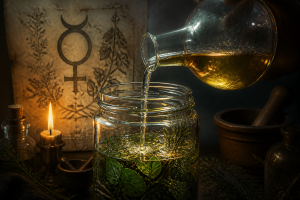
To extract Sulfur, a spagyrist macerates the plant in high-proof alcohol—traditionally grain alcohol or wine, though modern practitioners often use lab-grade ethanol. The plant material steeps for weeks. The alcohol dissolves and holds the essential oils and fat-soluble compounds. This is, in essence, tincture-making, but understood through the lens of principle-separation rather than simple extraction.
Tria Prima — Mercury: The Spirit and Animating Force
Mercury is the spirit—the most volatile, most ethereal principle. It is the carrier, the medium, the vital force that animates. In nature, Mercury is water, fermentable sugars, and the ethanol that results from fermentation. Mercury is what makes a plant alive; when a plant dies and decays, Mercury leaves first—the water evaporates, the sugars ferment away. What remains is the heavier Sulfur and eventually the fixed Salt.
Spiritually (in the hermetic sense, not the supernatural sense), Mercury is the messenger. It carries the other two principles. In the human body, Mercury corresponds to breath, to circulation, to the vital spark that animates flesh and bone. Without Mercury, there is no animation—only a corpse.
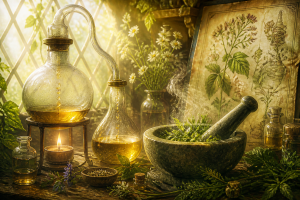
In spagyric work, Mercury is captured through fermentation and distillation. After the plant has been macerated and some of its Sulfur extracted, the remaining plant material (now depleted of alcohol-soluble compounds) is fermented with water and yeast. The sugars in the plant convert to alcohol. This fermented liquid is then distilled, and the resulting clear spirit—the most refined fraction—is the Mercury. It is pure alcohol carrying the subtlest, most volatile plant essences.
The Spagyric Process: Solve et Coagula
The spagyric working follows a pattern as old as alchemy: solve et coagula—dissolve and coagulate. Break the plant into its principles, purify each, then recombine them. The result is, in theory and often in practice, a medicine far more complete than any single extraction.
Step One: Separation (Solve)
- Maceration: Fresh or dried plant is covered with high-proof alcohol and allowed to steep for 2-4 weeks. The alcohol draws out the Sulfur—the essential oils, alkaloids, and fat-soluble compounds. This is your basic tincture.
- Distillation: The macerated liquid is distilled, usually in a water bath or alembic. As heat is applied, the Mercury—the most volatile fraction—rises first as vapor, condenses, and is collected. This is the clear spirit of the plant, often 80-95% alcohol by volume.
- Calcination: The exhausted plant material left after maceration and distillation is dried and burned at high heat in a crucible until it becomes white ash. This ash is the Salt—the mineral signature of the plant.
Now you have three separate fractions, each representing one principle.
Step Two: Purification
Each principle is then purified on its own. The Mercury is redistilled to increase its purity and potency. The Sulfur-rich tincture is filtered and may be reprocessed to concentrate it. The Salt is dissolved in distilled water, filtered repeatedly to remove char and impurities, and then evaporated to dryness. Ideally, the end result is three crystalline or liquid substances, each pure and stable.
Step Three: Recombination (Coagula)
Here is where the magic happens. The purified Salt is dissolved in the combined Mercury and Sulfur (or sometimes the process is reversed—the Salt solution receives the Sulfur and Mercury). The mixture is sealed and allowed to mature. Over weeks or months, the principles re-integrate. The result is a spagyric tincture—red, amber, or golden, depending on the plant—that contains all three principles in a balanced, recombined state.
Why the Tria Prima Matters: Beyond Simple Chemistry
A standard herbal tincture—the kind you’ll find in most apothecaries—is primarily an extraction of Sulfur and Mercury. Alcohol dissolves the volatile and semi-volatile compounds; water carries some minerals and soluble salts. But the bulk of the plant’s mineral matrix stays behind in the marc, which is discarded as waste.
In contrast, a spagyric preparation actively captures and reintegrates the mineral body. This is not a trivial difference. The minerals of a plant—especially trace minerals like silica, selenium, and germanium—are often medically significant. Silica, for instance, is crucial for connective tissue health. A standard tincture of nettle might miss 40-60% of the plant’s silica content.
Do you feel a difference when you take a spagyric versus a standard tincture? Many practitioners report yes—a deeper, more grounded action, a sense that the medicine is more “complete.” Is this scientific? Not in a way modern pharmacology can measure. But it is consistent with the principle: you’re adding something back that was previously removed.
What we can say with certainty: a spagyric tincture is a materially different substance. It contains a broader range of compounds—both the volatile essences and the mineral salts. Whether that translates to enhanced medicinal action is still, honestly, an open question for modern research. What it absolutely represents is fidelity to the plant as a whole.
The Tria Prima Spagyrist’s Way of Seeing
When I pick up a plant in my garden, I no longer ask just “what herb is this?” I ask three questions.
First: what is its Salt? What minerals did the soil give it? Comfrey, for instance, accumulates silica and calcium—its Salt is deep and structural. Nettles are mineral-rich throughout but especially loaded with silica. When I’m working with a plant, I think about its mineral ecology. Did it grow in limestone soil? Sandy soil? These distinctions matter in spagyric work because they shape the nature of the extracted Salt.
Second: what is its Sulfur? What is the plant’s characteristic smell, taste, color? A leaf of mint releases immediate aromatic compounds when crushed—that is its Sulfur expressing. Turmeric’s yellow-orange hue, its warm peppery taste—Sulfur. The deep red of a rose petal—Sulfur. This principle is where the plant’s medicinal personality lives. If you can smell it, it’s Sulfur.
Third: what is its Mercury? How fresh, how vital is this plant? A freshly harvested herb vibrates with Mercury—its cells are still full of sap, its waters still moving. A dried herb still possesses Mercury, but less—the vital force has begun to dissipate. Mercury is about aliveness and potential. When I macerate or ferment a plant, I’m working with its Mercury, trying to capture that vitality before it fades entirely.
This is how a spagyrist thinks. Not as a chemist analyzing component parts (though we do that too), and not as a romantic mystic (though there is beauty in the work). We think in principles. We see each plant as a trinity—body, soul, and spirit—and our craft is to separate and recombine these three into something more perfect than nature alone provides.
A Final Word on Tria Prima: Tradition and Evidence
I want to be clear about something: the traditional claims made by spagyrics are strong. Some practitioners insist that spagyric preparations are several times more potent than standard tinctures. Others claim that they can be preserved indefinitely without degradation, or that they possess unique abilities to harmonize the body’s energies. These claims deserve respect, but they also deserve skepticism.
Modern science has not yet validated most of these assertions, at least not in controlled studies. What we can validate is this: the tria prima is a coherent, historically serious framework. It produces a materially different preparation. And the herbalists and alchemists who have worked with these methods for centuries have left behind detailed records of what works.
The truth—as it usually is—lies somewhere between dogmatism and dismissal. Spagyrics is neither a cure-all nor a superstition. It is a real technique, grounded in real history, producing real results that can be felt and observed. Whether it is “better” than other methods is less important than understanding why a spagyrist chooses to work this way: because the tradition teaches us to see the whole plant, to honor all its parts, and to create medicines that are as complete as the herbs they come from.
That is enough. That is everything.
The Three in Turn
Paracelsus held that every created thing — every herb in the hedgerow — is woven from three principles. There is its Salt, the body: the fixed, earthen residue that remains when all else has burned away. There is its Sulfur, the soul: the oily, fragrant, combustible essence that carries the plant’s whole character. And there is its Mercury, the spirit: the volatile, animating quickness that binds the other two and lets virtue move. To know a plant in the old way is to learn to see all three — so we’ll take each in turn.
Alchemical Symbols at a Glance
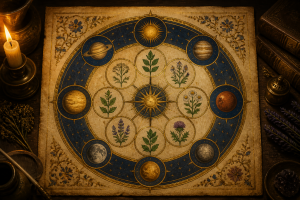
Alchemical texts used a shorthand of glyphs long before “Salt,” “Sulfur,” and “Mercury” were written out as words. You’ll still see these symbols on old manuscripts, in tattoo designs, and scattered across the internet, often without much explanation. Here are the ones that matter for the tria prima, plus the four classical elements they build on:
| Symbol | Name | Represents |
|---|---|---|
| 🜔 | Salt | The body — fixed, earthen, what remains after burning |
| 🜍 | Sulfur | The soul — the oily, combustible, characterful essence |
| ☿ | Mercury | The spirit — the volatile, animating principle (same glyph as the planet) |
| 🜁 | Air | One of the four classical elements |
| 🜂 | Fire | One of the four classical elements |
| 🜄 | Water | One of the four classical elements |
| 🜃 | Earth | One of the four classical elements |
| 🜀 | Quintessence | The “fifth essence” beyond the four elements — see our piece on quintessence |
One correction worth making, since it’s a common mix-up: the glyph 🜇 is not a symbol for solve or coagula. Unicode assigns it the name “Alchemical Symbol for Aqua Regia-2” — it denotes a corrosive acid mixture used to dissolve gold, not the dissolution-and-recombination process this post is about. There is, in fact, no single traditional ideogram for solve et coagula itself. Alchemical manuscripts represented the operation through emblem sequences and diagrams (the Mutus Liber and Splendor Solis are the classic examples) rather than a lone glyph — the phrase was written out in Latin because the process it names is a sequence of steps, not a static thing you can point to with one symbol.
Frequently Asked Questions
The tria prima are Salt, Sulfur, and Mercury — the three principles Paracelsus held make up every substance in nature. Salt is the body: the fixed, mineral residue. Sulfur is the soul: the combustible, characterful essence. Mercury is the spirit: the volatile, animating force. Together they’re distinct from the four classical elements (earth, air, fire, water) and form the working framework behind spagyric herbalism.
Paracelsus extended the tria prima beyond plants to human physiology: Salt corresponded to the solid, structural tissues, Sulfur to the combustible and fatty components, and Mercury to the body’s fluids and animating spirit. He didn’t map the principles onto specific named organs — the framework was a way of reading the body through the same three lenses used on plants and minerals, not a precise anatomical chart.
About This Article

Written by Kyle Bamboo. Kyle Bamboo has spent twelve years following the hermetic tradition of herbalism out of dusty reprints and into a home apothecary — spagyrics, planetary correspondences, and the strange internal logic of plant alchemy. Muddle and Mend takes its name from solve et coagula, dissolve and combine. He writes about the actual tradition, with its history, its vocabulary, and its genuine strangeness, not the Instagram version. More about this site.
Scope and limits. Kyle writes from a personal practice in traditional herbalism, not clinical training. Herbs interact with prescription medications and are not regulated as drugs — check interactions and talk to a pharmacist or clinician before taking anything.
Verify this against a primary source
Specifics change, and your situation may differ from the one described here. These are the authorities worth checking directly:
- NCCIH — herb safety, evidence and known interactions
- MedlinePlus Herbs and Supplements — documented interactions and cautions
- FDA Dietary Supplements — regulatory status and safety alerts