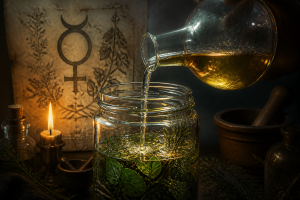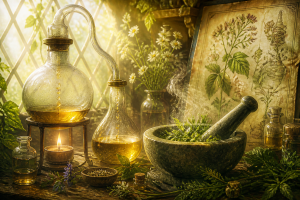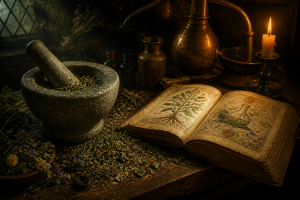
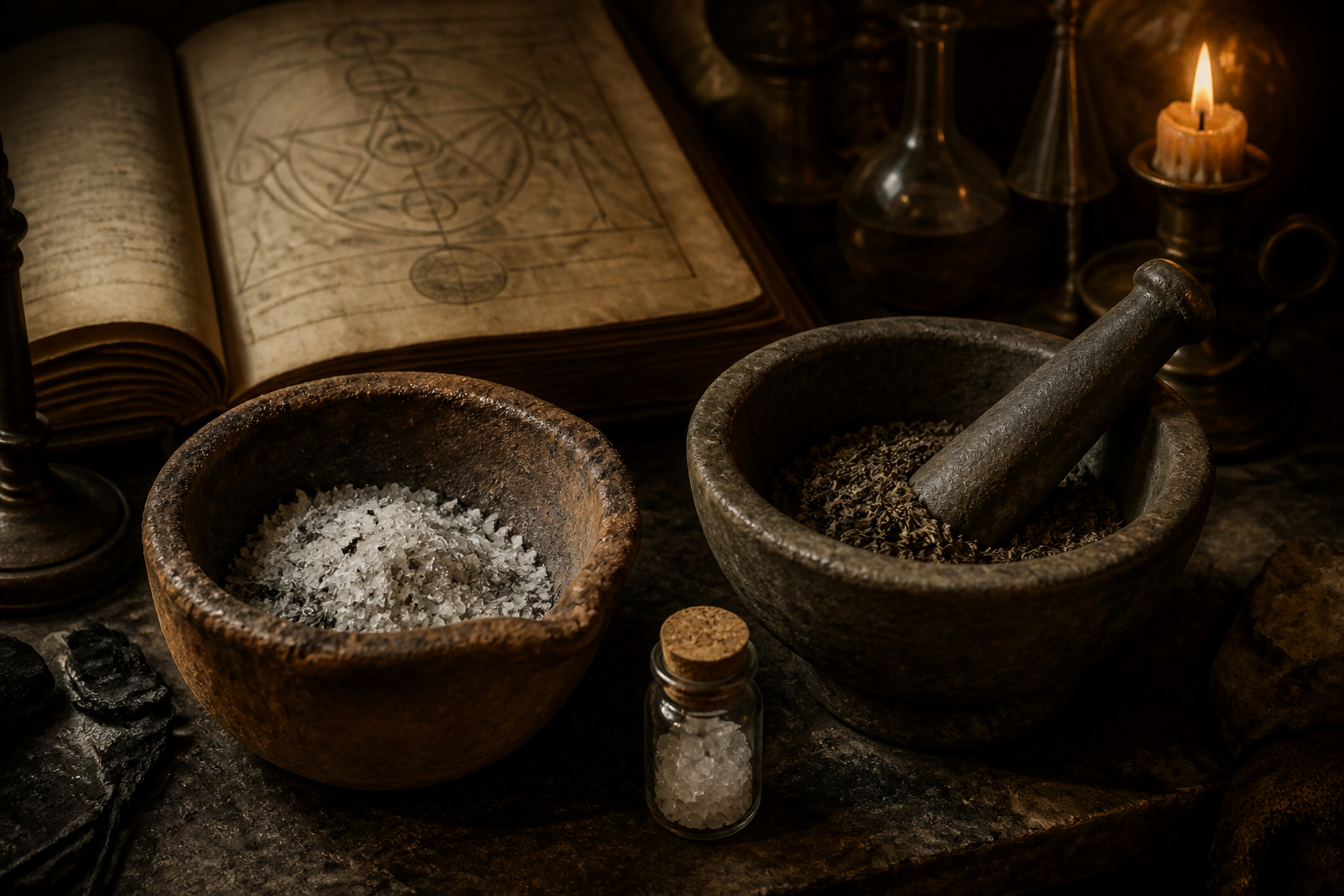
Look at the bottom of the mortar after you’ve ground dried herb to powder. Not the smell—that’s already climbing toward your nose, volatile and alive. Not the color, rich as it may be. Look instead at what clings to the pestle, the gritty grey-brown paste that remains when your grinding is done. It has almost no scent. It tastes of earth and mineral, of nothing particularly remarkable. This is the part most herbalists would brush into the compost without a second thought. This is the Salt. This is the body of the plant. This is what the old alchemists knew to save. In spagyrics, this residue matters: it is Salt, the fixed body that survives calcination and all the volatile losses that precede it. The calcination will confirm it.
The Salt is the principle of what remains. Not the ghost-light essential oil that rises in steam, not the alcohol that carries color and taste. The Salt is the fixed, the stable, the incombustible residue that persists when all volatility has fled. It is the principle of body itself—the corpus that gives form and endurance to living things. In your bones, in the mineral scaffold beneath your flesh. In metals, in the slag that won’t burn. In plants, in the ash.
Salt in Spagyrics: The Principle Behind Calcination
Before we go deeper, a necessary caveat—one that separates real craft from the softness of wellness-blog herbalism: Philosophers’ Salt is not table salt. Philosophers’ Sulfur is not brimstone. Philosophers’ Mercury is not quicksilver. This distinction matters, and Paracelsus himself was clear on it.
When Paracelsus (1493–1541) coined the tria prima—the three principles—he named them as qualities, as fundamental characteristics of matter and life, not as literal substances. The Salt principle is the quality of being fixed, earthy, crystalline, enduring. Common salt—sodium chloride, the white crystals in your kitchen—is certainly a carrier of this principle, the easiest everyday example to recognize. But it is not the thing itself. A plant’s Salt is the mineral essence of that specific plant, the particular fixity of that body, crystallized through patient work.
This is why the spagyric path matters. It demands precision. It asks the herbalist to think not in vague correspondences or poetic metaphors, but in actual operations—the real reduction of plant matter to its constituent principles, each separated, purified, and then reassembled into something whole again.
From Living Herb to Ash: Calcination in Spagyrics
The journey to Salt begins where most herbalists stop: at the spent plant material left over after the good stuff has been extracted. You’ve expressed the herb’s essential oils (the Sulfur). You’ve separated and distilled its alcohol (the Mercury). What remains in the strainer is the caput mortuum—Basil Valentine’s unforgettable phrase, the “dead head.” It looks dead. It smells of almost nothing. It is grey, exhausted, apparently worthless. The calcination process starts with this salt-bearing residue.
The spagyrist recognizes this exhausted plant body as the beginning of Salt-work, not the end of it. The marc is dried completely, then placed in a crucible and subjected to high heat. The alchemists called this calcination: the reduction of the body to ash through fire. In a laboratory, in your kiln or furnace, the plant matter blackens, then greys, then eventually whitens. All the volatile compounds—all the remaining moisture, all the oils trapped in cellular structure—burn away. What persists is the mineral skeleton of the plant, its fixed, earthy essence.
Manfred Junius, in his definitive modern manual Spagyrics: The Alchemical Preparation of Medicinal Essences, Tinctures, and Elixirs (Healing Arts Press), gives precise temperatures and timelines for this operation. The heat must be sustained but not violent. The ash must be white, not grey—a grey ash suggests incomplete oxidation, residual carbon still clinging to the mineral matter. Only white ash is ready for the next step.
The Purification: Salt Crystallized After Calcination
The white ash goes into distilled water. Not tap water. Distilled only, because you are working now with the most refined principles, and you cannot afford contamination. The ash is stirred and left to leach—to give up its water-soluble mineral salts to the liquid. After hours or days, depending on the plant, the solution is filtered carefully through linen or fine filter paper, removing all insoluble residue.
This filtered solution is then evaporated slowly, gently, by heat or in a warm place. As the water releases, crystals begin to form—white, angular, geometric. These crystals are the Salt of the plant. They are what remain when every trace of volatility has been driven off, what persists when even the water itself has fled. They are stable, dry, shelf-stable for years. They are also alive with the plant’s specific mineral nature—the salts of potassium, calcium, phosphorus, silica, and dozens of trace elements that give that particular plant its structure, its bone, its fixity.
This is not a thing most herbalists make. Few modern practitioners have the equipment, the knowledge, or the patience for calcination and leaching. But for the spagyrist—for anyone who wants to complete the medicine rather than merely extract from it—this operation is essential. It is where theory becomes practice. It is where you learn, with your hands in the mortar and your eyes on the crucible, what the alchemists meant by the body.
The Correspondence: Earth, Saturn, Moon
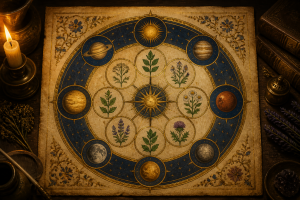
The Salt corresponds to the element Earth—the heavy, the dense, the grounded. In the planetary register (a topic we’ll explore more fully in the planetary correspondences cluster to come), Salt resonates with both Saturn and the Moon, though in different registers.
Saturn rules over limitation, consolidation, the passage of time that compresses and hardens and makes solid what was once fluid. The Salt is Saturnian in this sense: it is what endures beyond the moment, what resists dissolution, what persists when all else burns away. The Moon, too, governs Salt—the Moon of tides and time-cycles, the Moon that pulls crystallization toward order and geometry. Both planets have dominion over the fixed, the earthy, the crystalline qualities that Salt embodies. More on this when we map the planetary network; for now, hold that Salt is the principle of persistence, of structure maintained across time.
At the Mortar: Salt, Calcination, and a Daily Reminder
There’s a reason I began this essay at the mortar. Every time you grind dried herb with a pestle, you’re performing a miniature Salt-work. You are reducing the plant’s body to powder, breaking its structure down to its most fixed expression. The pestle pressing, grinding, pulverizing—this is not gentle work. It is work that respects the body by acknowledging it, by refusing to leave it whole, by accepting that to know a thing, you must be willing to take it apart.
Later, when you’ve tinctured that powder in alcohol and strained the liquid away, what remains in the strainer is spent plant matter. It is Salt-in-waiting. Most herbalists compost it. The spagyrist saves it, dries it, burns it clean in the crucible, leaches the ash, and crystallizes the salts back into being. This is not wastefulness turned useful. It is completion. It is the difference between extraction and the full work of spagyrics.
Why Salt Returns: The Body as Vessel
Here is the threshold thought that makes Salt not merely a residue, but essential. Salt emerges from calcination as the mineral core of what the plant truly is. The Salt is not just what remains. The Salt is the vessel of recombination. In the final operation—the coagula, the reassembly—the purified Salt is what the soul (the Sulfur) and the spirit (the Mercury) are returned to. Without the body, there is no dwelling for virtue.
A pure essential oil evaporates into the air—beautiful, potent, and volatile, gone. A pure alcohol-extract disperses, dilutes, loses potency over time. But a pure Salt, crystalline and stable, can hold form indefinitely. When you recombine the three—when you dissolve your Mercury into your Sulfur, then blend that union into your Salt—you have created something that endures. Something that can sit in a sealed glass bottle in your herb cabinet for years without degrading. Something that, when taken as medicine, carries not just the taste and aroma of the plant, not just its extractable virtues, but its structural essence. The body. The fixed. The root of manifestation in matter.
This is why the old alchemists made the tria prima. Not to seem mystical, not to be precious. Because they understood that a complete medicine must address not just spirit and soul, but body. Salt is body. Salt is what makes the medicine terrestrial, grounded, real.
The Work Continues: Salt, Calcination, and Return
The body has been reduced and purified. Now for the soul that will animate it. Read on: Sulfur: The Soul in the Scent — the oily, fragrant, combustible essence that makes a rose a rose and not a nettle. Or return to the three together: The Three Principles.
Frequently Asked Questions
What is the Salt principle in spagyrics?
In spagyrics, Salt is the fixed mineral essence of a plant—the stable, earthy principle that persists after calcination and volatile losses. It is the mineral skeleton of the plant body, crystalline and enduring. Salt corresponds to the element Earth and resonates with Saturn and the Moon in the planetary register.
How do you make Philosophers’ Salt from plant material?
After expressing oil and alcohol from an herb, dry the spent marc completely, place it in a crucible, and subject it to high heat until it whitens to ash—not grey, which indicates incomplete oxidation. Steep the white ash in distilled water, filter the solution through linen, then evaporate slowly by gentle heat or in a warm place until crystals form.
Is Philosophers’ Salt the same as table salt?
No. Paracelsus, who coined the tria prima, named Salt as a quality—the principle of being fixed, earthy, and crystalline—not as literal sodium chloride. A plant’s Salt is its particular mineral essence, crystallized through spagyric work. Common salt is merely an everyday example of the principle.
Why do spagyrists save plant ash instead of composting it?
The ash is Salt-in-waiting. In the final coagula, the purified Salt becomes the vessel for the reassembled three principles. A crystalline Salt can hold form indefinitely and carry the plant’s structural essence, whereas a pure essential oil evaporates and an alcohol-extract disperses and loses potency over time.
About This Article

Written by Kyle Bamboo. Kyle Bamboo has spent twelve years following the hermetic tradition of herbalism out of dusty reprints and into a home apothecary — spagyrics, planetary correspondences, and the strange internal logic of plant alchemy. Muddle and Mend takes its name from solve et coagula, dissolve and combine. He writes about the actual tradition, with its history, its vocabulary, and its genuine strangeness, not the Instagram version. More about this site.
Scope and limits. Kyle writes from a personal practice in traditional herbalism, not clinical training. Herbs interact with prescription medications and are not regulated as drugs — check interactions and talk to a pharmacist or clinician before taking anything.
Verify this against a primary source
Specifics change, and your situation may differ from the one described here. These are the authorities worth checking directly:
- NCCIH — herb safety, evidence and known interactions
- MedlinePlus Herbs and Supplements — documented interactions and cautions
- FDA Dietary Supplements — regulatory status and safety alerts