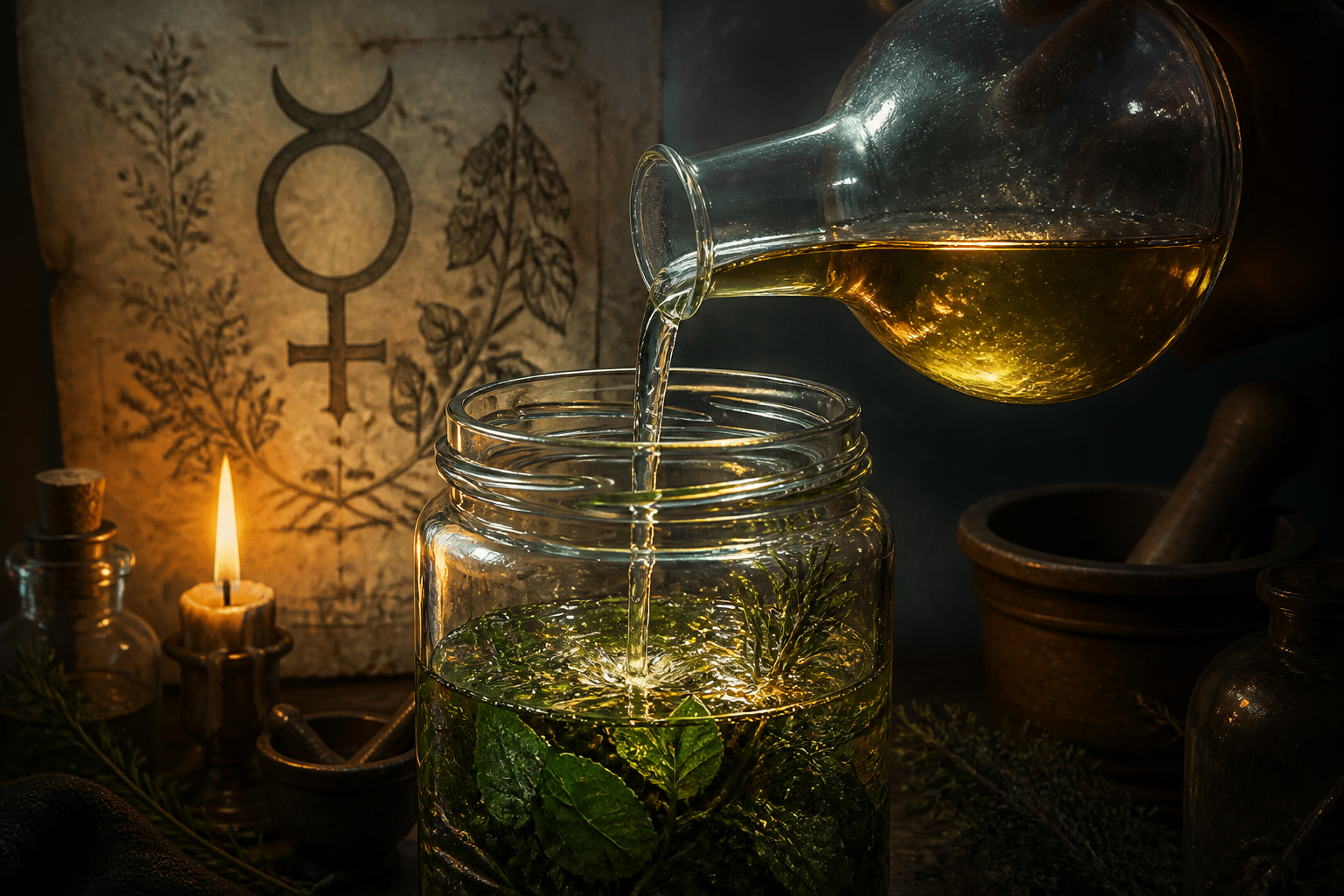
Watch it happen. A clean glass jar sits on the counter, the bottom lined with muddled herb—leaf fragments catching light, releasing scent into the still air. Your hand grips the bottle of clear spirit. You pour. What you are making is a spagyrics tincture. And what is doing the work—the alcohol, the solvent, the medium that carries everything into solution—is Mercury.
The liquid meets the plant and something invisible begins. Color leaches into the alcohol in threads—gold, amber, green, depending on what grows in your jar. The dried or fresh herb seems to revive under the wash of spirit, fibers softening, the whole mass becoming animate again. This is the moment. This pour is Mercury joining the plant. The menstruum—the liquid medium—has found what it came for, and the marriage of body and soul begins its work.
If you have read the previous entries on Salt and Sulfur, you already know the tria prima: Salt, Sulfur, and Mercury. Body, soul, and spirit. Fixed and volatile, dense and airy, the principles that alchemists believed lived in every plant and could be extracted, purified, and recombined into something more whole than nature had bothered to make. Salt came first—the ash that remains. Sulfur came second—the oil that carries scent and virtue. Mercury closes the circle. And Mercury is the one that makes the other two speak to each other.
Mercury in Spagyrics: Tincture as the Third Principle
In the alchemical tradition, Mercury is spiritus—spirit. Not in the religious sense, though the language is thick with theology. Spirit here means the volatile, fluid, animating, quickening medium. The living breath. The principle that moves, that carries, that connects.
Paracelsus, the 16th-century physician and alchemist, was precise about this. Mercury was not a substance first—it was a principle. The volatile animating quickness. The messenger between body and soul. The name came from the planet Mercury, the swift messenger god Hermes/Mercury in classical myth, always moving between worlds, never at rest, carrying messages between the fixed and the living.
In the human body, Mercury corresponds to the nervous system—the faculties that allow one part to signal to another. Breath. The faculty of speech and thought. Movement itself. Take Mercury away from the body and soul, and you have two inert things. Add Mercury, and they speak to each other. They become alive together.
Philosophically, Mercury is often drawn as the androgyne—the figure that reconciles opposites. Not because it is neutral, but because it moves between them. It is neither purely fixed (Salt’s domain) nor purely active and consuming (Sulfur’s work). It is the mobile medium that lets both exist in relation. The bridge. The solvent. The go-between.
A Necessary Caveat About Mercury Tincture (and the Best One)
The alchemists’ Mercury is not quicksilver—the toxic liquid metal you may have heard about. That metal gets the name because it is the most fluid, most volatile, most obviously mercurial of all the metals. Mercury metal moves. It refuses to hold form. Every schoolroom demonstration of its strangeness is a lesson in what “mercurial” means.
But in the plant kingdom—in the work we actually do with herbs and roots and flowers—the philosophers’ Mercury is something far more domestic: alcohol. The spirit of wine. The clear, volatile liquid raised by fermentation and distillation from the plant’s own sugars, or from grain, or from any fermentable matter.
This is the hidden-in-plain-sight detail that makes the whole tradition worth studying. A jar of fermenting apple cider, left to its own devices, will produce ethanol—the philosophers’ Mercury rising from the fruit’s own sugars. The alchemists were not being obscure for the sake of obscurity. They were naming a quality, and the quality was already there, waiting to be recognized.
Basil Valentine, the 17th-century alchemist whose Azoth became a cornerstone text, understood Mercury as the “first matter” of the alchemical work—the universal solvent. In plant work, that solvent is the spirit of wine. The alcohol that dissolves what water alone cannot touch. The medium in which the plant’s oils and active compounds become mobile, available, communicative.
The Language That Survived
Here is something worth knowing: the word “spirits” in “spirits of wine” and in “distilled spirits”—whisky, brandy, gin, vodka, all of it—is a direct survival of the alchemical vocabulary. Every time someone orders a gin and tonic at a bar, they are, entirely without knowing it, using the alchemical term for the Mercury of juniper berries. The language outlasted the framework by four hundred years. Every mercury tincture carries this history in it.
The alcohol was understood as the spirit of the fermented substance because it was—in the technical sense the alchemists meant—the volatile, animating, quickening principle. The thing that moved through the plant matter and carried its message. The Mercury.
Mercury in the Plant: Two Faces of the Tincture
When you pour that spirit over the muddled herb, two Mercuries meet. Understanding both is the key to understanding why the spagyric tradition distinguishes between a simple tincture and a true spagyric extraction.
First: the plant’s own Mercury. The volatile water-soluble compounds in the fresh plant. The ethanol produced when the plant material ferments on its own. The quickness that makes a living plant feel alive in a way a dried one does not—that’s the plant’s Mercury at work. It’s why fresh plant tinctures often feel more vibrant than dried ones. The plant’s own animating principle is still present, still mobile.
Second: the exogenous Mercury—the spirit of wine poured over the plant from outside. The menstruum. The solvent brought in to do the work of extraction. This outside Mercury meets the plant’s inner Mercury, and the two together dissolve the Sulfur (the essential oils, the active compounds, the soul of the plant) into solution.
Manfred Junius, in his practical masterwork Spagyrics: The Alchemical Preparation of Medicinal Essences, makes a distinction that most herbalists never consider. In a common tincture, you pour the menstruum (the outside Mercury) over the herb and let it steep. Simple. Effective. But in the full spagyric operation, something more happens. The fermented plant material is itself distilled. The plant produces its own alcohol through fermentation, and that spirit—the plant’s own Mercury—is captured and separated. Then, in the final step called cohobation, this purified plant Mercury is poured back over the other components. The plant’s own spirit returns to it.
This is not redundancy. It’s return. Reunion. The principle that the plant made itself is the one best suited to carry its own recovered essence.
Mercury’s Work: How the Tincture Dissolves and Connects
When you macerate an herb in alcohol, Mercury is doing the work. The spirit dissolves what it matches—the oils, the essences, the quickening compounds that Sulfur represents. But Mercury does more than simply extract. It creates a space of communication.
Steeping is Mercury at work in real time. The alcohol penetrates the plant’s cell walls. It loosens the bonds holding Sulfur in place. It draws the volatiles into solution. And—in ways the tradition understood even if modern chemistry is still catching up—it creates conditions for the Salt (the mineral compounds, the fixed nourishing parts) to come into suspension within the liquid. The tincture you strain into a dark glass bottle contains all three principles in temporary solution.
This is what the tradition spent centuries trying to understand and to make: body, soul, and spirit in one vessel. Not just mixed. Not just touching. Actually in relationship. Speaking to each other through the medium of Mercury.
In medicine and herbalism, Mercury corresponds to the nerves and breath—the faculties that allow one part of the body to signal to another. Without Mercury, a body is a collection of parts. With it, the parts coordinate. They become a whole. The same logic applies to a tincture: without the Mercury (the alcohol, the menstruum), you have dried plant matter sitting inert. With it, you have a vessel of communication, a liquid in which all three principles are present and mobile.
At the Mortar
Every tincture you have ever made begins with this moment. Even if you did not know the philosophy behind it, you were participating in the mystery. The spirit poured over the plant is Mercury joining the plant. The menstruum finding what it came for.
You muddle. You pour. You wait. Weeks pass. The liquid darkens. Flavor develops. Potency grows. This is Mercury doing the work of extraction, dissolution, and marriage. The alcohol is finding the oils, carrying them, holding them in solution. The plant’s own volatiles are merging with the exogenous Mercury. All three principles—body, soul, and spirit—are present in that dark glass bottle, held in relationship by the Mercury between them.
When you strain it, you are holding something the tradition understood as precious: a temporary union of the three principles. Body present. Soul present. Spirit present. Not as separate things. As one living liquid.
The Circle Closes: Mercury Tincture and the Coagula
The tria prima began with Salt—the body, the ash, the fixed principle. It moved through Sulfur—the soul, the oil, the animating principle. And now it closes with Mercury—the spirit, the solvent, the bridge.
But Mercury does more than simply conclude. It enables the final movement: the coagula. The rejoining of what was dissolved.
In the full spagyric operation, the three principles are separated. The herb is burned to ash (Salt is collected). The material is distilled or cold-pressed to gather the oils (Sulfur is collected). And the alcoholic fermentation yields the spirit (Mercury is collected). Three separate, purified principles.
Then comes the cohobation—the final step. The purified Salt (body) is dissolved into the Mercury (spirit). Then the Sulfur (soul) is reintroduced. The three principles, now purified separately and understood individually, are recombined into one vessel. This unified product is understood in the tradition as more whole, more potent, more balanced than any single extraction could be. The circle of solve et coagula—dissolve and coagulate—is complete.
Mercury makes this possible. It is the solvent that holds the Salt in solution. It is the carrier that allows the Sulfur to move through the body and reach every part. Mercury is the principle of wholeness—not because it is supreme, but because it reconciles and mediates between the other two.
The Mercury Tincture on Your Counter
Return to that moment. The pour. The spirit meeting the plant. If you understand Mercury as the principle of volatility, animation, and connection, that everyday act becomes something else. It becomes an act of bringing the three principles into relation. Of allowing body, soul, and spirit to speak to each other in the dark of a closed jar, over weeks and months, until what emerges is something whole.
You do not need to distill. You do not need to burn to ash. The simple tincture—maceration in alcohol—already contains the philosophy. It already demonstrates the principle. Mercury is present, at work, mediating between the fixed and the volatile, dissolving one into solution with the other, creating a vessel in which all three principles are present.
This is why the tradition was worth studying. Not because it was obscure or precious or distant from life. But because it named what was already there, waiting. In the jar of fermenting cider. In the bottle of gin. In the tincture steeping on your shelf. Mercury was there all along, doing the work of connection.
Body, soul, and spirit — reduced, purified, recombined. The circle of the tria prima closes here. Return to where it began: The Three Principles: Salt, Sulfur, and Mercury in Every Plant — and see all three as one. Or read the other spokes: Salt: The Body and the White Ash and Sulfur: The Soul in the Scent. And if you haven’t read the manifesto that names the whole project: Solve et Coagula: The Alchemy in a Muddle.
Nothing in this entry constitutes medical advice. Spagyric preparations are experimental products; consult a qualified medical professional before using any plant preparation described here.
Frequently Asked Questions
What is Mercury in the alchemical tradition?
In alchemy, Mercury is spiritus—spirit in the sense of the volatile, fluid, animating, quickening medium. It is the principle that moves, carries, and connects, named after the swift messenger god. In plant work, Mercury is alcohol, the spirit of wine that acts as the solvent dissolving what water alone cannot touch.
Is Mercury the same as quicksilver metal?
No. The alchemists’ Mercury is not quicksilver, the toxic liquid metal. That metal received the name because it is the most fluid and volatile of metals, but in the plant kingdom, the philosophers’ Mercury is alcohol—the clear, volatile liquid raised by fermentation and distillation from the plant’s own sugars or from grain.
Why does the spagyric tradition distinguish simple tinctures from full operations?
In a simple tincture, the menstruum steeps over the herb. In full spagyric work, the fermented plant material itself is distilled to capture the plant’s own Mercury. Through cohobation, this purified plant spirit is poured back over the other components. The plant’s own spirit returns to carry its recovered essence.
How does Mercury create wholeness in a tincture?
Mercury dissolves Sulfur into solution and holds Salt in suspension, creating a space where all three principles—body, soul, and spirit—are present and mobile, speaking to each other. Without Mercury, you have inert plant matter. With it, the principles coordinate and become whole through the medium of alcohol.
About This Article

Written by Kyle Bamboo. Kyle Bamboo has spent twelve years following the hermetic tradition of herbalism out of dusty reprints and into a home apothecary — spagyrics, planetary correspondences, and the strange internal logic of plant alchemy. Muddle and Mend takes its name from solve et coagula, dissolve and combine. He writes about the actual tradition, with its history, its vocabulary, and its genuine strangeness, not the Instagram version. More about this site.
Scope and limits. Kyle writes from a personal practice in traditional herbalism, not clinical training. Herbs interact with prescription medications and are not regulated as drugs — check interactions and talk to a pharmacist or clinician before taking anything.
Verify this against a primary source
Specifics change, and your situation may differ from the one described here. These are the authorities worth checking directly:
- NCCIH — herb safety, evidence and known interactions
- MedlinePlus Herbs and Supplements — documented interactions and cautions
- FDA Dietary Supplements — regulatory status and safety alerts