You open a spagyrics text for the first time. The author writes: “St. John’s Wort is a solar herb. Use it for the heart, for vision, for depression understood as a cold and darkened spirit.” This is planetary herbalism at work: the principle that what is above is reflected below, encoded in the plant’s form, scent, and action.
Your first thought is reasonable: this is medieval word-association. Yellow flowers, midsummer bloom, red oil when crushed—the author is playing a game of symbolic matching, reaching for connections that feel poetic but amount to nothing. The sun is gold; the flower is gold; therefore the flower belongs to the sun. Pleasing, but arbitrary. Planetary herbalism asks something different: not why the colors match, but why the plant and the planet share the same organizing principle.
You would be wrong. What you are looking at is not a collection of coincidences. It is a system. And the system only becomes coherent—only stops looking like a parlor trick—when you understand the single principle that holds it together.
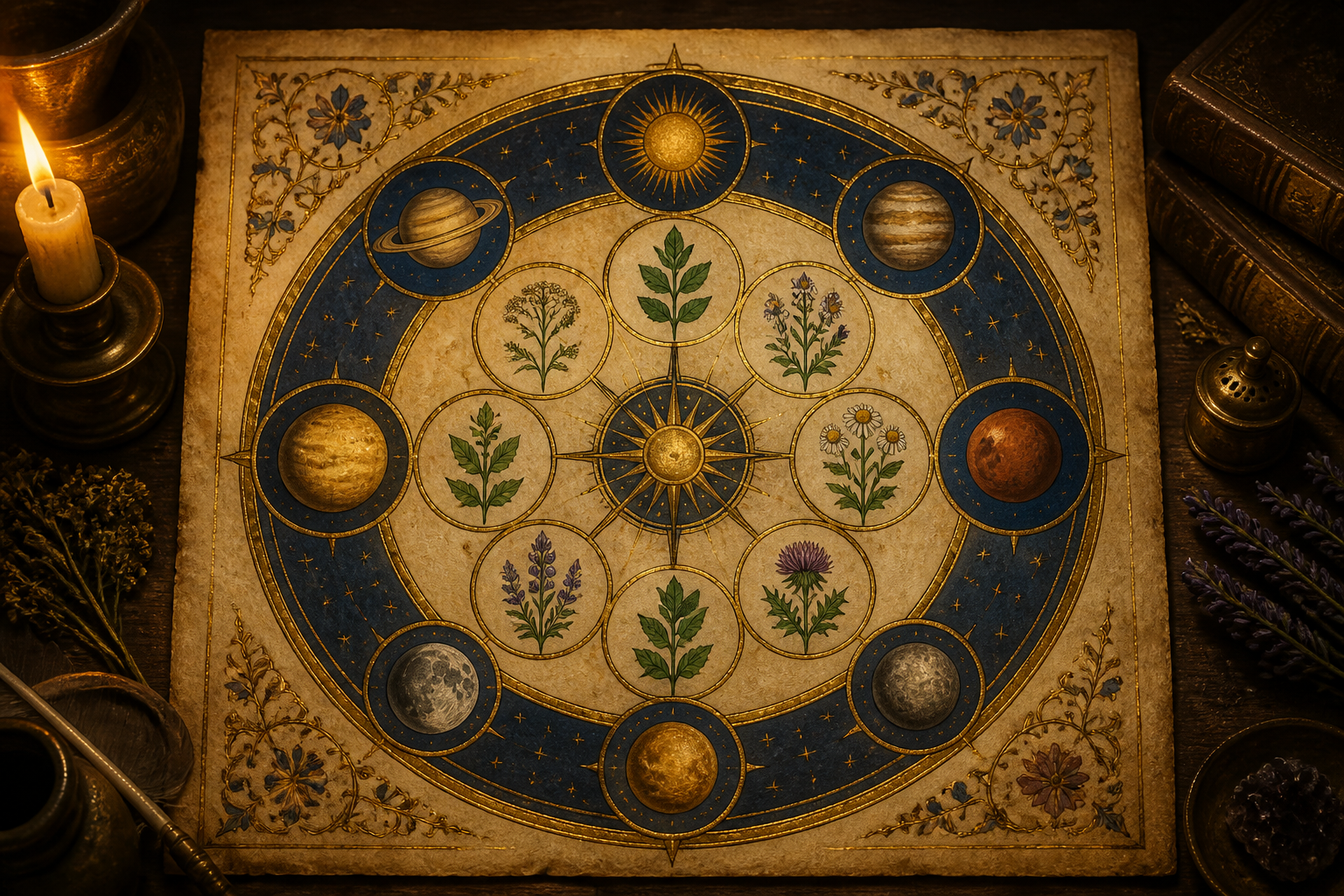
That principle is this: the same patterns repeat at every scale of reality. What governs the cosmos governs the body. What moves in the sky moves in the blood. The herbs are not assigned to planets out of poetic fancy. They are expressions of the same underlying principles that the planets express—merely at a different level of existence.
This is the doctrine of “as above, so below.” And it is the hermetic keystone that makes planetary herbalism a coherent system rather than a cabinet of curiosities.
| Planet | Metal | Governing Principle | Body System | Example Herb |
|---|---|---|---|---|
| Sun | Gold | Radiance, centrality, warmth | Heart, eyes, vitality | St. John’s Wort |
| Moon | Silver | Reflection, rhythm, moisture | Lungs, lymph, fluids, cycles | Mugwort |
| Mars | Iron | Heat, force, aggression, cutting | Blood, muscles, acute fevers | Nettles |
| Venus | Copper | Beauty, affinity, balance, sweetness | Kidneys, skin, reproductive system | Yarrow |
| Mercury | Quicksilver | Speed, communication, connection | Nervous system, lungs, breath | Fennel |
| Jupiter | Tin | Expansion, abundance, order, warmth | Liver, metabolism, digestion | Dandelion |
| Saturn | Lead | Contraction, consolidation, boundaries | Bones, joints, teeth, structure | Comfrey |
The Emerald Tablet: The Foundation of Planetary Herbalism
The Emerald Tablet—the Tabula Smaragdina—is a short Hermetic text attributed to Hermes Trismegistus. It was probably composed in Arabic between the 6th and 8th centuries CE, translated into Latin during the 12th-century renaissance of Arabic learning, and became the foundational document of Western alchemy.
Here is the crucial line, in its fullest form:
“Quod est superius est sicut quod inferius, et quod inferius est sicut quod est superius, ut perpetrentur miracula rei unius.”
— The Emerald Tablet, attributed to Hermes Trismegistus
“What is above is as what is below, and what is below is as what is above, so that the miracles of the One Thing may be perpetrated.”
This is not poetry. It is a metaphysical claim about the structure of reality. The claim is: reality exhibits self-similarity at every scale. The patterns you see in the celestial sphere (the planets, their cycles, their relationships) are the same patterns you see in the mineral earth, in the plant kingdom, in the animal body, in the human psyche. The same principles operate from the macrocosm to the microcosm.
If you can read the pattern at one level, you can read it at every level. If you understand the Sun’s role in the cosmos—its centrality, its warmth, its governance of light and life—you can understand the heart’s role in the body. Not metaphorically. Literally, as expressions of the same underlying principle.
This tradition was not fringe. Isaac Newton owned several editions of Hermetic texts and wrote his own translation of the Emerald Tablet. The great natural philosophers of the Renaissance—Paracelsus, John Dee, Robert Fludd—built their understanding of nature on this foundation. Hermetic philosophy was the intellectual framework of natural science until the late 17th century, when the mechanical philosophy and experimental method came to dominance.
The older system did not disappear. It went underground, preserved by herbalists, apothecaries, cunning folk, and practitioners of spagyrics. It is still there. And it still works.
The Seven Planetary Principles of Herbalism
The classical system recognizes seven primary planets (including the Sun and Moon in the old sense—the seven visible “wanderers” in the sky). Each planet embodies a principle. That principle manifests in a metal, in herbs, in the governance of specific body systems, and in qualities of character and action.
Once you grasp the principle, the correspondences are no longer arbitrary. They are deductions from a shared root.
The Sun: Radiance, Centrality, Warmth
The Sun is the heart of the solar system. It radiates outward. It governs light, warmth, life. It is the center around which everything else orbits.
Metal: Gold—the most perfect, unchanging, incorruptible metal. The alchemists saw in gold the perfected form of matter, just as the Sun is the perfected heavenly body.
Herbs: St. John’s Wort, chamomile, calendula, rosemary. These are yellow or gold-flowered. They bloom at the height of summer, at midsummer, when the Sun’s power is greatest. When you crush St. John’s Wort flowers, they release a deep red oil—the hypericin—which looks like blood, like the redness of life and heat.
Body governance: The heart, the eyes, the whole principle of vitality and central organization. The heart is the sun of the microcosm; it radiates blood and heat and rhythm outward to every part of the body.
Action: Solar herbs are warming, expansive, and brightening. They lift the spirit. They strengthen the heart. St. John’s Wort, used for depression, works on what traditional medicine understood as a “cold” condition—a condition where the sun of the spirit has grown dim. The remedy is solar: warmth, radiance, the restoration of central light.
The Moon: Reflection, Rhythm, Moisture, Tides
The Moon shines by reflected light. It waxes and wanes. It governs the tides—in the ocean and in the body’s fluids. It is the principle of rhythm, of the monthly cycle, of sleep and dreams.
Metal: Silver—bright but reflective, changeable, associated with water and moonlight. The mirror metal.
Herbs: Chickweed, cleavers, mugwort, white water lily, violet. These are water-loving or watery in their action. Many are white-flowered or pale. They are cooling and moist. Cleavers literally “cleaves” to your clothes—it is adhesive, moist, related to the body’s lymphatic fluids.
Body governance: The lungs, the lymph system, all fluids and cycles. The menstrual cycle, which is lunar. Sleep and dreams, which are the moon-governed states. The body’s moisture and permeability.
Action: Lunar herbs cool, moisten, and calm. They ease the flow of fluids. They affect dreams and the subconscious. Mugwort is burned or taken before sleep to vivify dreaming—to clarify the moon’s own domain, the watery depths of sleep.
Mars: Heat, Force, Aggression, Cutting
Mars is the god of war. The planet is red (the color of iron oxide). Mars embodies heat, force, aggression, the cutting stroke of the sword, the piercing of infection by fever. Planetary herbalism applies these Martian qualities directly to therapeutic assessment.
Metal: Iron—the metal of blood hemoglobin, the metal of the sword. Iron is hot; it rusts red. It burns and cuts.
Herbs: Nettles, wormwood, garlic, ginger, basil. These are hot, pungent, sharp-tasting herbs. Many are thorny or stinging (nettles literally sting the skin; wormwood is intensely bitter). Garlic is hot and sulfurous. Ginger burns the mouth. All of these have a martial quality—they are aggressive in their action.
Body governance: The blood, the muscles, acute fevers, and acute infections. Mars is the principle of the body’s aggressive immune response—the fever that burns out infection, the white blood cells that attack pathogens.
Action: Martial herbs heat and stimulate. They increase circulation. Nettles purify the blood and increase hemoglobin. They are used for acute, hot conditions—infections, inflammatory fevers, sluggish circulation. The sting of nettles meets heat with heat.
Venus: Beauty, Affinity, Balance, Sweetness
Venus is the principle of beauty, attraction, and the harmonious binding together of opposites. Venus brings things into relationship. She governs love, desire, and the marriage of contraries.
Metal: Copper—beautiful, warm-colored, used since antiquity for vessels and adornment. Copper conducts; it joins. Copper bracelets were traditionally worn for joint health.
Herbs: Roses, elderflower, yarrow, lady’s mantle, thyme. These are fragrant, often beautiful-flowered, and associated with love and desire. Rose is the traditional plant of Venus. Yarrow has an affinity for wounds—it binds them together. Lady’s mantle was traditionally used by women; it is gentle and beautifying.
Body governance: The kidneys—the organs that regulate the balance of opposites in the blood (sodium and potassium, acid and base). The skin, which is the membrane of relationship between the body and the world. The reproductive system, which is Venusian in every sense.
Action: Venusian herbs are affinity-building and balancing. They harmonize. They are often sweet, gentle, and skin-beautifying. Yarrow brings the edges of a wound together. Roses lift the heart and ease the affections.
Mercury: Speed, Communication, Connection, Messages
Mercury is the messenger god, the god of commerce and exchange. Mercury is fast, changeable, clever. Mercury governs the carrying of messages—between people, between body systems, between thoughts.
Metal: Quicksilver—mercury metal itself, which flows and divides and recombines. It is volatile, shiny, impossible to grasp.
Herbs: Fennel, lavender, dill, licorice, valerian. Many have feathery or finely divided leaves—the geometry of communication and branching. These herbs tend to affect the mind and the breath, to ease the passage of thought and air.
Body governance: The nervous system and the lungs. The breath itself. Mercury governs the transmission of signals—nervous transmission, respiratory exchange, the carrying of oxygen and nutrients through the blood.
Action: Mercurial herbs calm the mind, ease thought, improve focus and communication. They help the body’s systems talk to each other. Valerian settles the nervous system’s chatter. Fennel aids digestion by helping the gut and brain communicate (what we now call the gut-brain axis).
Jupiter: Expansion, Abundance, Order, Warmth
Jupiter is the great benefic. The principle of Jupiter is expansion, abundance, the proper ordering of plenty, the warm and generous distribution of gifts. Jupiter makes things grow.
Metal: Tin—the metal that brings flexibility to bronze, that conducts warmth, that reflects light.
Herbs: Dandelion, agrimony, melissa (lemon balm), oak, sage. These are robust, expansive herbs. Many are bitter, which is the taste of the liver. They tend to be tonics—herbs that build and restore over time, rather than acute remedies.
Body governance: The liver—the great metabolic organ that processes what enters the body, that transforms and expands, that makes sense of abundance and puts it to use.
Action: Jovian herbs are digestive, warming, and tonic. They strengthen and expand the body’s capacity. Dandelion root stimulates the liver and increases bile. Sage tones the whole system. These are herbs for building health over the long term, for the orderly abundance of a well-functioning body.
Saturn: Contraction, Consolidation, Boundaries, Deep Time
Saturn is the great limiter. The principle of Saturn is contraction, consolidation, the drawing of boundaries, the slowness of deep time. Saturn rules what endures, what crystallizes, what becomes fixed.
Metal: Lead—the heaviest metal, the most dense, the most fixed. Lead is slow; it does not shine. It is the base metal, but also the most stable.
Herbs: Comfrey, horsetail, Solomon’s seal, skullcap, mullein. These are dense, structural herbs. Comfrey is thick and mucilaginous; it knits bone. Horsetail is silica-rich and strengthens the skeletal system. Solomon’s seal is used for joints and ligaments.
Body governance: The bones, the joints, the teeth, the skin’s structure. Saturn governs what is most fixed and mineralized, what lasts the longest, what provides the body’s architecture.
Action: Saturnine herbs are for chronic conditions, for structural weakness, for the body’s slow consolidation and endurance. They build the scaffold on which everything else hangs. Comfrey heals breaks; it takes months of patient, slow work. Solomon’s seal restores the ligaments over time. These are not quick fixes. They are work for Saturn’s domain—the patient, deep, structural time.
Why Planetary Herbalism Is a System, Not a Collection of Coincidences
The planetary correspondences have internal logic. They are not arbitrary labels pinned to plants at random. Planetary herbalism derives its correspondences from a shared underlying principle, not from visual coincidence. They are deductions from a shared underlying principle.
Consider the Sun again. The solar principle is warmth + centrality + radiance + the governance of light and life. If you accept this, you can predict which herbs will be solar: Planetary herbalism gives you a principled way to extend the list, not just memorize it.
- Yellow or gold-flowered herbs (the color of the sun)
- Midsummer-blooming herbs (when the sun’s power peaks)
- Warming herbs (the sun’s thermal principle)
- Herbs that strengthen the heart (the sun of the body)
- Herbs that brighten the spirit (the sun of the soul)
St. John’s Wort ticks every box. It is not assigned to the Sun because someone thought it was pretty. It is a solar herb because it embodies the solar principle at every level of observation.
The same logic applies to every correspondence. Ask yourself: what is the principle? Then observe the herb. The correspondence either follows, or it doesn’t. The system is coherent because it rests on repeated application of a single rule.
This has practical value. Suppose you encounter an herb you have never worked with. You know nothing about it, but you can read its character: is it hot or cold? Does it act quickly or slowly? Does it affect fluids, or structures? Does it seem expansive or contractive? The answers point toward a planetary ruler. The ruler points toward the body systems most likely to respond. You have a framework for thinking about the unknown. This is planetary herbalism working as a practical diagnostic tool.
This is not magic. It is pattern recognition operating at the level of principle.
On Honesty: Where Planetary Herbalism Meets the Map and the Territory
We should be clear about something: this is a heuristic framework, not a law of physics. The correspondences are not “true” in the way that the periodic table is true. The system has been used and refined for two thousand years, which means it has practical wisdom embedded in it. But it is still a map. Maps are useful. Maps are also incomplete.
The correspondences sometimes contradict each other across different traditions. Nicholas Culpeper and John Gerard do not always agree on a plant’s planetary ruler. Sometimes a plant has multiple rulers depending on which quality you emphasize. This is not a failure of planetary herbalism—it is a sign that the system is responsive to complexity rather than reducing it. Rose is Venusian, but rosewood is said to be Saturnine because of its density and preservative power.
The doctrine does not claim that Mars literally reaches down from the sky to make nettles hot. Rather, it claims that the hot, aggressive, cutting principle that moves in Mars also moves in nettles and in fevers. The principle manifests at every level. The connection is real, but it is a connection of pattern and principle, not of physical force.
This is actually less mystical than it sounds. The same hypothesis—that deep patterns repeat at every scale—underlies fractal geometry and systems biology. It is not unscientific to ask: what is the underlying principle here? How does it manifest at different levels? The hermetic tradition simply asks these questions with more poetic language and more patience than modern science usually allows.
Conclusion: As Above, So Below — and What It Means for Planetary Herbalism
“As above, so below” is not mysticism. It is a hypothesis about pattern. Accept it, and the whole system of planetary herbalism comes into focus. The correspondences stop looking like a medieval parlor trick and become instead a map of the deep structure of nature.
The planet is not literally sending rays down to color the flower yellow. But the principle that animates the Sun—the principle of radiance, of centrality, of warmth—is the same principle that animates the yellow flower and the beating heart. The correspondence is real because the principle is real.
Once you grasp this, you can read the language of plants. You can look at St. John’s Wort and see not a collection of random features, but a coherent expression of the solar principle. The yellow flower, the midsummer bloom, the red oil, the heart-strength, the spirit-brightening—all of these are not arbitrary attributes pinned to a plant at random. They are the solar principle speaking itself into being at the level of the herb.
This understanding is the keystone of everything on this site. Every correspondence we explore, every recipe we share, every remedy we recommend—all of them rest on the truth of this single principle: that reality is self-similar at every scale, that the patterns which move the heavens also move the herbs and the human body, and that if you learn to read one level of the pattern, you can read them all.
What is above is as what is below. This is not poetry. This is how the world actually works.
Frequently Asked Questions
What is the Emerald Tablet and why does it matter?
The Emerald Tablet (Tabula Smaragdina), attributed to Hermes Trismegistus, was probably composed in Arabic between the 6th and 8th centuries CE and translated into Latin during the 12th-century renaissance. Its foundational claim—”What is above is as what is below”—established that reality exhibits self-similarity at every scale, making it the keystone of Western alchemy and planetary herbalism.
Why is St. John’s Wort considered a solar herb?
St. John’s Wort embodies the solar principle at every level: it is yellow or gold-flowered, blooms at midsummer when the Sun’s power peaks, releases a deep red oil (hypericin) when crushed, and strengthens the heart and spirit. It is not assigned to the Sun by visual coincidence, but because it expresses warmth, centrality, radiance, and the governance of light and life.
How do planetary herbalists determine which planet rules an herb?
Practitioners read an herb’s character—whether it is hot or cold, quick or slow, affecting fluids or structures, expansive or contractive—then deduce its planetary ruler from these qualities. The ruler points toward relevant body systems. This is pattern recognition operating at the level of principle, not arbitrary symbolic matching.
Did historical scientists believe in planetary herbalism?
Yes. Isaac Newton owned several editions of Hermetic texts and wrote his own translation of the Emerald Tablet. The great natural philosophers of the Renaissance—Paracelsus, John Dee, Robert Fludd—built their understanding of nature on this foundation. Hermetic philosophy was the intellectual framework of natural science until the late 17th century.
About This Article

Written by Kyle Bamboo. Kyle Bamboo has spent twelve years following the hermetic tradition of herbalism out of dusty reprints and into a home apothecary — spagyrics, planetary correspondences, and the strange internal logic of plant alchemy. Muddle and Mend takes its name from solve et coagula, dissolve and combine. He writes about the actual tradition, with its history, its vocabulary, and its genuine strangeness, not the Instagram version. More about this site.
Scope and limits. Kyle writes from a personal practice in traditional herbalism, not clinical training. Herbs interact with prescription medications and are not regulated as drugs — check interactions and talk to a pharmacist or clinician before taking anything.
Verify this against a primary source
Specifics change, and your situation may differ from the one described here. These are the authorities worth checking directly:
- NCCIH — herb safety, evidence and known interactions
- MedlinePlus Herbs and Supplements — documented interactions and cautions
- FDA Dietary Supplements — regulatory status and safety alerts