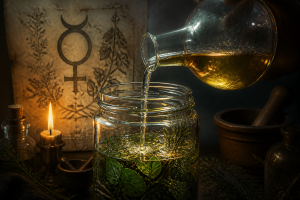
Press a fresh leaf of mint between your fingers. Not gently. Crush it.
What happens in that instant is alchemy. The cell walls collapse. Aromatic compounds that were locked in cellular vacuoles—held in check, waiting, invisible—suddenly flood out into the air. Your fingertips become wet. The smell explodes. You’ve just released something that was bound, and the world changes in the space of a second. This is not metaphor. This is what happens to matter when you apply pressure and intent.
This is solve et coagula alchemy: dissolve and combine.
The Bridge Between Kitchen and Athanor: Solve et Coagula in Practice
Most people never learn the Latin. They learn instead the folk version: “herbalism.” And folk herbalism—the kind you find in a thousand wellness blogs—treats plants as finished goods. Dried herb. Look up what it does. Add it to water. Move on. Easy. Safe. Inert.
But that is not where the real work lives.
In the medieval alchemical laboratories—the athanors where philosophers heated and cooled and distilled and recombined for years on end—the workers understood something different. They understood that no transformation happens without dissolution first. You cannot make gold from lead, they said, without first reducing both to prima materia—raw material. You must break things open. You must allow them to lose their form, to become chaotic, liquid, available. Only then can you recombine them into something new.
This is not sequential — not step one, then step two. Solve and coagula are the same movement, seen from different angles. The caterpillar does not first dissolve, then later coagulate. Inside the chrysalis, both happen at once—the body liquefies and reforms in the same alchemical space. The grape does not separate its rotting from its fermenting. These are one process wearing two names.
Where the Words Come From
Solve comes from the Latin for “loosen,” “unfasten,” “break apart.” Coagula means “thicken,” “curdle,” “bring together into a whole.” The phrase appears first in the work of Jabir ibn Hayyan—Geber to the Latin alchemists—an 8th-century Islamic polymath working in Kufa, in what is now Iraq. Jabir inherited the fragments of Hellenistic alchemy that had survived the fall of the classical world. He preserved them. He extended them. He transformed them into a systematic philosophy of matter and transformation.
When the crusaders and merchants brought these texts back to Europe in the 11th and 12th centuries, the monks and scholars who translated them found in solve et coagula something profound. Here was a principle that explained not just metal, not just mineral, but the whole architecture of change itself.
Paracelsus and the Medical Turn
Paracelsus, the mad Swiss physician of the 16th century, took this principle and made it medical. He understood that the alchemical operation was not about turning lead into gold for its own sake—that was metaphor, useful but secondary. The real operation was the transformation of poison into medicine. Paracelsus argued that every substance contains both poison and cure; the dose, the preparation, the dissolution, the recombination: these determine which you get. To be a physician was to be an alchemist. To heal was to dissolve and recombine.
Later, the phrase would be carved into illustrations by Eliphas Lévi—the 19th-century occultist who drew the figure of Baphomet, hands pointing up and down, holding the balance between opposites. To the shallow reader, this is occultism for its own sake, a gesture toward the forbidden. But Lévi was making a serious claim: that the supreme truth is not fixed in one pole or the other, but in the constant movement between dissolution and recombination. Spirit descends into matter; matter rises toward spirit. The athanor is the space where this dance happens.
This is not mysticism without rigor. It is rigor applied to the mystical.
Why Plants Practice Solve et Coagula Alchemy
If you want to understand solve et coagula alchemy, do not start with metals. Start with a plant.
A living plant performs this operation continuously, from the moment the seed splits until the leaf returns to soil. The roots draw minerals from the earth—iron, calcium, potassium, silica—in their inorganic form. These elements are dissolved in the soil solution, available but not yet integrated into living tissue. The plant draws them in. The chemistry of photosynthesis and cellular metabolism transforms them. They are coagulated into the structure of the plant itself: the green of the leaf, the strength of the stem, the medicine in the flower.
This is not figurative. This is literal alchemy happening in plain sight. A plant is solve et coagula made visible, made renewable, made accessible to human hands.
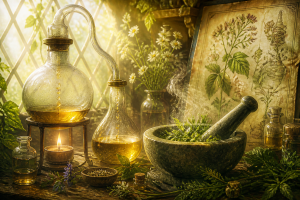
Because of this, the alchemists knew that plants were the primary laboratory. Not because plants were “natural” or “pure”—those words meant something different then—but because plants were already doing what the alchemist was trying to do. A plant is a master of transformation. It takes the dead minerals of the earth and births them into complexity, into fragrance, into action upon the body and mind. To work with plants alchemically is to join a process already underway, to accelerate it, to direct it, to recombine its products according to human intention.
What Lives in These Pages
This blog is rooted in spagyrics: the ancient practice of plant alchemy. Spagyrics is the art of extracting, purifying, and recombining the principles of plants—their sulphur (the volatile, aromatic, spiritual principle), their mercury (the mobile, fluid, psychic principle), and their salt (the fixed, material, grounding principle). These are not metaphors. They are categories of chemical action that medieval and Renaissance alchemists developed through centuries of careful work.
Spagyrics asks: What is inside the plant that produces its effects? Not just the active compound—though that matters—but the relationship between compounds. The whole that is more than the sum of its parts. When you prepare a tincture by dissolving plant material in alcohol, you are performing spagyrics. The alcohol dissolves compounds that water alone could not reach. You are applying solve et coagula alchemy as a practical method.
This blog will explore:
- The doctrine of signatures and correspondences: the idea that a plant’s form, color, and habitat hint at its action in the body and psyche
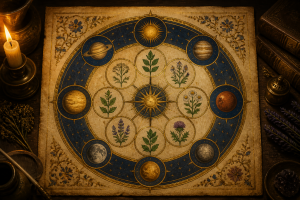
- Planetary herbalism: the assignment of plants to celestial bodies (Mars, Venus, Mercury, the Sun and Moon) and what these assignments mean
- The spagyric preparations: tinctures, oils, essences, ferments, and distillations that extract and recombine plant principles
- The history: where these ideas come from, who preserved them, how they evolved, and why they still matter
- The application: how to think alchemically about the plants in your own garden or apothecary, how to work with them as the ancients did
Not as a nature documentary. Not as a listicle of “lavender for sleep” and “ginger for digestion”—though those observations are not wrong, only incomplete. Not as folk remedy dressed in ancient language.
Instead: as a serious engagement with a real tradition. One that survived because it works. One that persists because it asks the right questions.
The Question Beneath the Surface of Solve et Coagula
Most people who touch herbs stop at the surface. Lavender is calming. Ginger is warming. Nettle is nutritive. These statements are true, as far as they go. But they answer the wrong question.
The alchemist does not ask what does this plant do? The alchemist asks what is this plant? What is its nature, its essence, its principle? What happens when you dissolve it? What can be recombined from its dissolution? How does its structure reflect celestial order? What does it teach about transformation itself?
These are harder questions. They require patience, study, and a willingness to think in symbols without abandoning rigor. They require you to see the plant not as a consumer product but as a teacher.
The plant is the process made visible. To work with plants alchemically is to join a transformation already underway.
This blog pursues those deeper questions. Not because I have all the answers—the alchemists themselves understood that the Work is never finished, that each generation must repeat the experiment—but because I believe those questions matter more than the easy ones.
Welcome to Muddle and Mend. We are going to dissolve some certainties and see what we can recombine in their place.
— Kyle Bamboo
Want the two words unpacked plainly, term by term? Read Solve et Coagula: What the Phrase Actually Means in the Glossary.
Frequently Asked Questions
What did Jabir ibn Hayyan contribute to alchemy?
Jabir ibn Hayyan, an 8th-century Islamic polymath working in Kufa, preserved fragments of Hellenistic alchemy after the fall of the classical world. He extended and transformed these fragments into a systematic philosophy of matter and transformation, and the phrase solve et coagula appears first in his work.
How did Paracelsus reframe alchemical philosophy?
Paracelsus, a 16th-century Swiss physician, made solve et coagula medical rather than metallurgical. He argued that the real alchemical operation was transforming poison into medicine, and that every substance contains both; dose, preparation, dissolution, and recombination determine which emerges.
What are sulphur, mercury, and salt in spagyrics?
In spagyrics—the ancient practice of plant alchemy—sulphur is the volatile, aromatic, spiritual principle; mercury is the mobile, fluid, psychic principle; and salt is the fixed, material, grounding principle. These are categories of chemical action developed through centuries of careful work.
What happens to minerals when a plant absorbs them?
Roots draw minerals like iron, calcium, potassium, and silica from soil in inorganic form. Through photosynthesis and cellular metabolism, the plant coagulates these dissolved elements into living tissue—the leaf’s green, the stem’s strength, the flower’s medicine.
About This Article

Written by Kyle Bamboo. Kyle Bamboo has spent twelve years following the hermetic tradition of herbalism out of dusty reprints and into a home apothecary — spagyrics, planetary correspondences, and the strange internal logic of plant alchemy. Muddle and Mend takes its name from solve et coagula, dissolve and combine. He writes about the actual tradition, with its history, its vocabulary, and its genuine strangeness, not the Instagram version. More about this site.
Scope and limits. Kyle writes from a personal practice in traditional herbalism, not clinical training. Herbs interact with prescription medications and are not regulated as drugs — check interactions and talk to a pharmacist or clinician before taking anything.
Verify this against a primary source
Specifics change, and your situation may differ from the one described here. These are the authorities worth checking directly:
- NCCIH — herb safety, evidence and known interactions
- MedlinePlus Herbs and Supplements — documented interactions and cautions
- FDA Dietary Supplements — regulatory status and safety alerts