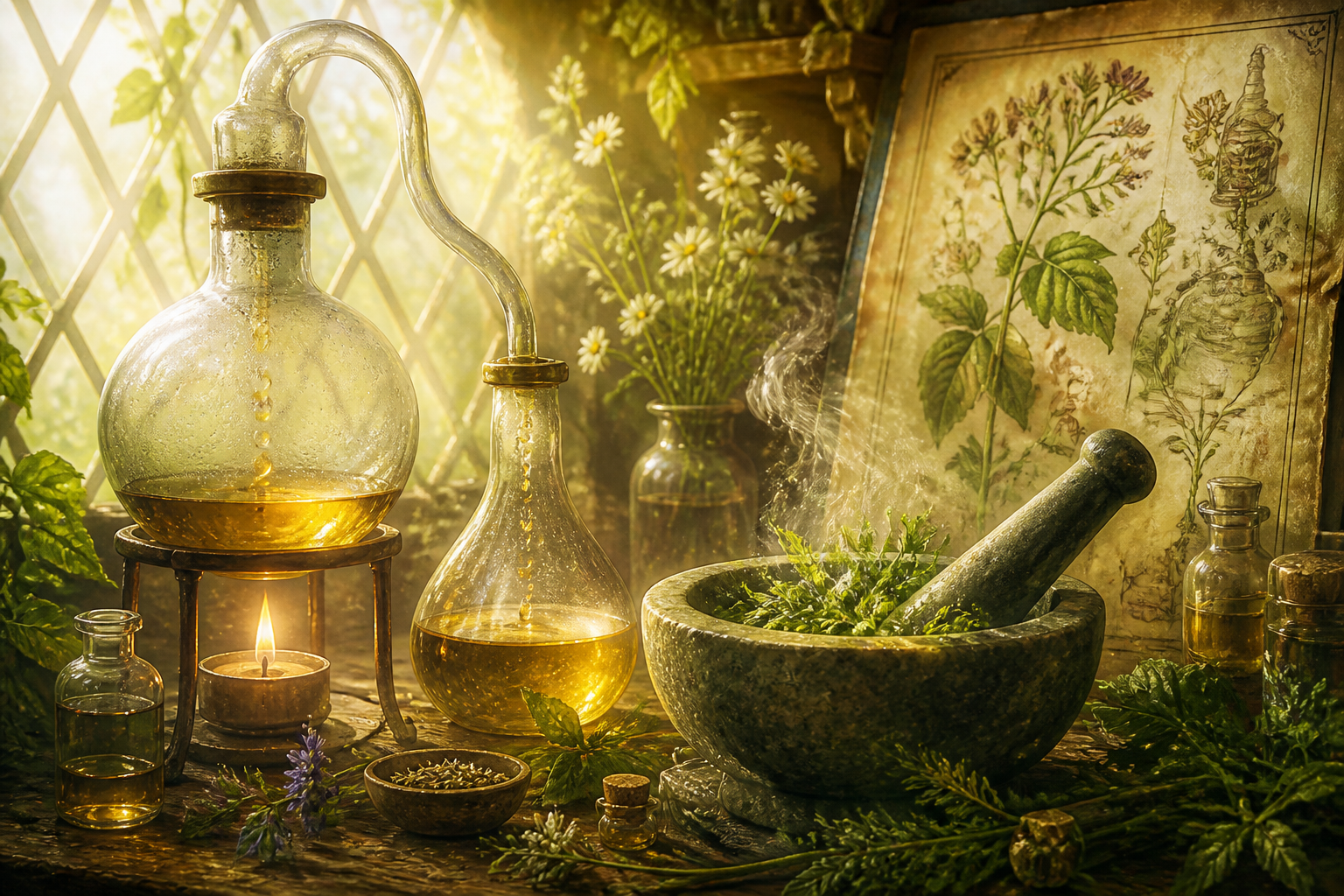
Crush a leaf of mint between your fingers. Not gently—crush it. Hold it close and breathe in the moment the oil glands rupture. That green-cold-sweet explosion that floods up instantly, that makes your eyes water slightly, that fills the small space around your hand with presence and vigor—that is the essential oil releasing. In spagyrics, this volatile fraction is called Sulfur: the soul principle, the carrier of a plant’s character and action. That is not mere chemistry. It is the soul of the plant becoming briefly sensible to you. It is Sulfur leaving the leaf and entering the air.
You have felt this a thousand times without knowing its old name. Every reader here knows the smell that rises when you tear basil for a sauce, when you strip rosemary needles from their stem, when you brush against crushed garlic. That immediate, almost aggressive fragrance is not incidental. It is the plant’s soul announcing itself. In the old language of alchemy and spagyrics, we call this principle Sulfur. And once you know to look for it, you cannot stop seeing it everywhere.
Sulfur in Spagyrics: Essential Oil as the Soul Made Sensible
In the spagyric tradition inherited from Paracelsus, the tria prima—the three principles—describe not three substances but three qualities of being. Salt is form and fixity. Mercury is volatility and binding. And Sulfur is the soul, the anima: the combustible, oily, fragrant essence that carries a plant’s individual character.
Paracelsus (1493–1541) understood Sulfur as the soul principle, the innermost virtue of a thing. Not the yellow mineral brimstone—though brimstone is the most obvious material carrier of this principle because it burns with color and smell and will not be ignored. Rather, Sulfur is the quality of expressed character wherever it appears: in the essential oil of lavender, in the volatile compounds of garlic, in the resin of frankincense, in the skin oil of your own hand that carries your scent into a room.
Sulfur is what makes a rose a rose and a nettle a nettle. It is individuality. It is the quality of oily, soulful combustibility—the part of the plant that burns, that smells, that declares itself. Where Salt gives form and structure, Sulfur gives personality. It is the difference between the mineral skeleton of a thing and the living warmth that inhabits it.
A Necessary Clarification
Before we go further, a caveat. When old spagyric texts speak of Sulfur, they mean the principle. The material sulfur—brimstone, the yellow powder that smells of rotten eggs and burns with a blue flame—is the most obvious carrier of this principle in the mineral world. But the principle itself is the quality, not the substance. Sulfur is the oily, the fragrant, the combustible, the characteristic. Wherever you encounter these qualities, you have encountered Sulfur. Sulfur in this system is not elemental sulfur—it is the essential oil, the aromatic fraction that makes each plant distinct.
Sulfur and Essential Oil in the Plant
Open a fresh leaf of oregano. Smell it. That immediate, bright, almost peppery presence is Sulfur. The plant did not make this for you—it made it for itself, to protect its leaves from insects and fungal infection, to mark its territory in the garden. But now it announces itself to your senses. This is the signature of the plant made visible. This is its soul.
In botanical terms, these aromatic compounds are called essential oils or volatile oils. They live in oil glands, resin ducts, and specialized hairs across the plant’s surface and throughout its tissues. In spagyric terms, they are the plant’s Sulfur—the oily, combustible, fragrant essence that carries the plant’s particular gift and character.
Basil Valentine, one of the great practical alchemists of the medieval period, understood this in his writings on the Azoth. The Sulfur of a plant, he argued, is its characteristic virtue—the thing that makes it itself, recognizable and distinct. This virtue is expressed first and most obviously through aroma and color. The scent is not a byproduct. It is an announcement. It is the plant’s signature written in volatile compounds.
The Spagyric Separation: Isolating the Essential Oil
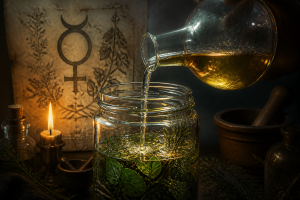
The spagyric operation for capturing and isolating Sulfur is distillation. In its simplest form, the process works like this: you heat plant material in water or alcohol. The volatile oils vaporize along with the water vapor. These vapors rise, travel through a cooling chamber, and condense. As they cool, the oil separates from the water—it rises to the surface as an oily layer, distinct and visible. This separated oil is the plant’s Sulfur held in a vial.
Manfred Junius, whose Spagyrics: TheAlchemy of Herbal Medicine and Medicine-Making remains one of the most rigorous practical guides to the craft, describes the procedures in exact detail. Whether you use steam distillation or hydro-distillation, the principle is the same: heat and separation reveal the soul of the plant as a liquid that can be captured, preserved, and used.
Even a simple alcohol tincture is a partial Sulfur-extraction. Why? Because alcohol, like essential oils, is partly polar. Both dissolve in each other. When you macerate plant material in alcohol—steep it for weeks, shaking it—you are drawing out the oil-soluble compounds. This is why your tincture smells like the plant. The aroma is trapped in the alcohol, carried by it, preserved in it. This is Sulfur beginning to be worked with Mercury, the volatile spirit that will bind it and preserve it.
Color, Aroma, and the Sulfur Signature of Essential Oil
The most aromatic part of a plant is usually its most medicinally active part. The scent is not incidental—it is an announcement. It tells you something true about the plant’s nature and gift. This recognition has a name in the herbalist’s vocabulary: the Doctrine of Signatures. The outward show of a thing declares something of its inner virtue.
Consider turmeric. Its brilliant golden color comes from curcumin, a powerful anti-inflammatory compound. The color is the signature—it announces what the plant does. Consider the deep red of hibiscus. Consider the pale yellow of yarrow flowers. Color and aroma are not decorations. They are the plant’s way of declaring its nature, of making its Sulfur visible and sensible to you.
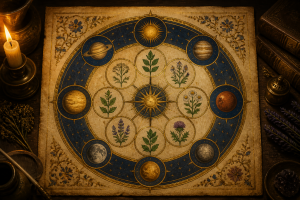
In the spagyric tradition, Sulfur corresponds to the solar, to fire, to the active and expansive. It is the principle of radiation and declaration—the part of the plant that reaches outward, that announces itself, that makes itself known. In the human triad—the body (Salt), the soul (Sulfur), and the spirit (Mercury)—it is Sulfur that makes you recognizable, that gives you your particular character, your presence in a room. It is what makes you you.
At the Mortar: Releasing Sulfur’s Essential Oil
This is the moment where the practice of Muddle and Mend—our brand, our claim, our reason for being—touches the deepest grammar of the craft. And it is worth naming clearly: muddling is Sulfur-work.
The entire technique of muddling exists to rupture the oil glands and release the essential oils into the medium. When a bartender bruises mint for a mojito, when an herbalist crushes fresh rosemary for an infused oil, when you press basil into your hand to scent it before you use it—you are performing the Sulfur separation at the kitchen scale. You are freeing the soul of the plant briefly, making it available, preparing it to combine with what comes next.
The smell that fills the room is the evidence. That sudden aromatic presence is not metaphorical—it is literal. You have ruptured the plant and released its Sulfur into the air. In the old language, this is called a “solve”—a loosening, a breaking apart of bonds so that what was fixed becomes volatile, available, mobile. This is why we muddle. This is why the scent matters. This is why technique is not incidental but essential.
The Problem With Sulfur and Essential Oil Unbound
But here is where the spagyric wisdom deepens into caution. A soul separated from its body is a soul that dissipates. An essential oil, uncaptured and unpreserved, evaporates and is gone. Leave a bottle of peppermint oil open on your shelf, and in months there will be nothing left but the faint memory of what was. The volatile nature of Sulfur is both its glory and its problem.
This is why distillation is only half the work. The separated oil must be stored in a sealed vessel, protected from heat and light. A tincture must be capped. An infused oil must be sealed and kept cool. The Sulfur, once freed, must be bound and preserved, or the virtue is lost to the air.
This brings us to the next principle. The soul has been separated and made sensible. But a soul that disperses is virtue lost. Something must carry it, bind it, hold it stable. Something must mediate between the fixed body and the fleeting essence. Enter Mercury: the volatile, animating spirit that serves as the medium and the binder.
The soul has been freed. But a soul that disperses is virtue lost. Something must carry it and bind it back. Read on: Mercury: The Spirit That Binds — the volatile, animating medium that holds body and soul in one living liquid. Or step back to see the structure: The Three Principles. And if you haven’t read it yet: Salt: The Body and the White Ash — what waits to receive what the soul returns to.
Frequently Asked Questions
What does Sulfur mean in the spagyric tradition?
In spagyrics, Sulfur is the soul principle—the oily, fragrant, combustible essence that carries a plant’s individual character and personality. It is what makes a rose a rose and a nettle a nettle. Paracelsus understood Sulfur as the innermost virtue of a thing, expressed most obviously through aroma and color, not as the yellow mineral brimstone but as the quality of expressed character itself.
How do you isolate a plant’s Sulfur through distillation?
The spagyric operation for capturing Sulfur is distillation. Plant material is heated in water or alcohol; the volatile oils vaporize with the water vapor, rise through a cooling chamber, and condense. As they cool, the oil separates from the water and rises to the surface as a distinct oily layer—the plant’s Sulfur held in a vial.
Why do essential oils evaporate if left unsealed?
In the spagyric understanding, a soul separated from its body dissipates. Essential oils are volatile by nature—this is both their glory and their problem. An uncapped bottle will evaporate over months, leaving only a faint memory. The separated Sulfur must be stored in a sealed vessel, protected from heat and light, or the virtue is lost to air.
What is muddling in terms of spagyric practice?
Muddling is Sulfur-work. The technique ruptures oil glands and releases essential oils into the medium. When you crush mint, bruise rosemary, or press basil, you are performing a Sulfur separation at kitchen scale, freeing the plant’s soul briefly and making it available. In the old language, this is called a “solve”—a loosening so that what was fixed becomes volatile.
About This Article

Written by Kyle Bamboo. Kyle Bamboo has spent twelve years following the hermetic tradition of herbalism out of dusty reprints and into a home apothecary — spagyrics, planetary correspondences, and the strange internal logic of plant alchemy. Muddle and Mend takes its name from solve et coagula, dissolve and combine. He writes about the actual tradition, with its history, its vocabulary, and its genuine strangeness, not the Instagram version. More about this site.
Scope and limits. Kyle writes from a personal practice in traditional herbalism, not clinical training. Herbs interact with prescription medications and are not regulated as drugs — check interactions and talk to a pharmacist or clinician before taking anything.
Verify this against a primary source
Specifics change, and your situation may differ from the one described here. These are the authorities worth checking directly:
- NCCIH — herb safety, evidence and known interactions
- MedlinePlus Herbs and Supplements — documented interactions and cautions
- FDA Dietary Supplements — regulatory status and safety alerts