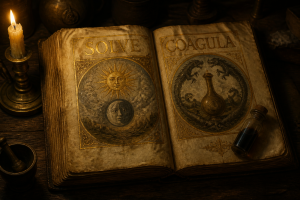
Prima materia (Latin, “first matter”) is the alchemical term for the raw, undifferentiated substance that remains once a thing has been broken down past its familiar form—the formless starting point every alchemical operation begins from, and the state every “solve” (see Solve et Coagula) is aiming to reach before the work of recombination can begin.
What Prima Materia Actually Names
Prima materia is not a single substance but a state—the condition of a material stripped of its accidental, surface qualities (color, shape, familiar identity) and reduced to raw potential. It’s the philosophical inheritance from Aristotle’s concept of “prime matter,” the substrate beneath all form; the alchemists adopted it and made it operational.
Here’s the crucial distinction: prima materia is not “the ingredient you start with.” A dried herb or raw ore is not yet prima materia. Only after the solve—the breaking-down—has done its work do you arrive at this formless, undifferentiated state. That’s when the real work can begin.
Why Alchemists Cared So Much About It
The entire alchemical premise rests here: you cannot build something truly new and purified on top of an old, still-intact form. Gold cannot be “made” from lead by addition alone. Lead’s own leaden nature—its formed, definite, corrupted state—has to be broken down first. The structure must collapse.
The Great Work (Magnum Opus) was believed to require reducing base matter all the way back to this formless first state. Only from prima materia could the ascent toward the purified, perfected substance—the Philosopher’s Stone (see The Philosopher’s Stone)—begin. Prima materia is the low point of the cycle, not a failure or waste state but a necessary threshold. Without it, no true transformation is possible.
Prima Materia in Plant Work
Ground this in spagyric practice, where it becomes visible. When a spagyrist calcines the spent marc of an herb—the exhausted plant material left after tincture or distillation—down to ash (see Salt: The Body and the White Ash), that grey-white ash is a working prima materia. It no longer resembles the plant it came from. All color, scent, and familiar form are gone. What remains is raw mineral potential, waiting to be purified further and eventually recombined with the plant’s own separated Sulfur and Mercury.
A softer, looser usage has crept into modern herbalism: some practitioners refer to a fresh-cut herb before any processing as “prima materia.” This is worth knowing but distinct from the strict alchemical sense. The true prima materia is post-reduction, formless, stripped. A fresh leaf is still very much in its familiar form.
How Alchemists Pictured It
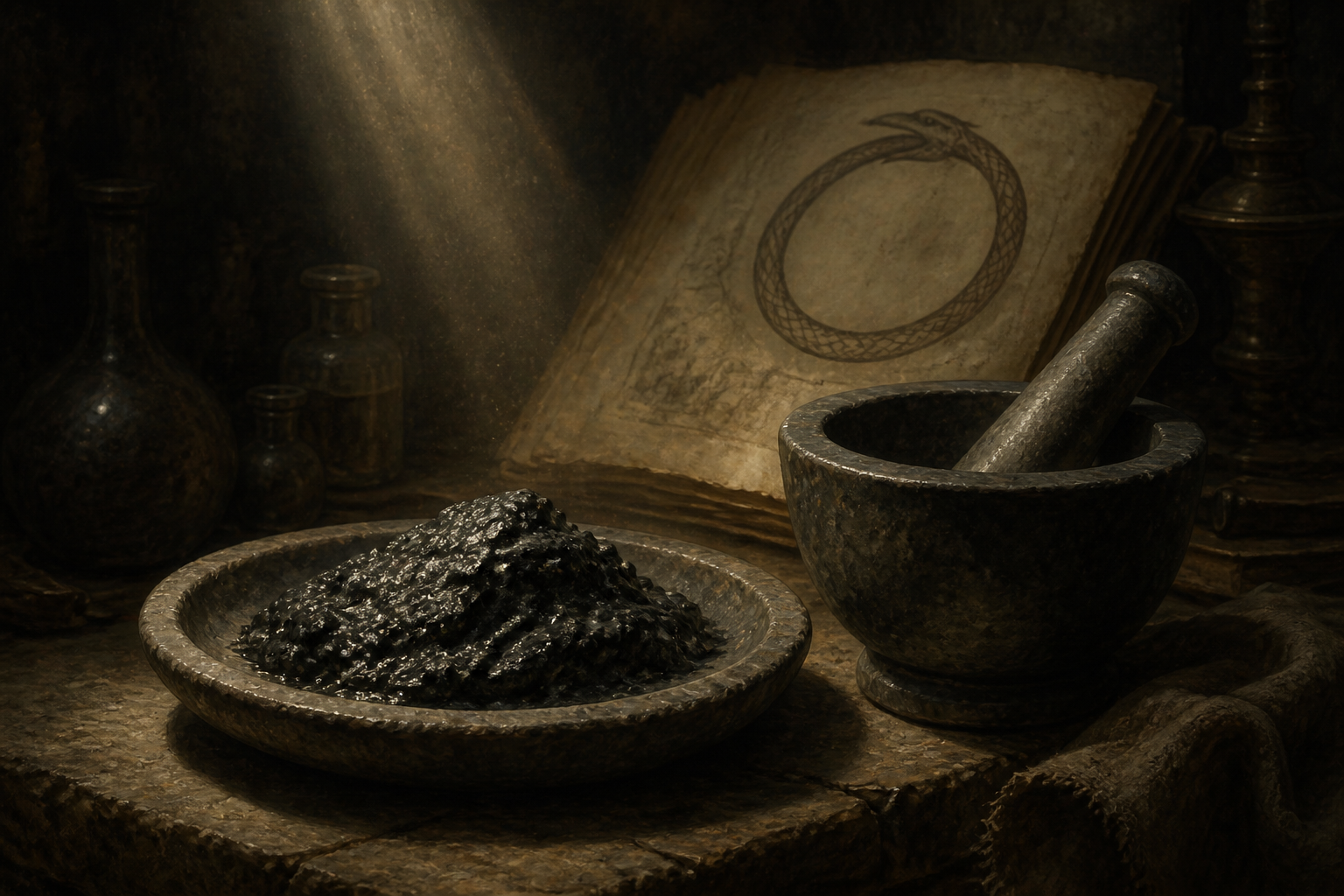
The ouroboros—the serpent devouring its own tail—is the most common visual symbol associated with prima materia. It represents a cycle with no true beginning or end, matter perpetually returning to its own source before rebirth. In illustrated manuscripts, prima materia was also depicted as formless chaos or as raw, base lead: visual shorthand for the undifferentiated state.
At the Mortar
The moment right after you’ve ground dried herb to its finest powder—before water, spirit, heat, or any external agent has been introduced—is as close as a home spagyrist gets to prima materia. Matter reduced as far as it can go by mechanical means alone, waiting. Every crystal and cell wall broken. No recovery to original form possible. That powder is potential.
Related Terms
- Solve et Coagula — the two-part operation that produces and then transforms prima materia
- The Philosopher’s Stone — what prima materia becomes at the end of the Great Work
- Salt: The Body and the White Ash — the plant-world operation (calcination) that yields a working prima materia
Nothing in this glossary entry constitutes medical advice. Spagyric preparations are experimental products; consult a qualified medical professional before using any plant preparation described here.
Nothing in this glossary entry constitutes medical advice. Spagyric preparations are experimental products; consult a qualified medical professional before using any plant preparation described here.
Frequently Asked Questions
Is prima materia the same as the ingredient you start with?
No. Prima materia is not the starting ingredient but a state reached after breaking down. A dried herb or raw ore is not yet prima materia. Only after the solve—the dissolution or breaking-down—has reduced the material to a formless, undifferentiated condition does prima materia exist.
What does the ouroboros symbol mean in alchemy?
The ouroboros—the serpent devouring its own tail—is the most common visual symbol for prima materia. It represents a cycle with no true beginning or end, with matter perpetually returning to its own source before rebirth.
How do spagyrists create prima materia from herbs?
When a spagyrist calcines the spent marc (exhausted plant material left after tincture or distillation) down to ash, that grey-white ash is a working prima materia. All color, scent, and familiar form are gone, leaving raw mineral potential waiting for further purification and recombination.
What’s the closest a home spagyrist can get to prima materia?
The moment right after grinding dried herb to its finest powder—before water, spirit, heat, or any external agent is introduced—is as close as a home spagyrist gets. Matter reduced mechanically as far as possible, with every crystal and cell wall broken, it is pure potential.
About This Article

Written by Kyle Bamboo. Kyle Bamboo has spent twelve years following the hermetic tradition of herbalism out of dusty reprints and into a home apothecary — spagyrics, planetary correspondences, and the strange internal logic of plant alchemy. Muddle and Mend takes its name from solve et coagula, dissolve and combine. He writes about the actual tradition, with its history, its vocabulary, and its genuine strangeness, not the Instagram version. More about this site.
Scope and limits. Kyle writes from a personal practice in traditional herbalism, not clinical training. Herbs interact with prescription medications and are not regulated as drugs — check interactions and talk to a pharmacist or clinician before taking anything.
Verify this against a primary source
Specifics change, and your situation may differ from the one described here. These are the authorities worth checking directly:
- NCCIH — herb safety, evidence and known interactions
- MedlinePlus Herbs and Supplements — documented interactions and cautions
- FDA Dietary Supplements — regulatory status and safety alerts