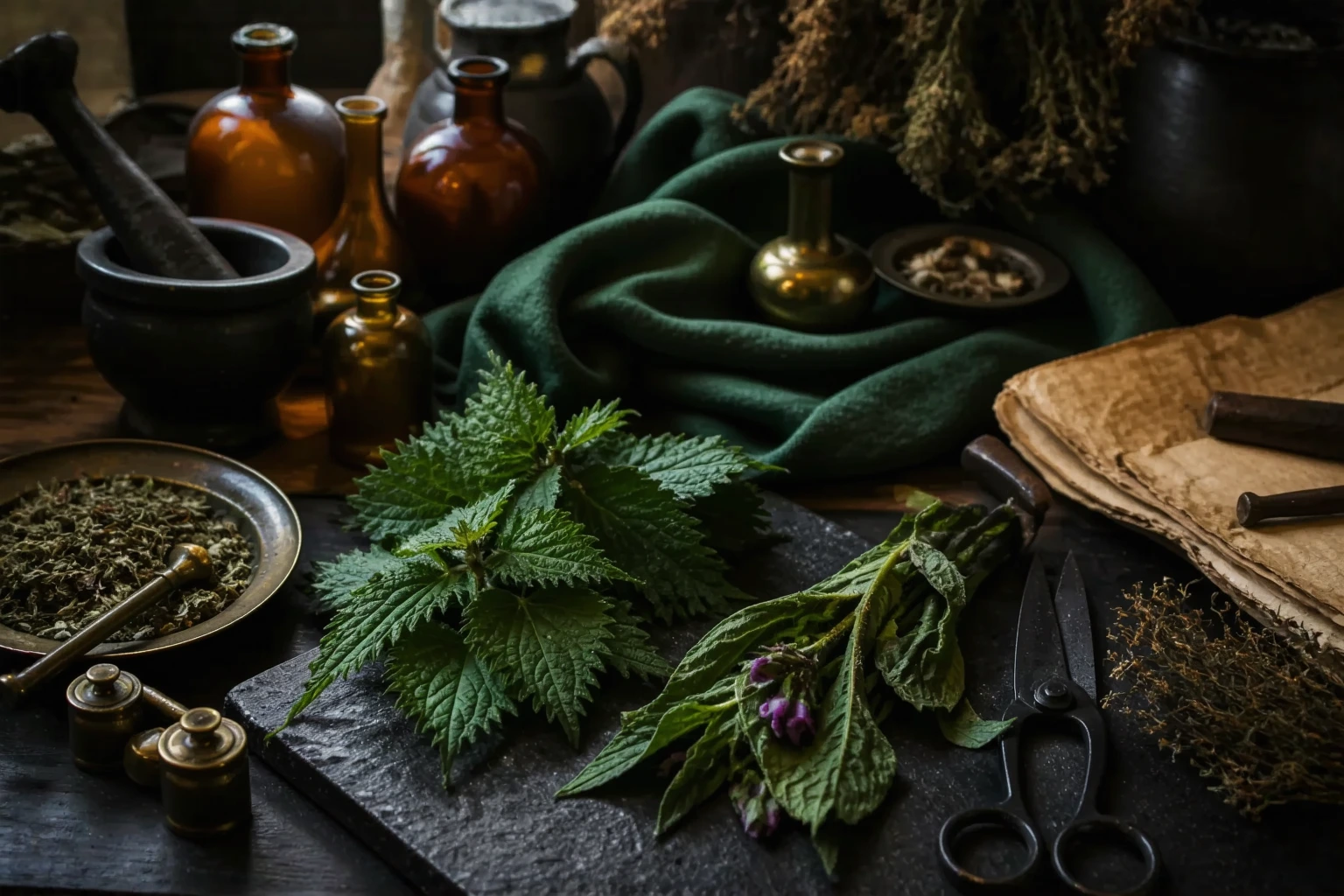
Grab a nettle stem bare-handed. Go ahead. If you’ve ever done it by accident—reaching into a hedge, brushing past a riverbank stand in August—you already know what happens. The sting is not a warning. It is the plant’s entire argument, delivered instantly and without negotiation. Formic acid, histamine, serotonin, oxalic acid: a chemical brief in four compounds, injected by hollow silica needles so fine they shatter on contact with skin, snapping at the tip and functioning as a perfect hypodermic. The nettle does not threaten. It simply acts. That is a Martian plant. You know it the moment it touches you.
Now go find a comfrey root. Dig one up if you can—they go down hard and deep, sometimes two feet into clay soil, dark and stubborn and thick as a man’s finger. Break it open. The interior is pale, almost white, and it weeps a mucilaginous sap that is immediate and strange: cool, slick, faintly astringent. It smells of the earth it came from. Nothing about this plant is in a hurry. Where the nettle is all surface aggression, comfrey works from underneath, from depth, from patience. That is a Saturnine plant. These two are not decorations for the same shelf. They represent opposite poles of the planetary framework, and the old physicians knew exactly what they were doing when they assigned them.
The Doctrine Is Not a Metaphor
The doctrine of planetary correspondences gets dismissed by people who have not actually worked with it. They assume it is poetic window-dressing layered over folk observation—a way for pre-scientific practitioners to feel cosmologically important. This misses the mechanism entirely.
The logic runs like this: the planets govern principles, not objects. Mars governs heat, sharpness, aggression, iron, speed, inflammation, the will to cut through. Saturn governs cold, heaviness, contraction, lead, slowness, structure, the bones of things. When the herbalist of the sixteenth or seventeenth century looked at a plant, they were reading a signature—not painting one on. They asked: what does this plant do? How does it behave? What does it look like? Where does it grow? What does it contain? And then they mapped the answers onto a coherent ontological system that had been in continuous development since at least the time of Galen in the second century CE.
Nicholas Culpeper, working in London in the 1640s and 1650s, was the most explicit English practitioner of this method. His Complete Herbal (1653) assigns Mars to nettle without hesitation: “This is also an herb Mars claims dominion over. You know Mars is hot and dry, and you know the nettle is hot and dry, and you know the reason why.” That is not naivety. Culpeper was a trained astrologer and an apothecary who ran a practice in Spitalfields serving patients who could not afford the College of Physicians. He was using a systematic correspondence model—one that connected Paracelsian chemistry, Galenic humoral theory, and astrological medicine into a single working framework. He got results. That is why people kept coming.
Urtica Dioica: The Martial Plant in Full
Nettle’s Martian character is not just the sting. That is the first chapter. Read the whole plant.
Nettle grows in disturbed ground—wherever soil has been broken, fertilized by animal waste, enriched by human activity. It is a plant that follows iron literally: it concentrates iron from the soil at rates that are measurable and significant. The leaves are green-black with it. It thrives on nitrogen, on the chemical residue of decay and disturbance. It is a colonizer, aggressive, territorial, difficult to remove once established. Its fibers—and nettle fiber is among the oldest textile materials in European history, with specimens found in Bronze Age Danish burial sites—are tough, wiry, and require considerable processing to render useful.
In the spagyric tradition, we care about what a plant contains as much as what it does. The mineral constituents of a plant are the Salt principle—the body, the fixed matter, the thing that remains when everything else burns away. Nettle’s Salt is dramatically mineral-rich: iron, silicon, calcium, potassium, magnesium. You can calcine nettle to ash, dissolve that ash, and recrystallize the mineral salts. What you get is a dense, dark, alkaline residue. This is the martial salt made visible. The Sulfur principle—the aromatic, volatile, spirituous quality—is in those formic acids, those sharp biologically active compounds that define the plant’s aggressive character. Even when dried, nettle retains something of that edge.
The virtue of resistance that Mars teaches is this: the plant that fights you is often the plant that strengthens you. Not because suffering is good, but because the compounds that make nettle defend itself are precisely the compounds that make it nutritionally and chemically dense. The plant earns its potency.
Symphytum Officinale: Saturn’s Patience Underground
Comfrey’s old names are the lesson. Symphytum comes from the Greek symphyo: to grow together, to unite. Knitbone. Boneset. Bruisewort. These are not marketing names. They describe what practitioners observed over centuries of use. Dioscorides mentions it in De Materia Medica, written in the first century CE. The medieval herbalists repeated it. By the time Gerard wrote his Herball in 1597, comfrey’s association with the knitting of broken things—bones, wounds, the rupture of surface—was firmly established across European herbal practice.
Saturn rules structure: the skeleton, the teeth, the boundary between the body and the world, the slow processes of hardening and consolidation. He is cold, he is dry, he is heavy. He is also time itself—Cronos, the great delimiter. A Saturnine plant works slowly, works deep, works on the framework rather than the surface. Comfrey’s root system exemplifies this. It does not spread by surface runners. It drops vertically, building its reserves in darkness, accumulating allantoin—a compound genuinely known to promote cell proliferation in connective tissue—deep in that pale, mucilaginous taproot.
The spagyric Salt of comfrey is earthy, heavy, mineral-dense in a different way from nettle. Where nettle’s salt is sharp and iron-forward, comfrey’s is mucilaginous even in dissolution, slow to release, reluctant. This is Saturn’s character in the laboratory: things do not happen quickly. You cannot rush a Saturnine process. The alchemists understood slow dissolution—the long maceration, the patient digestion over low heat—as a Saturnine operation. Comfrey belongs to that category of work.
A Plain Word on Comfrey and Safety
This is the place where the tradition requires honesty, and honesty here means being direct about a real issue that does not resolve neatly.
Comfrey contains pyrrolizidine alkaloids—particularly in the root, and in younger leaves. Pyrrolizidine alkaloids are hepatotoxic. They cause cumulative, dose-dependent damage to the liver. This is not a fringe concern or a regulatory overreaction. Multiple countries have restricted or banned the internal sale of comfrey-containing preparations. The German Commission E, which has done serious work evaluating traditional plant preparations, allows comfrey root preparations for external use only, with limits on pyrrolizidine alkaloid content and duration of use.
The tradition is old. The caution is real. These facts coexist.
Externally—as an infused oil, as a poultice, as a salve applied to unbroken skin—comfrey has a long and coherent history of use, and the external application does not carry the same risk profile as internal use. In the spagyric context, topical preparations made from the root are where this plant is most responsibly worked with. If you are considering any internal use of comfrey, including as a tea, consult a qualified medical herbalist or physician before you proceed. The tradition says respect the plant. Respect includes this.
The Difficult Teachers
The medieval and Renaissance physicians did not choose Mars and Saturn as the difficult planets without reason. In the old astrological medicine, Jupiter was beneficent, Venus was harmonizing, the Sun was vitalizing. Mars and Saturn were the malefics—the hard ones, the ones that pressed and tested. A Martian influence cut, inflamed, disrupted. A Saturnine influence restricted, delayed, calcified.
And yet: the malefics were not evil. They were demanding. The physician who understood how to work with a Martian or Saturnine plant—who could read their virtue, extract it properly, apply it at the right moment to the right condition—held something genuinely powerful. Paracelsus, writing in the early sixteenth century, was explicit about this: the poison and the medicine are the same substance, differentiated by dose and preparation. This is not romantic. It is chemical fact. The compounds that make nettle sting are also why it is nutritionally extraordinary. The alkaloids that make comfrey dangerous internally are part of the same biochemical architecture that makes it remarkable externally.
This is the real doctrine of correspondence: not a decoration, not a filing system for folklore, but a working hypothesis about the nature of plants as integrated, intelligent expressions of principle. The plant that resists you has something to teach about resistance. The plant that works slowly underground has something to teach about the kind of healing that cannot be hurried.
Muddle them correctly. Learn to read what they are. The sting is not an obstacle to the virtue—in both of these plants, it is the virtue, in one form or another. That is what Mars and Saturn have always asked us to understand.
Frequently Asked Questions
Why did Nicholas Culpeper assign Mars to nettle?
Culpeper, a trained astrologer and apothecary working in London in the 1640s and 1650s, used a systematic correspondence model connecting Paracelsian chemistry, Galenic humoral theory, and astrological medicine. He assigned Mars to nettle because both are hot and dry, mapping observable plant properties onto planetary principles in a coherent ontological framework developed since at least Galen in the second century CE.
What are the safety concerns with internal comfrey use?
Comfrey contains pyrrolizidine alkaloids, particularly in the root and younger leaves, which are hepatotoxic and cause cumulative, dose-dependent liver damage. Multiple countries have restricted or banned internal comfrey preparations. The German Commission E allows comfrey root preparations for external use only, with limits on pyrrolizidine alkaloid content and duration. Consult a qualified medical herbalist or physician before any internal use.
What mineral salts does nettle contain in spagyric practice?
In the spagyric tradition, nettle’s Salt principle—the fixed matter remaining after calcination—is dramatically mineral-rich: iron, silicon, calcium, potassium, and magnesium. Nettle concentrates iron from soil at measurable rates, producing a dense, dark, alkaline residue when the ash is dissolved and recrystallized, visibly demonstrating the martial salt.
How does comfrey’s root structure reflect Saturn’s planetary character?
Comfrey’s root drops vertically into darkness, building reserves deep underground rather than spreading by surface runners. This exemplifies Saturn’s governance of structure, slowness, and depth. The plant accumulates allantoin in its pale, mucilaginous taproot, reflecting Saturn’s association with patient, unhurried processes working on the framework rather than the surface.
About This Article

Written by Kyle Bamboo. Kyle Bamboo has spent twelve years following the hermetic tradition of herbalism out of dusty reprints and into a home apothecary — spagyrics, planetary correspondences, and the strange internal logic of plant alchemy. Muddle and Mend takes its name from solve et coagula, dissolve and combine. He writes about the actual tradition, with its history, its vocabulary, and its genuine strangeness, not the Instagram version. More about this site.
Scope and limits. Kyle writes from a personal practice in traditional herbalism, not clinical training. Herbs interact with prescription medications and are not regulated as drugs — check interactions and talk to a pharmacist or clinician before taking anything.
Verify this against a primary source
Specifics change, and your situation may differ from the one described here. These are the authorities worth checking directly:
- NCCIH — herb safety, evidence and known interactions
- MedlinePlus Herbs and Supplements — documented interactions and cautions
- FDA Dietary Supplements — regulatory status and safety alerts