Hold a piece of raw lead in your palm. Actually hold it — it’s heavier than you expect, cold, almost greasy against the skin. Now hold a gold coin. The weight is different, the temperature is different, the feeling is different. Ancient physicians and philosophers didn’t just notice this. They built an entire medical system on it.
The seven classical planets — Saturn, Jupiter, Mars, Sun, Venus, Mercury, Moon — were not thought of primarily as distant burning rocks. They were qualities. Forces that expressed themselves in metal, in organ tissue, in soil, in the chemistry of plants. When a medieval physician assigned Saturn to lead, to the spleen, and to the herb valerian, he wasn’t making a poetic gesture. He was cataloguing a perceived family of qualities: heaviness, coldness, slowness, contraction, melancholy. The metal, the organ, and the plant were instances of the same underlying principle made manifest in different materials.
This is the system. Not prediction. Not horoscopes. A map.
Where This Comes From
The framework has deep roots. Greek medicine established the four qualities — hot, cold, wet, dry — as the operating variables of all matter. Plants were classified by their degree of heat and moisture. Galen codified this exhaustively in the second century CE, and that framework never really left European medicine; it just accumulated layers.
The planetary layer arrived through Arabic intermediaries. Ibn Sina’s Canon of Medicine (1025 CE) integrates astrological correspondence into pharmaceutical reasoning. When this was translated into Latin in the twelfth century — primarily by Gerard of Cremona — European physicians inherited the whole system at once: Galenic qualities fused with planetary signatures. By the time Heinrich Cornelius Agrippa published De Occulta Philosophia in 1531, the planetary herb-metal-organ correspondences were a mature, densely articulated system.
Then came Paracelsus — Theophrastus Bombastus von Hohenheim, working in the same century as Agrippa — who hammered everything harder. He didn’t discard the planetary framework. He alchemicalized it. Every plant has a specific astral virtue, he argued, which the spagyric process could extract and concentrate. The planets weren’t just classifying agents; they were active intelligences whose signatures the skilled operator could isolate in sulfur, mercury, and salt — the three spagyric principles. This is the tradition this site lives inside.
What follows is the working map. Seven planets, seven metals, seven organs or body systems, representative herbs. Use it as a lens, not a law.
The Seven: A Table of Correspondences
The table below is drawn from the mainstream of the tradition — Agrippa, Culpeper’s Complete Herbal (1653), and the spagyric practitioners who followed Paracelsus. Where there is genuine disagreement across sources, I’ve noted it. These are not universal laws carved in stone; they are working propositions.
| Planet | Metal | Quality | Organ / System | Example Herbs |
|---|---|---|---|---|
| Saturn | Lead | Cold, dry, contracting | Spleen, bones, skin | Valerian, comfrey, horsetail |
| Jupiter | Tin | Warm, moist, expansive | Liver, arterial blood | Sage, hyssop, melissa |
| Mars | Iron | Hot, dry, sharp, cutting | Gallbladder, musculature | Nettles, wormwood, garlic |
| Sun | Gold | Hot, dry, vital, clarifying | Heart, vital spirit | St. John’s wort, chamomile, rosemary |
| Venus | Copper | Warm, moist, softening | Kidneys, reproductive system | Lady’s mantle, rose, elderflower |
| Mercury | Quicksilver | Variable, penetrating, volatile | Lungs, nervous system | Lavender, fennel, elecampane |
| Moon | Silver | Cold, moist, fluctuating | Brain, stomach, lymph | Cleavers, mugwort, white willow |
Reading the Qualities, Not the Sky
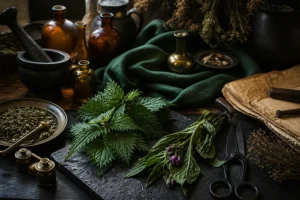
The critical thing to understand about this system is that it operates on qualities, not on celestial mechanics. When Nicholas Culpeper assigns nettles to Mars in his Complete Herbal, he isn’t saying the planet Mars is shining its light on nettles in a way that can be measured astronomically. He’s saying nettles share a quality-family with Mars: hot, dry, sharp, penetrating, provoking. The sting of the nettle leaf is almost a diagram of Martial energy — aggressive, immediate, irritating. The iron-rich content of the plant’s tissue fits. The traditional use for moving stagnant, cold conditions fits.
This is why the system works as a taxonomy even for people with no interest in astrology proper. It groups plants by a cluster of experienced qualities — thermal character, tissue action, organoleptic sensation, traditional use patterns — under a common symbolic header. The planet is a handle. The handle lets you hold a lot of information at once.
Saturn is the clearest example. Lead is the heaviest of the classical metals. Saturnine herbs tend to work slowly, on dense and structural tissues — bones, cartilage, connective tissue — and often have a quality of binding or contracting. Comfrey’s historical name, Symphytum officinale, derives from the Greek symphyo: to unite, to knit together. That is a Saturnine action in the most literal botanical Latin. Valerian slows, sedates, contracts the restless. Horsetail deposits silica — literally mineralizes — in vegetable tissue, and was used traditionally to support structural hardness in bone and nail. Same quality-family, three different plants, one planet-handle.
The Operator’s Interest: Spagyrics and Planetary Timing
For the practicing spagyrist, the planetary map does more than classify. It informs process. The tradition — articulated in detail by Alexander von Suchten and later by Johann Rudolf Glauber in the seventeenth century — holds that plants should ideally be harvested and worked under the influence of their ruling planet: at the correct planetary hour, on the correct planetary day, with the Moon in a favorable aspect if possible. Whether or not you accept the metaphysics, this imposes a discipline of timing and attention that is not trivial.
More practically: planetary assignment shapes which extraction method a spagyrist reaches for. A Mercurial plant — volatile, penetrating, working on the lungs and nervous system — suggests that its sulfur principle (essential oil, aromatic volatile fraction) is primary. Lavender is Mercurial by most authorities. The essential oil is lavender’s most potent and characteristic fraction. That correspondence has craft logic.
A Saturnine plant, by contrast, may yield more to a long, slow maceration designed to pull mineral salts and fixed resins. Comfrey root in alcohol over weeks extracts allantoin and mucilaginous polysaccharides. Slow work for a slow plant. The planet is a working hypothesis about where the virtue lives in the plant and how to reach it.
A plain note on safety: several of the herbs named in this post have real contraindications. Comfrey root contains pyrrolizidine alkaloids; internal use is a serious regulatory and toxicological concern in many countries. Wormwood contains thujone; high doses are genuinely toxic. Mugwort is contraindicated in pregnancy. This post is a historical and craft overview, not medical advice. Consult a qualified practitioner before ingesting anything.
How to Actually Use This Map
Here is the practical starting point. Pick one planet. Read its quality-cluster until you feel it rather than just know it. Then go into your garden, or your herb jars, or your local hedgerow, and find two or three plants that seem to fit — not because a book told you, but because the qualities match in your hands and nose and observation. A hot, dry, sharply aromatic plant that provokes and irritates is probably Martial. A cool, moist, slightly sweet, diffuse plant that seems to relax tissue boundaries is probably Lunar or Venusian.
Then go check Culpeper. See whether your reading matches his. It won’t always, and when it doesn’t, that disagreement is the work — not a failure. The tradition itself contains internal argument. Culpeper and Agrippa don’t always agree. The point is not to memorize assignments but to train your sense of quality.
This is what separates the planetary herbal tradition from both astrology-as-prediction and from inert wellness herbalism. It is a method of qualitative perception. It teaches you to read matter. You learn to feel the difference between a Martial plant and a Jovial one the way a carpenter learns to feel the difference between grain directions in wood — not by looking up a table, but by repeated, educated contact with the thing itself.
The map is not the territory. But without a map, most people just wander.
Worth having on hand: Culpeper’s own Complete Herbal — the primary source behind most of the correspondence table above, in a full illustrated edition.
Frequently Asked Questions
What did Paracelsus contribute to planetary herbalism?
Paracelsus alchemicalized the planetary framework by arguing that every plant has a specific astral virtue which the spagyric process could extract and concentrate. He held that planets were active intelligences whose signatures could be isolated in the three spagyric principles: sulfur, mercury, and salt.
Why is comfrey considered a Saturnine herb?
Comfrey is Saturnine because it shares Saturn’s quality-family: slow action, contraction, and work on dense structural tissues. Its historical name, Symphytum officinale, derives from Greek symphyo meaning to unite or knit together—a Saturnine action expressed in the plant’s botanical Latin itself.
How did Ibn Sina influence European planetary herbalism?
Ibn Sina’s Canon of Medicine, written in 1025 CE, integrated astrological correspondence into pharmaceutical reasoning. When Gerard of Cremona translated it into Latin in the twelfth century, European physicians inherited a unified system fusing Galenic qualities with planetary signatures.
What safety concerns apply to comfrey and wormwood?
Comfrey root contains pyrrolizidine alkaloids; internal use is a serious regulatory and toxicological concern in many countries. Wormwood contains thujone; high doses are genuinely toxic. Mugwort is contraindicated in pregnancy.
About This Article

Written by Kyle Bamboo. Kyle Bamboo has spent twelve years following the hermetic tradition of herbalism out of dusty reprints and into a home apothecary — spagyrics, planetary correspondences, and the strange internal logic of plant alchemy. Muddle and Mend takes its name from solve et coagula, dissolve and combine. He writes about the actual tradition, with its history, its vocabulary, and its genuine strangeness, not the Instagram version. More about this site.
Scope and limits. Kyle writes from a personal practice in traditional herbalism, not clinical training. Herbs interact with prescription medications and are not regulated as drugs — check interactions and talk to a pharmacist or clinician before taking anything.
Verify this against a primary source
Specifics change, and your situation may differ from the one described here. These are the authorities worth checking directly:
- NCCIH — herb safety, evidence and known interactions
- MedlinePlus Herbs and Supplements — documented interactions and cautions
- FDA Dietary Supplements — regulatory status and safety alerts