Hold a St. John’s Wort flower bud between your thumb and index finger and squeeze. Hard. Watch what happens to your skin. It stains — a deep, bruised red, almost purple, like you’ve bled without breaking. That pigment is hypericin, and it has been sitting inside the glandular dots of Hypericum perforatum, pressurized and waiting, since the plant pushed its first buds up toward the June solstice light. You have just done, crudely and with your bare hand, what every solar herbalist since Paracelsus was trying to do with oil and time and patience: you pulled the light out of the plant.
This is the work. Not the label on a tincture bottle. Not the softened summary in a wellness newsletter. The actual, sticky, staining encounter with plant chemistry. And if you want to understand why the spagyric tradition assigned certain herbs to the sun — why Hypericum perforatum and Calendula officinalis appear together in virtually every Renaissance herbal under the solar column — you have to start here, with your fingers dyed red in a summer field.
The Doctrine and the Disk
The system of planetary correspondences that governs classical spagyrics descends from a long lineage: Dioscorides, Galen, the Arabic synthesizers like Ibn Sina, and then the European alchemical-medical tradition codified most aggressively by Paracelsus in the early sixteenth century. The core doctrine — as laid out in Paracelsus’s Archidoxis and later popularized for English readers by Nicholas Culpeper’s The English Physitian of 1652 — held that every plant stood under the governance of a celestial body, and that its virtues were an earthly expression of that body’s qualities. The sun governed gold, the heart, radiant energy, visibility, and vital heat.
The solar signature, then, is not arbitrary mysticism. It is a coherent observational framework, even if the metaphysics behind it is not ours. When you apply those criteria to the plant kingdom, the same genera keep surfacing: yellow or gold flowers; radial, disk-like forms that visually echo the solar wheel; peak flowering at or near the summer solstice; and aromatic or resinous compounds that suggest heat, volatility, and energetic intensity. St. John’s Wort and calendula match every criterion so completely that they would be solar herbs on morphology alone, before you ever opened a chemistry textbook.
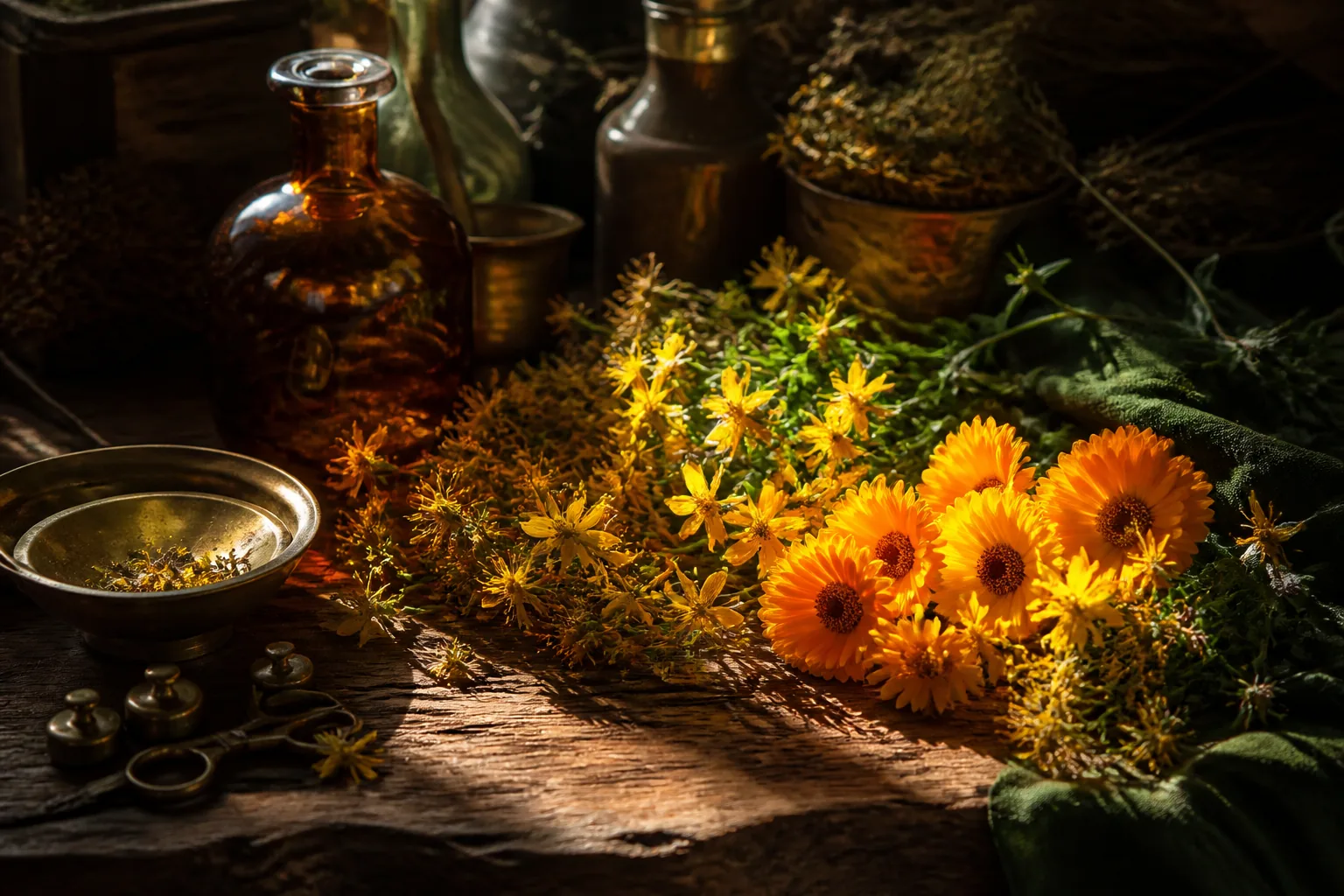
St. John’s Wort flowers at the summer solstice — so reliably that the Church grafted it onto the Feast of St. John the Baptist on June 24th, three days after the solstice, to absorb a pre-Christian midsummer festival that was already deeply tied to the plant. Calendula flowers continuously from late spring through first frost, its orange and yellow capitula tracking the sun like small heliotropic clocks. Both plants are covered with translucent oil glands you can see when you hold a petal to the light — little windows, punctures, reservoirs of volatile chemistry. Perforatum: the perforated one. The light shines through it. The ancients noticed.
Hypericin: When Chemistry Confirms Correspondence
Here is where the tradition stops being merely poetic and becomes interesting in a scientific sense. The red pigment you squeezed onto your fingers is hypericin, a naphthodianthrone — a class of compound so structurally complex that it was not fully characterized until the twentieth century. Hypericin is what turns a St. John’s Wort macerate in oil a deep, luminous red-purple after two to three weeks of sunlight exposure. And this is not incidental: hypericin is photoactive. It requires light to be activated. The sun does not merely ripen the plant that contains it; sunlight is the chemical trigger for its primary behavior.
The alchemical macerate — flowers and buds crushed into olive oil and left in a south-facing window through the height of summer — is not folk superstition dressed up as craft. It is an empirically effective extraction method for a light-activated compound, arrived at through centuries of careful observation before anyone had a structural formula. Solve et coagula, applied over weeks: the cellular structure breaks down, the oil draws the lipophilic constituents out, and the sun completes the chemistry that the plant began. The ruby color is your indicator. When the oil runs red, the work is done.
Alongside hypericin, Hypericum contains pseudohypericin, hyperforin, adhyperforin, and a constellation of flavonoids including rutin, quercetin, and isoquercitrin. This is a chemically complex plant. That complexity is exactly why it has real, measurable interactions with the body — and why it has serious, documented interactions with pharmaceutical drugs. We will come back to this.
Calendula: The Other Solar Fire
Calendula does not stain you red. It stains you yellow-orange, if you handle enough of the fresh flowers, because its signature pigments are carotenoids — the same family of compounds that color carrots, saffron, and the setting sun. The flavonoids isorhamnetin and narcissin, along with triterpene saponins like oleanolic acid glycosides, account for much of what the plant does chemically. The resinous stickiness of fresh calendula petals — the quality that makes them cling to your fingers when you harvest — is the triterpenoid fraction, and that fraction extracts well into both oil and alcohol.
Marigold — the old English name, from “Mary’s gold,” another ecclesiastical overlay on a much older solar plant — appears throughout the medieval and Renaissance herbals. John Gerard’s Herball of 1597 describes it as flowering “when the Sunne riseth” and closing at sunset, the heliotropic behavior lending it an almost theatrical solar devotion. Culpeper assigns it squarely to the sun in Leo. The spagyric use of calendula follows the same extraction logic as Hypericum: a slow cold macerate in vegetable oil, or an ethanol extraction that captures both the aromatic volatiles and the heavier resinous compounds.
Where St. John’s Wort carries the drama — the blood-red oil, the midsummer solstice timing, the powerful and potentially dangerous pharmacological activity — calendula carries a different quality. More generous. Continuously flowering, accessible, willing to give itself to almost any solvent. If Hypericum is the intense, complicated solar fire, Calendula is the steady warmth of a long afternoon.
A Warning Written in Chemistry
St. John’s Wort is one of the most pharmacologically active plants in the Western tradition. The same chemical complexity that makes it fascinating makes it genuinely hazardous in certain contexts, and this is not a place where traditional enthusiasm should outrun modern pharmacology. State this clearly: St. John’s Wort is a potent inducer of cytochrome P450 enzymes, specifically CYP3A4 and CYP2C9, and of the P-glycoprotein drug transporter. In plain terms: it accelerates the breakdown of a significant number of pharmaceutical drugs, reducing their effective concentration in the blood. The documented interactions include cyclosporine (transplant rejection has occurred), HIV antiretrovirals, warfarin, digoxin, oral contraceptives, and several classes of antidepressants. This is not theoretical. These interactions have caused serious harm.
Hypericin also causes photosensitization in fair-skinned individuals and in livestock — the condition called hypericism in animals — meaning that ingestion can increase sensitivity to UV radiation. The plant does not hide this. It broadcasts it in its own pigmentation.
This post is about craft and history. Nothing here is medical advice, and nothing here should be taken as a recommendation to use either plant therapeutically. If you are on any pharmaceutical medication — any — you must consult a qualified healthcare professional before working with St. John’s Wort internally in any form. Full stop.
The Midsummer Harvest and the Solar Oil
The craft itself is ancient and, for external work, relatively forgiving. The traditional solar oil — what some texts call Oleum Hyperici — is made at peak bloom, which in most temperate latitudes falls within a week either side of the summer solstice. You want the buds just opening, with the maximum load of intact hypericin glands. Harvest in full sun, midmorning, when the dew has burned off.
- Fill a clean glass jar loosely with fresh flowers and buds — do not pack them tightly, and do not wilt or dry them first.
- Cover completely with a good-quality olive oil. The lipids matter; traditional operators used what grew near them.
- Seal the jar and place it in direct sunlight — a south-facing windowsill, or outdoors under glass — for three to six weeks.
- Shake or invert daily. Watch the oil change: green first, then amber, then — if you have the right plant at the right time — that deep, iconic red.
- Strain through cloth, press the marc firmly, and decant into dark glass. The red color tells you the hypericin made it into solution. Pale oil means early harvest, or the wrong subspecies.
Calendula follows nearly identical steps. The flowers can be slightly wilted first — twenty-four hours in a shaded, airy spot — to reduce water content and lower the risk of fermentation in the jar. The resulting oil is gold, faintly resinous, and carries the carotenoids and triterpenoids beautifully.
These are not complicated preparations. They are slow ones. They require the same thing the sun requires: time, attention, and the willingness to watch something change over weeks rather than minutes. The spagyric tradition did not invent patience as a virtue out of nowhere. It understood that some chemistry cannot be hurried — that certain compounds release themselves only when the conditions are exactly right, that the red oil is a thing the sun makes with you, not a thing you make alone. Press the bud between your fingers again. Feel that stain. The work has already started.
Worth having on hand: amber glass jars for decanting and storing the finished solar oil out of the light once it’s run its weeks in the window.
Frequently Asked Questions
What is hypericin and why does it stain red?
Hypericin is a naphthodianthrone — a complex red pigment found in St. John’s Wort’s glandular dots. When you squeeze the flower buds, this pressurized compound stains skin deep red-purple. Hypericin is photoactive, meaning sunlight activates it chemically, which is why it develops in the oil macerate over two to three weeks of sun exposure.
Why does St. John’s Wort flower at the summer solstice?
St. John’s Wort flowers so reliably at the summer solstice that the Church grafted it onto the Feast of St. John the Baptist on June 24th, three days after the solstice, to absorb a pre-Christian midsummer festival already deeply tied to the plant. The timing is consistent enough that it became a marker in the tradition.
How do you make a traditional solar oil macerate?
Fill a clean glass jar loosely with fresh St. John’s Wort flowers and buds harvested at peak bloom near the summer solstice. Cover completely with olive oil, seal, and place in direct sunlight for three to six weeks, shaking daily. The oil will turn red when hypericin has entered solution. Strain through cloth and decant into dark glass to store.
What serious drug interactions does St. John’s Wort have?
St. John’s Wort is a potent inducer of cytochrome P450 enzymes, specifically CYP3A4 and CYP2C9, accelerating the breakdown of many pharmaceutical drugs. Documented interactions include cyclosporine, HIV antiretrovirals, warfarin, digoxin, oral contraceptives, and several antidepressant classes. Consult a qualified healthcare professional before using it internally if you take any medication.
About This Article

Written by Kyle Bamboo. Kyle Bamboo has spent twelve years following the hermetic tradition of herbalism out of dusty reprints and into a home apothecary — spagyrics, planetary correspondences, and the strange internal logic of plant alchemy. Muddle and Mend takes its name from solve et coagula, dissolve and combine. He writes about the actual tradition, with its history, its vocabulary, and its genuine strangeness, not the Instagram version. More about this site.
Scope and limits. Kyle writes from a personal practice in traditional herbalism, not clinical training. Herbs interact with prescription medications and are not regulated as drugs — check interactions and talk to a pharmacist or clinician before taking anything.
Verify this against a primary source
Specifics change, and your situation may differ from the one described here. These are the authorities worth checking directly:
- NCCIH — herb safety, evidence and known interactions
- MedlinePlus Herbs and Supplements — documented interactions and cautions
- FDA Dietary Supplements — regulatory status and safety alerts