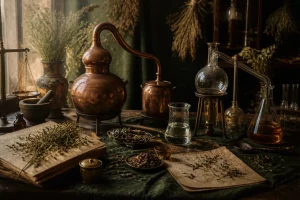
Hold a piece of glassware up to the light. A separatory funnel, if you have one — that teardrop-shaped vessel with the stopcock at the bottom. Fill it with anything: a tincture, a distillate, an oil-and-water mixture. Watch what happens without your interference. The heavy sinks. The light rises. The layers find themselves, separate, clarify. You didn’t command them. You provided the conditions, and matter obeyed its own nature.
That image — the separatory funnel, the spontaneous stratification of substances — is as close as I can get to describing what the Emerald Tablet is actually doing. Not poetry. Not allegory dressed up as chemistry. A set of operating instructions for the behaviour of matter, written in the compressed, elliptical language of a tradition that believed certain truths could only be spoken sideways.
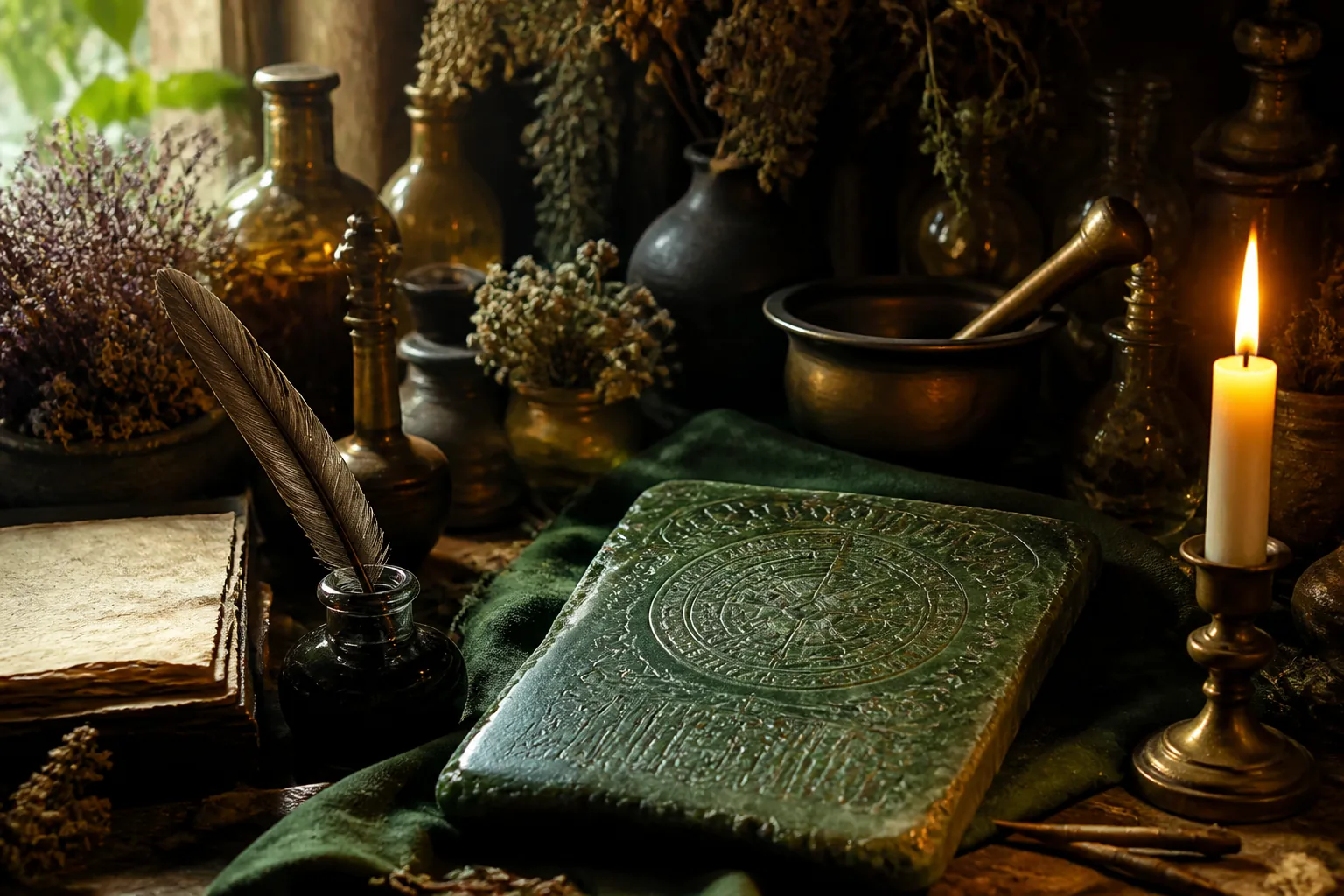
The Emerald Tablet — Tabula Smaragdina in Latin — first surfaces in Arabic sources around the eighth or ninth century CE, embedded in a text called the Book of the Secret of Creation, attributed to the semi-legendary Apollonius of Tyana. The first Latin translation appeared in the twelfth century. By the Renaissance it was everywhere: Roger Bacon quoted it, Albert the Great wrestled with it, Isaac Newton made his own private translation (now held in the Keynes Collection at King’s College, Cambridge). Dozens of versions exist. The one I am working from here is the translation attributed to a late medieval Latin manuscript tradition and rendered into English by scholars in the nineteenth century — public domain, freely available, and probably as close to a “standard” as this famously unstable text ever gets.
What I want to do is something the Renaissance practitioners actually did: read it line by line as a laboratory protocol. Not metaphorically. Practically.
The Opening Declaration Is a Claim About Structure
“True, without falsehood, certain and most true.”
The tablet opens not with a recipe but with an epistemological guarantee. It is telling you: what follows is not speculation. This irritates modern readers. It sounds like a con. But read it the way Paracelsus would have — who in the early sixteenth century built his entire medical-alchemical system on the premise that nature does not lie, only our reading of it fails — and the line becomes a methodological commitment. Trust the process. The material will tell you what it is, if you create the conditions for it to speak.
“That which is below is like that which is above, and that which is above is like that which is below, to do the miracles of one only thing.”
This is the famous correspondence principle, and laboratory workers in the spagyric tradition took it with dead seriousness. Volatility and fixity — the tendency of a substance to rise as vapour versus its tendency to remain solid — were understood as the “above” and “below” made manifest in chemistry. When you distil a plant, the volatile aromatic fraction rises first. The fixed mineral salts stay behind in the flask. Both are real parts of the plant. Neither is the whole. The miracle — the operatio — is the eventual reunion of what was separated.
Johann Rudolf Glauber, the seventeenth-century German-Dutch chemist who gave his name to sodium sulphate (“Glauber’s salt”), spent a career demonstrating this correspondence in practical terms: the volatile spirit of a plant and its fixed salt were not opposites but complements, two expressions of one underlying nature. He wasn’t doing metaphysics. He was doing chemistry, with that line of the tablet as his working hypothesis.
Separation: The Solve
“And as all things have been and arose from one by the mediation of one: so all things have their birth from this one thing by adaptation.”
“The Sun is its father, the Moon its mother, the Wind hath carried it in its belly, the Earth is its nurse.”
Translate the planetary language into laboratory language and you get a map of the spagyric process. The Sun — sulphur, the oily aromatic principle, the volatile essence — is what distillation captures first. The Moon — mercury, the watery menstruum, the spirit of alcohol — carries and dissolves. The Wind is the vapour phase: what rises in the alembic, what moves between states. The Earth is the fixed residue, the caput mortuum left in the retort after the volatile fractions have departed.
The practical instruction here is: do not discard anything. Folk herbalism throws away the marc — the spent plant matter after tincturing or infusion. The spagyric protocol does not. The spent marc is incinerated. The ash is calcined — heated to white heat in a crucible — until all organic carbon burns off and you are left with the mineral salts of the plant. These are the Earth. They go back in. Every fraction matters because the original unity of the plant demands eventual restoration.
A practical note, and I will be plain about it: calcination and the reintegration of mineral salts is advanced work. Some plants accumulate heavy metals or contain constituents that become genuinely hazardous when concentrated. Do not ingest anything produced this way without expert guidance. Consult a qualified practitioner. This is craft history, not a dosing protocol.
Ascent and Descent: The Circulation
“The father of all perfection in the whole world is here. Its force or power is entire if it be converted into Earth. Separate thou the Earth from the Fire, the subtle from the gross, sweetly with great industry.”
“It ascends from the Earth to the Heaven and again it descends to the Earth and receives the force of things superior and inferior.”
This is a description of distillation with cohobation. Cohobation is the practice of repeatedly pouring a distillate back onto its source material and distilling again. The distillate ascends, collects, descends back onto the plant, extracts more, ascends again. Each cycle concentrates and refines. The instruction to do this sweetly with great industry — gently, with sustained attention — is a precise technical warning against overheating. Scorching a delicate aromatic fraction destroys it. You want a slow, controlled rise, not a violent boil.
The alchemist and physician Michael Sendivogius, writing around 1604 in his Novum Lumen Chymicum (New Chemical Light), described this ascending-descending movement as the fundamental rhythm of all natural processes. He called it the circulation of the niter — the animating principle that moved between heaven and earth in rain and evaporation, and could be reproduced in the closed circuit of the alembic. Whether or not you accept his cosmology, the practical observation is correct: repeated distillation with reinfusion changes and concentrates a product in ways a single pass never achieves.
The closed circuit matters. In a Pelican — the self-circulating distillation vessel where the condensed distillate runs back down tubes into its own flask — the substance processes itself. It becomes the agent of its own refinement. That image runs through the entire Hermetic tradition from Zosimos of Panopolis in the third century CE right through to the laboratory manuals of the seventeenth century.
Recombination: The Coagula
“By this means you shall have the glory of the whole world and thereby all obscurity shall fly from you.”
“Its force is above all force, for it vanquishes every subtle thing and penetrates every solid thing.”
“So was the world created.”
The recombination — the coagula, the mend — is not a return to what was. The plant that re-absorbs its own purified fractions is not the same plant that went into the flask. Each separated constituent has been clarified: the mercury (spirit, alcohol) purified by distillation, the sulphur (essential oil) separated and freed from water, the salt (mineral body) calcined and cleaned of organic impurity. When these three are reunited, what the spagyrists called the tria prima — the three principles articulated by Paracelsus in the sixteenth century — you have, in theory, the essence of the original, heightened.
The claim that this product “vanquishes every subtle thing and penetrates every solid thing” was understood as a statement about bioavailability, expressed in the language available. A substance whose parts have been separated, purified, and recombined was thought to be more deeply and rapidly absorbed — more capable of acting on living tissue — than the crude starting material. Modern phytochemistry doesn’t validate the full metaphysic, but the underlying intuition — that physical processing changes what a substance is and how it behaves — is not wrong.
“So was the world created” is the tablet’s most audacious claim: what you have done in the flask replicates a cosmogonic act. Unity was divided. The parts were elaborated. They were rejoined at a higher order. This is not grandiosity for its own sake. It is a claim that the laboratory is a valid site of metaphysical knowledge — that you can learn something true about the structure of reality by watching what happens to matter under controlled conditions. That claim is, in a specific historical sense, the origin of experimental science.
The Final Line Is the Method
“This is why I am called Hermes Trismegistus, having the three parts of the philosophy of the whole world. That which I have said of the operation of the Sun is accomplished and ended.”
The attribution to Hermes Trismegistus — Thrice-Greatest Hermes, the syncretic fusion of the Greek Hermes and the Egyptian Thoth — grounds the text in the prisca sapientia, the ancient wisdom tradition that Renaissance thinkers believed underlay all genuine knowledge. The “three parts of the philosophy” map directly onto the tria prima: sulphur (soul), mercury (spirit), salt (body). Philosophy, laboratory, and cosmology as a single practice.
The final phrase — the operation of the Sun is accomplished and ended — is a process marker. The Sun operation is complete. What began as raw, living matter has been separated into its principles, those principles have been refined, and they have been returned to unity. Solve et coagula. The cycle closes.
Press that leaf between your fingers again. You’re already doing it — separating what was bound, releasing what was hidden. The Emerald Tablet is just the instruction manual for what to do next: catch what escapes, clean what remains, put it back together. The work is older than the text, and the text is older than anyone reading it. But the glass is right there. The plant is right there. Start.
Frequently Asked Questions
What is the Emerald Tablet and where did it come from?
The Emerald Tablet, or Tabula Smaragdina in Latin, first surfaces in Arabic sources around the eighth or ninth century CE, embedded in the Book of the Secret of Creation attributed to Apollonius of Tyana. The first Latin translation appeared in the twelfth century. By the Renaissance it was everywhere: Roger Bacon quoted it, Albert the Great wrestled with it, and Isaac Newton made his own private translation now held at King’s College, Cambridge.
What does the Emerald Tablet mean by above and below?
In this tradition, the correspondence principle—that which is below is like that which is above—refers to volatility and fixity made manifest in chemistry. When you distil a plant, the volatile aromatic fraction rises first as the ‘above,’ while fixed mineral salts stay behind as the ‘below.’ Both are real parts of the plant, and their eventual reunion is understood as the miracle of the work.
How do planetary symbols translate into the spagyric process?
In laboratory language: the Sun represents sulphur, the oily aromatic principle captured by distillation. The Moon is mercury, the watery menstruum and spirit of alcohol that carries and dissolves. The Wind is the vapour phase rising in the alembic. The Earth is the fixed residue, the caput mortuum left after volatile fractions depart. The protocol demands nothing be discarded—the spent marc is calcined to recover mineral salts.
What is cohobation and why does the Tablet describe it?
Cohobation is repeatedly pouring a distillate back onto its source material and distilling again. The distillate ascends, collects, descends, extracts more, and ascends again. Each cycle concentrates and refines. The instruction to work ‘sweetly with great industry’ warns against overheating—a slow, controlled rise prevents scorching delicate aromatic fractions and is essential to the process.
About This Article

Written by Kyle Bamboo. Kyle Bamboo has spent twelve years following the hermetic tradition of herbalism out of dusty reprints and into a home apothecary — spagyrics, planetary correspondences, and the strange internal logic of plant alchemy. Muddle and Mend takes its name from solve et coagula, dissolve and combine. He writes about the actual tradition, with its history, its vocabulary, and its genuine strangeness, not the Instagram version. More about this site.
Scope and limits. Kyle writes from a personal practice in traditional herbalism, not clinical training. Herbs interact with prescription medications and are not regulated as drugs — check interactions and talk to a pharmacist or clinician before taking anything.
Verify this against a primary source
Specifics change, and your situation may differ from the one described here. These are the authorities worth checking directly:
- NCCIH — herb safety, evidence and known interactions
- MedlinePlus Herbs and Supplements — documented interactions and cautions
- FDA Dietary Supplements — regulatory status and safety alerts