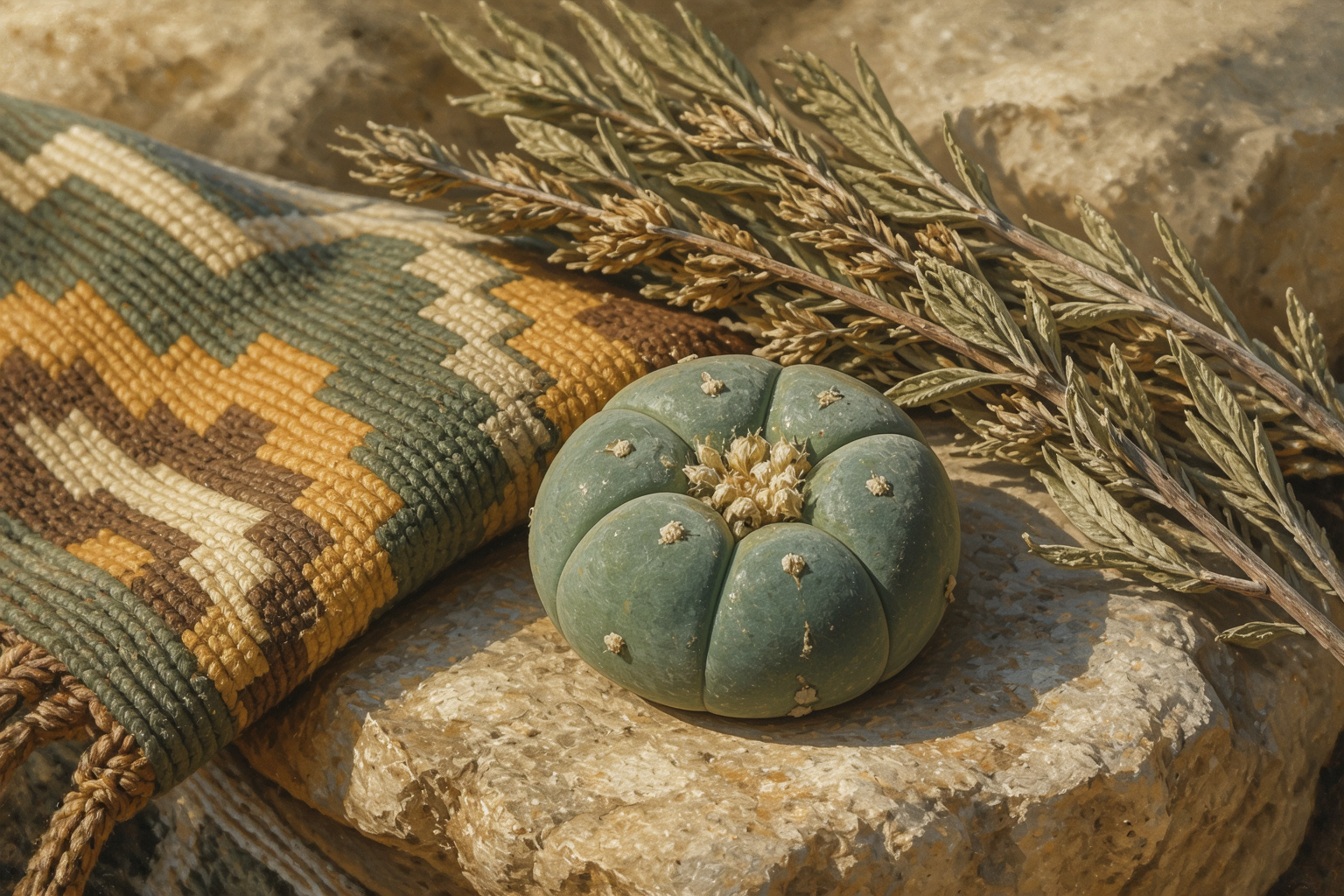
Peyote (Lophophora williamsii) is not a plant grown for visions alone. Among the Huichol people of Mexico, it is the herbal embodiment of Kauyumari, a divine deer spirit, reached through pilgrimage and used in ceremonial healing and divination. Yet the popular image of peyote as a hallucinogen first and foremost obscures what the historical record actually shows: that for centuries, it was valued across Mesoamerican and Plains cultures primarily as medicine—and that full visions, when they occurred, were sometimes regarded with caution rather than pursuit.
Kauyumari, the Divine Deer: Peyote in Huichol Belief and the Wirikuta Pilgrimage
The Wixárika, or Huichol people, of the Sierra Madre Occidental in Mexico’s Jalisco, Nayarit, Durango, and Zacatecas states have for generations understood peyote not as a drug but as a person—specifically, as Kauyumari, the Divine Deer, a sacred being whose body is found in the form of this small, spineless cactus. In Huichol cosmology, the pilgrimage to Wirikuta, the desert homeland of the gods in San Luis Potosí, some eight hundred kilometers from the Huichol heartland, is an act of remembrance and renewal.
This journey, still undertaken by initiated practitioners today, is neither a casual herb-gathering expedition nor a search for intoxication. It is a deliberate, arduous ritual movement through sacred geography, where each stage of the pilgrimage corresponds to spiritual stations in the Huichol understanding of cosmos and time. Participants fast, maintain sexual abstinence, and confess transgressions to the group before departure. The peyote encounter itself is framed not as consumption but as communion—a meeting with a living sacred being whose role encompasses healing, divination, and the alignment of human and divine will.
What outsiders have often termed “eating peyote” is, in the Huichol context, better understood as receiving Kauyumari into oneself as a guide and teacher. The plant carries knowledge and presence. The experience is embedded in kinship language, ceremonial protocol, and a cosmological framework where deer, human, and cactus share a continuous narrative rather than occupying separate categories. This remains a living tradition, maintained by Huichol ceremonial leaders and their communities today.
Medicine Before Vision: What Aztec, Kiowa, and Huichol Practice Actually Documented
When I turned to what the historical record actually shows about peyote’s use before the modern era, the first surprise was how early and how widespread the practice was. The 16th-century Nahua chronicler Bernardino de Sahagún documented ceremonial and medicinal peyote use already entrenched in the Aztec Empire by the time of the Spanish arrival. A 2023 peer-reviewed survey in the journal Molecules compiled the recorded applications: treatment of burns, wounds, fever, rheumatism, and the bites or stings of snakes and scorpions.
These are not mystical claims but pragmatic ones. Peyote was used because practitioners understood it to work for specific ailments in specific ways. Among the Kiowa of the Southern Plains, documented uses similarly centered on medicine: flu, scarlet fever, tuberculosis, and venereal disease. The plant was administered in ceremonial contexts, yes—but the purpose was healing and the restoration of balance, not the production of visions as an end in itself.
For the Huichol, the framework is different but equally pragmatic in its own terms. Peyote is consulted for divination, for the diagnosis of illness, and for the discernment of spiritual causes underlying physical or social disorder. The plant acts as an intermediary between human and divine knowledge. Vision may occur, but it emerges as one possible form of communication among others—not as the primary goal or the measure of a successful encounter.
Did Peyote Spread Because of Its Visions, or in Spite of Them?
Here the record becomes genuinely contested. Richard Evans Schultes, the pioneering ethnobotanist, conducted fieldwork among Kiowa and Comanche practitioners in 1938. His finding was striking: full-blown visions were reported as relatively uncommon, and were sometimes even regarded as spiritually improper—something to be cautious about rather than actively cultivated. If visions were rare, why did peyote spread so rapidly across different tribal nations from the late 19th century onward?
The popular account suggests that peyote’s hallucinogenic properties were the engine of its diffusion, the secret that made it irresistible. Schultes’s narrower finding—that full visions were rare in his fieldwork—invites a different possibility: that peyote was valued and transmitted because it was understood to facilitate healing, spiritual communication, and community cohesion in ways that had little to do with the intensity or frequency of visual phenomena. The plant worked. Whether it produced spectacular altered states appeared to be secondary.
What the full historical and ethnographic record actually supports is more modest: peyote was used as a medicine and a ritual technology, its effects were interpreted within existing cosmological frameworks, and its adoption across cultures occurred gradually, through trade networks and kinship ties, long before the formation of organized pan-tribal practices. The vision-quest narrative is Western in origin, imposed after the fact onto a plant whose role in Indigenous practice was far more anchored to healing, divination, and the maintenance of spiritual and social order.
A Word on Legality and Safety
Peyote containing mescaline is a Schedule I controlled substance under US federal law. A narrow legal exemption exists only for the ceremonial use of enrolled members of federally recognized tribes practicing within the Native American Church, under the American Indian Religious Freedom Act. It is not legal for general use.
This essay describes historical and religious practice among Indigenous peoples and in traditional healing contexts. It is not an invitation, endorsement, or guide to use peyote outside of these legally recognized and culturally rooted frameworks. The information here is offered for historical and anthropological understanding, not for personal experimentation. Readers seeking to understand peyote’s role in Indigenous ceremony should engage with living Huichol, Kiowa, and other tribal communities and their authorized teachers, not with plant material or written instructions.
Sources & What Didn’t Survive Fact-Checking
The backbone of this essay rests on several vetted sources. Bernardino de Sahagún’s 16th-century ethnographic accounts of Aztec peyote use, preserved in the Florentine Codex and cited in peer-reviewed ethnobotanical literature, provide the earliest documented medicinal applications. The 2023 peer-reviewed review in the journal Molecules collates historical evidence for peyote’s use in treating burns, wounds, fever, rheumatism, snakebite, scorpion sting, and specific diseases among Kiowa populations. Richard Evans Schultes’s 1938 fieldwork, published in ethnobotanical journals, forms the basis for the claim about the relative rarity of visions in his documented observations.
In the course of research, I encountered claims that did not survive scrutiny. A broader narrative holds that peyote’s rapid spread across tribes was driven primarily by its medicinal power rather than its visionary effects, with visions dismissed as incidental to the plant’s cultural transmission. This sweeping version of Schultes’s argument—that peyote succeeded because of healing applications and largely despite its hallucinogenic properties—proved too strong when tested against the full ethnographic record. The narrower finding, that full visions were rare in his fieldwork and sometimes discouraged, held firm. But the grand claim that medicine, not vision, explained peyote’s adoption across cultures went beyond what the available evidence supports. Similarly, specific claims about the Native American Church’s founding, its formal doctrinal statements, and the exact dates and theological language of its organizational history did not survive fact-checking at the level of precision required for this essay. Those details are omitted in favor of the more narrowly confirmed historical material.
What remains is a more textured picture: peyote as a plant medicine and ritual technology, used for healing and divination across multiple Indigenous cultures, embedded in cosmologies where the plant is a person, a teacher, a divine being—and where visions, when they arise, are one form of communication among many, neither pursued nor dismissed, but received as part of a larger sacred encounter.
—Frequently Asked Questions
What is Kauyumari in Huichol tradition?
In Huichol cosmology, Kauyumari is a Divine Deer—a sacred being understood as a person rather than merely a plant. Peyote (Lophophora williamsii) is regarded as the herbal embodiment of Kauyumari, encountered through pilgrimage to Wirikuta in San Luis Potosí as an act of communion with a living sacred guide and teacher.
How did Aztec and Kiowa peoples use peyote historically?
The 16th-century Nahua chronicler Bernardino de Sahagún documented Aztec peyote use for treatment of burns, wounds, fever, rheumatism, and snakebite or scorpion sting. Among the Kiowa of the Southern Plains, documented uses centered on medicine: flu, scarlet fever, tuberculosis, and venereal disease, administered in ceremonial contexts for healing and restoration of balance.
Did Richard Evans Schultes find visions common among peyote users?
No. Schultes’s 1938 fieldwork among Kiowa and Comanche practitioners found that full-blown visions were relatively uncommon and were sometimes regarded as spiritually improper—something to be cautious about rather than actively cultivated, suggesting visions were not the primary goal of use.
What is the legal status of peyote in the United States?
Peyote containing mescaline is a Schedule I controlled substance under US federal law. A narrow exemption exists only for enrolled members of federally recognized tribes practicing ceremonially within the Native American Church, under the American Indian Religious Freedom Act. It is not legal for general use.
About This Article

Written by Kyle Bamboo. Kyle Bamboo has spent twelve years following the hermetic tradition of herbalism out of dusty reprints and into a home apothecary — spagyrics, planetary correspondences, and the strange internal logic of plant alchemy. Muddle and Mend takes its name from solve et coagula, dissolve and combine. He writes about the actual tradition, with its history, its vocabulary, and its genuine strangeness, not the Instagram version. More about this site.
Scope and limits. Kyle writes from a personal practice in traditional herbalism, not clinical training. Herbs interact with prescription medications and are not regulated as drugs — check interactions and talk to a pharmacist or clinician before taking anything.
Verify this against a primary source
Specifics change, and your situation may differ from the one described here. These are the authorities worth checking directly:
- NCCIH — herb safety, evidence and known interactions
- MedlinePlus Herbs and Supplements — documented interactions and cautions
- FDA Dietary Supplements — regulatory status and safety alerts