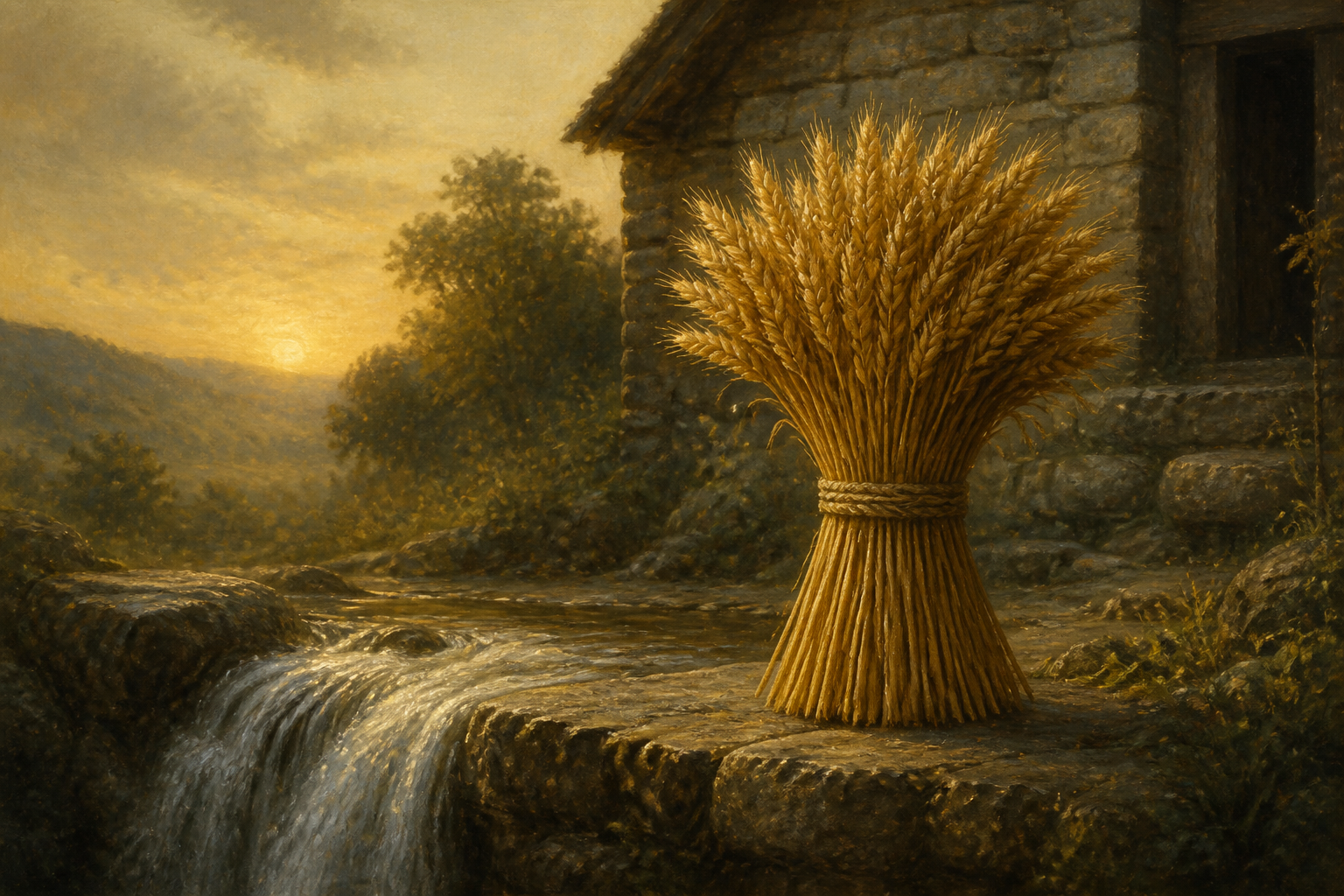
The sheaf of corn is a Fellowcraft emblem, paired with a flowing stream—and it is half of a bilingual pun that most readers of Masonic symbolism never see. Even more fundamentally, “corn” here means grain: wheat or barley, never the maize we now call corn. That single word slip has obscured the emblem’s true meaning for generations of English-speaking Masons, producing genuinely strange mental images of an ancient Near East full of corn on the cob.
Corn Means Grain, Not Maize
This is worth stating plainly because it is what almost every reader arrives confused about. When Masonic ritual speaks of corn, wine, and oil as the wages of the workmen at King Solomon’s Temple, “corn” is the King James word for grain—wheat or barley, the staple cereals of the ancient Mediterranean and Near East. Maize, the crop now called corn in American English, did not exist in the Old World until after Columbus. It could not possibly have been paid to temple workers or offered in Hebrew ritual.
The vocabulary shift matters because it changes what we see when we look at the symbol. A sheaf of wheat is a bound bundle of cut grain stalks, their seed heads intact and heavy. A sheaf of maize would be something else entirely—taller, coarser, a different plant altogether. When you read the older Masonic texts and encounter corn, wine, and oil as the three elements of consecration—which I’ve written about before in connection with the actual practice of lodge consecration—you are reading about grain in the sense a medieval English farmer would have known it. Hold that image steady. It changes what the emblem means.
For a deeper look at how these three elements function in the lodge and at the workbench, see Corn, Wine, and Oil: The Lodge’s Elements of Consecration at My Workbench.
The Wages of a Fellowcraft
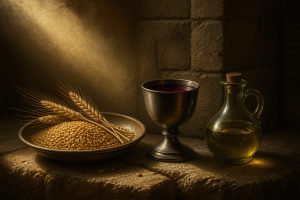
Corn, wine, and oil together represent the wages paid to the workmen who built King Solomon’s Temple. They are not arbitrary symbols. They are literal goods: bread made from grain, wine for refreshment, oil for anointing and burning. In Masonic working, these same three appear in the consecration of a lodge and in cornerstone-laying ceremonies. They stand for nourishment, refreshment, and joy—the actual needs and hopes of labor.
The sheaf of corn appears most closely with the Fellowcraft degree, the second step. A Fellowcraft is a working mason, the person who has moved beyond apprenticeship and now possesses skill. The sheaf represents not just the wage for labor already done, but the promise of sustenance continuing—the grain gathered at harvest, bound and stored, waiting to be ground and baked. It is practical symbol. It speaks the language of survival and of seasons turning in order.
To understand a sheaf of grain in this context is to understand that Freemasonry, whatever else it is, speaks first in the language of craft and labor. The symbols begin with what the hands know.
The Sheaf and the Waterfall
Here is where the emblem becomes strange and precise: the sheaf of corn is paired with a waterfall or flowing stream. That pairing seems arbitrary until you know Hebrew. In Hebrew, the word shibboleth means both “ear of grain” and “flowing stream” or “torrent.” One word. Two entirely different things. The emblem shows both meanings at once—it is a pun, visual and linguistic together, compressed into a single image.
This is the kind of thing that stays hidden until someone tells you to look for it. Once you see it, you cannot unsee it. The waterfall and the sheaf are not two separate things; they are two faces of one word. The emblem is a picture of language itself—the strange fact that a single utterance can mean harvest and also water, grain and also flow, stillness and also motion.
This pun survives only if you read the emblem knowing Hebrew. Most English-language Masonic readers, myself included, arrive at it only if someone older in the tradition points the way. But once pointed, it makes the emblem click into focus. The pairing is not decorative. It is the whole point.
The Word at the Ford
The word comes from a story in the book of Judges, chapter 12. The Gileadites held the fords of the Jordan against the fleeing Ephraimites. At the crossing, they used a single word as a test: they asked each person who came to the ford to say shibboleth. The Ephraimites could not produce the “sh” sound in their dialect and said “sibboleth” instead. Those who failed the test were killed at the crossing. The biblical text records forty-two thousand dead.
It is a grim story and should read as one. A password, a pronunciation, a marker of who belongs—and behind it, death at a river crossing. This is the source of our modern English word “shibboleth,” used now to mean any password or test of group belonging. We use it almost casually, when we mean “this is how you know if you are one of us.” But the word carries its history with it. It marks the moment when language became a matter of life and death.
Freemasonry inherits this weight when it inherits the pun. The sheaf and the waterfall are not ornamental. They point to a word that divided people at a ford, and to the stranger’s problem—how do you know who belongs?
What the Herbalist Sees
From the workbench, I see a sheaf of grain as something quite specific: a plant killed at the peak of its life, bundled, and held up as a promise of return. A grain stalk at harvest is at the fullness of its purpose—the seed head is heavy, ripe, ready. The cutting kills it. The binding preserves it. The storage keeps it until planting time comes again and the cycle can begin.
This symbolic life around grain is far older than Freemasonry. Across the ancient Mediterranean world, grain appears as a symbol of plenty, of sustenance, and of resurrection—the seed that must be buried in darkness before it can return. The mystery religions knew this. The harvest festivals knew it. It is a deep symbol because grain itself enacts it every year.
When I look at the sheaf in the lodge, I see the language of plants. The emblem speaks the same dialect that drove the mystery cults and the grain festivals. It says: what dies returns. What is cut can be bound and kept. Labor produces nourishment. The cycle turns. For more on how older plant symbolism enters the Masonic tradition, see Hyssop, Cedar, and Solomon’s Seal: Herbs of the Temple.
A Note on Variation
Masonic ritual differs substantially between jurisdictions and constitutions. The details of how the emblem is presented, explained, and used vary from one body to another. No single account is authoritative everywhere. This reading is my own, drawn from the common elements that appear across traditions and grounded in what the symbol actually is—a plant, a word, a story, and a promise.
For other explorations of how Masonic symbolism speaks to herbalism and the older plant traditions, see Three Degrees, Three Principles.
Frequently Asked Questions
What does corn mean in Masonic ritual and symbolism?
In Masonic ritual, corn means grain—wheat or barley—not maize. This vocabulary matters because maize did not exist in the Old World until after Columbus and could not have been paid to workers at King Solomon’s Temple or used in ancient Hebrew ritual. A sheaf of wheat is a bound bundle of cut grain stalks with seed heads intact, quite different from maize.
Why is the sheaf of corn paired with a waterfall in Masonry?
The pairing is a bilingual pun visible only in Hebrew. The word shibboleth means both “ear of grain” and “flowing stream.” The emblem shows both meanings simultaneously—it is a picture of language itself, where a single utterance carries two entirely different meanings. The pairing is not decorative; it is the entire point.
Where does the word shibboleth come from originally?
Shibboleth comes from the book of Judges, chapter 12. The Gileadites used it as a test at the fords of the Jordan to identify fleeing Ephraimites, who could not pronounce the “sh” sound. Those who failed were killed at the crossing. The biblical text records forty-two thousand dead. The word now means any password or test of group belonging.
What do corn, wine, and oil represent in Masonic working?
Corn, wine, and oil represent the wages paid to the workmen who built King Solomon’s Temple—literal goods including bread made from grain, wine for refreshment, and oil for anointing and burning. In Masonic working, they appear in lodge consecration and cornerstone-laying ceremonies, standing for nourishment, refreshment, and joy.
About This Article

Written by Kyle Bamboo. Kyle Bamboo has spent twelve years following the hermetic tradition of herbalism out of dusty reprints and into a home apothecary — spagyrics, planetary correspondences, and the strange internal logic of plant alchemy. Muddle and Mend takes its name from solve et coagula, dissolve and combine. He writes about the actual tradition, with its history, its vocabulary, and its genuine strangeness, not the Instagram version. More about this site.
Scope and limits. Kyle writes from a personal practice in traditional herbalism, not clinical training. Herbs interact with prescription medications and are not regulated as drugs — check interactions and talk to a pharmacist or clinician before taking anything.
Verify this against a primary source
Specifics change, and your situation may differ from the one described here. These are the authorities worth checking directly:
- NCCIH — herb safety, evidence and known interactions
- MedlinePlus Herbs and Supplements — documented interactions and cautions
- FDA Dietary Supplements — regulatory status and safety alerts