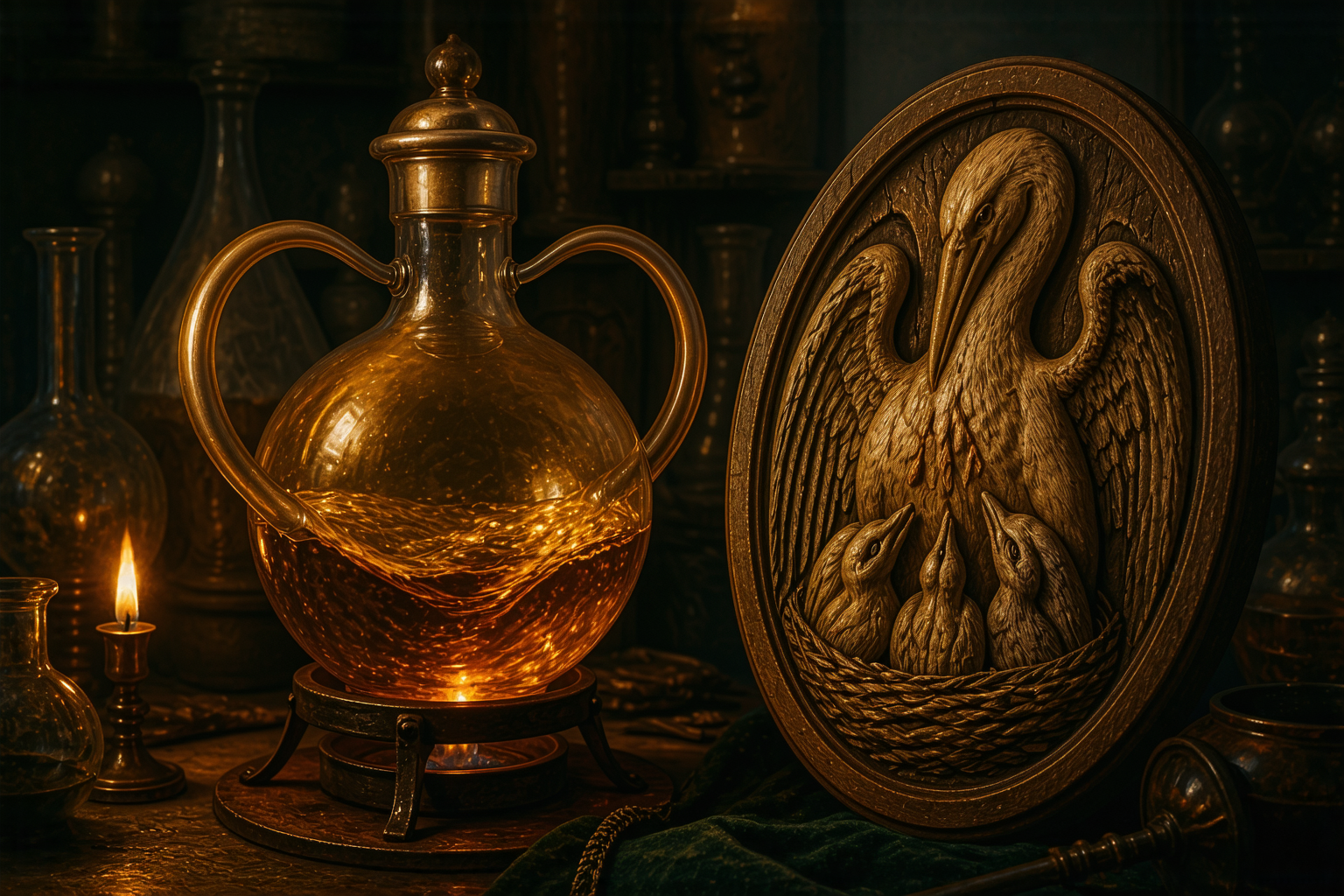
One image. Three traditions. In medieval Christian bestiaries, the pelican pierces her own breast to feed her starving young with her blood—a legend so potent that it became the emblem of Christ’s sacrifice, though real ornithology offers no support for it. The image lodged itself so deeply in Western symbol-work that alchemists named a glass vessel after her. And in the Scottish Rite’s publicly listed 18th degree, the Knight Rose Croix, the pelican appears again, bearing the same weight of self-nourishment and redemption. I own the middle one—the alchemical vessel—so I’ll begin there, and follow the bird across three different rooftops.
The Pelican in Glass
The alchemical pelican is a circulatory vessel: a round-bodied flask with two side-arms that curve upward and then bend back inward, re-entering the body of the flask itself. When you gently heat liquid at the base, vapor rises into the arms, condenses on the cooler glass, and flows back down into the belly—round and round, a closed loop of distillation and return. The vessel feeds itself from its own body, exactly as the medieval bird does in the woodcut. The operation is called circulation, and its close cousin is cohobation—the deliberate re-distillation of a liquid poured back onto its own matter, again and again.
I have watched this happen in my own work. A finished distillate, poured back over fresh plant material or over the spent residue of the first run, grows darker, richer, more integrated. The practitioners who wrote in cipher and allegory—who filled margins with birds and alchemical toads—understood that refinement didn’t always mean separation. Sometimes it meant feeding the work back to itself until something fundamentally changed in the character of the whole.
Why the Image Mattered
The pelican is not a neutral symbol in alchemy. She represents sacrifice-that-nourishes—matter giving itself up, repeatedly, to feed its own perfection. Solve et coagula, the great binary of alchemical work—dissolve and coagulate—usually appears in the literature as a sequence: break it down, build it back up, repeat. But run it as a closed loop instead of a line, and you have the pelican’s operation. The matter doesn’t escape; it returns. Each circulation exalts it further.
This is not sentiment. Chemically, repeated circulation of a liquid through plant material extracts deeper layers of compounds, allows esterification to deepen the aromatic profile, and mellows harsh or volatile notes. The modern chemistry catches what the old symbol held: that self-feeding can refine. The alchemists had no gas chromatograph, but they had eyes and patience, and they knew that some essences grew finer the longer they returned to themselves.
The Lodge’s Rose and Eagle
I am not a Freemason, and I will not claim to know anything the lodges keep private. What I know comes from the published record—from Albert Mackey’s Encyclopedia of Freemasonry, from the printed ritual books of the Scottish Rite available to anyone willing to buy them, and from the open historical archive. The Scottish Rite’s 18th degree, known publicly as the Knight Rose Croix, carries among its emblems the pelican alongside the eagle. Older public titles for this degree include Knight of the Eagle and Pelican.
Mackey’s Encyclopedia, which sits on any lodge library shelf and in the used market, glosses the pelican in the Rose Croix by way of the same medieval sacrifice-emblem: the bird as Christ, as self-giving love, as the nourishment that flows from voluntary suffering. The degree’s published teachings connect the pelican to regeneration and to the renewal that comes through repeated trials.
Here is what matters to me as a spagyrist: the lodge and the laboratory both borrowed this bird from the same upstream source—the medieval bestiary, the church emblem—and each bent her to its own work. The Craft uses her to teach something about initiation and renewal. We use her to teach something about circulation and refinement. The emblem is older than both of us, and big enough to hold more than one meaning.
At the Bench: Circulation Without the Glassware
Not every spagyrist owns a pelican flask. The glassware is expensive, and an antique one more so. I have one, but I learned circulation long before I could afford it. The home method is simpler and older than the dedicated vessel.
- A sealed jar in a warm, stable place—a kitchen cabinet, a shelf above a radiator—swirled gently and deliberately each morning and night for weeks or months.
- Cohobation in practice: a finished tincture or distillate poured deliberately back over fresh plant matter or spent marc, left to macerate, decanted, and poured again.
- The simplest method—return. Each time you work with a preparation, you pour it back into the jar with fresh intention, letting it settle and darken and age into complexity.
What does long circulation actually do? It continues extraction—new solvents hitting remaining plant compounds. It encourages esterification, the bonding of alcohols and acids into aromatic esters that mellow harsh notes and deepen fragrance. It allows oxidation, which in plants (as in wine) can transform a raw tincture into something with body and grace. Time and motion: the work feeds itself.
What the tradition said it did: exalted the essence, refined the virtue, made the medicine more potent, more aligned with the celestial influences of the plant. Hold both statements at once. The chemistry is true. The metaphysics was their way of honoring a truth they could taste but not yet measure.
The Patron of Patient Return
The pelican is the emblem of every preparation that gets better by feeding on itself—and of the maker who comes back to the same jar day after day, giving the work another turn. A good tincture demands this. A fine distillate rewards it. The mediocre preparation, the one made in haste or half-attention, teaches you nothing. But the one you return to, the one you work with intention over months or years, begins to hold your attention back.
This is what I recognize when I see the pelican in the old books, and what I suspect the Masons recognized in their own way—that excellence comes not from a single perfect gesture but from willingness to return, to feed the work again, to let yourself be changed by the changing of what you tend. The bird feeds her young from her own substance. We feed our medicines from the substance of plants, but also from the substance of our own time, our own attention, our own return.
The lodge meets monthly. I work my jars daily. Different rhythms, same patience. The emblem holds us both.
Frequently Asked Questions
What is an alchemical pelican flask used for?
The alchemical pelican is a circulatory vessel with a round body and two side-arms that curve upward and back inward into the flask. When gently heated, liquid vaporizes, condenses on cooler glass, and flows back down into the belly in a closed loop—a process called circulation that allows a preparation to feed itself from its own body.
How does circulation differ from cohobation in spagyrics?
Circulation is the continuous looping of a liquid through vapor and condensation within a closed vessel. Cohobation is the deliberate re-distillation of a finished liquid poured back onto fresh plant material or spent residue, then repeated again and again. Both refine through self-feeding, but cohobation involves manual re-application.
Can you practice circulation without a pelican flask?
Yes. The older home method uses a sealed jar in a warm, stable place, swirled gently each morning and night for weeks or months. A finished tincture or distillate is poured deliberately back over fresh plant matter or spent marc, left to macerate, decanted, and poured again—simple return with patient intention.
Why does the pelican appear in Freemasonry’s Rose Croix degree?
According to published Masonic sources including Mackey’s Encyclopedia of Freemasonry, the pelican appears in the Scottish Rite’s 18th degree alongside the eagle, carrying the medieval emblem of self-giving sacrifice. The degree’s teachings connect the pelican to regeneration and renewal through repeated trials, distinct from the spagyric use.
About This Article

Written by Kyle Bamboo. Kyle Bamboo has spent twelve years following the hermetic tradition of herbalism out of dusty reprints and into a home apothecary — spagyrics, planetary correspondences, and the strange internal logic of plant alchemy. Muddle and Mend takes its name from solve et coagula, dissolve and combine. He writes about the actual tradition, with its history, its vocabulary, and its genuine strangeness, not the Instagram version. More about this site.
Scope and limits. Kyle writes from a personal practice in traditional herbalism, not clinical training. Herbs interact with prescription medications and are not regulated as drugs — check interactions and talk to a pharmacist or clinician before taking anything.
Verify this against a primary source
Specifics change, and your situation may differ from the one described here. These are the authorities worth checking directly:
- NCCIH — herb safety, evidence and known interactions
- MedlinePlus Herbs and Supplements — documented interactions and cautions
- FDA Dietary Supplements — regulatory status and safety alerts