For roughly eighteen centuries, the most prestigious medicine in the Western world was a single preparation: theriac—a fermented paste of five to seven dozen ingredients including opium and the flesh of vipers, aged like wine, priced like treasure, and dispensed against everything from snakebite to plague. No modern drug has held the market for a tenth as long. That alone makes it worth understanding rather than mocking.
I’ve spent the last decade reading old pharmacopeias with a mortar in one hand and a magnifying glass in the other. I know what it looks like when a formula works—and when it’s theater. Theriac is neither pure genius nor pure nonsense. It’s something harder to categorize: a genuine pharmaceutical technology built on partly true observations, preserved by institutional momentum and imperial patronage, and only slowly dismantled by skepticism. For a spagyrist, it’s a necessary study in what herbalism can do well, and where the drive to universality becomes dogma.
From Mithridates to Andromachus: The Lineage of a Legend
The story begins with paranoia. Mithridates VI Eupator, king of Pontus, ruled in the second century BC—a time when poisoning was statecraft. Legend tells that he dosed himself daily with small quantities of every known poison, building an immune system against assassination. Whether this actually happened matters less than that he *believed* it could, and that belief produced a formula: mithridatium, a universal antidote meant to neutralize any toxin.
The formula itself is lost to us—we know it only through later reworkings. But the idea took hold. When Rome conquered Pontus in 63 BC, the Romans adopted the concept wholesale. For the next five centuries, physicians experimented with variations, adding and subtracting ingredients, each convinced they’d improved the original.
Then came Andromachus the Elder, physician to Nero in the first century AD. Andromachus didn’t merely tweak Mithridates’ formula. He fundamentally reimagined it. He raised the proportion of opium significantly—a decision that transformed the preparation from a theoretical antidote into something that actually *worked*, at least by the standards of ancient analgesia. More provocatively, he added viper flesh itself.
This was not random. The logic was sympathetic: a poison neutralizes a poison. Viper flesh embodied snakebite—so by ingesting it (aged and fermented), you supposedly trained your body to resist it. I can see the reasoning now, reading it across the centuries. It’s wrong, but it’s not stupid. It’s the kind of mistake that a working physician, facing patients bitten by serpents, might make when desperation meets limited data.
Andromachus called his improved version galene—”tranquility”—and it circulated widely enough that it became known as the Theriac of Andromachus. The name stuck. For a thousand years, this was what “theriac” meant.
Galen’s Seal
Theriac might have faded as one medical fashion among many. It didn’t. In the second century AD, Galen—the most authoritative physician of the Roman era—wrote extensively about theriac. He didn’t invent it; he defended it, systematized it, and explained it within his larger theory of medicine. By the time Galen’s reputation solidified as the foundation of Western medicine, theriac had become inseparable from medical authority itself.
This matters. Galen’s endorsement didn’t prove theriac worked—it proved that learned physicians believed it worked, and that was often enough for another fifteen centuries. Institutional inertia is a real force in pharmacy.
What Was Actually in the Jar
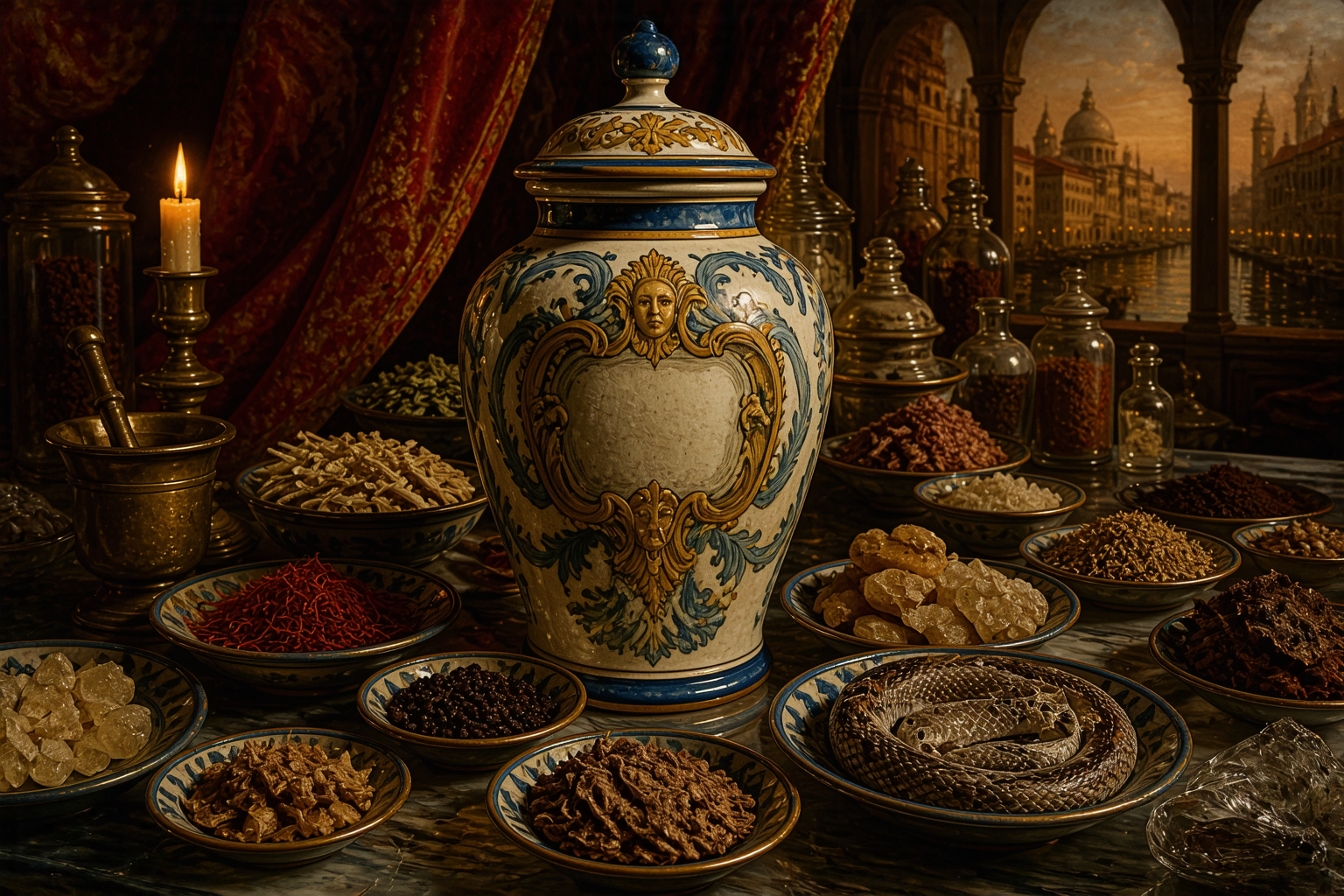
Formularies varied wildly—theriac was decentralized, made across the Mediterranean by different physicians, each with regional access and personal conviction. But the classic preparations contained 60 to 70+ ingredients. I’ve read six different versions, and the overlaps are real.
- Opium (a large proportion—sometimes as much as 2 oz per pound of final preparation)
- Viper flesh (dried, fermented)
- Aromatic resins: myrrh, frankincense
- Spices: cinnamon, cassia, saffron
- Roots and barks: gentian, valerian, costus, calamus
- Pulped fruits and seeds: squill, cardamom
- Animal products: castoreum (from beaver glands)
- All bound in honey—the vehicle that made it an electuary
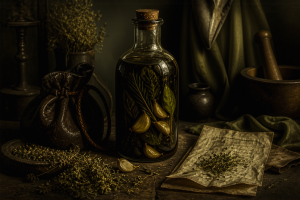
An electuary is a medicinal paste, thicker than a syrup, thick enough to hold its shape in the spoon. The honey served multiple purposes: vehicle, preservative, flavor-mask for bitter herbals, and (genuinely) a mild antimicrobial. The binding of many powdered herbs in honey is honest work, even when the theory behind the formula is medieval.
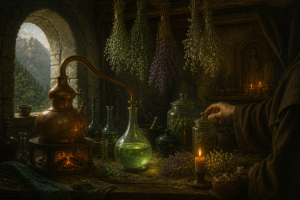
Preparation was labor-intensive. You compounded the ingredients in sequence, each with its own milling, sieving, or processing. Then—and here’s the crucial step—you aged the paste. Years. Often a decade or more before it was considered ready to dispense. I’ve read apothecaries’ logs noting that the best theriac came from batches made by their predecessors, aged in their fathers’ time.
Venice Treacle and the Politics of Pharmacy
Why Venice? The answer is economic and political. Venice controlled the Mediterranean spice trade. Cinnamon, saffron, myrrh, frankincense—the rare ingredients that made theriac prestigious—flowed through Venetian ports. The city had access that no inland apothecary could match. But access alone doesn’t explain the reputation.
Venice did something revolutionary: they compounded theriac publicly. In civic ceremonies, with announced dates and audiences, the state appointed officials inspected each ingredient as it was laid out. Guilds oversaw the proportions. The process was theater, yes—but it was also proto-regulation, a ancestor of the modern pharmacopoeia and batch record. You could see what was going in. You could verify it.
Theriac’s prestige rested partly on spectacle, partly on genuine craft, and partly on institutional authority. Venice understood this better than anywhere else.
“Treacle” is simply the English reflex of the medieval “theriaca.” After theriac declined, the word transferred itself to the dark, sugary syrup we still call treacle. But for centuries, “Venice treacle” meant the premium import—the real thing, made in the arsenal of the state, aged in Venetian cellars. English apothecaries sold it at prices that reflected its rarity and reputation.
The Long Goodbye: When a Drug Outlives Its Usefulness
By the 18th century, something had shifted. The Enlightenment brought a new appetite for skepticism. In 1745, William Heberden published Antitheriaka, a direct, methodical attack on theriac’s claims. Heberden was no fool—he was a physician of real standing. He simply asked: where is the evidence that this massive, expensive preparation actually cures plague, poison, or anything else? The claims outpaced the proof.
The effect was gradual, then sudden. By 1800, theriac was embarrassing to most physicians in England and France. Yet it lingered in continental pharmacopoeias—in Italy, in Spain—into the 19th century. That astonishing institutional lag speaks to something true about medicine: we do not abandon old authorities quickly, even when new ones contradict them.
By 1900, theriac was historical. But it had already taught Western pharmacy something essential about compounding, aging, and the power of procedure to generate trust. That legacy, at least, didn’t fade.
What Theriac Got Right—An Honest Audit
I don’t mock remedies because they’re old. I audit them. What, genuinely, was working in theriac?
The Opium Question
First and obviously: opium. A significant proportion of theriac—sometimes 2 ounces per pound—was poppy latex. Opium genuinely relieves pain, suppresses cough, and arrests certain kinds of diarrhea and dysentery. For a medieval or ancient physician facing patients in genuine distress, opium worked. The centuries of sincere testimonials for theriac aren’t fabricated; they’re the documentation of opium’s effects, credited to the entire preparation.
This is important. Theriac had a active ingredient—a real drug—built into its structure. The rest of the formula could be inert, and theriac would still seem to work. The patient would report relief. The physician would attribute it to the whole, when much of the effect came from one powerful component. It’s a pharmaceutical illusion, but it’s an understandable one.
Public Compounding and the Birth of Quality Control
The Venice model pioneered something that mattered: transparency in preparation. Ingredient inspection. Announced procedures. The idea that pharmacy is not a hidden art but a public trust, subject to verification. This is the ancestor of the modern pharmacopoeia, of batch records, of labeling requirements. When the state compounded theriac in public, it was inventing the discipline of the archive—the notion that every action should be recorded, every ingredient logged, every batch marked.
Theriac’s decline as a drug didn’t erase this innovation. Modern pharmacy inherited the procedural rigor without the formula.
The Honey Electuary as Craft
And then there’s the form itself. An aged, honey-bound electuary is real craft, even when the theory beneath it was wrong. Honey is a genuinely effective preservative. Aging softens harsh flavors and allows chemical reactions between components. The slow binding of pulverized herbs into a stable paste concentrates their activity. None of this vindicates the universal-antidote theory, but it vindicates the *method*.
What Theriac Got Wrong
The universal-antidote theory was fantasy. No single preparation cures snakebite, plague, poison, and apoplexy. Viper flesh added nothing—the sympathetic logic was poetic, not pharmacological. And the drive to add more and more ingredients, the belief that virtue scaled with complexity, became a liability. More was assumed to be better. Purity was sacrificed for comprehensiveness.
This is exactly what spagyrics, a century later, was meant to fix. Paracelsus and his heirs explicitly rejected the Galenical everything-in-one-pot philosophy. They wanted essences—the distilled, purified principle of a single plant, not the muddled sum of seventy. The move from theriac to spagyrics was a philosophical turn toward specificity, away from the grandiose universal. You can read the whole history of medicine in that shift. What we gained in chemistry, we lost in some kinds of subtlety—but what we gained in precision was worth the trade.
At the Mortar: What I Keep and What I Leave
I’m not here to resurrect theriac. The formula stays in the archive. Opium and viper flesh remain historical curiosities, not tools in a contemporary kitchen. But I keep certain principles from theriac’s long dominion.
I keep the patience. A formula worth making is worth aging. Years in glass, in darkness, in the steady cool. This isn’t medieval superstition—it’s practical chemistry. Time does work that heat and effort cannot.
I keep the accountability. Every ingredient labeled, dated, sourced. Every batch logged. The Venice apothecaries understood that trust is built in procedure. I take that seriously. Label everything. Record everything. The archive is not burden—it’s honor.
I keep the form—the honey electuary itself. It works. It preserves. It tastes better than bitterness should. The honey-bound paste is a real technology, worth using when a formula calls for it.
What I leave: the belief that more ingredients means more virtue. I leave the reach for universality, for the single preparation that cures everything. One thing, done well—one plant, understood carefully—beats seven dozen thrown together.
Theriac lasted 1,800 years. That’s astonishing. Not because it was perfect—it wasn’t—but because it held a real truth at its center (opium works), wrapped in plausible procedure (public compounding, patient aging), and defended by institutional authority (Galen, Venice, the crown). The formula finally fell not because it suddenly stopped working, but because skepticism caught up with enthusiasm. The Enlightenment asked: *prove it*. And theriac had no proof.
That’s a lesson too. Confidence and time are not the same as evidence. But nor should we mock the old pharmacy for trying. They were working with what they had: plants, animals, minerals, the logic of sympathy and balance, and the need to *do something* when patients were suffering. Theriac was their best answer to an impossible question: what if we could cure everything? They couldn’t. But they created something that lasted, that taught us procedure, that showed us what patience and spectacle and genuine craftsmanship could accomplish.
This is a historical essay, not medical advice. Theriac is not a modern preparation and its ingredients are of historical interest only.
Frequently Asked Questions
Why did Andromachus add viper flesh to theriac?
Andromachus employed sympathetic logic: he believed a poison neutralizes a poison, so viper flesh—embodying snakebite itself—would train the body to resist snakebite when aged and fermented into the preparation. The reasoning was not stupid, though it was wrong. He also raised opium’s proportion significantly, which genuinely affected the formula’s practical effects.
What made Venice treacle different from other theriac?
Venice compounded theriac publicly in civic ceremonies with announced dates and official inspection of each ingredient. Guilds oversaw proportions. This transparency was proto-regulation—an ancestor of the modern pharmacopoeia and batch record. Venice’s control of the Mediterranean spice trade also gave them access to rare ingredients like cinnamon, saffron, myrrh, and frankincense that other apothecaries lacked.
How much opium was actually in theriac?
Theriac contained a large proportion of opium—sometimes as much as 2 ounces per pound of final preparation. Opium genuinely relieves pain, suppresses cough, and arrests certain kinds of diarrhea and dysentery. Much of theriac’s reputation for working came from opium’s effects, though physicians credited the entire complex formula.
When did theriac fall out of medical use?
By 1800, theriac was embarrassing to most physicians in England and France, though it lingered in continental pharmacopoeias into the 19th century. In 1745, William Heberden published Antitheriaka, a methodical attack on theriac’s claims. By 1900, theriac was historical. Enlightenment skepticism demanded evidence theriac could not provide.
About This Article

Written by Kyle Bamboo. Kyle Bamboo has spent twelve years following the hermetic tradition of herbalism out of dusty reprints and into a home apothecary — spagyrics, planetary correspondences, and the strange internal logic of plant alchemy. Muddle and Mend takes its name from solve et coagula, dissolve and combine. He writes about the actual tradition, with its history, its vocabulary, and its genuine strangeness, not the Instagram version. More about this site.
Scope and limits. Kyle writes from a personal practice in traditional herbalism, not clinical training. Herbs interact with prescription medications and are not regulated as drugs — check interactions and talk to a pharmacist or clinician before taking anything.
Verify this against a primary source
Specifics change, and your situation may differ from the one described here. These are the authorities worth checking directly:
- NCCIH — herb safety, evidence and known interactions
- MedlinePlus Herbs and Supplements — documented interactions and cautions
- FDA Dietary Supplements — regulatory status and safety alerts