The Comte de Saint-Germain is the eighteenth century’s most durable mystery: a courtier of unknown origin who dazzled Versailles in the 1750s—spoke half a dozen languages, played violin brilliantly, dabbled in alchemy and dyes, claimed (or slyly allowed others to claim) to be centuries old and to possess an elixir of life. Voltaire called him, with an arched eyebrow, “a man who never dies and who knows everything.” The official record has him dying at Eckernförde in 1784, in the household of Prince Charles of Hesse-Kassel; the legend, of course, refuses the date—occultists have kept him alive ever since, and theosophy made him an ascended master. This essay is not about the legend. It is about the one preparation that verifiably carries his name—and what it actually is.
The Man Behind the Cipher
Let me start with what I can verify: the Comte de Saint-Germain was documented at the French court in the 1750s, worked on dyeing and chemical projects for Louis XV’s circle, became diplomatically entangled (naturally), and spent his final years under the patronage of Prince Charles of Hesse-Kassel in Schleswig-Holstein. He received a church burial in 1784—the date appears in the parish records, as mundane as gravity.
Everything else fractures. Was he a Transylvanian prince? A Portuguese converso? A runaway Benedictine with a taste for intrigue? Nobody knows, and nobody has proven to know. The gaps in his origin story were a feature, not a bug. He moved through Versailles like smoke, offering just enough expertise to be essential and just enough mystery to be unforgettable. His actual chemical competence—in dyes, in gemstone “improvement”—was real enough to earn royal patronage. The man was a genuine practical chemist wrapped in self-generated myth, which is perhaps the only honest biography we have.
The Immortality Rumor
The legend that attached itself to him promised longevity beyond reason. He reportedly attributed his youth to diet and a secret preparation—some whispered elixir that had kept him vivid across centuries. Salon gossip did the rest. There’s a famous anecdote, probably apocryphal, of an aged servant asked to confirm his master’s age: “I cannot say, I have only been in his service a hundred years.” Whether true or invented, it captures the machinery perfectly. In the 1750s, every impressive stranger needed an elixir of life attached to his name. It was the era’s favorite alchemy rumor—the Philosopher’s Stone’s medicinal aspect made portable, made personal, made sellable.
The elixir of life and the Philosopher’s Stone were not the same thing, though the distinction rarely mattered in gossip. The Stone itself was a symbol of transformation—the elixir, its practical and immortalizing medicine. Saint-Germain’s reported preparation carried the weight of both mythologies.
The Punchline Arrives
The preparation that actually entered the pharmacopoeias under his name is the Tisane de Saint-Germain. In German pharmacy, it became St.-Germain-Tee. In Latin nomenclature: Species laxantes Saint-Germain. It is a laxative tea. That’s the whole joke—the immortal count’s verifiable legacy to medicine is regularity.
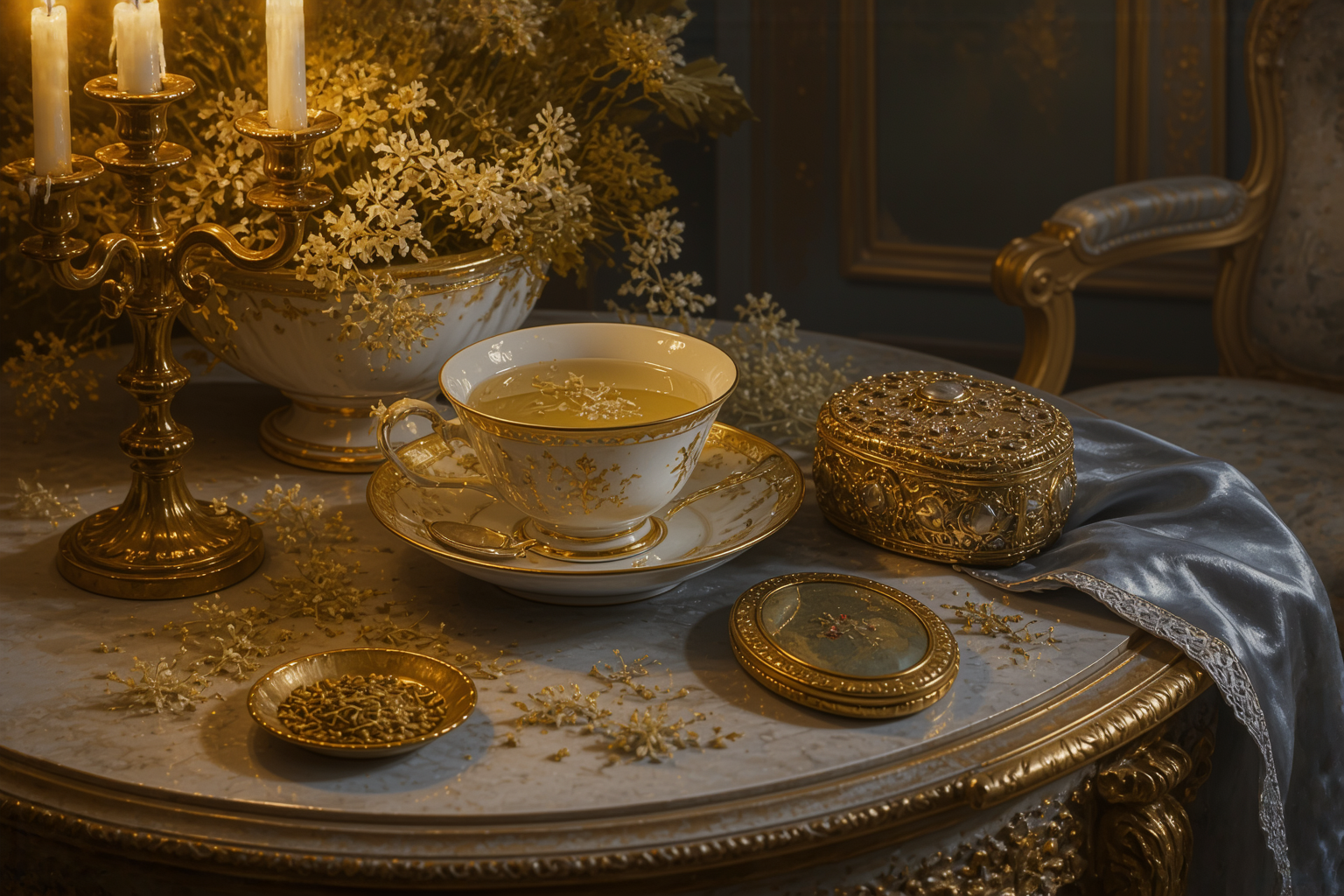
I’ll deliver the composition with a straight face: senna leaves as the active core, elder flowers, fennel and anise seed, and potassium bitartrate (cream of tartar). The formula appears consistently in German pharmacopoeias and formularies from the nineteenth into the twentieth century. The attribution itself is murky—the name may attach to him mainly through legend and marketing, which somehow makes the whole thing perfect. The mysterious count, the elixir, the whispers of immortality—all of it bottoms out in what every human body eventually requires.
What Actually Works
Here’s where the herbalist’s audit becomes interesting: this humble tea is actually well-constructed. Senna—the sennosides it contains—remains a genuinely effective stimulant laxative, still in modern pharmacopeias, still prescribed. It works. The elder, fennel, and anise are sound carminative supporting players, chosen specifically to counteract senna’s griping tendency. On the bench, this formula makes sense. The one “elixir” actually bearing Saint-Germain’s name works—just not for what the legend promised.
I won’t prescribe it here. Senna is for occasional short-term use; this is history, not medical advice. But the pharmacological reality—the fact that this formula is arguably more genuinely effective than almost anything else in this legend-saturated category—deserves the attention it rarely receives. The immortal count left behind something better than fantasy. He left behind something useful.
The Old Dispensatory’s Best Parable
Saint-Germain teaches us something the old dispensatory never tires of teaching: the distinction between a name’s claims and what the jar must actually contain. The legend promised eternal life and delivered a good bowel formula. Meanwhile, the anonymous monastery formularies—the ones that never made headlines, never attached themselves to mysterious counts—promised digestion and delivered four-century institutions. Contrast that with institutions built on pure secrecy, and you see the real alchemy.
On my bench, the label makes claims the jar must keep. This is the discipline that separates the archive from the mythology. A name is just a name until the contents prove it honest. The Comte de Saint-Germain arrived at Versailles promising everything and delivering nothing but cipher and smoke. His one pharmacopeial ghost—the Tisane that bore his name—kept its promise in the plainest way imaginable. It worked.
That’s the parable I keep on my shelf.
Frequently Asked Questions
What is the Tisane de Saint-Germain exactly?
The Tisane de Saint-Germain is a laxative tea that entered nineteenth and twentieth-century German pharmacopoeias under the Comte’s name. It contains senna leaves, elder flowers, fennel and anise seed, and potassium bitartrate. In Latin nomenclature it is called Species laxantes Saint-Germain.
Did the Comte de Saint-Germain actually live for centuries?
The official record documents the Comte’s death in 1784 at Eckernförde in Prince Charles of Hesse-Kassel’s household, with a church burial recorded in parish records. Occultists and theosophists have refused this date and kept him alive in legend, but no evidence supports his claimed longevity.
What was the Comte de Saint-Germain’s actual expertise?
The Comte worked on dyeing and chemical projects for Louis XV’s circle at Versailles in the 1750s and demonstrated genuine practical chemical competence in dyes and gemstone improvement, which earned him royal patronage despite his mysterious origins.
Why does the formula include elder, fennel, and anise alongside senna?
In this tradition, elder, fennel, and anise are chosen specifically as carminative supporting players to counteract senna’s griping tendency, making the formula a well-constructed whole rather than senna alone.
About This Article

Written by Kyle Bamboo. Kyle Bamboo has spent twelve years following the hermetic tradition of herbalism out of dusty reprints and into a home apothecary — spagyrics, planetary correspondences, and the strange internal logic of plant alchemy. Muddle and Mend takes its name from solve et coagula, dissolve and combine. He writes about the actual tradition, with its history, its vocabulary, and its genuine strangeness, not the Instagram version. More about this site.
Scope and limits. Kyle writes from a personal practice in traditional herbalism, not clinical training. Herbs interact with prescription medications and are not regulated as drugs — check interactions and talk to a pharmacist or clinician before taking anything.
Verify this against a primary source
Specifics change, and your situation may differ from the one described here. These are the authorities worth checking directly:
- NCCIH — herb safety, evidence and known interactions
- MedlinePlus Herbs and Supplements — documented interactions and cautions
- FDA Dietary Supplements — regulatory status and safety alerts