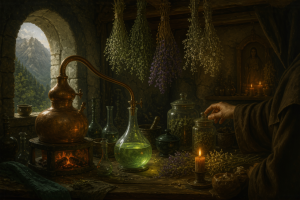
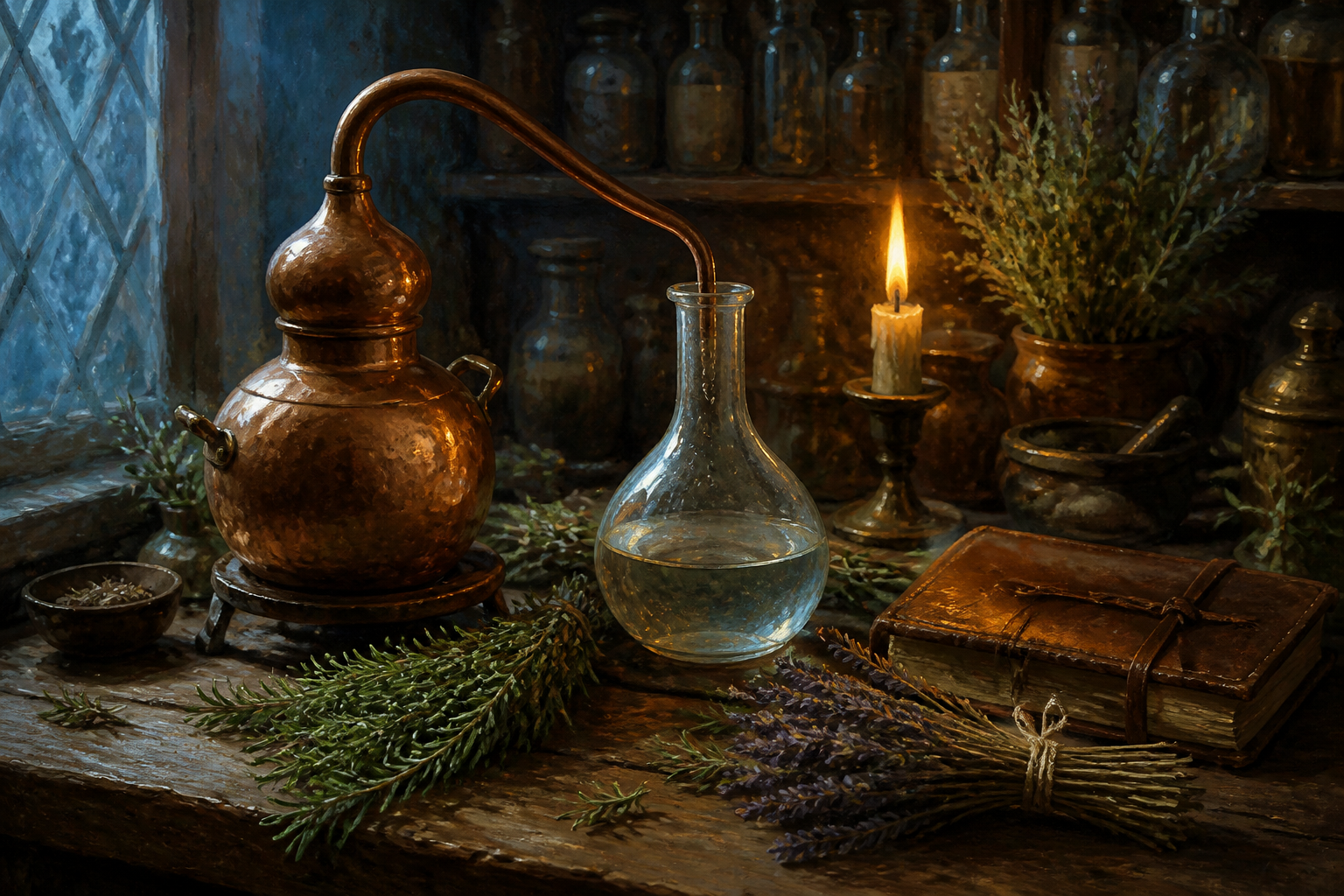
Every bottle of Hungary Water came with a story about a queen. In the version that circulated in early modern Europe, an aged and ailing Queen of Hungary was given a recipe for a rosemary water, used it faithfully, and recovered her health and her looks so completely that a younger king asked for her hand. Depending on who tells it, the recipe came from a hermit, from an alchemist at her court, or from an angel who appeared to her in a garden.
The story is almost certainly not true, at least not in that form. The distillate is real, though. Aqua reginae Hungariae, the Queen of Hungary’s Water, was one of the first alcohol-based fragrances in Europe, and for generations it was among the most popular of them, used as a perfume, a wash and a remedy until eau de Cologne displaced it in the eighteenth century.
The Queen, the Alchemist, and the Story That Stuck
If the legend has a real queen behind it, the usual candidate is Elizabeth of Poland (1305–1380). She married Charles I of Hungary, outlived him by nearly forty years, saw her son reign as Louis I, and served as regent of Poland in the 1370s. That is where the legend’s date of around 1370 comes from. No contemporary record ties her to a rosemary water. The accounts of the queen and her recipe mostly date from the seventeenth century, three hundred years after she died, and they disagree with each other on who gave her the formula and what it cured.
That gap is the honest answer to the question of origins. A good product needs a good story, and an apothecary selling a costly distilled water had every reason to attach a royal name to it. By the eighteenth century the name had stuck so firmly that the first edition of the Encyclopaedia Britannica (1771) simply defined Hungary water as a distilled water named after a queen of Hungary, for whose use it was first prepared, and printed recipes for making it.
What I care about as a maker is what survived the story: the formula. It was copied, varied, written into recipe books and sold for generations, and it never stopped being useful. That longevity tells you something about what it actually did.
The Herbs in the Bottle
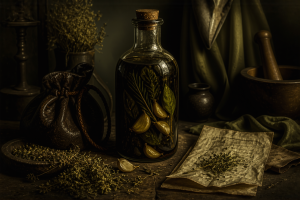
Rosemary was the heart of every version. Old recipes call for fresh rosemary tops and flowers, sometimes with thyme, and later formulas added lavender, sage, mint, marjoram, and citrus peel or orange blossom. The rosemary always dominated. Hungary Water was never a floral perfume in the later sense: it was herbal, green, slightly medicinal and unmistakably clean.
There is one technical point that modern retellings often get wrong. The historical Hungary Water was not a plain water distillate. The recipes printed in the eighteenth century, including the ones the 1771 Britannica took from the apothecary John Quincy, distil rosemary with spirit of wine, that is, with alcohol, over a water bath. The alcohol carries the aromatic oils out of the plant and into the finished liquid, which is why the water could be splashed on the skin, dabbed on the temples, or taken a few drops at a time as a medicine. It was a spirit-based fragrance from the start, and that is what makes it an ancestor of cologne.
The Mechanism: What the Water Actually Did
It smelled clean. That is not a trivial claim in an age when personal hygiene was unreliable and city air was rank. A rosemary spirit cut through stale and animal smells and left a sharp, resinous freshness on the skin. That alone would explain its popularity across classes.
There was also a physical effect. Rosemary oil’s main components, including 1,8-cineole, camphor and alpha-pinene, produce a cooling, tingling sensation on the skin. Rubbed on the temples, the water feels clarifying, which is part of why it was sold as a remedy for headaches. That sensation is real. The promise of restored youth was marketing.
A Wash for Body and Linen
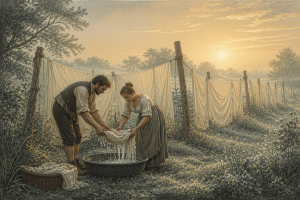
Hungary Water was used on more than skin. Recipe books recommend it as a wash and a refresher, and rosemary’s volatile oils do have some antimicrobial activity, the same property that makes rosemary extract a common natural preservative in cosmetics and foods today. How much a splash of the water preserved anything is another matter. What it certainly did was make things smell clean.
From Hungary Water to Eau de Cologne: A Lineage
Hungary Water held its place until the early eighteenth century, when Giovanni Maria Farina, an Italian perfumer working in Cologne, created a lighter, citrus-forward spirit that he named after his adopted city. Eau de Cologne shared the basic idea, aromatic plant materials carried in alcohol, but it was brighter and more refined, and it eventually overshadowed its herbal predecessor. Hungary Water never disappeared, though. It is still made today, and the rosemary at its centre still does what it did three centuries ago.
I Distill It. Here’s How.
I keep a batch of Hungary Water on my bench, though I use it differently from how the queen supposedly did. For me, it is a practical distillate: a rosemary hydrosol that I use for linen, for freshening drawers and storage, for rubbing into my temples when I need clarity during long work at the still. My version is a water distillate, a hydrosol, which is gentler and easier to make at home than the historical recipe; if you want the old style, distil the same herbs in spirit of wine instead of water.
Ingredients:
- Rosemary tops and flowers: 2 parts by weight
- Sage leaves: 1 part
- Lavender flowers: ½ part
- Whole cloves: a small pinch (too much dominates)
Fill your still with distilled water and pack the herbs loosely into the charging chamber. Heat gently—rosemary distills easily and doesn’t need aggressive temperature. Collect the distillate in clear glass, about 3 to 4 ounces from this quantity of herbs. The first fraction will be the strongest, most aromatic. You’ll know it when you smell it: sharp, clean, unmistakably rosemary, with sage’s green bitterness underneath and a faint sweetness from the lavender. Age it for a week before using. The harshness of fresh distillation mellows.
Storage and Shelf Life
Hydrosols are less stable than alcohol tinctures. They will eventually support microbial growth. Store yours in a cool, dark place—refrigerated is best if you can manage it—and use it within 3 to 6 months. If it smells off, discard it. The volatility of the aromatic compounds means it will lose potency before it goes rancid. This is why the apothecaries kept making fresh batches. Distillation was not a labor they wanted to repeat, but the chemistry demanded it.
Why This Formula Matters to My Work
Hungary Water sits at a hinge in history. It is at once an early cosmetic, an early medicine and a demonstration of what distillation could do with a common garden herb: concentrate its volatile essence into something portable, stable and useful. It is a reminder that the people who worked with stills were solving practical problems, smell and comfort and cleanliness, as well as chasing gold and elixirs.
It is also a lesson about stories. The tale of the queen restored to youth is fiction, but it is effective fiction, because the water did produce real effects. It smelled clean, it felt clarifying on the skin, and people believed in it. That is how folk remedies become legends.
I keep making it because it does exactly what it promises. Not to restore youth, and not to win a king, but because it smells clean, clears the head, freshens the linen cupboard, and carries a long history of apothecary craft in a single bottle. The queen may have been a convenient story. The rosemary was real.
This is a historical essay, not medical advice. Hydrosols should be stored properly and discarded if they show signs of spoilage. Rosemary hydrosol may cause skin irritation in sensitive individuals; patch test before use.
About This Article

Written by Kyle Bamboo. Kyle Bamboo has spent twelve years following the hermetic tradition of herbalism out of dusty reprints and into a home apothecary — spagyrics, planetary correspondences, and the strange internal logic of plant alchemy. Muddle and Mend takes its name from solve et coagula, dissolve and combine. He writes about the actual tradition, with its history, its vocabulary, and its genuine strangeness, not the Instagram version. More about this site.
Scope and limits. Kyle writes from a personal practice in traditional herbalism, not clinical training. Herbs interact with prescription medications and are not regulated as drugs — check interactions and talk to a pharmacist or clinician before taking anything.
Verify this against a primary source
Specifics change, and your situation may differ from the one described here. These are the authorities worth checking directly:
- NCCIH — herb safety, evidence and known interactions
- MedlinePlus Herbs and Supplements — documented interactions and cautions
- FDA Dietary Supplements — regulatory status and safety alerts