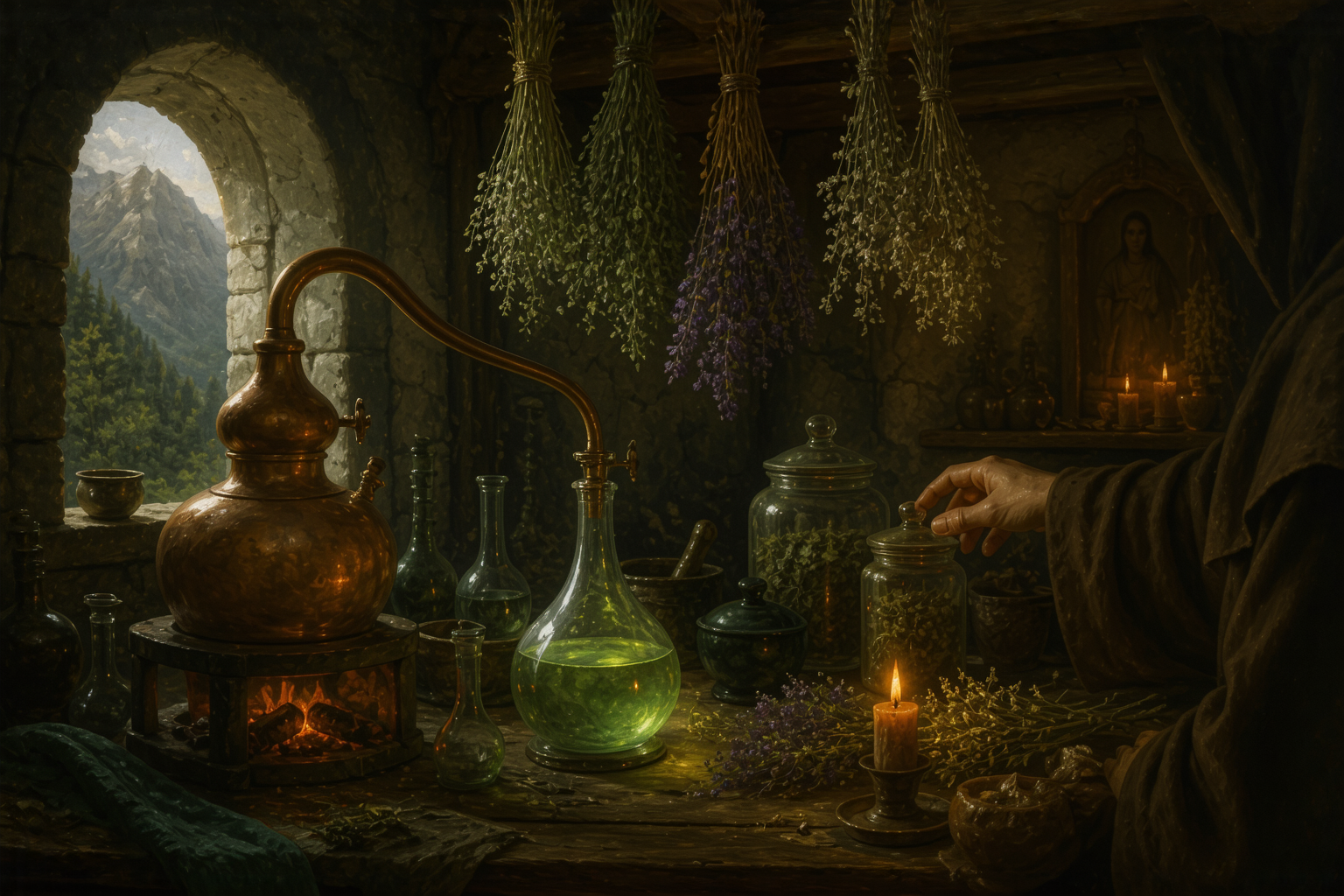
In 1605, the Carthusian monks of a charterhouse near Paris received a manuscript from François Hannibal d’Estrées, a marshal of France: a formula titled an “Elixir of Long Life.” It took the order more than a century to fully decode and master it; by 1737 the recipe had traveled to the Grande Chartreuse in the French Alps and become the Élixir Végétal de la Grande-Chartreuse—69% alcohol, reportedly some 130 plants, and a recipe that to this day is said to be known in full by only two monks at a time. I make plant essences for a living, and I regard this as the tradition’s greatest long-running experiment.
I’ve spent the last decade studying which herbal preparations have actually survived four centuries in production. Most fail. Most disappear into the apothecary’s graveyard, forgotten by the second generation. The ones that endure teach you something. They teach you about fidelity—about what happens when a formula is written down, protected, followed exactly, and handed on with the kind of obsessive care usually reserved for religious relics. Which, in the monastic tradition, it was.
Where Distillation Came From: Not the Tavern
Most people assume distilled spirits arrived in Europe as luxury goods destined for the tavern. Wrong. Aqua vitae came here as medicine. Medieval physicians, drawing on Arabic alchemy and the theoretical framework of Aristotle’s four elements, understood that distillation was a form of extraction—a way to isolate the incorruptible essence from the perishable body of a plant.
In the 14th century, the Franciscan alchemist John of Rupescissa crystallized this into doctrine. His quintessence theory held that all matter contained a fifth essence—beyond earth, water, air, and fire—and that distilled alcohol was the vehicle for capturing and preserving it. High-proof spirits didn’t just extract; they exalted. They were immortal carriers of vegetable virtue. Read his work and you understand why monastery infirmaries, not kitchens, received the first stills.
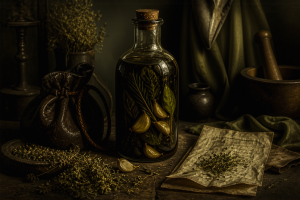
For centuries, the monk’s still-room was the pharmacy. Herbal waters, cordials—literally “for the heart,” the organ Renaissance medicine held as the seat of life—and tinctures were not luxuries. They were medicine, preserved in alcohol, dispensed in small measured doses. The word cordial itself tells you the theory. When you’re extracting herbs into high-proof spirit and sweetening them into tolerability, you’re working in the oldest tradition of European medicine.
The Élixir Végétal: Four Centuries of Fidelity
Here’s what I know about the Chartreuse formula. The d’Estrées manuscript arrived in 1605. The monks of the nearby charterhouse began attempting to decode and recreate it—work that took over a century. Frère Jérôme Maubec, the monastery’s apothecary in the early 18th century, is credited with finally cracking it, though the full story is murky; monastic records were kept deliberately obscure.
By 1737, the formula had migrated south to the Grande Chartreuse in the Alps, where it’s been manufactured ever since. The Élixir Végétal itself—somewhere between 69 and 71% alcohol, containing roughly 130 plants (the exact number varies with the source you trust), and green-gold in color—is still sold in small glass vials nestled inside a wooden presentation case. It’s still marketed as a tonic, a digestif, a “long life” preparation. The dosage: a teaspoon at a time.
What strikes me most is not the formula itself but what it survived. The monks were expelled from France in 1903 during the secularization campaigns; they decamped to Tarragona, Spain, and took the recipe with them. The French state seized the distillery. It nationalized the brand. Yet it could not seize the formula. It lived in two monks’ heads and in the disciplined practice of the still-room. The state could own the building; the tradition owned itself.
The color green became so identified with the liqueur that the color itself took the name from it—not the reverse. You see “chartreuse” in a paint swatch today and you’re looking at a 400-year-old formula’s signature shade.
Two Monks and a Secret
The detail I find most worth sitting with: the formula is said to be known in full by exactly two monks at any given time. Not one, which would be fragile. Not three, which dilutes the responsibility. Two. One leaves, one teaches the apprentice. The knowledge survives in redundancy and in relationship. This is not how modern companies protect intellectual property. It’s how traditions actually survive.
Bénédictine: The Beautiful Fake
Now I have to tell you the truth that complicates the story—and a spagyrist working with the old dispensatory needs to hold both truths at once. Bénédictine’s origin story is largely invented. The liqueur’s romantic pedigree traces it to Dom Bernardo Vincelli, a Benedictine monk who supposedly created an elixir at the Fécamp abbey in 1510. The label still carries “D.O.M.”—Deo Optimo Maximo, “To God, the Greatest and the Best.”
Here’s the catch: historians and the company itself have long since admitted the story is a myth. The abbey was ruined during the French Revolution. No verified Vincelli manuscript survives. The Bénédictine liqueur was created around 1863 by a man named Alexandre Le Grand, who wrapped a modern formula in an invented monastic narrative because in the 19th century, monastic origin stories sold spirits.
I say this with affection, not contempt. Bénédictine is a well-made liqueur. The formula works. But it taught me something crucial: the old dispensatory contains both genuine survivals and beautiful fakes, and loving the tradition means telling them apart.
What the Monastic Tradition Actually Got Right
The “elixir of long life” claims? Unsupported. High-proof alcohol does not make you live forever. But audit the tradition against actual pharmacology and chemistry, and you find something worth defending. High-proof alcohol IS a superb preservative and extractor. A well-made herbal infusion in spirit genuinely keeps for decades with minimal degradation. I have bottles twenty years old that taste as intended.
The bitter alpine herbs—gentian, wormwood family species, angelica—genuinely stimulate digestion. Angelica, “the root of the Holy Ghost,” carries the genre’s signature note. The digestif tradition is folk pharmacology that holds up in the narrow sense: it works as a digestive aid. The mechanism isn’t mystical; it’s botanical chemistry. Bitter principles trigger digestive secretions. This is real.
- High alcohol as preservative and extractor—proven
- Bitter alpine herbs for digestion—proven
- Many-herb formulas, macerated and distilled in stages—genuine craft
- “Long life” claims—unsupported
The form itself—dozens of plants, prepared through multiple rounds of maceration and distillation, balanced against sweetness, aged—represents craft of the highest order regardless of what theory animates it. When I stand at my bench building a formula with this logic, I’m not following superstition. I’m following working pharmacology from a tradition that spent four centuries refining it through trial, failure, and the feedback loop of actual use.
What I Take From Four Centuries at the Still-Room Bench
The most interesting thing about old formulas isn’t secrecy. It’s fidelity. The two monks knowing the Chartreuse recipe aren’t guarding it as intellectual property; they’re maintaining it as a practice. They follow it exactly. They improve it deliberately. They hand it on. Write it down. Commit to it. Change it only when evidence demands change.
This is the real elixir of long life: the institution, not the liquid. A formula survives four centuries not because it’s magical but because someone, somewhere, decided it was worth doing the same way today that it was done in 1737. And the next person decided the same thing. And the next.
When I make tinctures or distill essences now, I keep meticulous records. I label everything with date, source material, proof, and observation. I follow the formula exactly until I have grounds to change it. I write down what I learn and I hand it on. This is the discipline I borrowed from the monks. Not magic. Not “long life” in the literal sense. But a way of working that has now lasted centuries, and that creates something worth preserving. That’s the real genius of the old dispensatory.
The state could own the building; the tradition owned itself.
Read More
Quintessence: The Fifth Essence — John of Rupescissa and the theory that made monastic pharmacy possible.
Menstruum Matters — Why high-proof alcohol works (and when it doesn’t).
Label Everything — The discipline of the still-room: how to keep formulas alive across generations.
Frequently Asked Questions
When did the Carthusian monks receive the Élixir Végétal formula?
In 1605, Carthusian monks of a charterhouse near Paris received a manuscript titled an “Elixir of Long Life” from François Hannibal d’Estrées, a marshal of France. It took the order more than a century to decode and master it before the recipe traveled to the Grande Chartreuse in the Alps by 1737, where it became the Élixir Végétal de la Grande-Chartreuse.
Why were the first distillation stills placed in monastery infirmaries?
Medieval physicians, drawing on Arabic alchemy and Aristotle’s four elements, understood distillation as extraction. The Franciscan alchemist John of Rupescissa theorized that all matter contained a fifth essence, and that distilled alcohol captured this essence. High-proof spirits were seen as immortal carriers of vegetable virtue, making monastery infirmaries—not kitchens—the proper site for the still-room pharmacy.
How many people know the full Chartreuse formula at once?
The formula is said to be known in full by exactly two monks at any given time. This redundancy ensures the knowledge survives: one leaves while the other teaches the apprentice. This structure represents how traditions actually survive across generations through relationship and responsibility, rather than how modern companies protect intellectual property.
Is the Bénédictine liqueur’s origin story historically accurate?
No. Bénédictine traces its pedigree to Dom Bernardo Vincelli, a Benedictine monk who supposedly created an elixir at Fécamp Abbey in 1510, but historians and the company have admitted this story is myth. The liqueur was actually created around 1863 by Alexandre Le Grand, who invented the monastic narrative because monastic origin stories sold spirits in the nineteenth century.
About This Article

Written by Kyle Bamboo. Kyle Bamboo has spent twelve years following the hermetic tradition of herbalism out of dusty reprints and into a home apothecary — spagyrics, planetary correspondences, and the strange internal logic of plant alchemy. Muddle and Mend takes its name from solve et coagula, dissolve and combine. He writes about the actual tradition, with its history, its vocabulary, and its genuine strangeness, not the Instagram version. More about this site.
Scope and limits. Kyle writes from a personal practice in traditional herbalism, not clinical training. Herbs interact with prescription medications and are not regulated as drugs — check interactions and talk to a pharmacist or clinician before taking anything.
Verify this against a primary source
Specifics change, and your situation may differ from the one described here. These are the authorities worth checking directly:
- NCCIH — herb safety, evidence and known interactions
- MedlinePlus Herbs and Supplements — documented interactions and cautions
- FDA Dietary Supplements — regulatory status and safety alerts