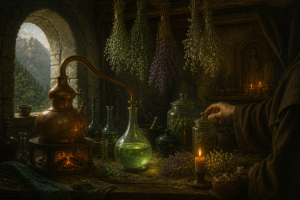
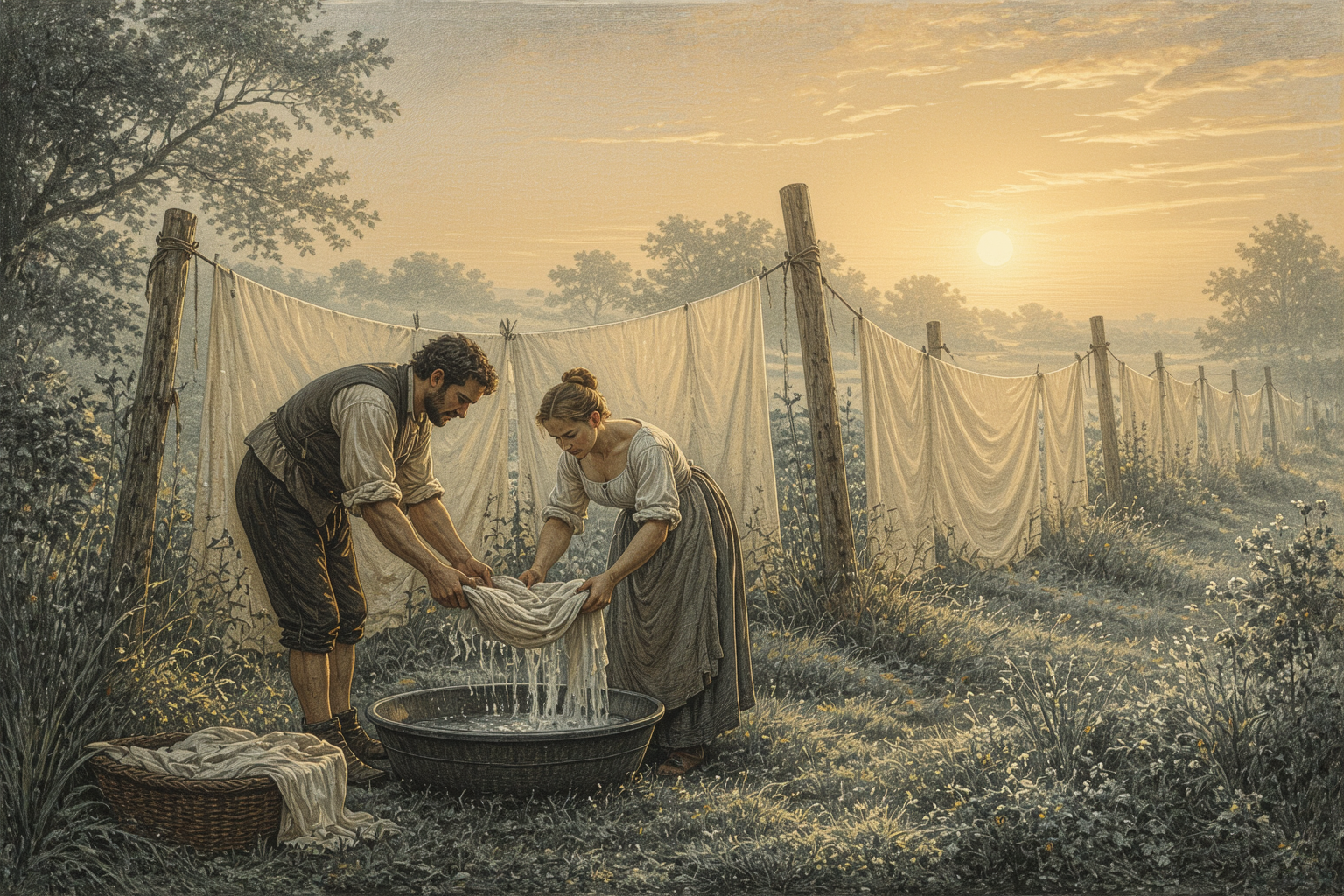
In 1677, in La Rochelle, France, a book was published that contains almost no words: the Mutus Liber, the “Silent Book”—fifteen engraved plates showing, without explanation, the stages of an alchemical work. Authorship hides behind the anagram “Altus.” Its most famous plates show something disarmingly concrete: a man and a woman in a field at dawn, stretching cloths between posts to soak up dew, then wringing them out into a basin. Among the most secretive books ever printed, the plainest instruction is: go outside in May, before sunrise, and collect the dew.
I love this book because it is the tradition at its most beautiful and most literal. A book with no words whose clearest page is about collecting water from grass.
The Silent Book and Its Wordless Argument
The Mutus Liber was published by Pierre Savouret in La Rochelle. Its title page declares in Latin that here is a book “in which the whole hermetic philosophy is represented in hieroglyphic figures”—dedicated to the sons of the art. The format itself was both security and pedagogy. Nothing within it could be quoted to an inquisitor or a jealous rival; the tradition held with near-religious conviction that the work must be seen and done, not merely read from a page.
Across all fifteen plates, the alchemical process unfolds in pure image. Ladders appear, angels descend, stars bloom in Solomon’s-seal geometries. A king and queen meet. The materia undergoes its transformations. Yet nowhere does the engraver explain himself. The reader—or rather, the practitioner—must stand before each plate and read it as one reads a drawing of the stars, or the postures of a dance. This silence is not a flaw. It is the whole point.
Why Dew, in the Tradition’s Own Logic
The dew-collection plates appear early—conventionally plate 4 and following—and they are the ones nearly every commentator fixes on. The figures move through spring, through Aries and Taurus, roughly April through May, when the world’s generative virtue was believed strongest. The timing is no accident. In hermetic philosophy, dew was understood as celestial water: literally condensed from the sky itself, falling nightly, heaven’s contribution to earth.
This was not mere poetry. Alchemists held that dew carried the “universal spirit” or celestial nitre—the above descending into the below, the Emerald Tablet made visible on a grass blade. It was the most direct menstruum they knew for dissolving metals and minerals. It was a starting matter for the universal spirit itself. In the old accounts, dew was not gathered carelessly; it was harvested as a substance of art, a gift that required witness and gratitude.
The Folk Twin
The learned hermetic tradition did not invent dew-gathering. In European folk custom, May-morning dew held a place of quiet power. Women washed their faces in it for beauty and health. It was collected for eye-washes and consumption remedies. Samuel Pepys noted in his diary that his wife went out for May dew—this in the 1660s, on the cusp of the Enlightenment, as if the practice were still both normal and necessary.
The learned and the folk traditions clearly drink from the same well. Neither invented it; both knew, by direct observation, that dew in spring possessed a virtue. The hermetic philosophy gave it a cosmological name. The village traditions simply used it, year after year, dawn after dawn, without needing explanation.
What Dew Actually Is, Honestly
Let me be plain about the chemistry. Dew is pure condensate—naturally distilled water, condensed from atmospheric vapor onto a cool surface. It is extremely soft, low in minerals, and carries whatever the surface gives it: pollen, plant exudates, dust, and in a modern field, quite possibly agrochemicals.
The old intuition that dew is “distilled by heaven” is chemically half-true. It is atmospheric distillation, a process of evaporation and recondensation that requires no fire and no apparatus. The universal-spirit part, the celestial nitre, the claim that dew carries a unique virtue—those remain in the philosophy column. I do not pretend they are chemistry.
For actual work on my bench, the sane menstruum is rainwater or distilled water. Both are reliable, clean, and available year-round. If a reader collects dew from clean, unsprayed grass with a stretched cloth, I honor the impulse—but understand it as ritual pleasure and connection to the Mutus Liber itself, not as a substitute for chemical sense.
The Real Lesson at the Mortar
What the Mutus Liber teaches me, day after day at my bench, is that the work can be shown but never shortcut. Each plate unfolds a stage that must be entered, lived, and understood in the body, not merely in the mind. The process asks for patience. It asks for attention. It asks, sometimes, for nothing more than a clean sheet, a field, and the willingness to wake before dawn.
This is the quiet dignity of instructions simple enough to need no words. The Mutus Liber does not argue. It does not explain. It simply shows the way. If you wish to understand it, you must put on your shoes, go outside, and look.
Frequently Asked Questions
What is the Mutus Liber and who wrote it?
The Mutus Liber, or Silent Book, was published in 1677 in La Rochelle, France by Pierre Savouret. It contains fifteen engraved plates depicting alchemical stages without written explanation. Authorship hides behind the anagram Altus. Its title page declares the book represents hermetic philosophy in hieroglyphic figures dedicated to the sons of the art.
Why does the Mutus Liber show dew collection in May?
In hermetic philosophy, dew was understood as celestial water—condensed from the sky itself and carrying the universal spirit. The dew-collection plates appear in spring, through Aries and Taurus roughly April through May, when the world’s generative virtue was believed strongest. Alchemists held dew was the most direct menstruum for dissolving metals and minerals.
Did May dew collection exist before the hermetic tradition?
Yes. European folk custom held May-morning dew as having quiet power—women washed their faces in it, and it was collected for eye-washes and remedies. Samuel Pepys noted in his 1660s diary that his wife gathered May dew as a normal practice. The learned and folk traditions clearly drink from the same well.
What is dew chemically and why does it matter?
Dew is pure condensate—naturally distilled water from atmospheric vapor onto cool surfaces. It is extremely soft and low in minerals but carries whatever the surface gives it: pollen, plant exudates, dust, and possibly agrochemicals. The old intuition that dew is distilled by heaven is chemically half-true, though the universal-spirit claims remain in philosophy.
About This Article

Written by Kyle Bamboo. Kyle Bamboo has spent twelve years following the hermetic tradition of herbalism out of dusty reprints and into a home apothecary — spagyrics, planetary correspondences, and the strange internal logic of plant alchemy. Muddle and Mend takes its name from solve et coagula, dissolve and combine. He writes about the actual tradition, with its history, its vocabulary, and its genuine strangeness, not the Instagram version. More about this site.
Scope and limits. Kyle writes from a personal practice in traditional herbalism, not clinical training. Herbs interact with prescription medications and are not regulated as drugs — check interactions and talk to a pharmacist or clinician before taking anything.
Verify this against a primary source
Specifics change, and your situation may differ from the one described here. These are the authorities worth checking directly:
- NCCIH — herb safety, evidence and known interactions
- MedlinePlus Herbs and Supplements — documented interactions and cautions
- FDA Dietary Supplements — regulatory status and safety alerts