I am not a Freemason. I need to say that plainly and early, because what follows is a conversation across a real boundary—the one between my bench and the lodge. Freemasonry, by its own public record in every encyclopedia and printed ritual, has built its allegorical architecture around the construction of Solomon’s Temple. Albert Mackey’s Encyclopedia of Freemasonry makes this explicit. The books are in libraries. The scholars cite them openly. I cannot speak to what the Craft means by that allegory from the inside—that is not mine to say—but the Temple itself, as the Hebrew Bible describes it, had a botany. And botany I can do.
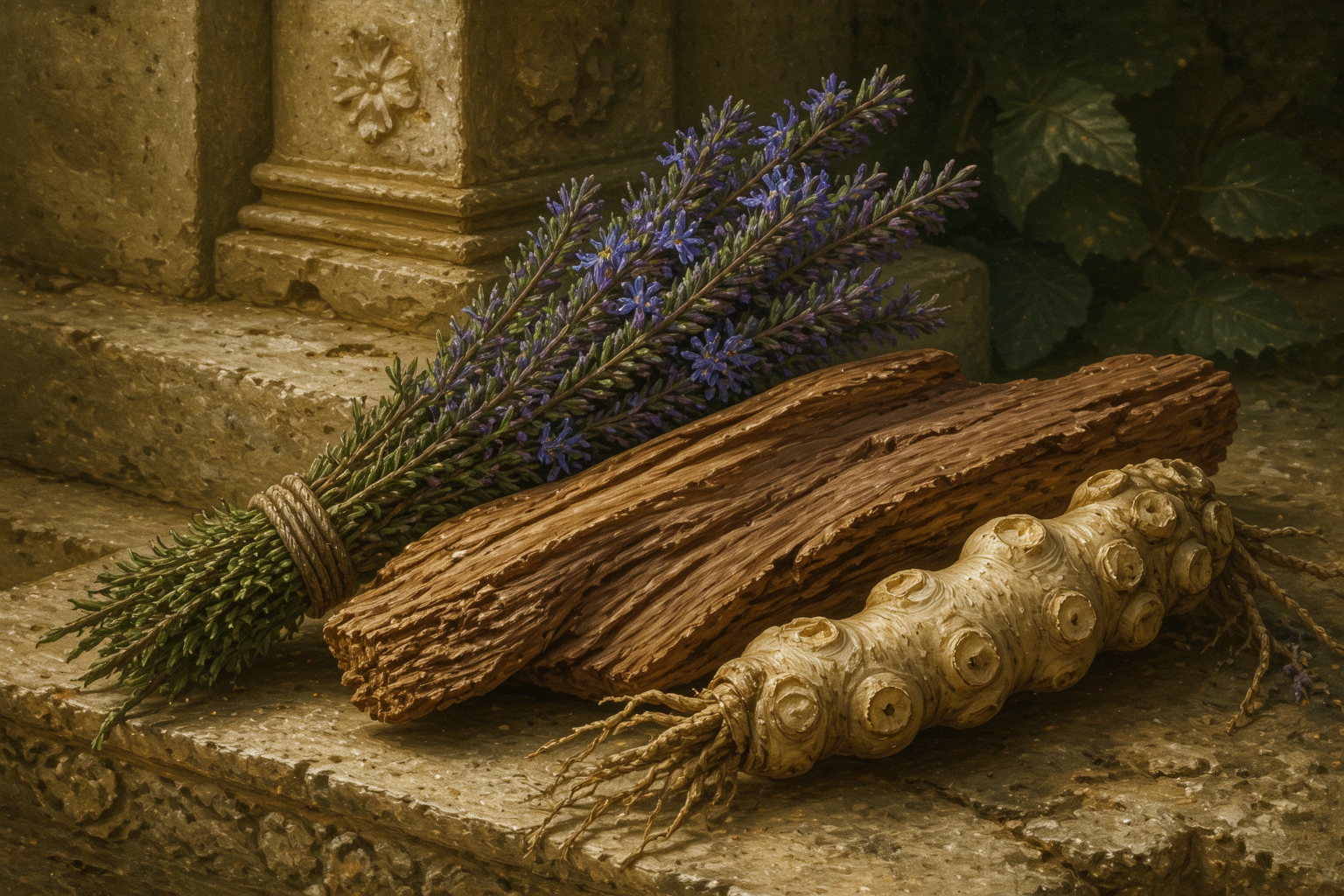
Three plants lived in that world: the timber that would not rot, the herb that washed clean, and the root that bore a king’s own mark. What I want to offer here is a herbalist’s reading of those three—not the secret of the Temple, but the secrets the plants themselves kept.
The Timber: Cedar of Lebanon
First Kings tells the story plainly enough. Solomon contracted with Hiram of Tyre—the Phoenician king—for cedar. Lot after lot of it, cut in the Lebanon mountains, seasoned and bound into rafts, floated down the Mediterranean coast to be hauled inland and set into the Temple’s structure. The practical reason appears in the text itself: cedar does not rot. The heartwood resists decay so thoroughly that cedar logs have been found intact in archaeological sites after millennia. No moth will eat it.
A timber-wright and a spagyrist read that same fact differently. To the builder, cedar’s incorruptibility is structural—a wood that stays sound through centuries of humidity, temperature, and the appetite of insects. To the herbalist, that durability is chemical. Cedar’s heartwood is saturated with volatile oils, compounds of the aromatic principle that the old alchemists called Sulfur—not the mineral, but the soul of a substance, the part that smells, that moves, that carries life. Those oils are what preserves the wood. They are preservative and sacred scent in one package.
Ancient Egypt understood this. Cedar was one of the three plants used in the mummification protocols—along with natron and frankincense—to preserve the body against decay. Cedar oil was distilled and applied, bottled, traded as wealth. The scent of cedarwood became synonymous with the eternal. That connection between aroma and incorruptibility runs through spagyric practice to this day. Sulfur—the aromatic principle—is literally what we call the soul in the scent, and that soul is what keeps things whole.
There is a closing footnote, though, and I will not soften it. The great cedar forests of Lebanon are nearly gone. What was once so abundant that kings could float it down rivers in rafts is now a protected species, its groves reduced to fragments. The tree of permanence proved mortal. That is not mysticism; it is history. When you work with cedar now, you work with a ghost of abundance, and the spagyrist’s job is to honor that scarcity in the work.
The Purifier: Hyssop and the Problem of Translation
Purge me with hyssop, and I shall be clean. The words are David’s, in Psalm 51, written after the prophet Nathan confronted him about Bathsheba. Hyssop appears in the Bible as the purifying herb—used in the Levitical rites to sprinkle blood and water, to mark the clean from the unclean, to restore what had been broken. Every old herbalist knew it. Every monastery grew it. The name became synonymous with ritual cleansing itself.
But here is the honest puzzle that plants often present to history: Biblical ezov almost certainly is not the European Hyssopus officinalis that medieval monks and modern gardeners know. The plant did not grow wild in ancient Israel. Scholars who have paid attention—botanists and Hebraists both—favor a different plant entirely: Origanum syriacum, the za’atar of the modern Levantine kitchen, a wild oregano that grows in the hills where the Temple stood.
This is not a problem. It is an invitation to read the two plants together and understand what “purifier” actually means in the plant world.
Origanum syriacum: The Purifier’s Chemistry
Syrian oregano carries the phenolic compounds that moderns isolate as thymol and carvacrol—the same aromatic molecules that give thyme and oregano their antimicrobial signatures. These compounds are volatile and powerful. They kill bacteria. They dry secretions. They clean. The old herbalist who prescribed hyssop for purification was not inventing metaphor—the plant’s chemistry genuinely does what the ritual demanded. The signature matches the action.
Hyssopus officinalis: The European Tradition
Garden hyssop, the plant European herbalists adopted and grew in their plots, carries its own gifts. It is an expectorant—it thins mucus and brings up phlegm. It appears in every old respiratory formula, every monastic liqueur meant to clear the chest. Its volatile spirit moves through the body like purification itself. Medieval herbalists, working in a tradition that valued the doctrine of signatures and the transfer of properties, understood the two plants as one principle expressed through different geographies and chemistries.
Both plants answer to the same logic: a purifier is a volatile spirit that moves, that stings, that cleans what it touches. Whether you use the Levantine plant or the European one, you are working with Mercury—the quick, mobile principle of alchemical tradition—in plant form.
The Seal: Solomon’s Root
Solomon’s Seal carries the king in its very name. The plant—Polygonatum species, most commonly Polygonatum multiflorum in Europe—bears a mark that no herbalist could miss and no gardener who digs it can forget. The rhizome, when scarred or cut, shows round, seal-like impressions where the old stems have detached. The herbalists of the Renaissance saw those scars and read them as a signature. Solomon, they said, had marked his own root.
John Gerard, in his great Herball of 1597, devoted paragraph after paragraph to Solomon’s Seal. He praised it for sealing wounds, for knitting bone, for drawing together bruises and contusions. The doctrine of signatures speaks here in its clearest voice: a root stamped with a seal, prescribed to seal flesh. A plant marked with its king’s emblem, given to bind what had been broken.
The doctrine of signatures is not magic in the sense of breaking the laws of nature. It is reading what the plant literally shows and trusting that form tells you function. In this case, tradition and modern herbalism partly agree: a poultice of Solomon’s Seal rhizome, applied to bruises, does seem to accelerate healing and reduce swelling. The herb works.
I will note, plainly, what every herbalist knows: the berries and aerial parts are toxic. This is a lore essay, not a dosing guide. Solomon’s Seal demands respect and knowledge before use. It is a powerful plant, and powerful plants bite back if you are careless.
Reading Them Together: The Three Principles at Work
What do these three plants have in common? They are preservation, purification, and binding. They are, in other words, the basic work of any sacred space—keeping what is holy from decay, washing what is unclean, and sealing what has been broken back together.
If I map them onto the old spagyric framework—the tria prima, the three principles—I read them this way: Cedar is Sulfur, the aromatic soul that preserves and sanctifies. Hyssop is Mercury, the volatile spirit that moves and cleanses. And Solomon’s Seal is Salt, the dense, rooted body that holds form and binds.
The three principles are not mystical abstractions. They are ways of naming what plants actually do—how they move through the body, how they change matter, how they hold their power. To read a Temple through its plants is to see the three principles at work in stone and wood and herb.
At the Mortar: Building Small Temples
I do not know what Solomon’s Temple means to a Freemason standing in a lodge. That is their tradition to keep, their labor to understand. But I know what it meant to build a holy place in the ancient world, and the criteria have not changed.
You choose timber that will not rot. You choose herbs that will cleanse and seal. You select plants that mean what they do, whose chemistry matches their story. My bench is a very small temple. I do not build in stone. But when I cut cedar for an oil, when I brew hyssop for a formula, when I dig Solomon’s Seal root for a poultice, I am using the same plants that the ancients did—not because they are magical, but because they work. Because they have always worked. Because preservation, purification, and binding are not metaphors. They are the basic labor of any tradition that builds something meant to last.
The lodge and the laboratory are different rooms. But we furnish them with the same plants.
Frequently Asked Questions
Why did Solomon use cedar from Lebanon for the Temple?
First Kings records that Solomon contracted with Hiram of Tyre for cedar timber because the heartwood resists decay so thoroughly that cedar logs have been found intact in archaeological sites after millennia. No moth will eat it. The wood stays sound through centuries of humidity, temperature, and insect damage.
Is Biblical hyssop the same as garden hyssop?
No. Biblical ezov almost certainly is not the European Hyssopus officinalis that medieval monks grew. Scholars favor Origanum syriacum, the za’atar of the modern Levantine kitchen, a wild oregano that grows in the hills where the Temple stood. Medieval herbalists understood both plants as expressing the same purifying principle through different geographies.
What does Solomon’s Seal root look like?
The rhizome of Polygonatum species, most commonly Polygonatum multiflorum in Europe, bears round, seal-like impressions where old stems have detached. Renaissance herbalists read these scars as a signature—Solomon’s own mark—and prescribed the root for sealing wounds and knitting bone.
What are the toxic parts of Solomon’s Seal?
The berries and aerial parts are toxic. Solomon’s Seal is a powerful plant that demands respect and knowledge before use, as powerful plants will harm you if you are careless with them.
About This Article

Written by Kyle Bamboo. Kyle Bamboo has spent twelve years following the hermetic tradition of herbalism out of dusty reprints and into a home apothecary — spagyrics, planetary correspondences, and the strange internal logic of plant alchemy. Muddle and Mend takes its name from solve et coagula, dissolve and combine. He writes about the actual tradition, with its history, its vocabulary, and its genuine strangeness, not the Instagram version. More about this site.
Scope and limits. Kyle writes from a personal practice in traditional herbalism, not clinical training. Herbs interact with prescription medications and are not regulated as drugs — check interactions and talk to a pharmacist or clinician before taking anything.
Verify this against a primary source
Specifics change, and your situation may differ from the one described here. These are the authorities worth checking directly:
- NCCIH — herb safety, evidence and known interactions
- MedlinePlus Herbs and Supplements — documented interactions and cautions
- FDA Dietary Supplements — regulatory status and safety alerts