The legend arrived in my apothecary the way most do—half-remembered, several versions tangled together, and absolutely irresistible. Four thieves, a plague city, a secret formula traded for their lives. During the great plague outbreak in Marseille in 1720, the story goes, four men were caught robbing the dead. They never fell sick. The magistrate offered them a bargain: their freedom for the recipe. What emerged was vinaigre des quatre voleurs—four thieves vinegar—a maceration of herbs and garlic in wine vinegar, rubbed on skin and sniffed from a sponge. The court got their formula. History got a legend that has never stopped being useful.
| Ingredient | Traditional Theory | Actual Property |
|---|---|---|
| Vinegar (acetic acid) | Counteracts miasma vapor | Mild antiseptic |
| Garlic | Pungent aroma repels bad air | Contains allicin; antimicrobial |
| Rosemary | Strong smell combats corruption | Volatile oils with antimicrobial activity |
| Sage | Aromatic defense against foul vapors | Volatile oils with antimicrobial activity |
| Wormwood | Pungent volatiles ward miasma | Volatile compound extraction in vinegar |
| Lavender | Aromatic protection layer | Volatile oils in solution |
The Story, and What Actually Happened
I need to be honest here: I don’t know if those four thieves existed. The Marseille 1720 version is the most famous, but the story also attaches itself to the plague in Toulouse (1628–31), and the numbers shift depending on who’s telling it—four thieves, six, sometimes just one clever apothecary. Some versions end in a pardon; others have them hanged anyway. The narrative is too neat, too archetypal, to trust completely.
But here’s what matters to me as a maker: vinaigre des quatre voleurs became a real thing. It entered the French pharmacopoeia in the 18th and 19th centuries as vinaigre antiseptique—an official, recorded remedy with actual pharmaceutical standing. Whether the thieves existed or not, someone valued this preparation enough to standardize it. That suggests it was doing something. The question is what.
The Herbs, the Theory, and the Wrong Answer
The core ingredients shift slightly between sources, but they cluster around a consistent family. You’ll find wine vinegar as the base; then wormwood, rue, rosemary, sage, mint, and lavender in most versions. Garlic is nearly universal. The pharmacopoeia versions add camphor. Clove and cinnamon appear in variations. These aren’t random—they’re all volatiles, all pungent, all the herbs a plague-era apothecary would reach for when trying to combat miasma.
Miasma theory, remember, was the working explanation for how plague moved. Disease traveled on bad air, foul vapors rising from corpses and rot. The cure, logically, was strong smell—the pungent aromatics that could theoretically counteract the corruption. This is why the plague doctor wore his beaked mask stuffed with herbs, why he carried pomanders, why he clutched a vinegar-soaked sponge to his nose. The logic was internally consistent. It was also completely wrong about the mechanism.
What the Formula Actually Got Right
If I audit the ingredients against what we now know, the results are interesting. Vinegar—acetic acid—is a genuine mild antiseptic. It was one of the few disinfectants available before the 20th century, which is why it survived so long in every folk pharmacy. Garlic contains allicin, a sulfur compound with laboratory-demonstrable antimicrobial activity. The same goes for the volatile oils in rosemary, thyme, and sage. None of these are powerful enough to stop Yersinia pestis. Not even close.
But they’re not nothing either. And there’s a third factor—one nobody involved could have suspected until the 1890s, when we finally figured out that plague spreads primarily by flea. Someone doused in pungent vinegar and strong herbs probably repelled fleas somewhat. Not completely. But somewhat. The remedy could have actually worked, for reasons nobody proposed. The people who used it got results. The theory was wrong. The practice was accidentally right. This is how folk medicine actually operates most of the time.
I Make It. Here’s How.
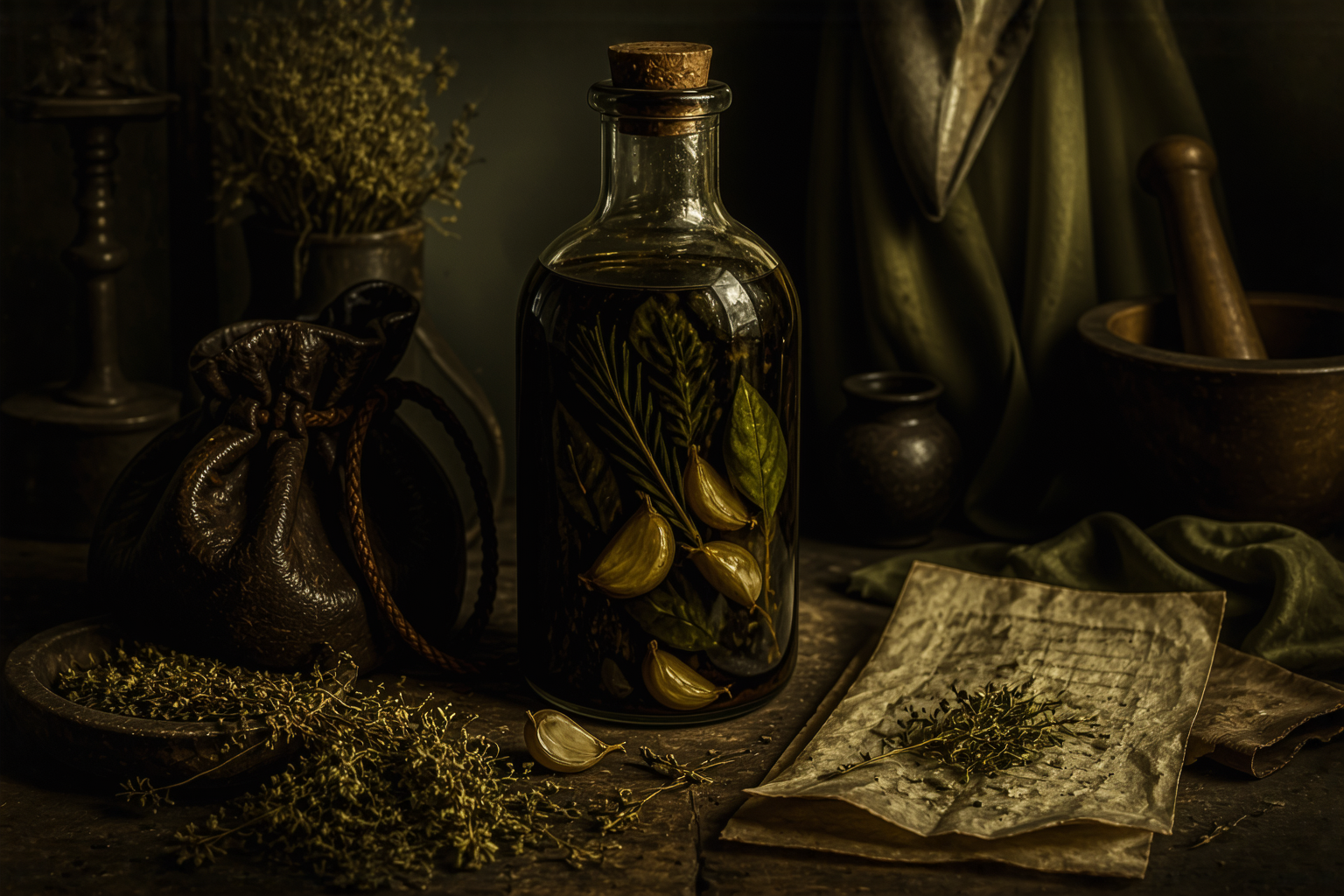
I keep a batch on my bench, though I’m clear about what it is: a culinary herbal vinegar with a story attached. Nothing more. Here are my proportions, refined over several batches. Take a small handful each of dried rosemary, sage, thyme, lavender, and mint. Bruise three or four cloves of garlic. Pack them into a clean jar and pour about a quart of good red wine vinegar over them. Cap it.
- Maceration time: 2 to 3 weeks in a cool, dark place
- Straining: Through cheesecloth or fine mesh; bottle the clear liquid
- Storage: Cool, dark, sealed—keeps indefinitely
The vinegar is your menstruum here, and this matters. Acetic acid pulls certain compounds beautifully—minerals, some alkaloids, the volatile essences of herbs—while other things resist extraction in vinegar. If you want to understand what you’re actually pulling into solution, my piece on menstruum matters walks through that logic. Vinegar as a solvent is gentler than alcohol and often overlooked, but it has its own chemistry worth understanding.
What I Actually Use It For
Salad dressing. A splash in cleaning water—it cuts grease and smells clean. Historical reenactors love it sniffed from a sponge or pomander while they’re doing their demonstrations. I’ve had people ask if it can protect them from illness. I tell them no, plainly. It never protected anyone from plague. It tastes and smells good. Beyond that, leave the claims behind.
Why This Matters to My Work
Four thieves vinegar is the old dispensatory in miniature. It’s a real preparation with documented history. It rests on a theory—miasma—that was wrong. Its actual mechanism, if one existed, involved something nobody suspected. And the story around it is too good to let die, so it won’t. That’s the honest work of herbalism and spagyrics. We inherit formulas layered with folklore and failed theories. Our job is to strip them down honestly, understand what’s actually happening, and decide whether to keep making them.
I keep making this one. Not because it cures plague—it doesn’t. Because it’s a bridge between the way people used to think, the way they thought they were protecting themselves, and the actual chemistry underneath. Because the herbs are genuinely useful in vinegar form for other things. And because some stories, even when the mechanism is wrong, are too instructive to abandon. The thieves may not have existed. But the formula did. That’s enough.
Make it if the story calls to you. Use it in your kitchen. Enjoy the irony that the remedy worked for reasons nobody guessed. That’s how the old dispensatory actually teaches.
Frequently Asked Questions
Did four thieves really exist in Marseille 1720?
The most famous version places them in Marseille during the 1720 plague outbreak, but the story also attaches to Toulouse (1628–31), with numbers shifting between sources. The narrative is archetypal enough that its historical truth remains uncertain. What matters is that vinaigre des quatre voleurs became a real preparation, entering the French pharmacopoeia in the 18th and 19th centuries as vinaigre antiseptique with actual pharmaceutical standing.
What are the core ingredients in four thieves vinegar?
Wine vinegar forms the base, with wormwood, rue, rosemary, sage, mint, and lavender appearing in most versions, plus nearly universal garlic. Pharmacopoeia versions add camphor. Clove and cinnamon appear in variations. These are all volatile, pungent herbs that a plague-era apothecary would reach for when trying to combat miasma—the prevailing theory of disease transmission at the time.
How do you macerate four thieves vinegar at home?
Pack a small handful each of dried rosemary, sage, thyme, lavender, and mint with three or four bruised garlic cloves into a clean jar. Pour about a quart of good red wine vinegar over them, cap, and macerate in a cool, dark place for two to three weeks. Strain through cheesecloth or fine mesh, then bottle the clear liquid. It keeps indefinitely in cool, dark, sealed storage.
What is four thieves vinegar actually useful for?
In this tradition, it is a culinary herbal vinegar with historical significance. It works as salad dressing and can be splashed into cleaning water. Historical reenactors use it sniffed from a sponge during demonstrations. It was never an effective plague preventative, and the theory behind it—miasma—was incorrect, though some ingredients do contain antimicrobial compounds.
About This Article

Written by Kyle Bamboo. Kyle Bamboo has spent twelve years following the hermetic tradition of herbalism out of dusty reprints and into a home apothecary — spagyrics, planetary correspondences, and the strange internal logic of plant alchemy. Muddle and Mend takes its name from solve et coagula, dissolve and combine. He writes about the actual tradition, with its history, its vocabulary, and its genuine strangeness, not the Instagram version. More about this site.
Scope and limits. Kyle writes from a personal practice in traditional herbalism, not clinical training. Herbs interact with prescription medications and are not regulated as drugs — check interactions and talk to a pharmacist or clinician before taking anything.
Verify this against a primary source
Specifics change, and your situation may differ from the one described here. These are the authorities worth checking directly:
- NCCIH — herb safety, evidence and known interactions
- MedlinePlus Herbs and Supplements — documented interactions and cautions
- FDA Dietary Supplements — regulatory status and safety alerts