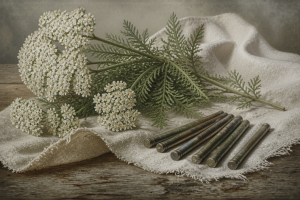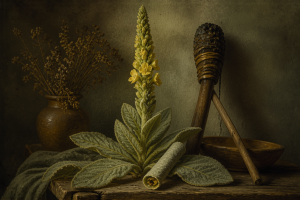
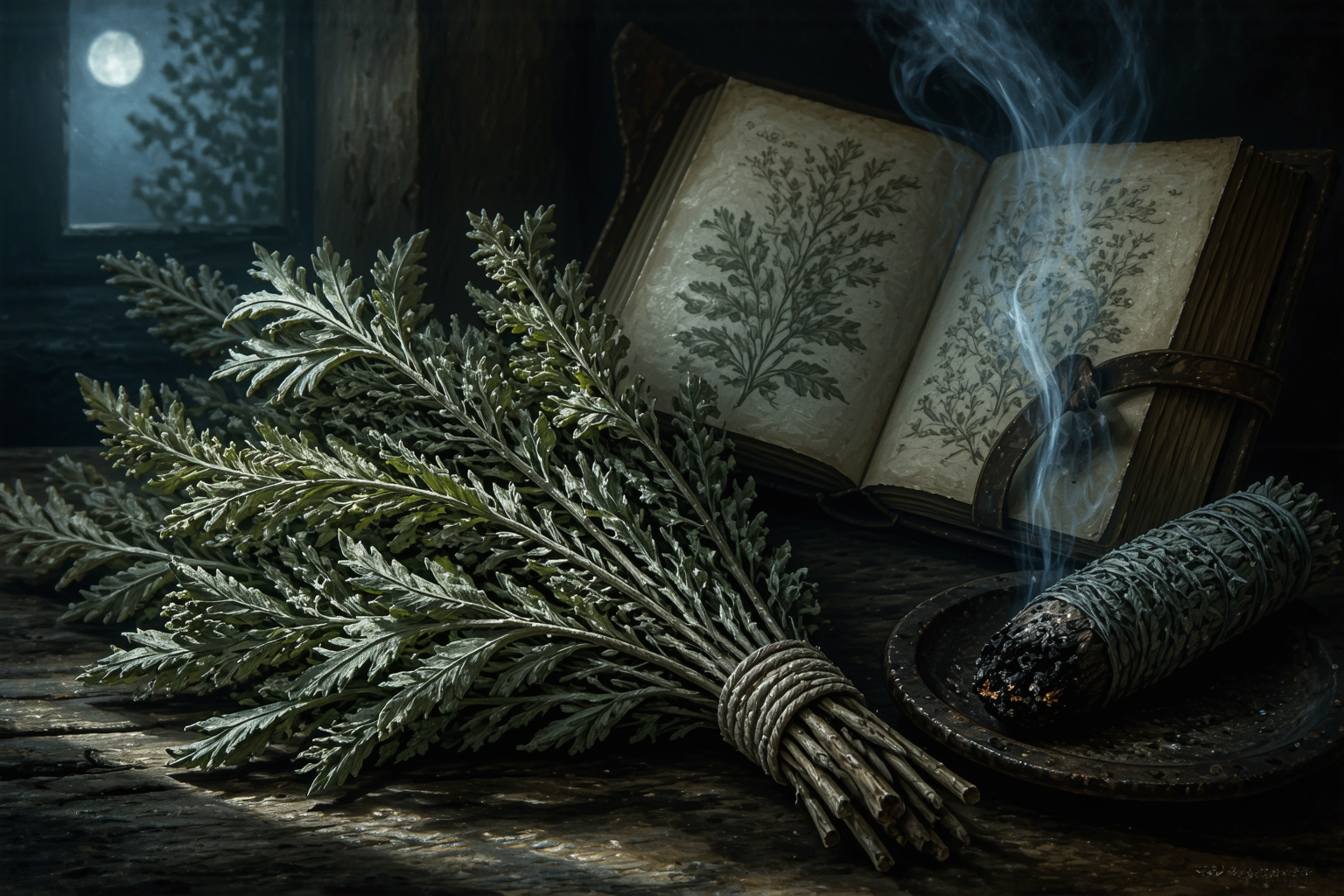
Artemisia vulgaris, the Mugwort, is the Moon’s own herb—a plant of silver undersides and nocturnal counsel. She rules the woman’s blood, kindles vision, and bears the reputation of both healer and hedge-witch. Let the reader mark her with respect.
Of Its Names and Nature
The plant I speak of bears the botanical name Artemisia vulgaris, a genus named for Artemis, the Moon goddess and virgin huntress—a fitting patronage for a herb so bound to the feminine mysteries and the night. It belongs to the Asteraceae family, kin to wormwood, yarrow, and chamomile, and grows wild in temperate lands across the Northern Hemisphere, as common as a weed along hedgerows, ditches, and waste ground.
The old herbalists knew her by many names. Cronewort she was called—the wise woman’s plant, the crone’s companion in matters of blood and prophecy. Felon herb, too, for her virtue in drawing out infection. The Anglo-Saxons named her St. John’s plant, and some say she was strewn on the roads before St. John’s processions. In the East, dried and prepared for burning on the skin, she is called moxa—from the Japanese mogusa—and this preparation remains central to the moxibustion of Chinese medicine to this day.
We use chiefly the leaf and the flowering top, gathered in high summer when the volatile oils peak. The plant stands two to four feet tall, with deeply lobed, feathery foliage that is green above and—most tellingly—clothed below in fine silver hairs. These silver-backed leaves catch the light like the underside of the moon itself, and in this doctrine of signatures, the plant declares its nature as a lunar herb. She rules under the Moon, that witness of the night, dreaming, and the tides of the female body.
Of Its Virtues
The old writers held mugwort foremost as an emmenagogue—that is, a herb that stirs and regulates the menses. Culpeper declared it “a strengthener of the womb” and prescribed it for women troubled by obstructed or scanty courses. Dioscorides knew her as a promoter of the female issue, and Galen endorsed her for warmth and drying action in matters of the blood. The traditional reading casts her as warm in the second degree and dry in the first, with a special affinity for the uterus and the circulation of the lower belly.
This reputation rests on sound ground. Modern phytochemistry has identified in mugwort volatile oils rich in thujone—the same volatile that gives her sharp, bitter character—and a host of sesquiterpene lactones whose bitter taste signals their digestive action. These constituents do indeed stimulate uterine muscle and encourage blood flow, making her a true, if powerful, emmenagogue. She is also a bitter tonic of the highest order; the old practitioners prescribed her as a digestive aid before meals, to kindle the digestive fire and clarify clouded appetite.
Yet mugwort’s most storied virtue—the one that has earned her place in folk medicine from Britain to Japan—is her power to kindle and clarify the dream. Place the dried leaf beneath the pillow, the tradition says, and the sleeper shall see visions vivid and strange. I have tested this myself; whether by some gentle action of the volatile oils on the sleeping mind, or by the authority of expectation, the effect is real. Many who use her report dreams of uncommon clarity and sometimes of prophecy or warning. This property made her sacred to the oracles and healers of the ancient world.
The moxa tradition—her burning on or above the skin in Asian medicine—speaks to a warming, vitalizing force. The heat penetrates deep; the smoke carries the plant’s essence into the meridians. Practitioners use it especially for cold, stagnant conditions and to turn breech presentations in pregnancy (though this application lies beyond the scope of a home reader). The burning releases and concentrates the plant’s warming and moving virtues.
Of Its Shadow
Yet every Moon has her dark face, and so does mugwort. She was sacred to Artemis not only as maiden but as guardian of the liminal spaces—the forest edge, the night, the threshold between the living and the dead. In the folklore of witches and wise women, mugwort held a place of honor; it was woven into the besoms of cunning folk, hung in doorways as a ward, and burned to aid in scrying and prophecy. But where the healer’s craft shades into the forbidden, mugwort follows.
The dreams she brings are not always benign. Those who sleep with her beneath the pillow sometimes report nightmares—visions disturbing, prophetic, or unwelcome. The old grimoires speak of her use in rites of divination and summoning, of her virtue in opening the sight to things hidden or dangerous. Medieval writers warned that excessive use could induce a sort of waking dream, a loosening of the hold on ordinary sense. The plant, in short, was feared as well as revered—a tool for those who knew what they were doing, and a peril to the curious.
More gravely still, mugwort’s emmenagogue power has long been understood as an abortifacient. The tradition is clear and unambiguous: women seeking to end a pregnancy have used mugwort for centuries, and it is potent enough to do real harm. This is not folklore invented to warn the foolish; it is hard historical fact. The plant’s very name in some tongues—motherwort in older usage (not to be confused with the herb Leonurus)—speaks to her dominion over the womb, for good or ill.
Of Its Degree of Poison
Mugwort is classed Degree III—Potent. Her volatile oil contains thujone, a terpene that in high doses acts as a convulsant and neurotoxin; her sesquiterpene lactones are powerful emmenagogues and uterine stimulants. Used carelessly or in excess, she can induce miscarriage, cause tremor, or provoke allergic reaction in those sensitive to the Asteraceae family.
Of Its Preparations
The art of working with mugwort lies in choosing the method that suits her nature and one’s intention. Let me lay out the principal paths, for not all are equally wise or safe.
- Dried leaf and infusion (tea). Dry the leaf in the shade after flowering, and steep it in hot water for five to ten minutes. The infusion is bitter, warming, and gentler than the fresh plant. This is the safest route for regular use as a digestive bitter—a small cupful before meals. It is also the method for the dream work: one may drink a cup an hour before bed, or simply place the dried herb beneath the pillow where no ingestion occurs.
- Tincture (spirit extraction). Fresh leaf tinctured in high-proof alcohol extracts and preserves the volatile oils beautifully. The bitterness is pronounced and the action swift. However, tincture concentrates the active principles; it should be used with caution and never in large or frequent doses. A few drops in water, taken once daily for a short period, is appropriate; long-term use invites toxicity.
- Smoking and burning (moxa). This is mugwort’s true native habitat. Dried leaf bound tightly into a stick or rolled into a thin paper and burned slowly, either held above the skin or placed on a rice base directly on it (though the latter requires trained hands), releases her warming and moving virtues with extraordinary power. The smoke alone—inhaled in ritual or healing space—is calming and clarifying. This is the method most aligned with her traditional use and safest for a home practitioner, as long as one does not apply the burning moxa to bare skin without proper training.
- Oil infusion and salve. Fresh leaf steeped gently in olive oil or rendered fat yields an ointment suitable for rubbing on the belly to ease menstrual cramps or stagnation. Strain carefully; the oil is warming and aromatic. Use externally only.
- Bath and wash. An infusion of dried mugwort added to bathwater makes a pleasant and gently warming wash; the ritual of bathing in it carries perhaps as much power as the chemistry. Safe and traditional.
- Fresh plant (raw). I do not recommend chewing or eating the fresh leaf. It is harsh, bitter to the point of burning, and the concentration of volatile oils is too high for safety without the tempering of drying or infusion. The fresh plant is best reserved for tincture-making.
- Calcination (spagyric work). The herbalist-alchemist may reduce the leaf to ash, leach it, and precipitate the mineral salt as part of a calcination working. The salt, being fixed and stable, loses the volatile thujone and represents the plant’s essence without its peril. This is esoteric work, suitable only for those with grounding in spagyric method.
For choosing among these paths, consult the guide to extraction methods and let your intention be your compass. Infusion for gentle, daily use and dream-work; tincture only for short-term, focused application; smoke for ritual, clarity, and warming; oil for external comfort. Never drink the fresh plant, and never apply burning moxa to skin unless trained.
A Word to the Living
Modern herbalists and physicians agree on mugwort’s potency and its serious limitations. Here are the facts you must know:
Do not use mugwort if you are pregnant or might be pregnant. The plant is a genuine emmenagogue and uterine stimulant; it has caused miscarriage and can cause serious harm to a developing pregnancy. This is not folklore—it is biochemistry and obstetric history. If you are of childbearing age and using mugwort regularly, use effective contraception or do not use the herb.
Thujone toxicity is real. Heavy or long-term use of mugwort—particularly the tincture or fresh plant—can cause tremor, dizziness, and nervous system irritation. Do not use it daily for months on end. If you use the infusion, limit it to two or three times weekly, and do not exceed a cupful per dose.
Asteraceae sensitivity is common. If you are allergic to ragweed, chrysanthemums, chamomile, or other members of this family, you may react to mugwort. Test it in small amounts first, and stop immediately if you develop any rash, swelling, or difficulty breathing.
Do not self-treat hormonal or menstrual conditions. While the old herbalists prescribed mugwort widely, hormonal health is complex and easily worsened by the wrong herb, dose, or method. A qualified practitioner—herbalist, midwife, or physician—should guide any use of this plant for menstrual or reproductive concerns.
This entry is historical and folkloric, not medical advice. I have set down what the tradition knew and what I have learned in my practice. But you live in a time of regulated medicine and legal liability. Before you use mugwort internally, consult a qualified herbalist or physician. The dream pillow, the bath, and the smoke are low-risk; the infusion and tincture demand caution and knowledge. Do not dose yourself. Do not treat pregnancy or serious illness with herbs alone.
The Moon is beautiful and terrible. Mugwort is her messenger. Treat her with the reverence she deserves—and the caution she demands.
Frequently Asked Questions
Why is mugwort called a lunar herb?
In the doctrine of signatures, mugwort’s deeply lobed leaves are green above but clothed below in fine silver hairs that catch the light like the underside of the moon itself. This silver-backed appearance declares her nature as a lunar herb, and in spagyric tradition she rules under the Moon, that witness of the night, dreaming, and the tides of the female body.
What is mugwort’s connection to moxa and moxibustion?
Dried and prepared for burning on the skin, mugwort is called moxa, from the Japanese mogusa, and this preparation remains central to the moxibustion of Chinese medicine to this day. The burning releases the plant’s warming and moving virtues; the heat penetrates deep and the smoke carries the plant’s essence into the meridians.
What are the safety concerns with mugwort use?
Mugwort is classed Degree III—Potent. Her volatile oil contains thujone, a terpene that in high doses acts as a convulsant and neurotoxin. Used carelessly or in excess, she can induce miscarriage, cause tremor, or provoke allergic reaction in those sensitive to the Asteraceae family. Do not use if pregnant or possibly pregnant.
How is mugwort traditionally used for dream work?
The tradition holds that placing dried leaf beneath the pillow brings vivid and strange visions, and some drink a cup of infusion an hour before bed. The dreams are not always benign; some report nightmares. Heed the warning that goes with it: do not use mugwort if you are pregnant or might be pregnant, and never drink the fresh plant.
About This Article

Written by Kyle Bamboo. Kyle Bamboo has spent twelve years following the hermetic tradition of herbalism out of dusty reprints and into a home apothecary — spagyrics, planetary correspondences, and the strange internal logic of plant alchemy. Muddle and Mend takes its name from solve et coagula, dissolve and combine. He writes about the actual tradition, with its history, its vocabulary, and its genuine strangeness, not the Instagram version. More about this site.
Scope and limits. Kyle writes from a personal practice in traditional herbalism, not clinical training. Herbs interact with prescription medications and are not regulated as drugs — check interactions and talk to a pharmacist or clinician before taking anything.
Verify this against a primary source
Specifics change, and your situation may differ from the one described here. These are the authorities worth checking directly:
- NCCIH — herb safety, evidence and known interactions
- MedlinePlus Herbs and Supplements — documented interactions and cautions
- FDA Dietary Supplements — regulatory status and safety alerts