Artemisia absinthium, the green bitter of Mars, stands among the most storied and contentious plants in the Western apothecary—a worm-expeller, a digestive awakener, and the botanical ghost that haunts the absinthe bottle and the fevered dreams of nineteenth-century Paris.
Of Its Names and Nature
The plant is called by its Latinate name Artemisia absinthium L., a member of the Asteraceae family—the daisies and their kin. Common speech names it wormwood, absinthe, or green ginger; the old herbals knew it as old woman, warmwood, and wermod. The name wormwood itself speaks plainly: an herb that expels worms, from the Anglo-Saxon wyrmwōd, worm-wood. It is the aerial parts—the leaves and small flowering stems gathered in high summer—that hold the virtue, though the root has its use in the hands of the learned.
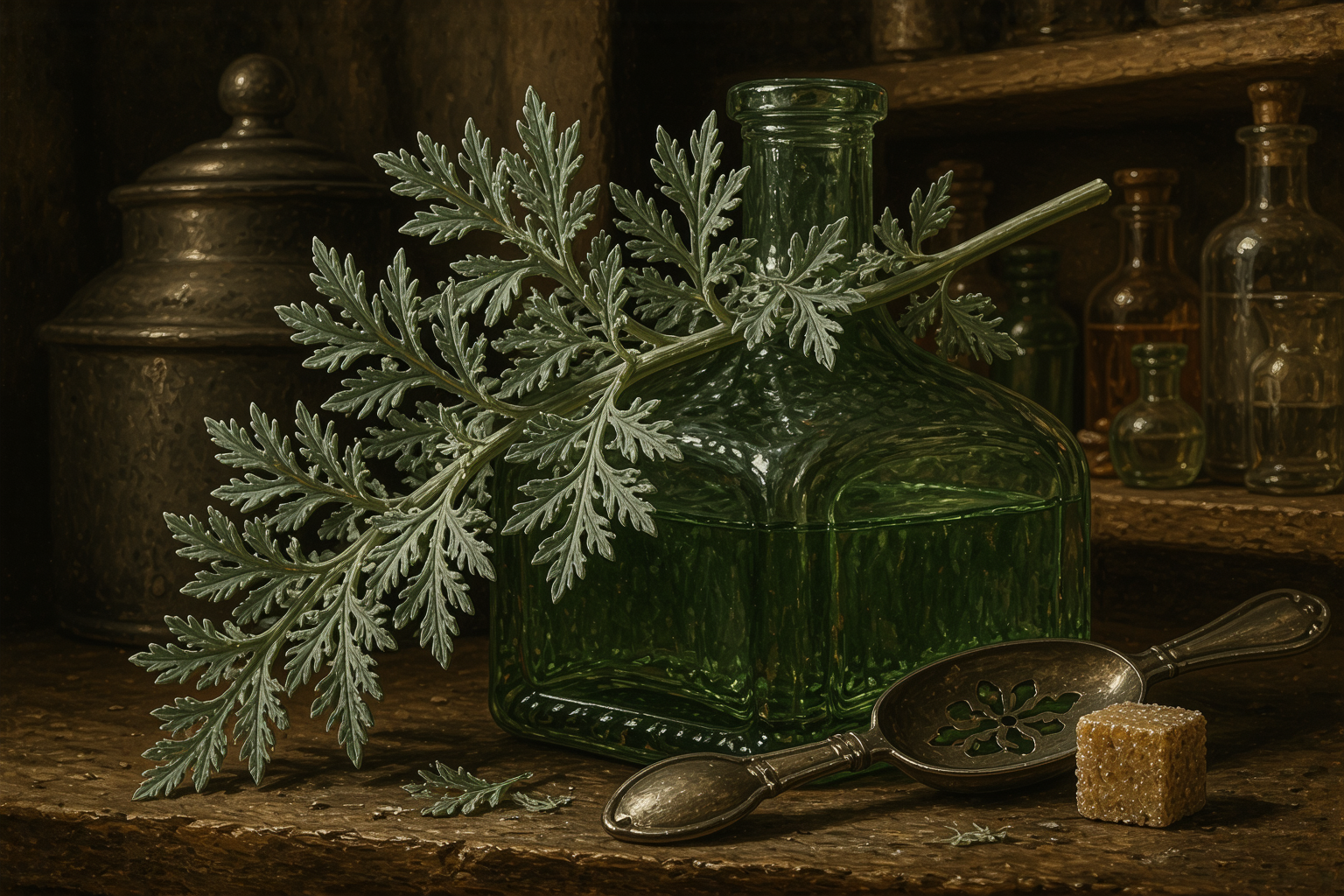
The plant stands two to three feet high, a silver-green ghost of a thing, hairy and fine-leaved, with flowers like dust. It is unmistakable to the nose: crush a leaf and you meet a bitterness so sharp it seems to enter the skull itself. The whole plant exudes a resinous warmth. Wormwood is ruled by Mars, that planet of heat, dryness, and vigorous resistance—the martial virtues of bitterness and the expulsive force. Its form, moreover, declares its doctrine: the fine, threadlike leaves speak to its power against worms, those thread-like invaders of the belly.
Of Its Virtues
I hold wormwood to be the sovereign bitter tonic of the Western tradition. Dioscorides prescribed it for the worms that plague children and swine; Galen deemed it hot and dry in the third degree, fit to kindle the digestive fire; Gerard called it “a singular remedy against worms,” and Culpeper set down its use as one of the surest anthelmintics known. The old humoral writers agreed: its heat and dryness restore appetite, stimulate the secretion of bile, and kindle the sluggish digestion of those enfeebled by disease or melancholy.
What does the modern enquirer find? Wormwood contains thujone, a volatile ketone of real potency (and, as I shall note, real peril in excess), and the intensely bitter compound absinthin. These constituents do indeed stimulate bile flow, and there is evidence that wormwood preparations increase gastric secretion and ease the inflammation of the gut. The anthelmintic claim has been investigated: in animal studies, wormwood shows activity against certain parasites, though the doses required bear scrutiny. The tradition was not mistaken, but neither has science crowned it with certainty. I counsel the reader that for worm infestation—in our modern age a rarer thing—a physician’s guidance is needful.
Beyond the belly, wormwood has been used as a febrifuge (to cool burning fevers), as a tonic for the liver and spleen when these organs fall into sluggish complaint, and as a bitter restorative for those broken by long illness. Vermouth—whose name is the French corruption of the German “Wermut”—takes wormwood as its defining botanical; a small glass before meat was long held to ready the stomach for its work. The tradition of the absinthe spoon, too, speaks to this: the green liqueur was meant (in theory, at least) to be taken as a digestive cordial, not as the intoxicant it became.
Of Its Shadow
Yet wormwood carries with it a darkness that no apothecary may ignore. In the Book of Revelation, the star Wormwood falls upon the waters and makes them bitter—a sign of calamity and the poisoning of sustenance. The plant became, by this association, a symbol of desolation, bitterness of spirit, and the ruin of hope. Medieval herbals sometimes refused to name it plainly, speaking instead of “the herb that turns the waters bitter” or wrapping it in apotropaic verse.
The nineteenth century brought forth a new darkness: the absinthe panic. As absinthe drinking spread through France and Europe—reaching heights of frenzied consumption among the urban poor—a moral and medical terror arose. The spirit was blamed for madness, for “absinthism,” for the peculiar green sickness that seemed to afflict the drinkers of la fée verte. Wormwood itself was accused; thujone was isolated, its neurotoxic properties noted, and the plant was made a scapegoat for the ravages of chronic alcoholism and, as modern scholarship has shown, of adulterated spirits laced with metals and industrial toxins.
In folklore, wormwood was gathered with ceremony and caution; some held that it must be cut with a blessing, lest it bring malice upon the house where it was dried. The plant is associated with farewell, with the parting of lovers, and with the bitterness of remembrance. In some regions it was hung in chambers of the dying—whether to ease their passage or to mark the threshold between life and death, I cannot say with certainty. It is a plant of grief made manifest, the green signature of all that turns sour.
Of Its Degree of Poison
Wormwood is of Degree III—Potent. The essential oil and the isolated thujone are genuine neurotoxins; in quantity, thujone causes tremors, convulsions, and damage to the central nervous system. The whole-herb infusion, taken in the doses long hallowed by tradition, is far safer than the oil, yet it is not a plant for the careless or the greedy. Cumulative toxicity is possible with prolonged use. The danger is real; it is not a plant of comfort but of medicine.
Of Its Preparations
The reader should consult the entry on choosing the right extraction for a fuller account; here I set down what suits wormwood and what does not.
- Infusion (leaf tea): Wormwood is a supreme subject for the infusion—the traditional steep of dried leaf in hot water. The bitterness is intense; most take it in small cup-fuls, well-diluted with honey or lemon to ease the blow to the palate. This is the safest and most traditional form. Never exceed a cupful of weak infusion daily, and not for more than two to three weeks at a stretch.
- Decoction: Not needful; the leaf requires no prolonged heat. A short steep suffices.
- Spirit tincture (bitters): Wormwood takes well to alcohol. A maceration of the dried herb in spirits for two to four weeks yields a powerful tincture, dark and bitter, which may be taken in drops (10–15 in a little water) before meals. This concentrates the virtue and also preserves it; such a preparation will keep for years.
- The vermouth and absinthe tradition: Wormwood was long steeped in wine or spirits with other botanicals (anise, fennel, hyssop, angelica, and more) to create digestive cordials. These belong to the apothecary of the household, not the home clinic; they are pleasant aperitifs, but their medicinal standing is modest.
- Dried whole herb: May be dried and stored; the bitterness fades only slowly. Keep in a cool, dark place.
- Essential oil: Never internally. The essential oil is far too concentrated; a few drops can cause serious toxicity. It belongs only to the perfumer or the external bath.
- Poultice or wash: A decoction may be used as a wash for wounds slow to heal or for the cleaning of surfaces; this is safe.
- Calcination: In spagyric work, wormwood may be burned to ash and the salt extracted; the salt principle thus obtained is said to retain the mineral essence of the plant, refined of its volatile dangers. This is work for the adept, not the apprentice.
A Word to the Living
Stop here. This entry is historical and folkloric. It is not medical advice.
Wormwood contains thujone, a documented neurotoxin. The essential oil is toxic and must never be taken internally under any circumstance. Even the leaf infusion is powerful and must be used with restraint: no more than a weak cup once daily, and only for short periods (two to three weeks maximum). Do not use wormwood if you are pregnant or breastfeeding; it may stimulate uterine contractions and is not safe for the unborn. Do not use it if you have epilepsy or a seizure disorder, as thujone lowers the seizure threshold. If you take warfarin or other anticoagulants, ask your doctor before using wormwood, as it may interact. Do not self-treat intestinal parasites with wormwood; a proper diagnosis and a physician’s guidance are necessary.
If you wish to explore wormwood’s use in your health, consult a qualified herbalist, naturopath, or physician. Do not dose yourself on the basis of historical texts or folklore. This plant has genuine power, and genuine power requires genuine knowledge and caution.
Frequently Asked Questions
Why is wormwood called the green bitter of Mars?
In this tradition, wormwood is ruled by Mars, the planet of heat, dryness, and vigorous resistance. Its martial virtues are bitterness and expulsive force. The plant’s form—its fine, threadlike leaves—declares its doctrine, speaking to its power against worms, those thread-like invaders of the belly.
What historical figures used wormwood as an anthelmintic?
Dioscorides prescribed it for worms plaguing children and swine. Galen deemed it hot and dry in the third degree, fit to kindle digestive fire. Gerard called it a singular remedy against worms, and Culpeper set it down as one of the surest anthelmintics known.
How is wormwood safely prepared as an infusion?
Wormwood is a supreme subject for infusion—steeped dried leaf in hot water. The bitterness is intense; most take it in small cupfuls, well-diluted with honey or lemon. The tradition advises never exceeding a cupful of weak infusion daily, and not for more than two to three weeks at a stretch.
Why did wormwood become associated with the absinthe panic?
As absinthe drinking spread through France and Europe in the nineteenth century, a moral and medical terror arose. Wormwood was accused of causing madness and absinthism. Thujone was isolated and its neurotoxic properties noted, making the plant a scapegoat for chronic alcoholism and adulterated spirits laced with metals and toxins.
About This Article

Written by Kyle Bamboo. Kyle Bamboo has spent twelve years following the hermetic tradition of herbalism out of dusty reprints and into a home apothecary — spagyrics, planetary correspondences, and the strange internal logic of plant alchemy. Muddle and Mend takes its name from solve et coagula, dissolve and combine. He writes about the actual tradition, with its history, its vocabulary, and its genuine strangeness, not the Instagram version. More about this site.
Scope and limits. Kyle writes from a personal practice in traditional herbalism, not clinical training. Herbs interact with prescription medications and are not regulated as drugs — check interactions and talk to a pharmacist or clinician before taking anything.
Verify this against a primary source
Specifics change, and your situation may differ from the one described here. These are the authorities worth checking directly:
- NCCIH — herb safety, evidence and known interactions
- MedlinePlus Herbs and Supplements — documented interactions and cautions
- FDA Dietary Supplements — regulatory status and safety alerts