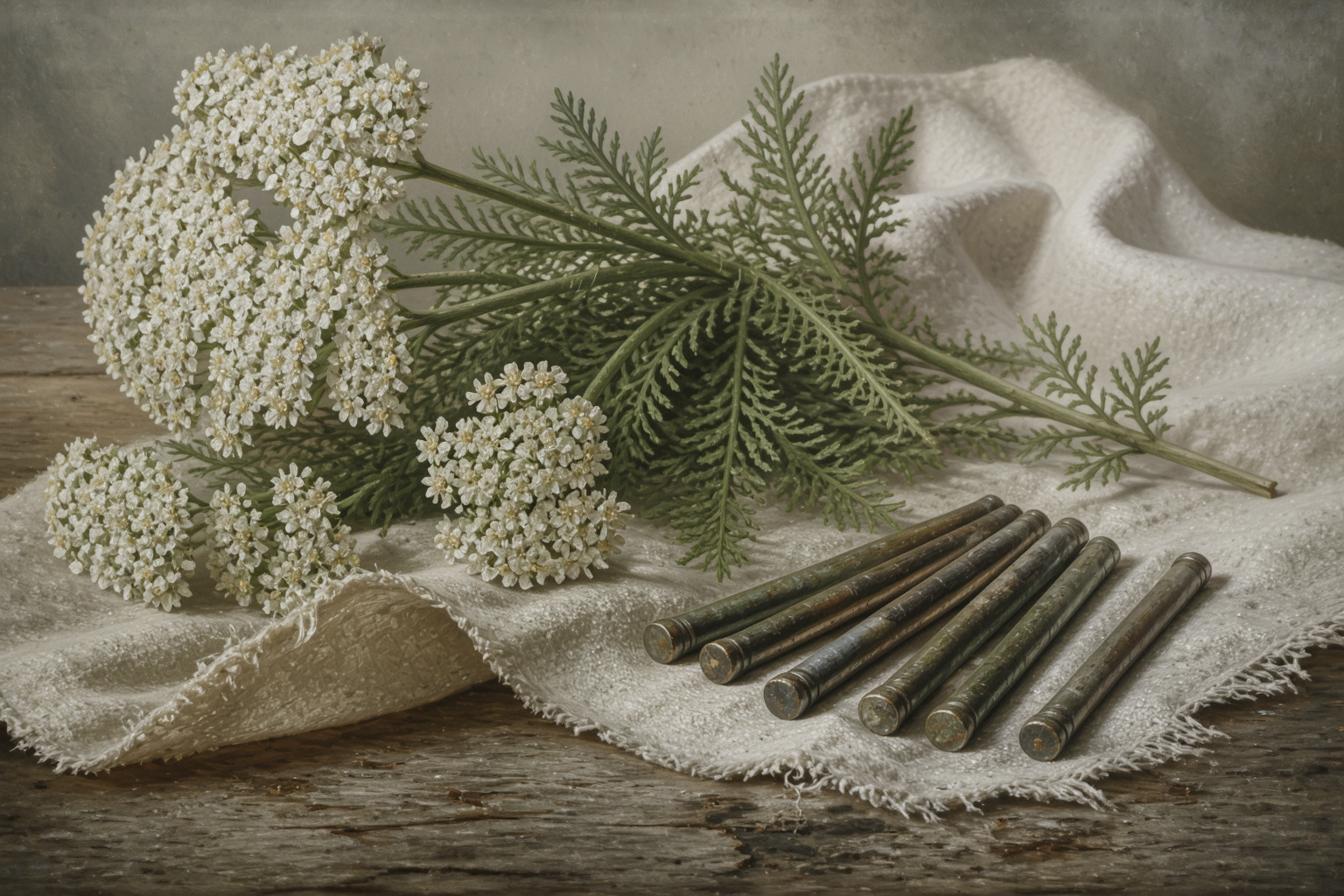
Yarrow, Achillea millefolium, is the great styptic and fever-herb of Western herbalism—a plant ruled by Venus yet bearing a martial edge, equally famed for stanching the blood of warriors and for divining the secrets of the heart. I hold it to be one of the true normalizers of the green medicine cabinet, and no herbalist’s tradition is complete without it.
Of Its Names and Nature
The plant answers to many names, each bearing the mark of its ancient repute. In English it is called soldier’s woundwort, staunchweed, nosebleed (a name that reveals both its virtue and its shadow), devil’s nettle, and carpenter’s herb. The old herbalists knew it as milfoil, from the finely divided leaves—a thousand leaves, they seemed to say, on a single stem. The botanical name honors Achilles, whom the tradition credits with learning the plant’s use from the centaur Chiron, and employing it to stanch the wounds of his soldiers at Troy. It belongs to the Asteraceae, that noble family of the daisy and the chamomile.
The herb itself grows freely in temperate meadows and roadsides. Its stem is tough and finely hairy; its leaves are feathery and fern-like, finely cut into thread-like segments—a signature of their penetrating, subdividing action. The flowers are clustered in flat-topped cymes (the umbel-like head) and range in color from pink to white, pale yellow to crimson, depending on the variety. The whole plant exhales a peppery, slightly medicinal aroma.
Yarrow is ruled by Venus, the planet of harmony and the opening of closed things—yet in its styptic action and its old use in the hands of warriors, it bears the signature of Mars as well. It is a plant that unites; it closes wounds and yet opens the pores to sweat. The parts used are the flowering aerial tops, gathered when in bloom.
Of Its Virtues
The tradition ascribes to yarrow five principal virtues, and I have found all of them borne out by my own use and by the testimonies of those herbalists whose judgment I trust.
First, the styptic action. Dioscorides knew yarrow as a stancher of wounds, and Galen employed it in his practice as a healer of fresh cuts and abrasions. This action—the arrest of bleeding—proceeds from the presence of achilleine, a compound whose name itself declares its lineage, and from the flavonoids and resins that bind and seal the wound tissues. I have applied the fresh herb, bruised into a poultice or pressed as a juice, directly to cuts, and the bleeding ceases promptly. This is no fancy; it is a plain fact of the plant’s chemistry.
Second, the diaphoretic and fever-breaking virtue. Culpeper noted that yarrow “opens the pores and causes a sweat,” and the old herbalists reached for it in fevers of the acute sort—those burning heats where the body is closed and the sweat will not come. The mechanism is gentle: the plant’s volatile oils and bitter principles stimulate the skin and the digestive fire, coaxing the body into a productive sweat that breaks the fever. The azulene and chamazulene compounds in yarrow—the same that give it its blue tincture when extracted—carry anti-inflammatory and warming properties. Modern inquiry has confirmed this; yarrow infusion does indeed lower a fever by promoting diaphoresis.
Third, the bitter digestive action. As a plant of Venus, yarrow has long been used to settle the stomach and to aid digestion. Its bitterness stimulates the flow of bile and gastric juices, making it serviceable in sluggish digestion, loss of appetite, and mild dyspepsia. I prescribe it to those whose digestion is weak and whose appetite has faded, and I have found it brings a slow and steady recovery of the appetite and the digestive fire.
Fourth, the virtue of normalization. This is the most subtle of its actions and the most difficult to articulate in the cold language of chemistry. Yet the tradition, with one voice, testifies that yarrow restores balance—that it acts as a regulator. Whether the system is too hot or too cold, too moist or too dry, yarrow seems to nudge it toward the middle. For this reason, I have used it long-term in cases of constitutional imbalance, and I have seen good results. The flavonoids and the resins likely account for this; they are gentle and broad-acting substances, not sledgehammer drugs.
Fifth, a tonic and astringent action upon the vessels. Yarrow has long been held to be a strengthener of the veins and arteries. Pliny spoke of it in this regard, and the old herbalists employed it to support the circulatory system in cases of fragile capillaries and poor tone. The compounds I have named—the flavonoids especially—are known to strengthen vascular walls.
Of Its Shadow
Yet yarrow is not without its dark lore, and the old writers are not silent on the matter. If it is called staunchweed for its healing, it is called nosebleed for a darker reason: there existed an old belief—I do not credit it, but I report it—that the mere presence of yarrow could provoke a nosebleed, that it possessed a malign potency in that regard. Whether this arose from confusion, from a particular sensitivity in certain bodies, or from mere superstition, I cannot say. But the name persists.
The plant has also long been entangled with the lore of divination and witchcraft. The stalks of yarrow, when dried, are traditionally used as the divining tokens of the I Ching—that great Chinese oracle—and the herb has been employed in love divination and in the reading of hidden things. In some European folklore, it is associated with melancholy, with the devil, and with the boundary between the living and the dead. An old superstition held that one must gather it with ceremony and with a particular regard for the moon’s phase, lest it turn against the gatherer. These beliefs I set down as ethnographic fact, not as endorsement; yet they speak to something in the plant’s nature—a power that demands respect and right intention.
Of Its Degree of Poison
Degree I–II (Benign to Temperate). Yarrow is fundamentally safe; it is a food-herb in many traditions and carries no serious toxin. The cautions that attend it are constitutional—allergy to the Asteraceae family, a mild photosensitivity in some sensitive individuals, and its emmenagogue action, which counsels against use in pregnancy—not true toxicity.
Of Its Preparations
Let the reader mark the following methods, each suited to a different virtue of the plant:
- Fresh poultice or bruised herb: For acute wounds and fresh bleeding, gather the aerial parts in season, crush them between the hands or with a mortar, and apply directly to the wound. This is the truest and most direct use of yarrow’s styptic virtue.
- Infusion (steeped tea): Steep one teaspoon of dried herb (or two teaspoons of fresh) in a cup of hot (not boiling) water for 5–10 minutes. Strain and drink warm. This is the proper preparation for the diaphoretic and digestive actions, and may be taken as a fever tea or as a gentle tonic. Infusion suits the delicate oils and the volatile principles far better than prolonged heat.
- Tincture in alcohol (spirit): Yarrow tinctures beautifully. Take the dried herb, chop it finely, and macerate in 40% alcohol (vodka or brandy) for two to four weeks, then press and bottle. This extraction captures both the volatile and the resinous principles, and yields a preparation of broad utility. Dose by drops in water.
- Oil or salve: Infuse the dried herb in a neutral oil (sweet almond, sunflower) by solar or slow heat, or use an alcohol tincture as your base and add it to melted beeswax and oil. These preparations are excellent for wound care and as a circulatory rub.
- Fresh juice: The expressed juice of the flowering plant, taken in small doses, is a traditional remedy for fever and for sluggish digestion. This is a living preparation and must be used quickly.
- Dried stalks for divination: The dried stems, cut into equal lengths and bundled, have long served as the divining tokens of the I Ching. Gather them in late summer or early autumn, dry them thoroughly, and store in a clean, dry place.
- Calcined salt: The herbalist inclined toward spagyric work may burn yarrow in a clean vessel and collect the ash, then calcine it further and dissolve it in distilled vinegar to produce a salt of profound virtue. This calcination and redemption of the salt is said to concentrate and perfect the plant’s normalizing action. Such work is beyond the scope of the household herbalist, but I note it for those with the skill and patience.
A Word to the Living
Drop the old language now: what you need to know in plain terms.
Yarrow is genuinely safe for most people. You can use it as an everyday tea without worry. However: if you are allergic to ragweed, chrysanthemums, or other plants in the daisy family (Asteraceae), you may react to yarrow—start small or avoid it. Some people report that yarrow makes their skin more photosensitive; if you’re on photosensitizing medications or have sensitive skin, be cautious about strong sun exposure after drinking yarrow tea. Do not use yarrow if you are pregnant—it can stimulate uterine contractions. If you have a clotting disorder or take blood thinners, talk to your doctor before using yarrow regularly, since it does affect blood coagulation.
This entry is historical and folkloric in nature, not medical advice. If you have a wound that won’t stop bleeding, a fever, or any other health concern, see a doctor or qualified medical herbalist. Do not self-diagnose or self-treat serious conditions. Yarrow is a tool in a much larger toolkit, and it is not a substitute for professional care.
Frequently Asked Questions
Why is yarrow called soldier’s woundwort?
In the tradition, Achilles learned yarrow’s use from the centaur Chiron and employed it to stanch the wounds of his soldiers at Troy. The styptic action—the arrest of bleeding—proceeds from achilleine and from flavonoids and resins that bind and seal wound tissues.
What planetary rulership does yarrow hold?
Yarrow is ruled by Venus, the planet of harmony and the opening of closed things, yet it bears the signature of Mars in its styptic action and its old use by warriors. The tradition holds it as a plant that unites—it closes wounds and opens the pores to sweat.
How do you make a yarrow infusion for fever?
Steep one teaspoon of dried herb, or two of fresh, in a cup of hot but not boiling water for five to ten minutes, then strain and drink warm. Do not use yarrow if you are pregnant, as it can stimulate uterine contractions, and if you react to ragweed or other Asteraceae, start small or avoid it. This is not medical advice.
What safety concerns attend yarrow use?
Yarrow is fundamentally safe, but cautions include allergy to the Asteraceae family, mild photosensitivity in sensitive individuals, and its emmenagogue action, which counsels against use in pregnancy. If you have a clotting disorder or take blood thinners, consult your doctor before regular use.
About This Article

Written by Kyle Bamboo. Kyle Bamboo has spent twelve years following the hermetic tradition of herbalism out of dusty reprints and into a home apothecary — spagyrics, planetary correspondences, and the strange internal logic of plant alchemy. Muddle and Mend takes its name from solve et coagula, dissolve and combine. He writes about the actual tradition, with its history, its vocabulary, and its genuine strangeness, not the Instagram version. More about this site.
Scope and limits. Kyle writes from a personal practice in traditional herbalism, not clinical training. Herbs interact with prescription medications and are not regulated as drugs — check interactions and talk to a pharmacist or clinician before taking anything.
Verify this against a primary source
Specifics change, and your situation may differ from the one described here. These are the authorities worth checking directly:
- NCCIH — herb safety, evidence and known interactions
- MedlinePlus Herbs and Supplements — documented interactions and cautions
- FDA Dietary Supplements — regulatory status and safety alerts