Angelica archangelica, the great warming root of northern Europe, ruled by the Sun and called in old times the Root of the Holy Ghost—a herb of protection, of digestion, and of the plague-spirit’s ancient terror. I set down here what I have gathered from the tradition and from my own bench regarding this noble and singular plant.
Of Its Names and Nature
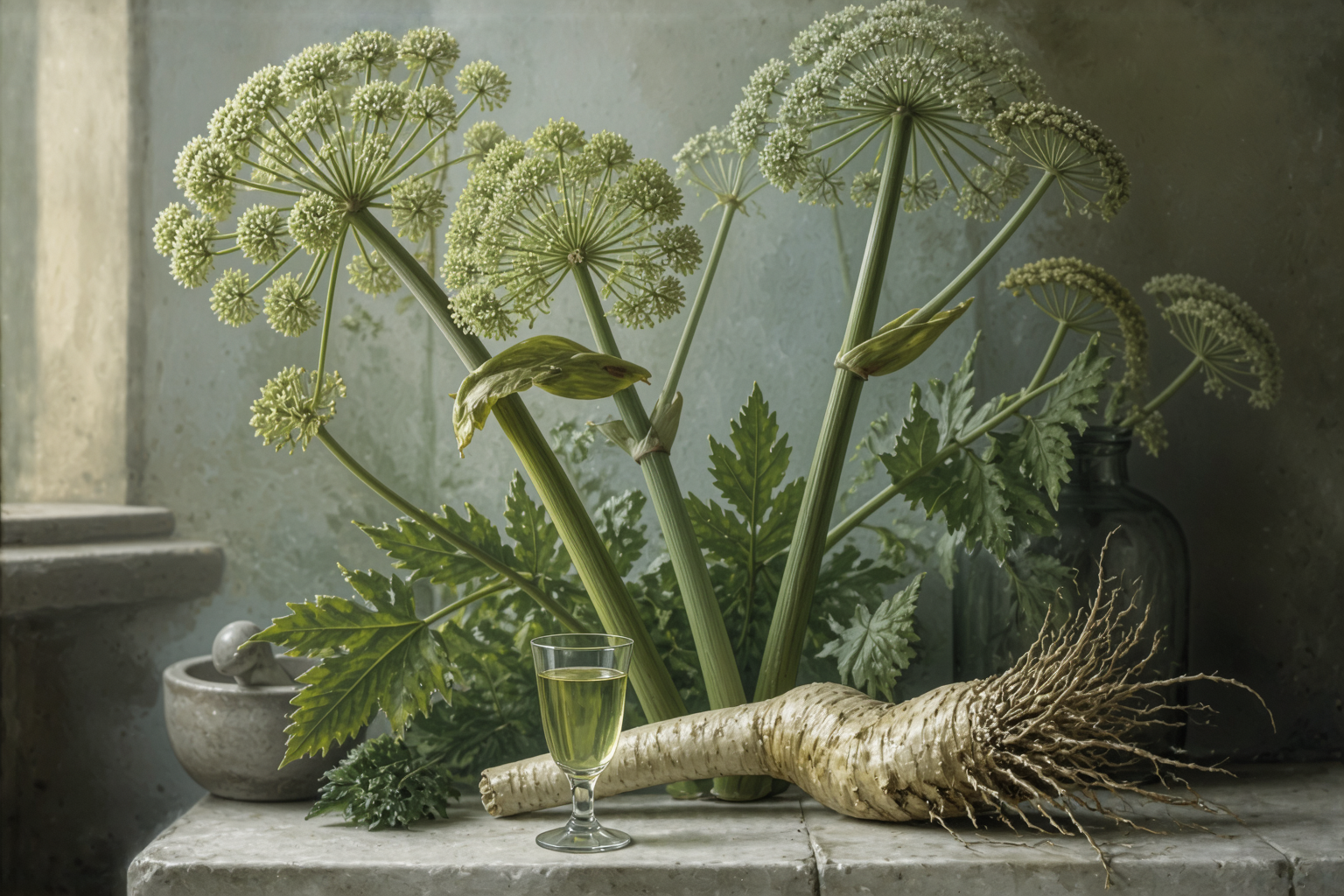
The plant bears the scholarly name Angelica archangelica and dwells in the great family Apiaceae, kin to fennel, parsnip, and the perilous hemlock. The common names speak its character: archangel, masterwort, wild celery, and that most reverent of all—the Root of the Holy Ghost, for legend holds that the Archangel Michael (or in some tellings Raphael) revealed it as a cure against the plague in the terrible year of 1348. The part we gather is the root, harvested in autumn after the plant’s second year, when the Sun’s heat has drawn the virtue deep into the earth. The stem, too, is used—pale green, thick, hollow, and candied by the confectioner’s art into a golden sweetmeat.
Angelica rules beneath the Sun, that great luminary of warmth, protection, and vital force. The plant wears the doctrine of signatures plainly: its tall umbel flowers—those broad, flat-topped clusters of tiny gold blooms—turn upward like hands in prayer or supplication to heaven. The root itself, when dried, becomes light and spongy, as though the plant had breathed itself into the ethereal realm. Its correspondence with the Sun marks it as a herb of illumination and wholeness—a plant that stands apart from the shadow-loving nightshades and the lunar mysteries.
Of Its Virtues
The old writers—Dioscorides, Gerard, and Culpeper—held angelica in high esteem as a warming, drying herb of the Sun, belonging to the second degree of heat. Galen praised it for moving the blood and dispersing stubborn cold humours. I hold with them in this: angelica possesses a genuine carminative virtue, warming the belly and settling the spasms that attend digestion. The root, when decocted, eases wind and bloating, quiets cramps, and awakens a sluggish appetite. The bitters in it—those volatile oils and the bitter aromatic note that lends its character to Chartreuse and Bénédictine—belong to the monastic elixir tradition, where the liqueur-makers of the Alps preserved its warming force for winter and for times of plague.
The old herbalists prized angelica above all for its expectorant action: chewed and carried in the great pestilences, it was held to clear the lungs and fortify the breath against the miasmic air that brought fever and death. Modern chemistry confirms the presence of furanocoumarins and volatile oils—compounds that do indeed stimulate secretion and warm the tissues. The reputation as a plague-herb, while bound up in fear and superstition, rests on a real pharmacological foundation: a warming carminative with genuine action on the respiratory tract. Where tradition claims it “strengthens the heart,” we must be cautious; this likely refers to its warming effect on the cardiac circulation and the ease it brings to the anxious, shallow breath of grief or dread.
Of Its Shadow
It is a curious thing, and worth marking, that angelica bears almost no shadow in the folklore—or rather, its shadow is the inversion of its light. Where most medicinal plants carry a darker reputation, a tincture of maleficence or death, angelica stands nearly spotless. The old tradition held it as a ward against witchcraft and the plague-spirit itself; it was carried as an amulet, hung above doors, and placed beneath the pillow of the fevered to draw down the archangel’s protection. In a tradition steeped in the fear of evil eye, of maleficium, and of the spirits that rode the pestilent air, angelica emerged as wholly benevolent—a herb that repelled rather than attracted darkness.
This is a rarity. The researcher who moves through the old herbals encounters many plants shadowed by witchery, by poison, by associations with death and the grave. Angelica, by contrast, wears the light of heaven. The very legend of its naming—revealed by an archangel in answer to prayer—lifts it beyond the merely natural into the sacred. Some held that it bloomed always near the Michaelmas of the Apparition, the eighth of May, as though it kept its holy calendar. Whether one reads this as folklore or as an old memory of an herb’s true phenology, the mark is clear: this plant belonged to the diurnal world, to prayer and healing, not to the nocturnal and the fell.
Of Its Degree of Poison
Angelica archangelica is of Degree II—Temperate. It is safe in ordinary culinary and traditional use, yet the reader must mark two genuine cautions: the furanocoumarins it contains render the skin phototoxic (meaning that contact with the fresh plant followed by sun exposure may cause a blistering eruption), and it is an emmenagogue—that is, it stirs the menses and may precipitate miscarriage in pregnancy. Do not confuse it with its deadly kindred in the Apiaceae: water hemlock (Cicuta virosa) and poison hemlock (Conium maculatum) are Degree V poisons that can kill in small doses, and the unwary forager has paid with his life for such error.
Of Its Preparations
Angelica yields its virtue by many means, and the choice of extraction shapes the result. Let me set forth what I have found to suit this plant:
- Decoction of the root — This is the sovereign preparation. Simmer one dram of dried root in a pint of water for fifteen to twenty minutes; strain while warm. The heat draws forth the volatile oils and the bitter principles. Drink half a cup before meals to settle digestion, or in small sips throughout the day as a general tonic. This is safe and traditional.
- Tincture in high-proof spirit — The root may be tinctured in brandy or neutral alcohol at a ratio of 1 part dried root to 5 parts spirit, macerated in a dark place for two to four weeks. A teaspoon or two of this tincture—a dose of the old apothecaries—stirs the digestion and settles the nerves. The alcohol extracts the aromatic compounds excellently.
- Candied stem — A genuine preparation, much favoured in the confectioner’s art. Fresh young stems are cut in spring, simmered gently in sugar syrup until translucent, then rolled in coarse sugar and dried. These sweetmeats were eaten as a digestive aid and as a ward against plague-miasma. They are both nourishment and medicine.
- Infused honey — The root may be macerated in raw honey for several weeks; the result is a amber-gold sweetness that carries the plant’s warming virtue. A spoonful taken before sleep aids digestion and settles a restless belly.
- The liqueur preparation — Chartreuse and Bénédictine both honour angelica as a cornerstone herb. A simple steep of the root and other aromatics in brandy or high-proof spirit, left to infuse for weeks, then strained and subtly sweetened, yields a digestive elixir in the monastic tradition.
- Fresh plant contact — Handle the fresh green stems and leaves with care if the skin is to meet sunlight. Wear gloves, or handle in shadow. The phototoxic furanocoumarins will cause no harm if the plant is not exposed to strong sun directly thereafter.
- Infusion (hot steep) — While the decoction is superior, a hot infusion of dried root in boiling water (steeped ten to fifteen minutes) will serve. The result is less potent than a decoction but still virtuous.
- Calcination to salt — In the spagyric art, the dried root may be burned to ash, leeched in water, and crystallized to yield angelica salt—a quintessence of the plant’s solar virtue. This is an advanced work, belonging to the calcination and refinement of the three principles: salt, sulfur, and mercury. Small doses of such a salt—a grain or two—are said to carry the plant’s essence in the purest form.
I do not advise smoking angelica root, as is sometimes done with other aromatics. The heat and smoke destroy much of what makes this herb valuable; the decoction or the tincture will serve far better.
A Word to the Living
This entry is a historical and folkloric account. It is not medical advice, and you should not use it to treat, diagnose, or prevent any disease. If you are considering using angelica, consult a qualified herbalist or physician first.
Safety facts: Angelica root contains furanocoumarins, compounds that cause phototoxic reactions. If you handle the fresh plant, wear gloves and keep your skin out of direct sunlight for at least 12–24 hours afterward, or do not handle it in the sun at all. Angelica is an emmenagogue—it stimulates menstruation and can trigger miscarriage. Do not use it if you are pregnant, nursing, or trying to become pregnant. If you take blood thinners (warfarin, aspirin, other anticoagulants) or have a bleeding disorder, do not use angelica without medical clearance. Some people are allergic to plants in the Apiaceae family; discontinue use if you experience rash, swelling, or difficulty breathing.
Critical warning: Do not forage angelica from the wild unless you are absolutely certain of your identification. Water hemlock and poison hemlock are deadly Apiaceae look-alikes that grow in similar habitats. Water hemlock kills in doses as small as a few leaves; poison hemlock causes severe chemical burns and internal poisoning. If you are uncertain, buy dried angelica root from a reputable herbalist or supplier. Do not experiment with wild plants in this family unless you have expert training.
Angelica is suitable for culinary use in small amounts (the stems in desserts, the root as a flavouring in bitters and liqueurs). For medicinal use beyond such culinary applications, work with a practitioner who knows your health history and can monitor your response.
Frequently Asked Questions
When should angelica root be harvested?
Angelica root is harvested in autumn after the plant’s second year, when the Sun’s heat has drawn the virtue deep into the earth. At this stage, the root yields its fullest virtue for decoction, tincture, and other preparations in the spagyric and herbal traditions.
Why is angelica called the Root of the Holy Ghost?
Legend holds that the Archangel Michael (or in some tellings Raphael) revealed angelica as a cure against the plague in 1348. This divine revelation earned it the reverent name Root of the Holy Ghost, lifting it beyond the merely natural into the sacred in medieval tradition.
What are the phototoxic dangers of angelica?
Angelica contains furanocoumarins that render the skin phototoxic. Contact with the fresh plant followed by sun exposure may cause a blistering eruption. Wear gloves when handling fresh stems and leaves, and keep skin out of direct sunlight for at least twelve to twenty-four hours afterward.
How do you prepare angelica root as a decoction?
Simmer one dram of dried root in a pint of water for fifteen to twenty minutes and strain while warm. The tradition takes half a cup before meals. Do not use angelica if you are pregnant, nursing, or trying to conceive, and not without medical clearance if you take blood thinners or have a bleeding disorder. Not medical advice.
About This Article

Written by Kyle Bamboo. Kyle Bamboo has spent twelve years following the hermetic tradition of herbalism out of dusty reprints and into a home apothecary — spagyrics, planetary correspondences, and the strange internal logic of plant alchemy. Muddle and Mend takes its name from solve et coagula, dissolve and combine. He writes about the actual tradition, with its history, its vocabulary, and its genuine strangeness, not the Instagram version. More about this site.
Scope and limits. Kyle writes from a personal practice in traditional herbalism, not clinical training. Herbs interact with prescription medications and are not regulated as drugs — check interactions and talk to a pharmacist or clinician before taking anything.
Verify this against a primary source
Specifics change, and your situation may differ from the one described here. These are the authorities worth checking directly:
- NCCIH — herb safety, evidence and known interactions
- MedlinePlus Herbs and Supplements — documented interactions and cautions
- FDA Dietary Supplements — regulatory status and safety alerts