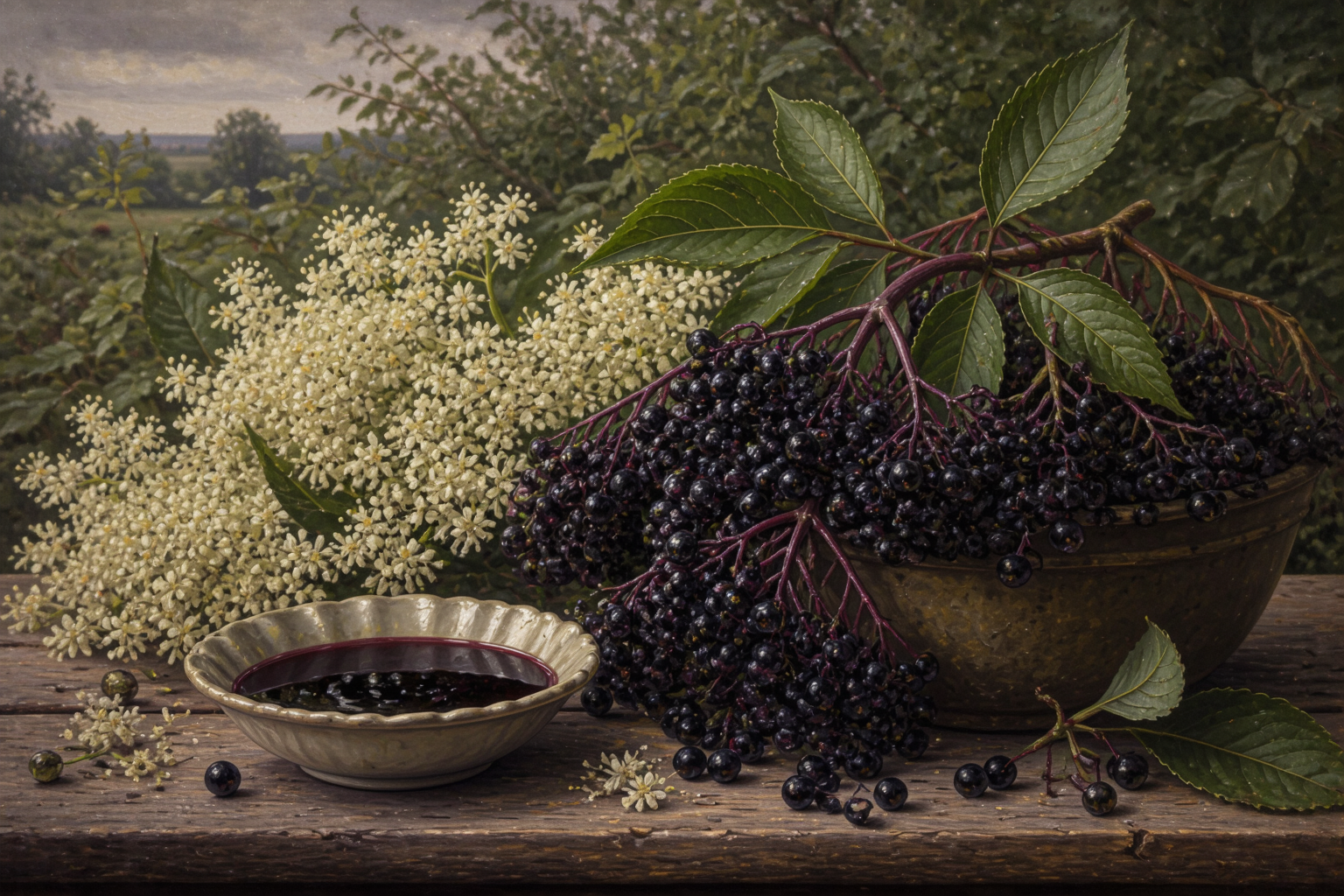
Sambucus nigra, the Elder, a tree of Venus and old counsel. Her flower warms the cold humours and opens the pores; her berry, when rightly cooked, stands among the most reliable remedies for the winter fevers. Yet she is no mere kitchen herb—she is guarded, watched over by powers that forbid the casual hand. The tradition holds her sacred, and demands respect.
Of Its Names and Nature
The Elder bears the botanical name Sambucus nigra and belongs to the family Adoxaceae, once classed among the Caprifoliaceae. She is known by many names across the tongues of Europe: Elder, Boortree, Black Elder, Pipe-tree. The old folk called her the Elder Mother, or in the Danish and German tradition, Hyldemoer—a name that carries within it the sense of an indwelling spirit, a being who inhabits the tree as surely as the wood itself. In darker tellings, some knew her as Devil’s Wood, though this was a fear-name, not a truth.
The parts we employ are chiefly the flower and the ripe berry—the first gathered in early summer when the creamy white umbels hang heavy, the second in late August and September when the berries blacken. The leaf, bark, root, and unripe fruit we shall address under the shadow of their nature. The flower is small, pale, with a faint honey-like smell; the berry is round, dark as night, containing a thin purple juice and small hard seeds.
Elder rules under Venus, and her signature is written plainly in her form. The tree’s wood is pithy and hollow—the doctrine of signatures reads in this emptiness the capacity to open channels, to move blockage, to let the heat of fever pass freely through the body. Observe too her abundance: she bears flower and fruit in profusion, a Venusian gift of generosity.
Of Its Virtues
I hold with the old writers that the Elder flower is hot and dry in the second degree, and works chiefly as a diaphoretic—that is, it provokes sweat and opens the pores of the skin, thereby releasing the fevers that lodge in the cold humours. Dioscorides praised the flower for its action on the skin, and Culpeper affirmed that it “opens the pores and causes sweat.” The ripe berry, when cooked, is cooling and moist, nourishing and gently laxative, and does not heat the blood as the raw fruit does.
In the practice of the apothecaries, elderflower tea—a simple infusion—has long been the first reach for the onset of cold and influenza, especially in children and the elderly. The flowers are steeped in hot water until the warmth draws forth their virtues, and the steam rises to meet the face and nose. A elderflower cordial, taken warm at the first sign of a chill, often turns aside the illness before it establishes itself. For inflammation of the eyes and the skin, the cooled infusion serves as a wash of great gentleness and astringency.
The ripe berry, boiled into a syrup or rob (a thick reduction), is a remedy of common report for the influenza. Modern inquiry, which I do not dismiss, suggests that the anthocyanins—the purple pigments themselves—may act upon the immune system and may shorten the course of viral fevers, though the evidence remains modest and hedged. What I can say from long use is that the berry, properly cooked, seems to warm the belly, steady the digestion, and ease the transition from fever into recovery.
The flower contains flavonoids and other volatile compounds that appear to support its diaphoretic action. The berry is rich in anthocyanins—those very pigments that give it its colour—and these show immunomodulatory properties in the test-tube, though what occurs in the living body remains less clear. The tradition here speaks louder than the laboratory, and I do not quarrel with that. Where tradition and evidence accord, we may trust more readily.
Of Its Shadow
The Elder is no common tree. Across Northern Europe, from Scandinavia to the Low Countries, the tradition holds that she is inhabited—that an old woman, the Elder Mother or Hyldemoer, dwells within her wood and guards her. To cut the Elder without first asking leave is to invite her wrath: the cutter’s children will sicken, or his cattle will fail, or a hex will settle upon his house. The old practice was to stand before the tree, bare-headed, and speak aloud a request for permission to take what was needed. Only then might the knife be drawn.
This was not mere superstition, though it wore superstition’s clothes. It was a rite that enforced restraint, that prevented the thoughtless stripping of a tree and acknowledged that the plant was not mere stuff, but a being deserving of regard. Whether one believes in the Elder Mother as a literal spirit or as the voice of conscience itself, the effect was the same: respect, caution, and reciprocity.
The wood of the Elder carried further prohibitions. It was never to be made into a cradle, for the Elder Mother would pinch the sleeping child in anger at the offense. It was never to be burned in the hearth, for the smoke would draw evil and the Devil himself into the house. The wood was fit only for pipes, for flutes, for small implements—things that honoured the hollow nature of the tree without presuming to master it.
Some tellings hold that Judas Iscariot hanged himself upon an Elder, and that the tree has borne shame and dread ever since. Whether this was true or was invented to explain an older fear, the weight of the story settled upon the Elder and made her at once a tree of protection (for evil herself dwelt in her, and thus the Devil could not freely pass) and a tree of ill-omen. Grief, madness, suicide, and the gallows were bound to her in the darker corners of folk-memory.
The remedy for this shadow is not to deny it, but to approach the Elder with the ancient courtesy: ask leave, take only what is needed, give thanks, and never presume that you have a right to her gifts. In this way, fear becomes respect, and respect becomes safety.
Of Its Degree of Poison
The Elder stands at Degree II–III: the cooked flower and the ripe, fully blackened berry are safe foods and remedies; but the raw berry, and every other part of the plant (leaf, bark, root, stem, and the unripe fruit), contain cyanogenic glycosides—chiefly sambunigrin—which are destroyed by heat and therefore rendered harmless in the cooking.
This is the whole of the safety story: cooking is not a refinement, but a necessity. Consume the raw berry and nausea, vomiting, and abdominal cramping will follow within hours. The green parts of the tree are more strongly cyanogenic and are never eaten. The danger is real but entirely manageable by adherence to a single rule: cook the berry; never eat it raw; do not ingest leaf, bark, or root.
Of Its Preparations
The Elder rewards the maker who understands her nature and applies the proper method to each part. I shall set down which preparations serve and which should be avoided.
- Flower Infusion (the classic cold-and-flu remedy): Dry the flowers fully in shade (fresh flowers may ferment and spoil). Pour hot water over a small handful of dried flower-heads—about one heaping teaspoon per cup—and steep covered for 5–10 minutes until the liquor turns pale gold. Drink warm, as often as thrice daily at the onset of fever. This is the safest and most reliable preparation. The heat of the water does not harm the flower’s action; it opens and carries the virtues.
- Berry Decoction or Syrup (the rob): Only fully ripe, black berries must be used. Fresh berries may be stewed gently with a little water and sugar to make a thick syrup, or dried berries may be simmered in water. The cooking step is essential—it neutralizes the cyanogenic glycosides. A traditional method is to simmer the berries for 15–20 minutes, then strain and reduce the liquor over low heat until it coats the back of a spoon. This can be stored in sealed jars and taken by the spoonful, or diluted in warm water as a drink. The longer the cook, the safer the preparation.
- Elderflower Fritters or Fried Flowers: A delightful and wholly traditional way to use the flower: dip the fresh umbels lightly in a thin batter and fry briefly in warm fat until just crisp. The flower may be eaten whole, or carefully picked from the stem. This is both food and remedy, and belongs to the Venusian domain of pleasure and healing married together.
- Cordial: A flower cordial may be made by infusing the dried flowers in a sugar syrup, then straining. A few spoonfuls diluted in warm water makes a pleasant and protective drink for winter.
- Oxymel: A mixture of the flower infusion or berry decoction with honey and vinegar, in equal parts. This preparation was prized by the old herbalists as it preserved the remedy, improved its taste, and added the virtues of vinegar (which cuts phlegm and aids digestion). It may be stored for months and taken by the spoonful in water.
- Infused Oil or Salve: The flower may be infused in warm oil and then made into a salve with beeswax, for use on inflamed skin or wounds. Only the flower is suitable for this; the other parts are not used.
- Bath or Wash: A strong infusion of the flowers may be added to bathwater for soothing inflammation, or used as a gentle wash for the eyes (cooled and strained carefully). This is an old remedy for conjunctivitis and tired eyes.
- Raw Fruit: Never. The raw berry causes nausea and vomiting. Do not eat it, and teach children not to strip the berries from the tree in late summer and consume them. This is not negotiable.
- Leaf, Bark, Root, or Unripe Fruit: Never ingested in any preparation. These parts are not used internally. If there is any doubt about whether a berry is fully ripe (deep purple-black), leave it on the tree.
- Calcination (spagyric work): The ripe berry may be dried, then burned to ash and the ash dissolved in distilled water, filtered, and evaporated to yield the salt of Elder. This salt contains the fixed mineral principles of the plant, separated from its volatile parts. This is a deep work, suited to the patient herbalist-alchemist, and lies beyond the scope of kitchen remedy-making.
For guidance in choosing the right method for your need, consult the principles of extraction. In the case of Elder, the answer is often simple: infuse the flower, decoct or reduce the berry, and forget all other methods unless you are a maker of salves or a student of alchemy.
A Word to the Living
This entry is historical and folkloric information about how Elder has been used traditionally. It is not medical advice, and you should not use it to treat yourself or others.
Raw elderberries and all green parts of the Elder tree (leaves, stems, bark, roots, unripe fruit) contain cyanogenic glycosides that cause vomiting, nausea, and abdominal pain. Do not eat them. Only fully ripe, black berries that have been cooked are safe. If you or someone else has ingested raw elderberries or other parts of the plant and feels ill, seek medical attention.
Elderflower and ripe cooked elderberry are generally well-tolerated in normal amounts, but: • Pregnant and nursing people should avoid Elder (traditional concern; safety not firmly established). • People on immunosuppressant medications should consult their doctor, as the berry may stimulate immune activity. • If you are allergic to plants in the Adoxaceae family, avoid Elder entirely. • Some people experience mild digestive upset; stop use if this occurs. • Do not use Elder as a substitute for medical treatment of serious illness. Influenza, especially in young children and the elderly, requires professional care.
Before using Elder or any herbal remedy, consult a qualified medical practitioner or registered herbalist. If you are taking prescription medications, check for interactions. Do not self-treat. Do not ingest raw berries. Do not burn Elder wood. Ask permission before you harvest.
Frequently Asked Questions
Why is Elder wood never burned in the hearth?
In the Northern European tradition, Elder wood was forbidden from the hearth because the smoke was believed to draw evil and the Devil himself into the house. The wood was considered fit only for pipes, flutes, and small implements that honored its hollow nature without presuming to master it.
What parts of Elder are safe to eat or use?
Only the fully ripe, blackened berry and the flower are safe when properly prepared. The raw berry and all other parts—leaf, bark, root, stem, and unripe fruit—contain cyanogenic glycosides that are destroyed by heat. The berry must always be cooked; the flower is used in infusions, cordials, and fried preparations.
What does Sambucus nigra taste like and smell like?
The Elder flower is small and pale with a faint honey-like smell. The ripe berry is round, dark as night, containing thin purple juice and small hard seeds. When properly cooked into a syrup, the berry offers a remedy traditionally used for winter fevers.
How long should elderberries be cooked to be safe?
The traditional method is to simmer ripe berries for 15–20 minutes, then strain and reduce the liquor over low heat until it coats the back of a spoon. The longer the cook, the safer the preparation, as heat neutralizes the cyanogenic glycosides present in raw fruit.
About This Article

Written by Kyle Bamboo. Kyle Bamboo has spent twelve years following the hermetic tradition of herbalism out of dusty reprints and into a home apothecary — spagyrics, planetary correspondences, and the strange internal logic of plant alchemy. Muddle and Mend takes its name from solve et coagula, dissolve and combine. He writes about the actual tradition, with its history, its vocabulary, and its genuine strangeness, not the Instagram version. More about this site.
Scope and limits. Kyle writes from a personal practice in traditional herbalism, not clinical training. Herbs interact with prescription medications and are not regulated as drugs — check interactions and talk to a pharmacist or clinician before taking anything.
Verify this against a primary source
Specifics change, and your situation may differ from the one described here. These are the authorities worth checking directly:
- NCCIH — herb safety, evidence and known interactions
- MedlinePlus Herbs and Supplements — documented interactions and cautions
- FDA Dietary Supplements — regulatory status and safety alerts