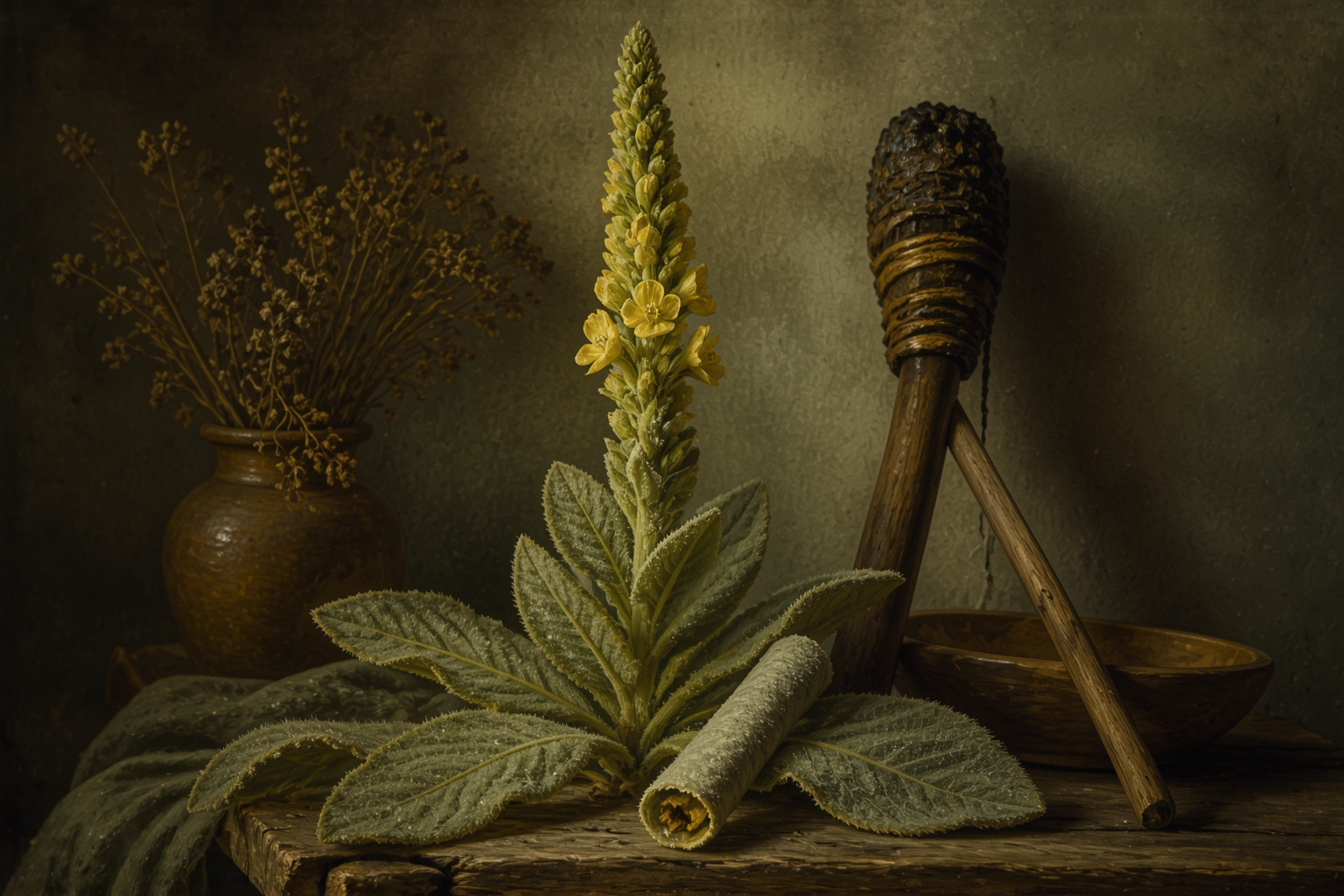
Verbascum thapsus, the tall herb of Saturn, stands sentinel in waste ground and graveyard margin. Mullein is the premier remedy for the lungs—a demulcent and expectorant of gentle power, whose soft leaves and golden flowers have eased the breath of the ill for centuries uncounted. Let the reader mark: it is among the kindest of medicinal herbs, yet demands respect in its preparation.
Of Its Names and Nature
The plant answers to many names, each revealing something of its character and use. In English: Mullein (from the Latin mollis, soft); also Hag’s Taper, Candlewick Plant, Aaron’s Rod, Lungwort, and in the rougher speech of the frontier, Cowboy’s Toilet Paper—a testament to its downy leaves. The old herbalists knew it as Torches, for its tall, solitary flower-spike, once dipped in tallow for funeral processions.
Botanically, Verbascum thapsus, of the family Scrophulariaceae, is a biennial herb. In its first year it sends forth a dense rosette of leaves—soft, flannel-like, pale grey-green, clothed in fine silken hairs that catch the light. In the second year it throws up a single, unbranching stalk, three to six feet tall, crowned with a dense spike of small yellow flowers that open in succession from bottom to top. The whole plant is downy and dry to the touch; nothing about it speaks of moisture or haste.
Planetary Rulership: Saturn. The plant’s tall, austere habit; its association with graveyards and the funeral torch; its dryness; and its traditional use among the old and the dying all align it with the planet of endings, of time’s passage, and of the threshold between the living and the dead. See the correspondence chart for the Saturnine signature. The doctrine of signatures reads plainly in its form: the soft, flannel leaves announce their virtue in poultice and fomentation; the tall, torch-like flower-spike speaks of light given to the dark.
Parts Used: The leaf is the primary remedy, gathered in the first year or early in the second, dried whole or cut. The flower has its own virtue, especially infused in oil. The entire above-ground plant can be dried for tea.
Of Its Virtues
I hold with the old writers—Dioscorides, Galen, Gerard, Culpeper—that mullein is the sovereign herb for diseases of the lungs and throat. The tradition is not mere fancy; modern investigation has borne it out. The plant is rich in mucilage, which coats and soothes the irritated tissues of the respiratory tract; in saponins, which act as a natural expectorant, loosening stuck phlegm; and in flavonoids and other anti-inflammatory compounds that ease congestion and suppress the dry, painful cough.
Humourally, the old herbals classified mullein as warm and moist—an apparent paradox given the plant’s dry appearance, yet sound in action. The warmth eases the cold, damp congestion of the bronchial passages; the moisture (the mucilage) coats without clogging. Culpeper writes that it “opens obstructions in the lungs” and “helps a cough and hoarseness of the voice.” I have found this true. The leaf infusion brings relief to those who cough through the night, to the old whose breath comes short on stairs, to any whose lungs are irritated by smoke, dust, or the damp.
The flower oil—the blooms infused in warm oil—has been the classic folk remedy for earache since time beyond memory. A single drop warmed and placed in the ear brings swift ease to the pain of otitis; the oil’s demulcent and anti-inflammatory properties soothe the inflamed tissue within. I have seen a fretful child quieted by a single application.
As a poultice or fomentation, the fresh or rehydrated leaves draw heat from inflamed skin, ease boils and slow-healing sores, and have been laid upon the chests of those with pleurisy. The downy surface seems made for the purpose.
Where tradition claims mullein cures consumption, the evidence is more modest—yet the plant’s constituents suggest why the old practitioners held it in such regard. It does not cure the disease of the lungs, but it does ease the symptom of the cough and support the body’s own effort to clear itself. That is no small thing.
Of Its Shadow
Yet mullein bears a darker name, and the tradition holds a shadow alongside its light. Hag’s Taper—the name itself whispers of witchcraft. The plant was said to be the witch’s torch, carried at night to light unholy gatherings, or stood in a grave to guide the corpse-candle homeward. The funeral torch tradition, which I have no reason to doubt as historical practice, became confused in folk memory with funeral rites of a more sinister sort.
In the graveyard lore of northern England and Scotland, mullein was planted on graves or grew wild among them—a Saturnine sentinel keeping watch over the dead. To cut the flower without permission, or to bring it inside the house from a churchyard, was held to bring death into the home. Some traditions forbade the picking of mullein altogether; others said it must be gathered with ceremony, or the gatherer would fall ill. These superstitions I report as the belief of our ancestors, not as truth—yet they speak to the plant’s long association with mortality and the threshold.
The fine hairs on leaf and stalk, which I shall address in preparation, were thought by some to carry a malevolent itch. Careless handling might cause a rash or tickle the throat; the plant was said to dislike rough handling, to resent being picked carelessly. Whether this springs from genuine irritant properties or from the plant’s Saturnine dignity, I cannot say with certainty—but both explanations point to the same practical caution.
Of Its Degree of Poison
Degree I–II: Benign to Temperate. Mullein is among the gentler of medicinal herbs, toxicity requiring only the most absurd excess or gross misuse. The principal caution lies not in poison but in the fine, irritating hairs that clothe the plant—these, if ingested unstrainéd, may cause tickling in the throat or a minor rash of the mucous membranes. There are no significant toxic alkaloids or cardiac glycosides; the plant is safe for long-term use in properly prepared infusions.
Of Its Preparations
The virtue of mullein lies in knowing how to call it forth. Different preparations suit different ends, and the curious reader would do well to consult our guide to choosing the right extraction before beginning work.
- Dried Leaf, as Infusion (Tea): This is the primary preparation. Pour near-boiling water over dried leaf (one handful to a pot, or one heaping teaspoon to a cup), steep covered for ten to fifteen minutes, and—this is essential—strain through a fine cloth or coffee filter to remove the irritating hairs. The liquor should be clear and golden. Drink warm, three times daily, for cough, bronchial congestion, or sore throat. The infusion may be sweetened with honey, which amplifies its soothing action.
- Smoked: Mullein holds a tradition—perhaps unique among medicinal herbs—of being smoked for the benefit of the lungs. Dried leaf, finely crumbled, is packed loosely into a pipe or hand-rolled into paper and smoked slowly, with intention to ease cough and open the passages of the chest. The smoke is mild, slightly bitter, and does not irritate as tobacco does. Many old herbalists and modern practitioners hold that mullein smoke, unlike tobacco smoke, actually soothes and supports the lungs rather than harming them. I myself have witnessed this, though I confess the mechanism remains somewhat obscure to me. The saponins may be absorbed through the smoke; the warmth and moisture of inhalation may soothe; or the plant’s Saturnine nature may work through the subtle body as much as the physical. In any case, this preparation is safe and has genuine traditional support.
- Flower-Infused Oil (for Earache): Gather fresh flowers, place them in a clean, dry jar, and cover fully with a neutral oil—sweet almond, olive, or mineral oil. Set the jar in warm sunlight (a south-facing window) for two to four weeks, shaking gently every few days. Strain through cloth. The oil should be golden and fragrant. Warm to body temperature and apply a single drop into the affected ear; plug gently with cotton. The oil keeps well in a cool place for a year or more. This is the classic folk remedy and remarkably effective.
- Poultice (Fresh or Rehydrated Leaf): Bruise fresh leaf (or rehydrate dried leaf briefly with warm water), apply directly to clean skin over an inflamed area, boil, or slow-healing sore. Cover with cloth to hold in place. Leave for thirty minutes to an hour, or overnight if tolerated. Refresh as needed. The downy surface clings pleasantly and seems to draw heat and inflammation.
- Tincture (Alcohol Extraction): Dried leaf tinctured in alcohol (at least 40% ABV; 70% is better) in a 1:5 ratio by weight extracts the plant’s virtues soundly. Macerate for two to four weeks, strain, press, and store in a cool place. A dropperful (about 1 ml) in warm water, taken three times daily, serves those who prefer not to drink the full infusion. The tincture is more concentrating and keeps indefinitely.
- Decoction: Not recommended. The roots are thin and not the primary medicine; simmering the leaf destroys the mucilage and concentrates the irritant hairs. Infusion is superior.
- Fresh Herb, Raw: Not advisable. The irritating hairs are most pronounced in fresh material and unpalatable.
- Incense or Smudge: Dried flower or leaf burns pleasantly and was traditionally used to fumigated sickrooms and homes believed to harbor ill spirits or the presence of death. The smoke is mild and aromatic, carrying the plant’s Saturnine virtue into the subtle realms.
- Calcined to Salt (Spagyric Work): The entire dried plant may be burned to ash and calcined to a white salt—a classical spagyric operation linking to the calcination stage and the three principles of salt, sulfur, and mercury. The salt, which fixes and carries the plant’s essential virtue in mineral form, may be added to herbal compounds or taken in minute doses (a few grains on the tongue) for deep systemic support of the lungs. This is an advanced preparation, best undertaken by those with some knowledge of spagyric method.
A note on straining: Whichever preparation you choose, if it involves the leaf itself rather than the flower alone, strain your finished tea or decoction through fine cloth, cheesecloth, or a coffee filter. The irritant hairs are minute and easily pass through coarse cloth. This single step prevents throat tickle and ensures a smooth, pleasant medicine.
A Word to the Living
Drop the old voice now, and listen plainly. Mullein is a gentle, safe herb with a long history of use for cough, bronchial irritation, and ear discomfort. It is not a cure for serious lung disease—pneumonia, tuberculosis, severe asthma, or any diagnosed condition requires proper medical care. If you are coughing for more than a few weeks, or if you have been diagnosed with a respiratory condition, see a doctor.
The only real precaution: strain the tea carefully to remove the leaf hairs. A few hairs won’t cause real harm, but they can tickle your throat and ruin the experience. Use a fine filter.
For the earache oil: do not use it if you have a perforated eardrum or suspect one. If your ear pain is severe, sudden, or accompanied by fever or hearing loss, see a doctor—it may be something that needs antibiotics or proper diagnosis. A simple ache from a cold or minor infection may be soothed by the oil, but only after you know what you’re dealing with.
Mullein is not known for drug interactions, but if you take medications, especially for high blood pressure or the heart, mention it to your pharmacist—as a courtesy and a caution. If you are pregnant, breastfeeding, or have a serious chronic illness, consult a qualified herbalist or doctor before adding mullein to your routine.
This entry is historical and folkloric—an account of what the old herbalists believed and what they did. It is not medical advice. Use it as one tool among many to understand this beautiful plant, but do not use it to diagnose or treat yourself. When in doubt, see a qualified practitioner. Mullein is a gift of the plant world, but it is not a replacement for professional care.
Frequently Asked Questions
Why is mullein associated with Saturn in herbalism?
In this tradition, mullein’s tall, austere habit, its association with graveyards and funeral torches, its dryness, and its historical use among the old and dying align it with Saturn—the planet of endings, time’s passage, and the threshold between the living and the dead.
How do you prepare mullein leaf tea to avoid irritation?
Pour near-boiling water over dried leaf, steep covered for ten to fifteen minutes, then strain through fine cloth or a coffee filter to remove the irritating hairs. The fine hairs must be strained out, or they may cause tickling in the throat and ruin the experience.
What is mullein flower oil traditionally used for?
Flower-infused oil has been the classic folk remedy for earache since time beyond memory. The caution matters more than the method: do not use it if you have a perforated eardrum or suspect one, and if ear pain is severe, sudden, or comes with fever or hearing loss, see a doctor. This is not medical advice.
What are the irritating hairs on mullein called and why strain them?
Mullein’s fine, irritating hairs clothe the leaf and stalk throughout the plant. If ingested unstrained, these hairs may cause tickling in the throat or minor rash of the mucous membranes, so all leaf-based preparations must be strained through fine cloth or coffee filter.
About This Article

Written by Kyle Bamboo. Kyle Bamboo has spent twelve years following the hermetic tradition of herbalism out of dusty reprints and into a home apothecary — spagyrics, planetary correspondences, and the strange internal logic of plant alchemy. Muddle and Mend takes its name from solve et coagula, dissolve and combine. He writes about the actual tradition, with its history, its vocabulary, and its genuine strangeness, not the Instagram version. More about this site.
Scope and limits. Kyle writes from a personal practice in traditional herbalism, not clinical training. Herbs interact with prescription medications and are not regulated as drugs — check interactions and talk to a pharmacist or clinician before taking anything.
Verify this against a primary source
Specifics change, and your situation may differ from the one described here. These are the authorities worth checking directly:
- NCCIH — herb safety, evidence and known interactions
- MedlinePlus Herbs and Supplements — documented interactions and cautions
- FDA Dietary Supplements — regulatory status and safety alerts