Mandragora officinarum, ruled by Saturn in the depths and by Mercury in the heights of desire, is perhaps the most storied of all solanaceous plants—a true narcotic, a legendary charm, and a poison whose reputation has overshadowed its actual virtues for two thousand years. Let the reader approach it as a matter of natural philosophy and lore, not of kitchen medicine.
Of Its Names and Nature
The plant bears the botanical name Mandragora officinarum and belongs to the Solanaceae, that family of nightshades which harbours both the nourishing potato and the deadliest of poisons. In the old herbals it is called mandrake, mandragora, Satan’s apple, and—most tellingly—the sorcerer’s root. The folk names run to love-apple and hand of glory, titles that betray the dual character of its lore: fertility charm and instrument of witchcraft, often one and the same.
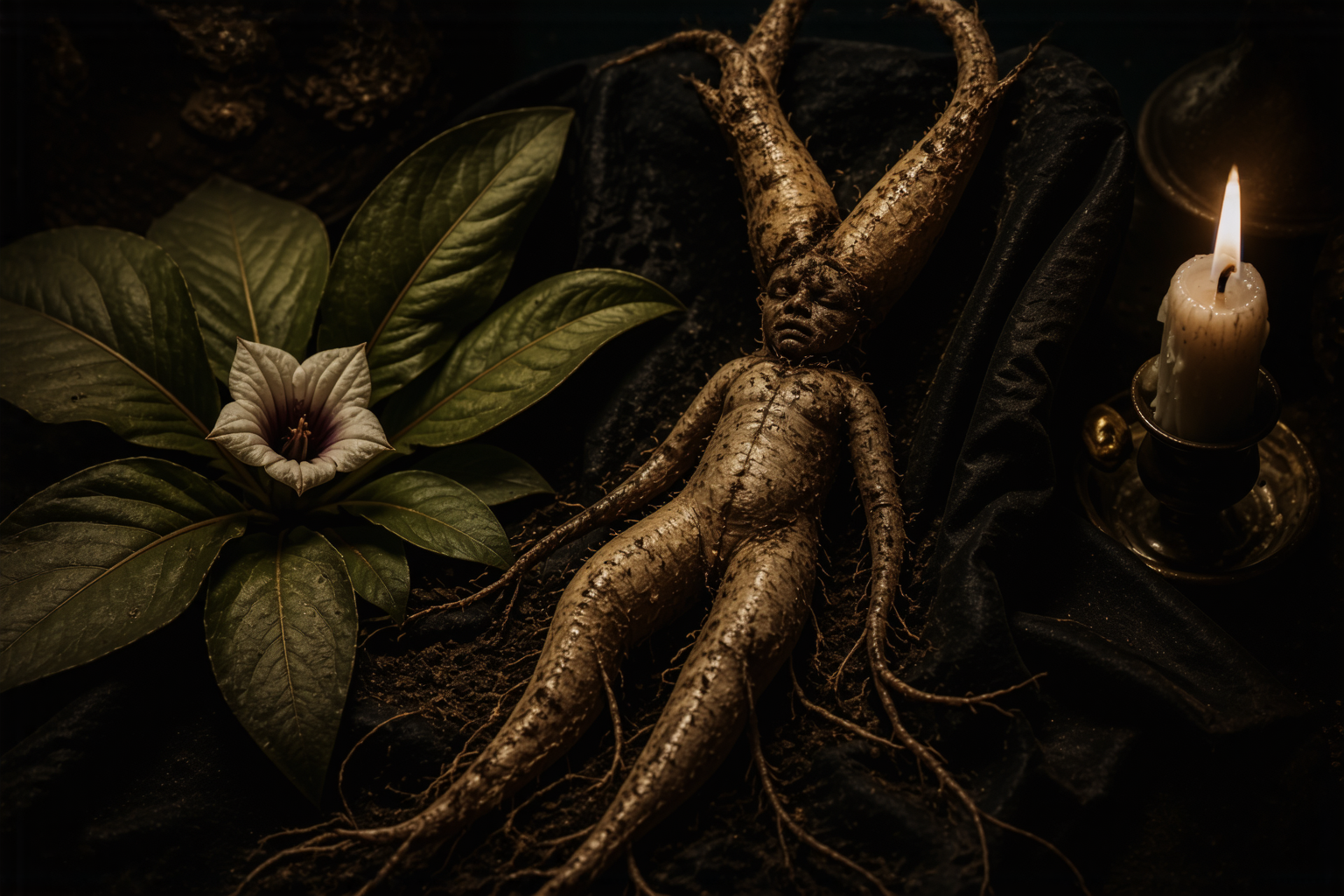
The part used in the tradition is the root, which alone justifies its fame. It grows thick and often forked, and in the soil takes on a shape startlingly human—two legs, a torso, even (the old stories insist) a head and arms. This form has made mandrake the supreme example of the doctrine of signatures, that principle by which a plant’s appearance declares its use. What plant could more plainly speak of its power over the human body than one that is human-shaped? The leaves are large, dark, coarse, springing in a rosette; the flowers small, pale purple or greenish; the fruit a yellow apple no larger than a walnut, which smells faintly of carrion.
Its planetary rulership divides the tradition. The old Saturn-workers held it Saturn’s own—a plant of the underworld, of death-sleep and deep binding. Yet the love-charms and fertility lore attributed it to Mercury or to Venus, those bright planets of desire and commerce. I hold with both: Saturn rules the root in its darkness, the poison in its core; Mercury rules the legendary fruit and the sexual magic wrapped about it. The plant is thus planetary-bifid, and the seeker must know which power calls to him.
Of Its Virtues
Mandrake holds one authentic medical virtue: it is a narcotic and anodyne of genuine power, and in the hands of trained physicians it became one of antiquity’s first surgical anaesthetics. Dioscorides prescribed it as a soporific, and Galen confirmed its strength. The preparation most famous in the medical tradition was the spongia somnifera, the “sleep-sponge”—a sea-sponge soaked in wine infused with mandrake root, henbane, opium poppy, and hemlock, which was held to the nose of a patient before surgery. The patient would fall into a deep and merciful unconsciousness, and the surgeon could work. This was the medicine of desperation in an age before ether, and it saved many from the agony of the knife whilst conscious.
The active principles responsible are tropane alkaloids—chiefly hyoscyamine and scopolamine, with smaller amounts of mandragorine and other compounds. These are the same poisons found in henbane and deadly nightshade, and they act upon the nervous system with brutal directness: they suppress the parasympathetic nervous system, dry the body’s fluids, dilate the pupils, induce sleep and delirium in turn, and in excess stop the heart. The boundary between the sleep-dose and the death-dose is thin and shifts with the plant’s age, the root’s vigour, and the season of harvest—a truth that medieval surgeons learned by losing patients.
Beyond this true anodyne virtue, mandrake was credited with aphrodisiac and fertility powers so deep that it entered scripture itself. In Genesis, Leah and Rachel quarrel over mandrake roots, which Rachel desires for their power to open the womb. This lore persisted through the Middle Ages: the root was carried as a charm for conception, worn in a pouch over the womb, even fed to cattle to improve breeding. Whether this rests on any constitutional action or on psychological authority alone, I cannot say with certainty. The plant is said to warm and dry—hot and dry in the second degree, by the old reckoning—which would argue some stimulant property; but modern analysis finds no compounds that would reliably effect conception. Here tradition has run beyond what the plant’s chemistry supports.
All other virtues ascribed to mandrake—as a purge, a cure for palsy, a healer of wounds—rest on slender evidence and must be regarded as the wraiths of older, cruder medicine. The plant’s sole authentic gift to healing is its narcotic power, and that gift is inseparable from its poison.
Of Its Shadow
No plant in the Western herbal carries a heavier shadow than mandrake. The folklore of its gathering is elaborate, specific, and—one must say—theatrical to the point of seeming invented. Yet it persisted across centuries and across many lands, which suggests that those who gathered the plant with such ceremony were protecting themselves against something real: the very strong effects of the alkaloids, the easy mistake of an overdose, and the genuine terror of having taken a poison.
The most famous prohibition is that the mandrake root shrieks when pulled from the earth, and that whoever hears the shriek dies or goes mad. To circumvent this doom, the ancient method required a dog: a cord was tied around the plant’s neck, attached to the dog’s collar, and the dog was driven forward by hunger or pain, tearing the root free. The gatherer’s ears were stopped with wax to muffle the cry. The root was then washed, wrapped in silk, and treated as a precious thing—fed bread and milk, clothed in a linen shirt, laid in a box by candlelight. This “homunculus” was believed to bring wealth and blessing to the house that kept it, and to sicken or die if neglected or insulted.
Darker still was the association with the gallows. The folk-belief held that mandrake grew beneath the tree of a hanged man, nourished by his seed or his corruption, and that such a root had the greatest power—especially for dark magic. To own such a root was to own a piece of death itself, and the witch-trials of the 16th and 17th centuries gave this image an ugly currency: mandrake roots were found among the possessions of the condemned, and inquisitors took them as proof of trafficking with the Devil.
The sexual magic attributed to mandrake is equally charged. It was an herb of love-spells, yes—but also of seduction, of the forcing of desire, of fertility magic that crossed into the abusive. In some regions, a woman might carry a mandrake root to draw a man’s lust; in others, a man might use one to bewitch a woman into his bed. The boundary between love-charm and love-curse was never clear, and mandrake stood at that threshold.
All of this shadow has a rational substrate: mandrake is a hallucinogenic poison, and those who ingested it in search of visions or healing would have experienced delirium, terror, and the sensation of leaving their bodies—experiences easily interpreted as encounters with spirits, demons, or the dead. The plant became, in the medieval mind, a key that unlocked the invisible world. Those who used it were neither frauds nor madmen; they were explorers of a chemical frontier who did not know they were poisoning themselves.
Of Its Degree of Poison
Mandrake is Degree V—Deadly. The tropane alkaloids in its roots (hyoscyamine, scopolamine, mandragorine, and others) are among the most toxic natural compounds known to the herbal, and their concentration varies wildly by season, plant age, and soil. A dose of 30 to 40 milligrams of scopolamine alone can prove fatal; mandrake roots may contain several hundred milligrams. Death by mandrake is recorded from the surgical tradition (miscalculated anaesthetic doses) and from folk use (the attempted magical ingestion of the root). There is no safe dose, and no reliable way to measure the alkaloid content of a given root or preparation.
Of Its Preparations
I must address the preparations in two registers: the historical and the forbidden.
Historical preparations (for knowledge only, not replication):
- The sleep-sponge: A sea-sponge steeped in a wine infusion of mandrake root, henbane, opium poppy, and hemlock, dried, and then soaked anew before use. Held to the patient’s nose, it delivered a mixture of alkaloids potent enough to induce unconsciousness within minutes. Medieval surgeons relied upon it; many of their patients did not wake.
- Ritual extraction: The root was sometimes dug at night under the full moon, with the ceremony of the dog (or, later, the simple tying of a cord and the steady pulling). It was then washed, dried (a process taking weeks), and stored in darkness to preserve its power. Some practitioners made wine infusions for internal use; others prepared oils or ungents for external application. All of these were equally dangerous.
- The homunculus or root-charm: The dried root was kept whole, clothed, fed (symbolically or materially), and used as a talisman or focus for magic. No ingestion was involved, but the root was sometimes rubbed against the skin, held in the mouth, or placed on wounds.
What the reader must understand: I have set down these preparations as history, as testimony to what the tradition believed and did. You must not attempt any of them. The sleep-sponge killed as often as it saved. Home extraction of mandrake alkaloids cannot be made safe. The dose is unmeasurable. The symptoms of overdose—wild hallucination, paralysis, respiratory failure, cardiac arrest—have no antidote but time and medical intervention, and even that fails more often than it succeeds.
I will not give ratios, weights, or step-by-step recipes. The plant’s only preparation method that merits serious consideration is studied historical extraction, and even this was performed by trained physicians who had access to post-mortem knowledge when their patients died. That knowledge is no longer common. The plant is best left ungathered and unprepared.
A Word to the Living
Please read this plainly:
Mandrake is deadly poison. Do not ingest it. Do not brew it into tea. Do not make tinctures or oils from it. Do not apply it to your skin. Do not smoke it. Do not give it to animals. The alkaloids are absorbed through mucous membranes and through the skin; you do not need to swallow it to be poisoned.
The folklore in this entry—the shrieking root, the homunculus, the love-magic—is worth reading as history and as a window into medieval thinking. It is not worth enacting. Medieval people died from mandrake use. They died from miscalculated surgery doses. They died from folk attempts at healing or magic. Their deaths were real.
If you have ingested mandrake or suspect you have, call emergency services or poison control immediately. Symptoms appear within 30 minutes to 2 hours: dry mouth, dilated pupils, rapid heartbeat, confusion, hallucination, seizures, loss of consciousness, respiratory failure. There is no antidote; treatment is supportive care only.
This entry is historical and educational. It is not medical advice. Do not self-treat with mandrake under any circumstance. Do not consult an herbalist about mandrake dosing—any responsible practitioner will refuse. If you are drawn to the plant’s lore, study its history and its chemistry from a distance, as you would the history of arsenic or strychnine. The plant’s shadow is instructive. Its poison is not.
Frequently Asked Questions
What is the doctrine of signatures and how does mandrake exemplify it?
The doctrine of signatures holds that a plant’s appearance declares its use. Mandrake exemplifies this principle because its root grows thick and forked, taking on a startlingly human shape in the soil—with what the old stories describe as two legs, a torso, head, and arms. This human form was taken to speak plainly of its power over the human body.
What was the spongia somnifera and how did it work?
The spongia somnifera, or sleep-sponge, was a sea-sponge soaked in wine infused with mandrake root, henbane, opium poppy, and hemlock. Held to a patient’s nose before surgery, it delivered a mixture of alkaloids potent enough to induce unconsciousness within minutes, allowing surgeons to work without the patient experiencing conscious agony.
Why did medieval gatherers use a dog to harvest mandrake roots?
Folk belief held that mandrake roots shrieked when pulled from the earth, and whoever heard the shriek would die or go mad. To circumvent this doom, a cord was tied around the root and attached to a dog’s collar; the dog was driven forward, tearing the root free. The gatherer’s ears were stopped with wax to muffle the cry.
What are the active alkaloids in mandrake and what do they do?
The active principles are tropane alkaloids—chiefly hyoscyamine and scopolamine, with smaller amounts of mandragorine and other compounds. These act upon the nervous system by suppressing the parasympathetic nervous system, drying the body’s fluids, dilating the pupils, inducing sleep and delirium in turn, and in excess stopping the heart.
What is planetary rulership divided in the mandrake tradition?
In this tradition, Saturn rules the mandrake root in its darkness and the poison in its core, as a plant of the underworld and deep binding. Mercury rules the legendary fruit and the sexual magic attributed to it, those bright powers of desire and commerce. The plant is thus planetary-bifid.
About This Article

Written by Kyle Bamboo. Kyle Bamboo has spent twelve years following the hermetic tradition of herbalism out of dusty reprints and into a home apothecary — spagyrics, planetary correspondences, and the strange internal logic of plant alchemy. Muddle and Mend takes its name from solve et coagula, dissolve and combine. He writes about the actual tradition, with its history, its vocabulary, and its genuine strangeness, not the Instagram version. More about this site.
Scope and limits. Kyle writes from a personal practice in traditional herbalism, not clinical training. Herbs interact with prescription medications and are not regulated as drugs — check interactions and talk to a pharmacist or clinician before taking anything.
Verify this against a primary source
Specifics change, and your situation may differ from the one described here. These are the authorities worth checking directly:
- NCCIH — herb safety, evidence and known interactions
- MedlinePlus Herbs and Supplements — documented interactions and cautions
- FDA Dietary Supplements — regulatory status and safety alerts