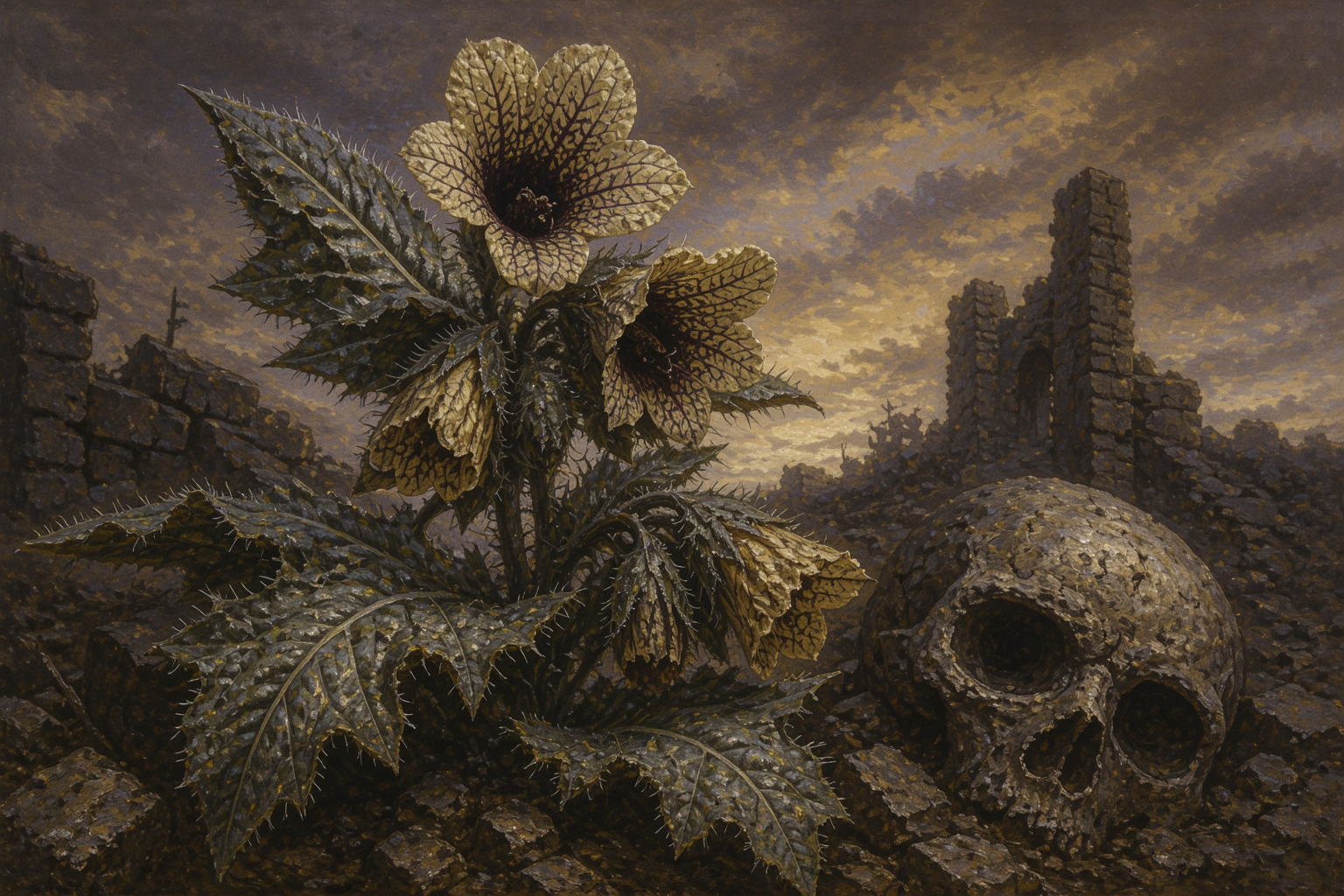
Hyoscyamus niger, the black henbane or stinking nightshade, is Saturn’s child and one of the most perilous plants that grows in the temperate earth. I set down what I know of it not as invitation to use, but as record—for the scholar, the gardener who has found it wild, and the reader who wishes to understand why the old physicians guarded it as they guarded fire, and why the folk feared it as they feared the gallows.
Of Its Names and Nature
The plant bears many names, each freighted with dread. Hyoscyamus niger is the learned binomial; it dwells in the Solanaceae, the nightshade family—that dark and numinous line of genera that gave us both the potato and the poison. The common names speak their own language: henbane, certainly; but also stinking nightshade, hog’s bean, henbell, and in older texts, Jupiter’s bean (though Saturn rules it truly) and devil’s eye. The whole herb is used—leaf, seed, and root alike—though the seed holds the greatest and most treacherous potency.
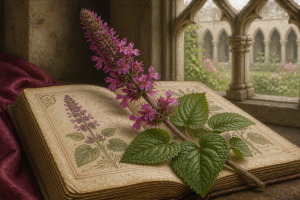
It is a coarse, hairy biennial or annual, standing two to three feet in height, with a rank and nauseating smell that warns even the untutored nose of its nature. The leaves are large, wrinkled, and deeply lobed, a dull greenish-yellow; the flowers small, dull purple with a darker vein—pallid things that seem to have forgotten health. The seed pods are urn-shaped, holding within them the black seeds that have caused more suffering than nearly any seed-bearing plant in Christendom.
Saturn rules it, and Saturn’s signature is written plain upon it: slowness, darkness, binding, numbness, and the approach toward death. Those who study the doctrine of signatures will note how the urn-shaped seed-vessel resembles a grave marker, and how the reek of it—acrid, animal, corrupted—suggests the tomb itself. One might also consult the correspondence chart to understand how Saturn’s medicines are, without exception, medicines of binding and breaking.
Of Its Virtues
Here I must speak with care and with two voices at once. The old physicians—Dioscorides, Galen, Gerard—knew henbane as a genuine medicine, though a dreadful one. They prescribed it, in minute and carefully reckoned doses, for pain that would not yield to other remedies, for spasm and convulsion, and as a sovereign anodyne before the knife or the cautery. A physician of the sixteenth century might mix a grain or two of the dried leaf into an oil, or steep a single seed in wine, and watch as the patient’s agony subsided into a twilit numbness. For this, henbane earned its place in every materia medica of note.
The reason is chemical truth. Henbane contains alkaloids of the tropane family—chiefly hyoscyamine and scopolamine—which are real pharmacological agents. Scopolamine, in particular, is still manufactured and prescribed in modern medicine, in controlled pharmaceutical form (as a transdermal patch, for instance) for motion sickness and nausea. The old physicians, working in darkness, found something that worked; modern chemistry has isolated the why. This is pharmacy’s kingdom, not the home herbalist’s.
But here tradition diverges from safety. What a physician once administered in grains—measured on a scale, diluted in oil, given under observation—cannot be replicated by a reader boiling leaves in a kettle. The margin between the dose that numbs pain and the dose that stops the heart is thin, ragged, and invisible to the naked eye. I hold with Gerard and Culpeper that henbane is a physician’s remedy and must remain so. The virtues are real; the danger is equally real.
Of Its Shadow
Few plants have gathered to themselves so much dark lore, and few deserve it more. Henbane is the archetypal herb of witchcraft—not as superstition, but as historical fact. The medieval and Renaissance “flying ointments” that tradition attributes to witches’ covens contained henbane as a principal ingredient, along with belladonna, hemlock, and fat. Applied to the skin (especially to the sensitive tissues of the vulva, as the records note with a kind of obscene exactitude), these unguents caused delirium, hallucination, a sensation of flying, and a profound dissociation from the body. The “witch” felt herself transported; in truth, she was poisoned.
The plant is also old Saturn’s servant in the necromantic arts. Strewn upon graves, burned in the chamber where the dying lie, it was believed to summon the dead or to keep them bound. Some scholars argue—and I find the argument persuasive—that the fumes arising from henbane burning in an enclosed space, inhaled over time, might produce the visions and the voice-hearing attributed to oracles. The Pythia at Delphi, it has been suggested, may have breathed the vapors of henbane (or hemlock) rising from fissures in the temple floor, and in that poisoned trance spoke the words that men took for divine utterance.
In the matter of Hamlet, too, henbane has left its mark. The ghost’s account of his death—of poison poured in the ear—speaks the word “hebona” or “hebenon,” which scholars have long puzzled over. Many hold it to be henbane, rendered in a kind of garbled Latin. If so, Shakespeare knew what he was writing: a poison subtle, a poison that kills by creeping corruption, a poison fit for a dark and Saturnian murder.
The very smell of the plant warns. Those who have brushed it accidentally report a stench like corrupted flesh, like urine, like something that has begun to rot. The plant seems to announce its own malevolence.
Of Its Degree of Poison
Degree V — Deadly. Henbane is a true poison; its toxins—the tropane alkaloids hyoscyamine and scopolamine—act upon the central and peripheral nervous system to produce delirium, cardiac arrhythmia, respiratory failure, and death. A single seed, or a handful of seeds, can kill a child. Adults have perished from accidentally ingesting what they believed to be a harmless plant. There is no safe home dose.
Of Its Preparations
For the sake of history and understanding, I will record what the tradition did. But the reader must mark well what follows the account: a plain, unambiguous prohibition.
- Infusion or decoction. The medieval apothecary might steep a single leaf, or a small portion thereof, in hot water or wine, straining carefully and administering by drop. The result was an oily, bitter liquid that dimmed pain and consciousness together.
- Oil or fat. The most famous preparation was the “flying ointment”—henbane leaf (dried and powdered) worked into lard or rendered fat, sometimes with other nightshades, and applied sparingly to the skin. This was the witches’ balm of legend and historical record.
- Smoke or vapour. Henbane burned in a brazier, its smoke inhaled in a confined space, was thought to produce the oracular trance. Some physicians prescribed the smoke as an inhalation for spasm or seizure.
- Tincture. A single seed, or a fragment of dried leaf, might be macerated in spirit over weeks, and a single drop administered. Even this was considered a dangerous preparation.
Here I forbid the reader plainly and without reservation: do not attempt any of these preparations. Do not ingest henbane in any form, quantity, or preparation. Do not brew it as tea. Do not make an oil or salve from it. Do not smoke it. Do not apply it to the skin. Do not give it to another person under any circumstance whatsoever. The knowledge I have set down is for historical record, for the scholar, and for the understanding of why this plant is feared. It is not a recipe. It is a warning written in the form of a memory.
A Word to the Living
Drop the antique language now. Here is the plain truth.
Henbane (Hyoscyamus niger) is a deadly poison. It contains tropane alkaloids—hyoscyamine and scopolamine—that cause delirium, hallucination, seizures, cardiac arrhythmia, and death. There is no safe home dose. The concentration of alkaloids varies unpredictably between plants, parts of plants, and seasons. A few seeds can kill a child. Adults have died from accidental ingestion. You cannot reliably dose this plant at home.
Do not ingest henbane. Do not brew it as tea. Do not apply it to your skin or make salves or oils from it. Do not smoke it. Do not give it to anyone else. If you have accidentally ingested henbane or any part of it, call poison control immediately (in the US: 1-800-222-1222) or seek emergency medical care.
Scopolamine, one of henbane’s active compounds, is used in modern pharmacy—but only in refined, pharmaceutical, dosed form (transdermal patches, for example), manufactured under strict controls and prescribed by medical professionals. The plant itself is not medicine. It is a poison.
This entry is a work of historical, folkloric, and botanical record. It is not medical advice. It is not an endorsement of use. It is a cautionary account. Consult a qualified physician for any health concern. Do not self-treat with henbane under any circumstance. Do not grow it for use. If you encounter it wild, note it, photograph it, and leave it undisturbed.
Frequently Asked Questions
What are the alkaloids in henbane and what do they do?
Henbane contains tropane alkaloids, chiefly hyoscyamine and scopolamine. These compounds act upon the central and peripheral nervous system to produce delirium, cardiac arrhythmia, respiratory failure, and death. Scopolamine is still manufactured and prescribed in modern medicine in controlled pharmaceutical form, such as transdermal patches for motion sickness.
Why was henbane called Jupiter’s bean in older texts?
Older texts called henbane Jupiter’s bean, though Saturn rules it truly. The article does not explain the origin of this alternate name, only that it exists in historical sources alongside the more accurate Saturnian attribution.
What is the historical connection between henbane and witchcraft?
Henbane was a principal ingredient in medieval and Renaissance “flying ointments” attributed to witches’ covens, along with belladonna, hemlock, and fat. Applied to the skin, especially sensitive tissues, these unguents caused delirium, hallucination, sensation of flying, and profound dissociation from the body.
How might henbane relate to the Oracle at Delphi?
Some scholars argue that the Pythia at Delphi may have breathed vapors of henbane or hemlock rising from fissures in the temple floor. Inhaled over time in an enclosed space, the fumes might produce the visions and voice-hearing attributed to oracles, spoken as divine utterance.
About This Article

Written by Kyle Bamboo. Kyle Bamboo has spent twelve years following the hermetic tradition of herbalism out of dusty reprints and into a home apothecary — spagyrics, planetary correspondences, and the strange internal logic of plant alchemy. Muddle and Mend takes its name from solve et coagula, dissolve and combine. He writes about the actual tradition, with its history, its vocabulary, and its genuine strangeness, not the Instagram version. More about this site.
Scope and limits. Kyle writes from a personal practice in traditional herbalism, not clinical training. Herbs interact with prescription medications and are not regulated as drugs — check interactions and talk to a pharmacist or clinician before taking anything.
Verify this against a primary source
Specifics change, and your situation may differ from the one described here. These are the authorities worth checking directly:
- NCCIH — herb safety, evidence and known interactions
- MedlinePlus Herbs and Supplements — documented interactions and cautions
- FDA Dietary Supplements — regulatory status and safety alerts