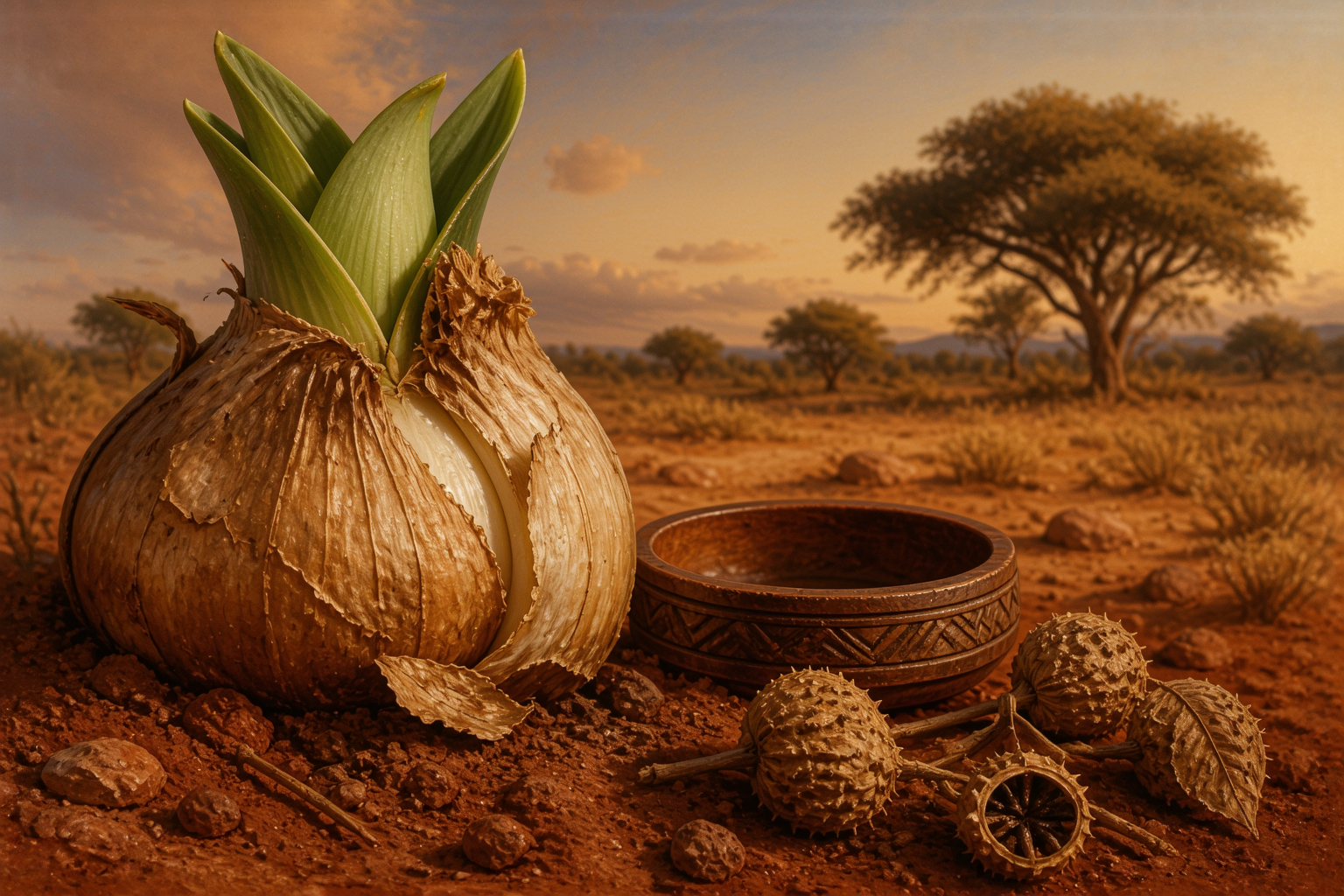
Among the Zulu, Xhosa, Shona, and San traditional medical practitioners of southern Africa, a particular bulb—Boophone disticha, known as leshoma in Sesotho—held a precise and austere purpose: not to heal a fever or stanch a wound, but to reveal the architect of misfortune itself. When someone fell ill without visible cause, or when calamity seemed to arrive from nowhere, practitioners prepared this toxic bulb as a decoction, administered it to the afflicted person, and waited for the visions to come. In that altered state, they believed, the guilty party would become visible—the person responsible for the harm.
Leshoma: A Bulb Prepared to Reveal the Cause of Misfortune
The cosmology underlying the use of leshoma rests on a fundamental premise shared across Bantu and San healing traditions: that human misfortune often originates not in accident or natural disease, but in the deliberate harm of another—whether through witchcraft, malice, or a transgression of social order that has drawn retaliation from the spirit world. In this framework, identifying the source of harm is not merely psychological comfort; it is prerequisite to remedy. You cannot treat what you do not know caused the injury.
Traditional healers (izangoma among the Zulu, isintu-speakers, and related practitioners across the region) prepared leshoma through a precise process documented in peer-reviewed ethnobotanical work. The bulb was processed as a decoction boiled three times, with the water discarded between each boiling cycle—a method that appears designed to reduce the concentration of the bulb’s toxic compounds while preserving its psychoactive alkaloid profile. The preparation was then administered orally to the person seeking divinatory knowledge, and the healer waited for the onset of the plant’s characteristic effects.
What followed was not gentle. The record shows that practitioners observed dilated pupils, visual disturbances, and a cataleptic state—a suspension between consciousness and unconsciousness in which the person remained aware but physically immobilized. In this condition, according to the tradition’s own account, the identity of the responsible party would arise in vision or knowledge. The experience was meant to be ordeal and oracle combined.
The Visionary Cataleptic State, and a Namibian Survey of Sixty-One Healing Plants
The mechanisms practitioners attributed to leshoma’s action operated entirely within a spiritual and social frame. The plant was not believed to simply induce hallucination; rather, it was understood to open a perceptual door—to thin the veil between the material world and the realm of ancestors, harmful agents, and hidden knowledge. In Zulu and related cosmologies, the ancestors maintain active concern with the living and can communicate through dreams, illness, and altered states induced by powerful plants. Leshoma was a technology for that communication.
The cataleptic paralysis itself was significant. It marked the person as temporarily removed from ordinary social space, placed in a condition where spirit and flesh could converse without the interference of ego or social performance. The inability to move or speak became evidence of the plant’s efficacy—proof that a threshold had been crossed. When sensation returned and the person could speak again, what they reported was treated as testimony from that threshold.
This framework was not unique to leshoma, nor was it confined to the Zulu and related groups. A peer-reviewed ethnobotanical survey conducted in Namibia’s Oshikoto region (Cheikhyoussef et al., 2011) documented 61 medicinal plant species across 25 botanical families in active use by traditional healers at the time of the study. Among them was Datura stramonium, locally called Egwitha, used to treat mental illness. The survey recorded self-reported recovery times ranging from two to three days to as long as sixteen months, suggesting that practitioners distinguished between acute and chronic presentations of mental disturbance. That same study confirmed the active, ongoing nature of these healing traditions—not historical artifacts, but living practices held by practitioners who continue to refine and apply them.
What Traditional Efficacy Claims Can and Cannot Tell Us
Here the record becomes more complicated, and I must mark where scholarship genuinely remains open. The question of whether leshoma—or indeed any divinatory plant of the southern African tradition—actually succeeds at revealing guilt or misfortune’s origin cannot be answered from ethnobotany alone. The plant certainly produces striking neurological effects: catalepsy, visions, altered perception of causality and meaning.
Whether those effects constitute genuine divination or (in modern psychological terms) a culturally-structured way of surfacing tacit social knowledge, or unconscious fears about interpersonal harm, remains contested even among sympathetic scholars. The stronger evidence indicates that the experience is psychologically real and socially consequential to practitioners and their communities—that leshoma does something significant in the context of those communities’ frameworks of meaning and accountability. Whether that accomplishment is best described as “revealing truth” or “generating socially-binding narrative” remains an open question, and I resist flattening it into certainty.
A Word on Legality and Safety
Both Boophone disticha and Datura stramonium are genuinely toxic plants. Boophone bulbs contain cardiac glycosides and other alkaloids capable of causing severe poisoning; Datura’s tropane alkaloids produce unpredictable and dangerous effects including seizure, cardiac arrhythmia, hyperthermia, and death. Neither plant has a safe home-use tradition in any contemporary context. The preparation methods documented in the ethnobotanical record were embedded in specific diagnostic and supervisory contexts—practitioners with years of training, familiar with individual patient variation, able to respond to medical crisis, and operating within communities where such use carried social sanction and accountability.
This essay is a work of history and ethnography. It documents how traditional healers of southern Africa understood and used these plants, and why those practices matter to the history of human knowledge and belief. It is not a guide to use, nor an endorsement. The traditions described here remain living practices held by real practitioners; they deserve respect as such. But that respect includes a clear statement: these are dangerous plants, and their historical use does not make them safe for contemporary independent experimentation.
Sources & What Didn’t Survive Fact-Checking
This essay draws on a peer-reviewed article examining Boophone disticha’s traditional preparation and reported effects across Bantu and San practitioners (available in PubMed Central, PMC11162113), which provided the documented decoction method and cataleptic presentation. The Namibian ethnobotanical survey—Cheikhyoussef et al. (2011) in the Journal of Ethnobiology and Ethnomedicine—supplied the specific data on 61 plant species, Datura stramonium’s local nomenclature, and recovery time ranges, grounding the essay’s claims about active contemporary practice. Additional context derives from broader ethnobotanical literature on southern African plant knowledge and its integration into healing and divination frameworks.
In the course of research, I checked several claims that circulate in popular writing on these plants but did not hold up to verification. A claim you may have encountered: that Datura stramonium’s traditional name derives from a Sanskrit word meaning “divine inebriation,” and that it possesses a documented 400-year history of use via smoke inhalation in southern African traditions. This etymological and historical claim did not survive fact-checking and is omitted from this piece. Similarly, claims about Sceletium tortuosum (kanna) preparation methods and a serotonin-reuptake-inhibitor mechanism attributed to San and Khoi tradition—while kanna has its own genuine and significant ethnobotanical history—did not hold up under rigorous verification and are left out. The record is complex enough without the additions.
Frequently Asked Questions
What is leshoma and how did healers prepare it?
Leshoma is Boophone disticha, a bulb used by Zulu, Xhosa, Shona, and San traditional healers for divination. Practitioners prepared it as a decoction boiled three times, discarding the water between each boiling—a method designed to reduce toxic compounds while preserving its psychoactive alkaloid profile, then administered it orally to seek divinatory knowledge.
Why did southern African healers use divination plants?
In Bantu and San cosmologies, human misfortune often stems from deliberate harm through witchcraft or malice rather than accident. Identifying the source of harm was prerequisite to remedy. Traditional healers believed divination plants like leshoma opened perception to ancestors and hidden knowledge, revealing who caused the affliction.
What physical effects did leshoma produce in the person?
Leshoma induced a cataleptic state marked by dilated pupils, visual disturbances, and paralysis—a suspension between consciousness and unconsciousness in which the person remained aware but physically immobilized. Practitioners understood this cataleptic paralysis as evidence the plant had opened a perceptual threshold where spirit and flesh could communicate.
Is it safe to use Boophone disticha or Datura stramonium today?
No. Both plants are genuinely toxic. Boophone bulbs contain cardiac glycosides and alkaloids causing severe poisoning; Datura’s tropane alkaloids produce unpredictable dangerous effects including seizure, cardiac arrhythmia, hyperthermia, and death. Historical use in supervised traditional contexts does not make them safe for contemporary independent experimentation.
About This Article

Written by Kyle Bamboo. Kyle Bamboo has spent twelve years following the hermetic tradition of herbalism out of dusty reprints and into a home apothecary — spagyrics, planetary correspondences, and the strange internal logic of plant alchemy. Muddle and Mend takes its name from solve et coagula, dissolve and combine. He writes about the actual tradition, with its history, its vocabulary, and its genuine strangeness, not the Instagram version. More about this site.
Scope and limits. Kyle writes from a personal practice in traditional herbalism, not clinical training. Herbs interact with prescription medications and are not regulated as drugs — check interactions and talk to a pharmacist or clinician before taking anything.
Verify this against a primary source
Specifics change, and your situation may differ from the one described here. These are the authorities worth checking directly:
- NCCIH — herb safety, evidence and known interactions
- MedlinePlus Herbs and Supplements — documented interactions and cautions
- FDA Dietary Supplements — regulatory status and safety alerts