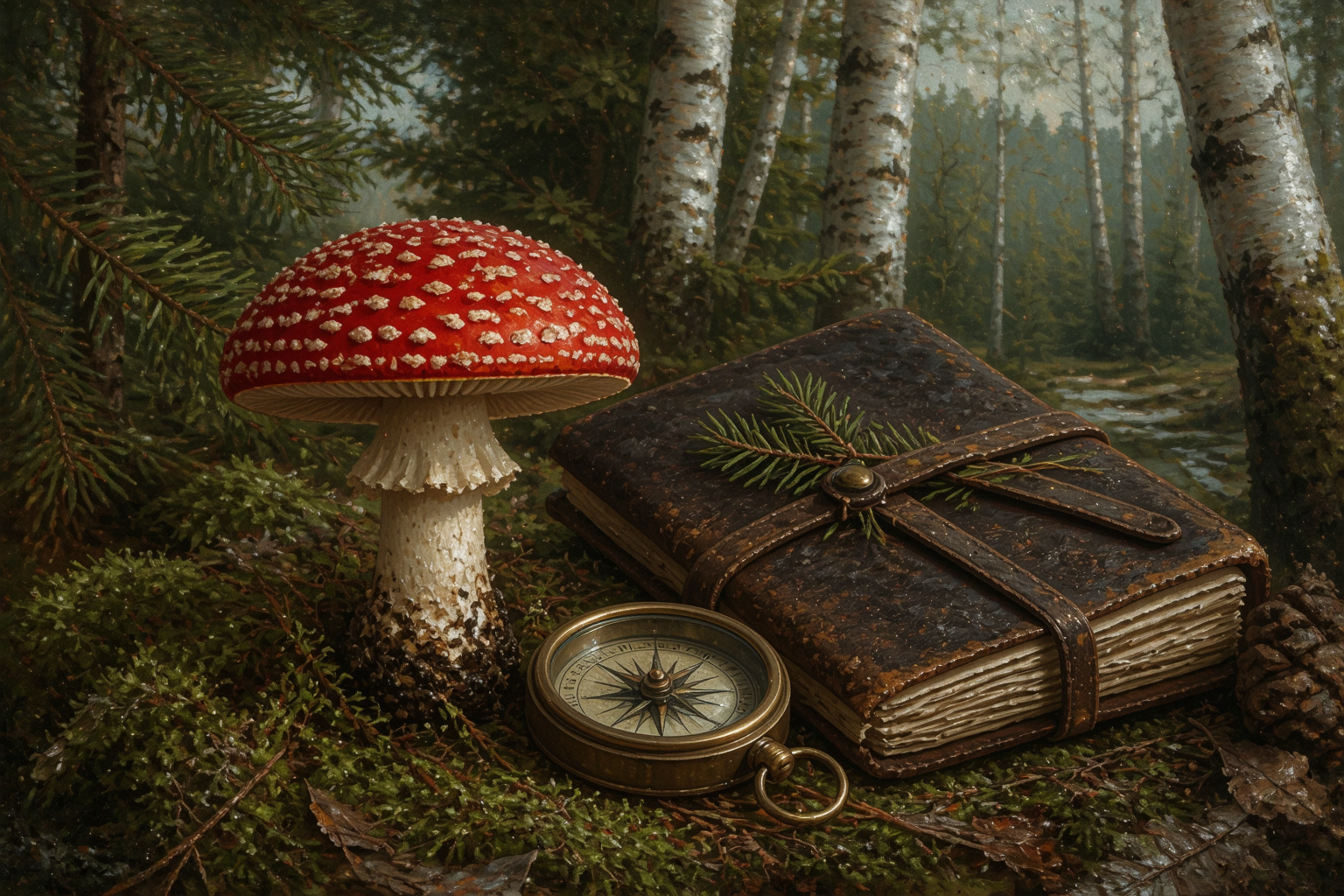
Among the Koryak peoples of northeastern Siberia, a red-and-white spotted mushroom called wapaq—known to science as Amanita muscaria, the fly agaric—held a place at the very center of shamanic healing and divination. What made this fungus extraordinary, in the eyes of the Koryak, was not merely its capacity to alter consciousness, but its role as a direct conduit to the spirit realm: shamans ingested it to diagnose the hidden causes of illness, to journey to the Upperworld and Underworld, to summon protective spirit allies, and to foretell what the future would bring. The mushroom itself was believed to be a manifestation of the Koryak supreme deity, woven into their origin myths and their understanding of how the cosmos worked.
The Koryak Wapaq: A Mushroom in the Myth of the Supreme Deity
The Koryak are an indigenous people of the Kamchatka Peninsula and the Russian Far East, with a shamanic tradition that maintained continuity well into the twentieth century—long enough for anthropologists and ethnobotanists to document it in detail. Their cosmology centered on a tiered universe: an Upperworld inhabited by benevolent spirits and celestial powers, a Middle World of human habitation, and an Underworld of the dead and malevolent forces. In this framework, illness was understood not as a mere bodily ailment but as a spiritual imbalance—a soul displaced, a protective spirit withdrawn, or a malevolent being sent to cause harm.
The mushroom wapaq was central to the Koryak shaman’s practice. Historical sources indicate that the fungus was prepared by drying and sometimes rehydrating it, then consumed—though the exact ceremonial protocols varied by community and practitioner. A peer-reviewed ethnobotanical study published in Roczniki Kulturoznawcze demonstrates that Amanita muscaria‘s prominence in Koryak myth, particularly its direct association with the supreme deity, was not decorative folklore but rather a reflection of its genuine historical function in shamanic diagnosis and soul-work. The mushroom was not peripheral to Koryak spiritual life; it was foundational.
What the Mushroom Was Believed to Do: Diagnosis, Dreams, and the Journey of the Soul
In the hands of a trained shaman, wapaq was believed to accomplish several distinct spiritual functions. First and foremost, it was a diagnostic tool. When a community member fell ill, the shaman would ingest the mushroom and, in the visionary state that followed, would perceive the spiritual cause of the sickness: perhaps a soul-loss, the intrusion of a malevolent spirit, or the anger of an offended guardian being. This diagnosis shaped the subsequent healing work.
Second, the mushroom facilitated what scholars call “soul-journeying”—a core shamanic practice across Siberia. The shaman’s consciousness, in the traditional understanding, would leave the body and ascend to the Upperworld or descend to the Underworld to negotiate with spirits, to recover lost souls, or to understand events hidden from ordinary sight. The USDA Forest Service ethnobotany program has documented that Amanita muscaria served this function explicitly: shamans used it to summon spirit helpers, to shelter and restore the souls of the sick, and to defend against malevolent spiritual attack.
Third, the visions induced by the mushroom were believed to reveal knowledge otherwise inaccessible: the interpretation of dreams, the reading of omens, and glimpses of future events. In a culture where spiritual knowledge determined survival and community cohesion, this capacity was precious. The mushroom did not reveal arbitrary fantasies; it was understood to pierce the veil between worlds and show what was actually there.
The Soma Question: A Landmark Theory, Not a Settled Fact
In 1968, the ethnobotanist R. Gordon Wasson published a provocative hypothesis: that Amanita muscaria—not a plant, but a fungus—was the identity of Soma, the mysterious, ecstatic inebriant celebrated in the Vedic hymns of ancient India. Wasson had documented fly agaric as a sacred, non-alcoholic ritual substance among Siberian peoples of the Ob and Yenisei river valleys, and he argued that the plant’s role in those northern traditions mirrored the Soma cult described in texts thousands of years old and thousands of miles to the south.
This theory remains contested. While Wasson assembled compelling linguistic and ethnobotanical parallels, many scholars have questioned whether the evidence is strong enough to identify Soma with certainty. Alternative candidates—including various plants and even fermented beverages—have been proposed. The Soma question illustrates an important principle: even when historical ethnobotanical sources are robust, the interpretation of mythic and ancient textual evidence leaves room for genuine scholarly disagreement. What we can say with confidence is that Amanita muscaria held a sacred place in Siberian shamanic practice; whether it held that same place in ancient India remains an open question.
A Word on Legality and Safety
Amanita muscaria is not a controlled substance in most jurisdictions. However, it is genuinely toxic. The mushroom contains ibotenic acid and muscimol—compounds that cause unpredictable and sometimes severe poisoning in humans. Effects can include nausea, vomiting, tremor, confusion, hallucinations, and in serious cases, seizures or respiratory depression. There is no safe home-use tradition for fly agaric in contemporary Western medicine or herbalism, and no reliable dosing protocol. This essay is a work of history and anthropology—an account of what Siberian peoples believed and practiced, documented by ethnographers. It is not a foraging guide, a preparation manual, or an endorsement of use. Anyone curious about these traditions should engage with them through reading and scholarship, not experimentation.
Sources & What Didn’t Survive Fact-Checking
This piece draws on Peter T. Furst’s ethnobotanical survey at the Penn Museum, which established fly agaric as the primary ecstatic inebriant of Siberian shamanic traditions; the peer-reviewed ethnobotanical scholarship in Roczniki Kulturoznawcze linking fly agaric to Koryak deity-mythology; and the USDA Forest Service ethnobotany program’s documentation of the mushroom’s role in Koryak healing practices. Wasson’s 1968 monograph on Soma remains the landmark statement of the hypothesis, though subsequent scholarship has both supported and criticized aspects of his argument.
One claim you may have encountered in popular accounts is that Koryak fly-agaric shamanic use persists as a living folk-medicine practice in the present day. The sourcing I have checked supports only the historical claim—that the tradition existed and was well-documented in the twentieth century—not present-day continuity. Similarly, the vivid folk image of shamans distributing mushroom to participants so that all experience “flying through the air in a spiritual sleigh pulled by reindeer,” and the specific costume detail of shamans dressed in red garments trimmed in white fur who enter the yurt through the smoke hole, both failed adversarial fact-checking against primary and secondary sources. These details circulate in popular writing about shamanism, but I have found no robust ethnographic documentation to support them. I have chosen to leave them out in favor of claims that the record actually sustains.
“` —Frequently Asked Questions
What did the Koryak call fly agaric mushroom?
The Koryak peoples of northeastern Siberia called the fly agaric mushroom wapaq. In the Koryak tradition, this red-and-white spotted fungus, known scientifically as Amanita muscaria, held a central place in shamanic healing and divination, and was believed to be a manifestation of their supreme deity.
How did Koryak shamans use wapaq for diagnosis?
When a community member fell ill, the shaman would ingest wapaq and, in the visionary state that followed, would perceive the spiritual cause of the sickness—perhaps soul-loss, intrusion of a malevolent spirit, or anger of an offended guardian being. This diagnosis shaped the subsequent healing work.
What is the Soma hypothesis and who proposed it?
In 1968, ethnobotanist R. Gordon Wasson proposed that Amanita muscaria was the identity of Soma, the mysterious inebriant celebrated in ancient Vedic hymns. He argued the mushroom’s role in Siberian traditions mirrored the Soma cult described in texts thousands of years old and miles to the south, though this theory remains contested among scholars.
Is fly agaric poisonous to humans?
Yes. Amanita muscaria is genuinely toxic, containing ibotenic acid and muscimol. Effects can include nausea, vomiting, tremor, confusion, hallucinations, and in serious cases, seizures or respiratory depression. There is no safe home-use tradition or reliable dosing protocol in contemporary Western medicine or herbalism.
About This Article

Written by Kyle Bamboo. Kyle Bamboo has spent twelve years following the hermetic tradition of herbalism out of dusty reprints and into a home apothecary — spagyrics, planetary correspondences, and the strange internal logic of plant alchemy. Muddle and Mend takes its name from solve et coagula, dissolve and combine. He writes about the actual tradition, with its history, its vocabulary, and its genuine strangeness, not the Instagram version. More about this site.
Scope and limits. Kyle writes from a personal practice in traditional herbalism, not clinical training. Herbs interact with prescription medications and are not regulated as drugs — check interactions and talk to a pharmacist or clinician before taking anything.
Verify this against a primary source
Specifics change, and your situation may differ from the one described here. These are the authorities worth checking directly:
- NCCIH — herb safety, evidence and known interactions
- MedlinePlus Herbs and Supplements — documented interactions and cautions
- FDA Dietary Supplements — regulatory status and safety alerts