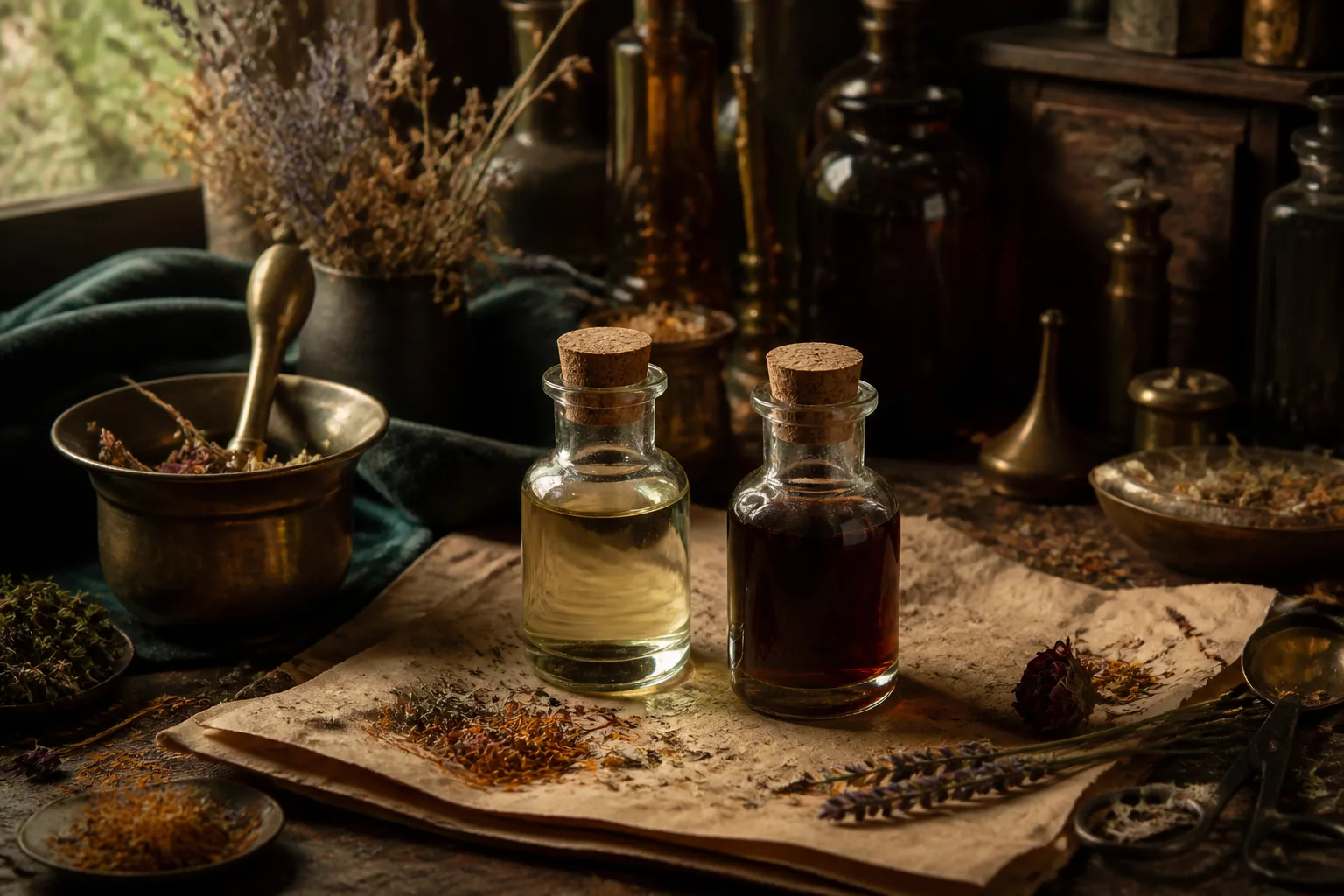
Take a finished tincture — one you made yourself, six weeks of patience, good menstruum, quality herb — and pour a small amount into a white dish. Let the alcohol evaporate off. What’s left? A thin, resinous film. Maybe a faint color. Rub it between your fingers and you get something slightly sticky, slightly aromatic, faintly alive. That residue is the sum of everything your solvent could pull out of the plant: the alcoholic fraction, the water-soluble fraction, whatever traveled across the boundary between herb and liquid.
Now ask yourself what didn’t make it in. What stayed behind in the marc — the spent, pressed-out vegetable matter you composted or threw away. The answer, in the spagyric tradition, is the most permanent part of the plant: its salt. Its mineral skeleton. And throwing that away, according to Paracelsus and every serious spagyrist who followed him, is like making a key and leaving out the metal.
| Principle (Tria Prima) | Physical Manifestation | Captured in Folk Tincture? | Captured in Spagyric? |
|---|---|---|---|
| Sulphur | Essential oils, resins, aromatic compounds | Yes | Yes |
| Mercury | Watery sap, dissolved compounds, volatile spirit | Mostly | Yes |
| Salt | Mineral ash, potassium carbonate, bioaccumulated minerals | No | Yes (via calcination) |
What a Folk Tincture Actually Is
A standard folk tincture is a solvent extraction. You’re using alcohol — usually somewhere between 40% and 70% ethanol depending on what you’re after — to pull constituents out of plant material and hold them in suspension. The alcohol grabs the resins, essential oils, and many alkaloids. The water in your menstruum grabs the sugars, tannins, and water-soluble glycosides. Done right, it’s efficient, it’s stable, and it’s been the backbone of Western herbalism for centuries. The London Pharmacopoeia was listing tincture preparations by 1618. This is not a fringe method.
What the folk method does not do, and has never claimed to do, is work with the plant as a complete philosophical subject. It treats the herb as a source of target compounds. Extract, discard the rest, bottle the liquid. The marc goes in the bin. The mineral content of the plant — everything that wouldn’t dissolve into your alcohol-water mixture — never makes it into the bottle. For most modern herbalists, that’s fine. Pragmatic. The tincture works.
But the alchemical tradition looked at a plant differently. It saw three principles at work in all matter, not one.
The Tria Prima and Why the Salt Matters
Paracelsus — Theophrastus Bombastus von Hohenheim, writing in the early sixteenth century — formalized what became the operating theory of spagyrics: the tria prima, the three primes. Every substance in nature expresses Sulphur, Mercury, and Salt. Not the literal minerals (though the Salt does correspond to actual mineral content). These are principles. Sulphur is the oily, combustible, aromatic soul of a thing — what burns away, what you smell. Mercury is the volatile, the fluid, the mediating spirit — what rises, what carries. Salt is the body: the fixed, incombustible residue that remains after you burn everything else away.
In a plant, you can map this fairly directly onto physical reality. The essential oils and resins are your Sulphur — volatile, aromatic, soluble in alcohol. The watery sap and its dissolved compounds are your Mercury. The mineral ash — potassium, calcium, silica, magnesium, whatever the plant accumulated from its soil — is your Salt. A folk tincture, by this accounting, captures the Sulphur and most of the Mercury. It leaves the Salt in the compost.
The spagyric process recovers all three. The Sulphur and Mercury are extracted via fermentation and distillation, or via simple maceration depending on the practitioner and the tradition. The marc is then incinerated — calcined — at high heat until it becomes a white or gray ash. That ash is dissolved in distilled water, filtered, and evaporated down to a crystalline salt. The salt is then reintroduced into the liquid extract. Solve et coagula: dissolve and recombine. The preparation is now, in theory, whole.
The Honest Question: Does the Salt Do Anything?
Here is where intellectual honesty is required, and where a lot of spagyric writing goes soft and mystical when it should stay sharp. The calcined salt of a plant is primarily potassium carbonate — potash — with whatever other minerals the plant happened to bioaccumulate. When you dissolve it and filter it and evaporate it, you get a water-soluble mineral concentrate. It is real. It is chemically distinct from the tincture it gets added back into. It will shift the pH of your preparation. It contains minerals that were in fact part of the living plant’s structure.
What you cannot honestly claim is that this process has been subjected to the kind of controlled study that would let you say, in specific terms, what the recovered salt contributes to the body. The tradition is rich. The theory is coherent within its own framework. The chemistry is real. The therapeutic specifics are not established by anything resembling modern evidence. Any practitioner who tells you otherwise is selling something.
What we can say: the mineral fraction of medicinal plants is genuinely underexplored in mainstream research. We know that plant-form minerals differ in bioavailability from inorganic supplements. We know that the full spectrum of a plant’s chemistry often behaves differently than isolated compounds — this is not woo, it’s the documented complexity of phytochemistry. Whether the spagyric salt tips any of those scales in a meaningful direction is a legitimate question without a satisfying answer. Any reader planning to ingest a spagyric preparation — or any herbal preparation — should be working with a qualified practitioner. Some plants are genuinely dangerous, and calcination does not neutralize every toxin.
What the Tradition Claims, and Why Practitioners Still Do It
The spagyric literature — from Paracelsus through the Rosicrucian pharmacopoeia of the seventeenth century, through Johann Rudolf Glauber’s practical chemistry, through the twentieth-century revival in figures like Albert Richard Riedel (Frater Albertus), whose Alchemist’s Handbook appeared in 1960 and brought laboratory spagyrics to a new generation — consistently makes a specific claim: the reintegrated preparation works more efficiently and more completely than the extracted fraction alone. The Salt, by this argument, acts as a vehicle. It carries the subtler constituents deeper, more specifically, more intelligently.
This is a philosophical claim rooted in a cosmology. The tria prima model holds that body, soul, and spirit must work in concert. Separating and discarding the Salt is, within that framework, a kind of violence against the wholeness of the plant. You wouldn’t evaluate a person by studying only their thoughts and ignoring their bones. The spagyric tradition treats the plant with analogous respect.
Practitioners continue the work for reasons that don’t reduce neatly to the question of measurable effect. There is the act of attention: the calcination takes hours, the dissolution takes care, the filtration asks you to be precise. You handle the ash. You watch what was green and cellular become white and mineral. The process teaches you something about the plant’s relationship to fire, to water, to time. This is not nothing. The alchemical tradition always held that the operator is changed by the operation. Whether or not the salt does something specific in the body, the practitioner who made the salt knows the plant differently than one who strained and bottled.
The Real Difference, Plainly Stated
A folk tincture is a solvent extraction. It is practical, historically validated, and chemically meaningful. It captures the majority of what a plant has to offer a menstruum and delivers it in a stable, concentrated form. For most purposes, it is exactly sufficient.
A spagyric preparation adds the mineral salt fraction, reintegrated after calcination. The process is more labor intensive by an order of magnitude. It is grounded in a specific cosmological framework — the tria prima — that is coherent, historically serious, and not currently provable or disprovable by modern analytical methods in terms of its claimed effects.
What the extra work demonstrably gets you: a preparation that includes the plant’s mineral content in a form derived directly from that plant; a changed relationship to your material; and membership in a tradition of practice that stretches from the Renaissance pharmacy to the present day. What it may get you beyond that remains genuinely open. Anyone claiming certainty in either direction — that spagyrics are definitively superior, or definitively equivalent — is speaking past the evidence.
The work is worth doing. Know what you’re doing it for.
Worth having on hand: Manfred Junius’s Spagyrics: The Alchemical Preparation of Medicinal Essences — still the standard modern manual for the fuller process this post compares against a folk tincture.
Frequently Asked Questions
What are the three principles in spagyric theory?
In spagyric theory, the tria prima are Sulphur (the oily, combustible, aromatic principle), Mercury (the volatile, fluid, mediating principle), and Salt (the fixed, incombustible residue). A folk tincture captures Sulphur and most of Mercury but leaves the Salt — the mineral ash — behind in the spent plant matter.
Why do spagyrics calcine the plant marc?
The marc is incinerated at high heat until it becomes ash, which is then dissolved in distilled water, filtered, and evaporated to a crystalline salt. This recovered salt is reintroduced into the liquid extract. Within the spagyric framework, this reconstitutes the plant as a complete whole through the principle of solve et coagula — dissolve and recombine.
Is the spagyric salt primarily potassium carbonate?
Yes. The calcined salt of a plant is primarily potassium carbonate — potash — along with whatever other minerals the plant bioaccumulated from its soil. When dissolved, filtered, and evaporated, it becomes a water-soluble mineral concentrate that shifts the pH of the preparation.
When did folk tinctures first appear in Western pharmacy records?
The London Pharmacopoeia was listing tincture preparations by 1618. Standard folk tinctures use alcohol between 40% and 70% ethanol to extract resins, essential oils, alkaloids, sugars, tannins, and water-soluble glycosides from plant material.
About This Article

Written by Kyle Bamboo. Kyle Bamboo has spent twelve years following the hermetic tradition of herbalism out of dusty reprints and into a home apothecary — spagyrics, planetary correspondences, and the strange internal logic of plant alchemy. Muddle and Mend takes its name from solve et coagula, dissolve and combine. He writes about the actual tradition, with its history, its vocabulary, and its genuine strangeness, not the Instagram version. More about this site.
Scope and limits. Kyle writes from a personal practice in traditional herbalism, not clinical training. Herbs interact with prescription medications and are not regulated as drugs — check interactions and talk to a pharmacist or clinician before taking anything.
Verify this against a primary source
Specifics change, and your situation may differ from the one described here. These are the authorities worth checking directly:
- NCCIH — herb safety, evidence and known interactions
- MedlinePlus Herbs and Supplements — documented interactions and cautions
- FDA Dietary Supplements — regulatory status and safety alerts