I am not a Freemason. I want to say that plainly at the start, because what follows is a reading from outside the lodge—a spagyrist and plant alchemist examining the published record of Masonic practice the way I might study a historical text on mineral work or distillation. I read Albert Mackey’s Encyclopedia of Freemasonry, publicly available lodge education material, and the century-long printed archive. I make no claim to know what happens behind closed doors, and I offer no exposé. What I do recognize, however, is this: the furniture of a Masonic chamber used in initiation is, in its published description, nearly identical to the furniture of my workbench. The overlap is worth examining.
The Chamber of Reflection: The Published Record
In many Masonic traditions—notably the Continental European rites and the Scottish Rite, though I note honestly that most mainstream American Craft lodges do not employ this practice—a candidate enters what is called the Chamber of Reflection alone before initiation. The room is dark. Small. The candidate sits with nothing but symbols and the weight of solitude.
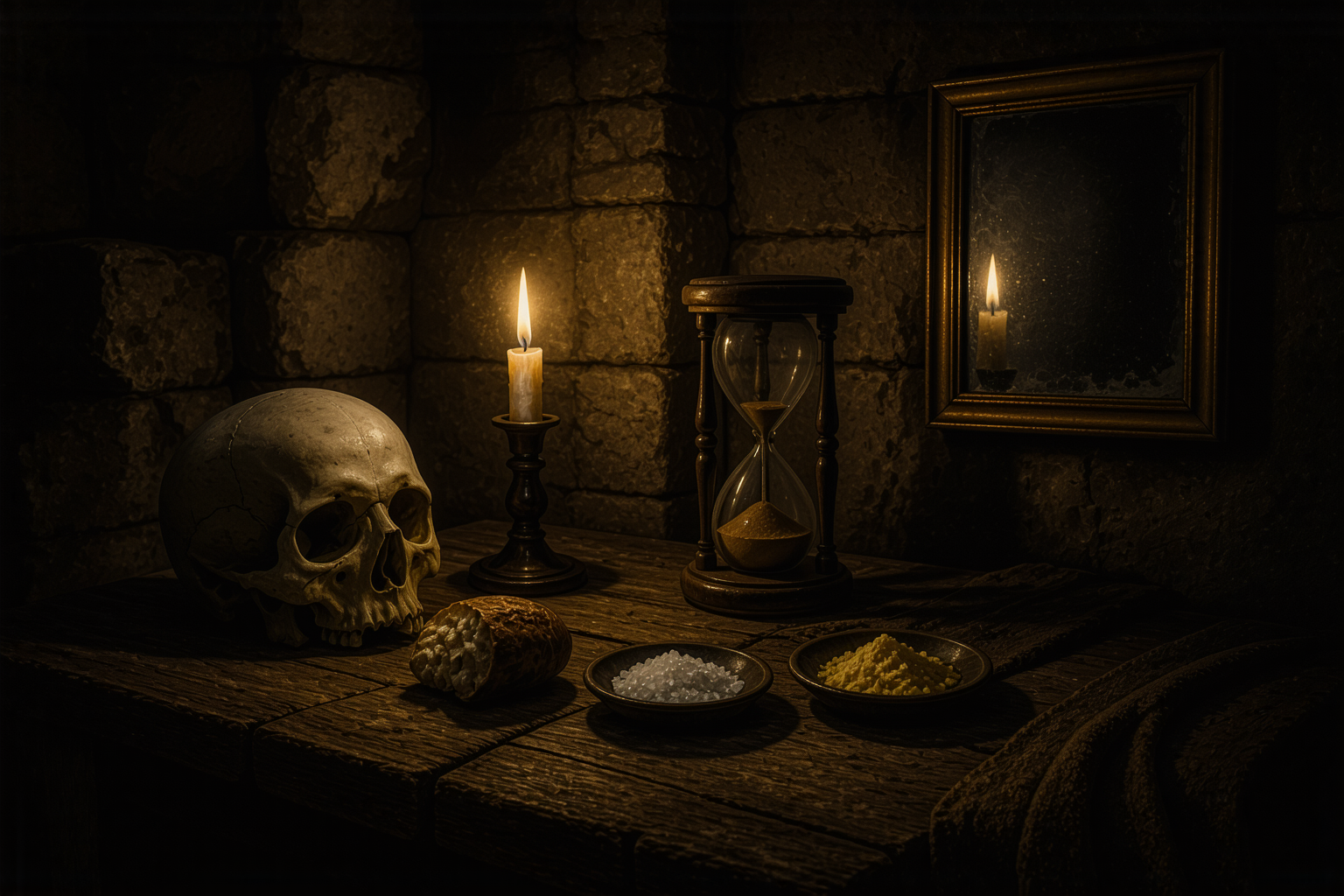
What sits on the table? The published sources are consistent. A skull. An hourglass. A candle. Bread and water. A mirror. Words written on the walls, memento mori—remember you will die. And, decisively for anyone reading alchemical texts, two dishes: one of salt, one of sulfur. Above them, or inscribed nearby, the acronym V.I.T.R.I.O.L.
This is not secret knowledge. Mackey’s Encyclopedia describes it. Lodge education lectures print it. Masonic historians have documented it for over a century. I am reading what has been published, what sits in any library, what a curious mind can find. What strikes me is not that I have uncovered something hidden, but that something published speaks the language I speak at my own bench.
Two of the Three Principles Arranged and Waiting
In spagyric and alchemical work, we recognize the three principles articulated by Paracelsus: Salt, Sulfur, and Mercury. These are not the chemical substances alone, though they include them. They are principles—ways of understanding how matter moves, how spirit and body speak to each other in the work.
- Salt is the fixed, the body, the ash—what remains when all else burns away. It is stability, mineral, earth.
- Sulfur is the volatile soul, the principle of combustion and transformation, will and appetite, the reddening principle.
- Mercury is the mediator, spirit, the animated principle that moves between the other two and allows their marriage.
On the Chamber table lies salt. Sulfur. The third principle—Mercury, the living spirit—is not there. But someone enters the room. The candidate is the Mercury. The chamber has been arranged with two principles waiting for the third to arrive, to be tested, to be transformed by descent into solitude and shadow.
This is my reading, flagged as such. But I am not alone in it. Masonic scholars and writers themselves have drawn this parallel in print. The chamber is not arbitrary decoration. It is a statement in symbols about what transformation requires: the marriage of opposites, and the spirit of the candidate as the living agent that makes the work possible.
V.I.T.R.I.O.L. and the Descent
Above the salt and sulfur, on the wall, stands the acronym V.I.T.R.I.O.L. If you have worked in alchemy or herbal spagyrics, this letter-string will stop you. It is an instruction, a formula, a map of the first stage of the Great Work. I have written a full entry on V.I.T.R.I.O.L. in the Muddle and Mend glossary, but the kernel is this:
Visita Interiora Terrae, Rectificando Invenies Occultum Lapidem. Visit the interior of the earth; by rectifying you will find the hidden stone.
In alchemy, this is the instruction for the nigredo—the blackening, the descent, the necessary dissolution that begins all true work. You do not rise until you have descended. You do not find the stone until you have gone into the earth, into the dark, into the breaking-down of what was whole. The formula hangs on the Chamber wall as if to say: this room you are entering, this darkness, this is the work itself beginning.
The Chamber as Nigredo: A Lived Darkness
The Chamber of Reflection is, in its architecture and furniture, a nigredo made visible. Darkness. Solitude. Memento mori—the skull, the hourglass, the written words of mortality. The candidate is stripped of rank, of external identity, of companionship. Brought to the barest elements. Bread and water. The humblest prima materia of nourishment—not feast but sustenance, the raw and undifferentiated beginning.
This is the solve. The breaking-down. In alchemical terms, it is the dissolution of the gross self before any coagula—any building up, any reconstitution in a higher form—can begin. The lodge, when the candidate emerges and enters the light of the Lodge proper, will perform the coagula. But first, there is this: the dark stage, alone, where nothing happens except the work of bearing witness to one’s own dissolution and sitting with it.
The mirror on the table is not accidental. The candidate sees themselves. In the darkness, in the company of mortality, of salt and sulfur waiting, of the instruction V.I.T.R.I.O.L. written on the stone. The reflection is the beginning of knowledge.
At the Mortar: What the Herbalist Carries Home
I bring this understanding to my own bench. Every first maceration jar in my spagyric work is a small Chamber of Reflection. I seal it. I set it in darkness—a cabinet, a basement shelf, the cool interior away from light. The plant material sits alone with itself, breaking down, oxidizing, speaking to the menstruum in the dark where I cannot see or hurry it.
Salt and sulfur are there in the plant—fixed mineral body and volatile aromatic principle—beginning their long negotiation without my presence. The work requires waiting. Darkness. The refusal to rush the nigredo. Both traditions teach this discipline: the dark stage cannot be skipped, cannot be hurried into light before its time. The stone is only found by those willing to descend and stay in the interior of the earth until the descent is complete.
On Genealogy and Shared Waters
I should end with honest edges. The historical relationship between Freemasonry and alchemy remains debated by scholars. Shared symbol vocabulary does not prove shared descent or direct lineage. Both traditions drew deep from the same Renaissance hermetic well—the Emerald Tablet, Paracelsus, the Neoplatonists, the printed explosion of alchemical texts in the sixteenth and seventeenth centuries. They may have evolved in parallel. They may have cross-pollinated. The truth is complex.
What I can say plainly is this: the overlap at the level of published symbols, published sources, and the visible architecture of practice is real. A spagyrist reading Masonic education material recognizes not theft or conspiracy, but kinship—the recognition of one craftsman’s tools in another tradition’s hands. We are both reading the same old books. We are both working with salt and sulfur and the long dark of necessary transformation. The Chamber of Reflection and the maceration jar speak the same language, born in the same Renaissance hermetic library, refined in separate disciplines, both still at work.
Frequently Asked Questions
What objects sit on the Chamber of Reflection table?
In Masonic traditions, particularly Continental European rites and the Scottish Rite, the Chamber table holds a skull, hourglass, candle, bread, water, a mirror, and two dishes—one of salt, one of sulfur. The acronym V.I.T.R.I.O.L. is inscribed nearby, along with memento mori writings on the walls. These are documented in Mackey’s Encyclopedia and published lodge education material.
What are the three principles in spagyric work?
In this tradition, Paracelsus articulated Salt, Sulfur, and Mercury as three principles. Salt is the fixed body and ash; Sulfur is the volatile soul and principle of transformation; Mercury is the mediator spirit that moves between the other two. These are not chemical substances alone, but principles describing how matter and spirit interact in the work.
What does V.I.T.R.I.O.L. stand for in alchemy?
V.I.T.R.I.O.L. stands for Visita Interiora Terrae, Rectificando Invenies Occultum Lapidem—Visit the interior of the earth; by rectifying you will find the hidden stone. This instruction describes the nigredo, the necessary dissolution and descent that begins the Great Work. In the Chamber of Reflection, it appears as a written formula directing the initiate into transformative darkness.
How does a spagyrist use darkness in herbal maceration?
In spagyric work, the first maceration jar is sealed and set in darkness—a cabinet or basement shelf—where plant material breaks down alone without the herbalist’s presence or intervention. This mirrors the alchemical nigredo. The dark stage cannot be skipped or rushed; salt and sulfur principles negotiate in absence until the descent completes and the work is ready for light.
About This Article

Written by Kyle Bamboo. Kyle Bamboo has spent twelve years following the hermetic tradition of herbalism out of dusty reprints and into a home apothecary — spagyrics, planetary correspondences, and the strange internal logic of plant alchemy. Muddle and Mend takes its name from solve et coagula, dissolve and combine. He writes about the actual tradition, with its history, its vocabulary, and its genuine strangeness, not the Instagram version. More about this site.
Scope and limits. Kyle writes from a personal practice in traditional herbalism, not clinical training. Herbs interact with prescription medications and are not regulated as drugs — check interactions and talk to a pharmacist or clinician before taking anything.
Verify this against a primary source
Specifics change, and your situation may differ from the one described here. These are the authorities worth checking directly:
- NCCIH — herb safety, evidence and known interactions
- MedlinePlus Herbs and Supplements — documented interactions and cautions
- FDA Dietary Supplements — regulatory status and safety alerts