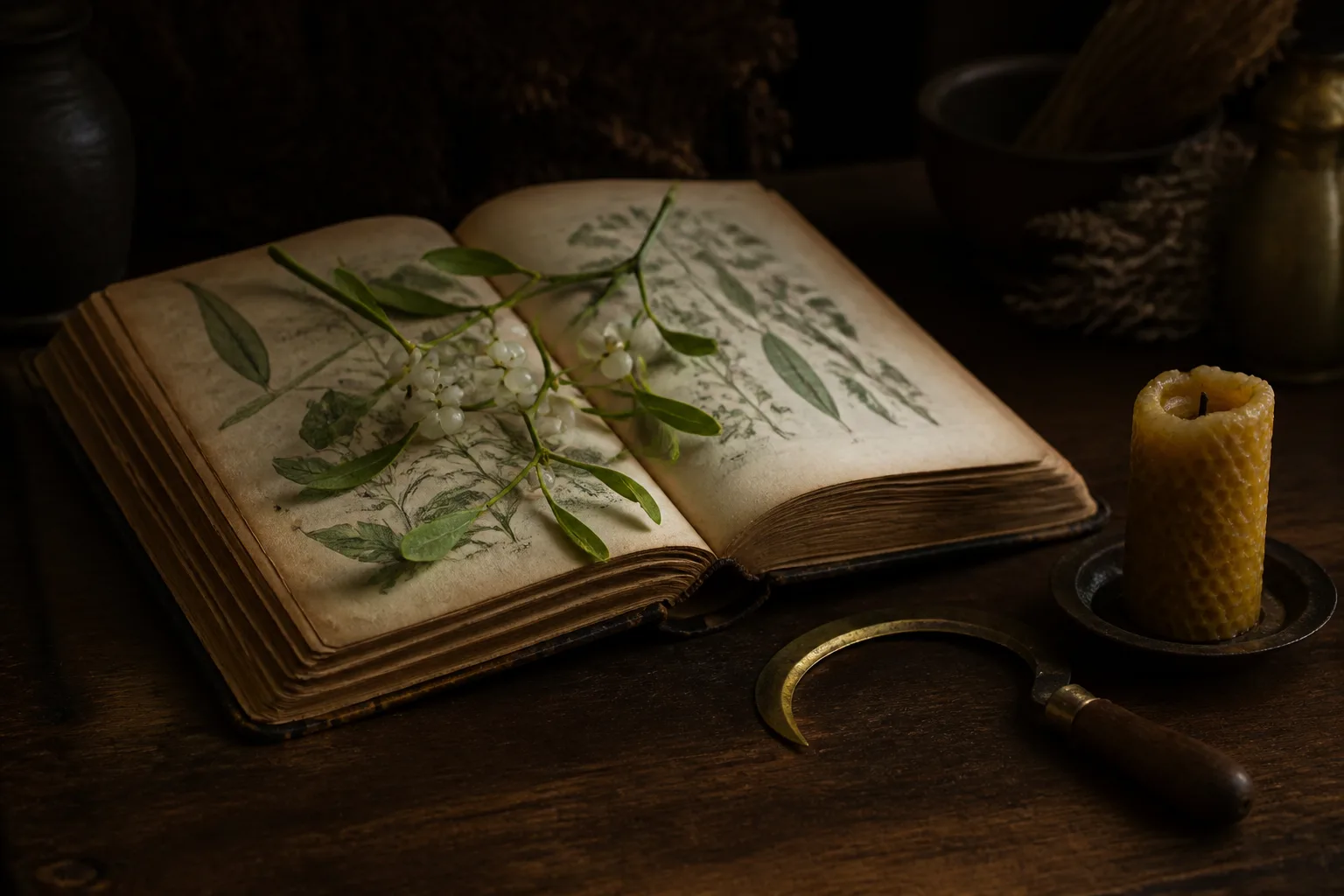
Ask most people what druids did with mistletoe and you will get a picture: a white-robed priest on a misty oak, a golden blade flashing, a cloak held out below to catch the falling sprig. It is a vivid image, and almost all of it comes from a single paragraph in Pliny the Elder’s Natural History, written in the 70s AD by a Roman who did not claim to have watched the ceremony himself.
So here is the direct answer. Pliny says the druids regarded mistletoe, when it grew on an oak, as the most sacred thing in their world. He describes gathering it on the sixth day of the moon, with a priest cutting it from the tree with a golden sickle, and with two white bulls sacrificed afterward. The rest of the image, including the kissing and most of the Norse and Victorian material, was added later by other people. This post sorts out which parts are Pliny, which parts are later invention, and which parts are simply botany.
What Pliny Actually Wrote
The passage sits in Book 16 of the Natural History, in the sections on trees. Pliny’s central claims are short and specific. The druids, he says, hold nothing more sacred than mistletoe and the tree that bears it, provided that tree is an oak. Mistletoe is rarely found on oak, which is part of why it mattered. It is gathered with great ceremony on the sixth day of the moon. The druids call it by a word meaning “all-healing.” A priest dressed in white climbs the tree and cuts the sprig with a golden sickle. It is caught in a white cloak. Then two white bulls, whose horns have been bound for the first time, are sacrificed. Taken in drink, the plant was believed to make barren animals fertile and to serve as an antidote to all poisons.
Pliny then moves on with a dismissive remark about how much reverence people give to trifling things. That tone matters. He is not a sympathetic witness. He is a Roman encyclopedist reporting foreign custom, and he does not name a source. Everything the later centuries built on this passage rests on one secondhand account by a writer with his own purposes.
Why the Golden Sickle Does Not Quite Work
The golden sickle is the most memorable detail, and it is also the least plausible as a working tool. Gold is too soft to cut the woody stems of mistletoe cleanly and would dull or bend quickly. Scholars have proposed that Pliny, or his source, meant a sickle of gilded bronze, or that the gold was a symbol of sanctity rather than a practical blade. Others read it as literary embellishment. None of these readings can be proven from the text alone, and that uncertainty is worth keeping in mind when you see the golden sickle reproduced as fact.
The Botany Pliny Got Right, and Where It Gets Interesting
The plant itself is a real and unusual organism. European mistletoe, Viscum album, is a hemiparasite: it draws water and minerals from its host through its own root-like structures while photosynthesizing with its own green leaves. It is genuinely uncommon on oak, which is an observation Pliny could have made in the field. It is far more often found on apple, lime (linden), poplar and hawthorn. The American mistletoes are a different genus, Phoradendron, so any statement about “mistletoe” needs a location attached to it.
The table below separates what Pliny reports from what can be checked against botany or other evidence.
| Detail in Pliny’s account | What can be checked |
|---|---|
| Mistletoe is rarely found on oak | Consistent with botany; Viscum album is common on apple, lime and poplar instead |
| A priest cuts it with a golden sickle | Gold is too soft for practical cutting; likely symbolic or literary |
| Gathered on the sixth day of the moon | No independent source; cannot be verified |
| Two white bulls are sacrificed | No independent confirmation; unverifiable from Pliny alone |
| Taken in drink to restore fertility and as an antidote | No evidence that this was effective; the plant is toxic |
From Roman Paragraph to Norse Myth
Pliny’s paragraph was the seed, but the plant grew its reputation in other soils. In the Norse tradition recorded by Snorri Sturluson in the thirteenth-century Prose Edda, mistletoe plays the decisive role in the death of Baldr. Frigg, his mother, makes all things swear not to harm him, but she passes over the mistletoe as too young to bother asking. Loki fashions a dart from it and guides the blind god Höðr to throw it, and Baldr dies. The plant that was too slight to be bound by an oath becomes the instrument of the god’s death.
The classical world had its own version of the plant as a sacred object. In Virgil’s Aeneid, Book 6, the golden bough that Aeneas must pluck before he can enter the underworld is compared in a simile to mistletoe. James Frazer took the title of his enormously influential study The Golden Bough (1890) from that image. Frazer’s work did much to fix the idea of a sacred, dying-and-reviving vegetation spirit in the popular imagination, and it is a major reason the druid-and-mistletoe picture feels so settled today.
The Herbalists Take It Up
Early modern herbals gave mistletoe a medicinal career that was almost entirely built on expectation. Nicholas Culpeper, writing in the 1650s, placed mistletoe under the dominion of the Sun and noted that the kind growing on oak partakes somewhat of the nature of Jupiter. He recommended it for the falling sickness, the old name for epilepsy. In 1719 Sir John Colbatch published A Dissertation Concerning Mistletoe, promoting it as a specific for convulsive disorders. That is about where the historical record on mistletoe as a remedy stops being a story about ancient ritual and starts being a story about what physicians wanted to believe.
The modern thread runs through Rudolf Steiner, who proposed mistletoe preparations for cancer around 1917 to 1920. Those preparations are still used in parts of European complementary medicine, and the evidence for them is contested. That is a separate question from the history, and it deserves its own careful treatment.
How the Kiss Got Under the Branch
The kissing custom is not ancient. It is documented as an English practice from the late eighteenth century, and it is far removed from anything Pliny describes. Washington Irving, writing in 1820, records the rule that a berry is plucked for each kiss and that the privilege ends when the berries run out. The old pagan explanation, which says that a kiss under mistletoe was a fertility rite inherited from druids, does not have an ancient source behind it. It is a story told about a custom that was already in place.
If you want the sprig for the doorframe this season, that is a perfectly good reason to hang it. Just keep it out of reach of children and pets, because mistletoe leaves and berries are toxic (the compounds involved include viscotoxins and lectins). This is a history post, and nothing here is meant to be prepared or taken at home.
Reading the Source Honestly
The lesson of Pliny’s paragraph is less about druids than about how a few sentences can outlast the context that produced them. He reported a rite he did not see, from a source he did not name, and he framed it with a shrug. Every later generation that added the golden sickle, the kiss, the Norse death and the Victorian cure was building on that single foundation. When you read about druids and mistletoe, it is worth asking at each step whether the detail comes from Pliny, from a later writer, or from the imagination of someone who wanted the picture to be complete.
Frequently Asked Questions
Did druids really cut mistletoe with a golden sickle?
Pliny the Elder is the only ancient source that says so, and he does not claim to have witnessed the rite. Gold is too soft to cut woody mistletoe stems effectively, so scholars often read the detail as symbolic or as a literary flourish.
Why does Pliny say mistletoe on oak was special?
Mistletoe is genuinely uncommon on oak, and Pliny treats that rarity as part of its sanctity. European mistletoe is far more often found on apple, lime and poplar, so the oak association is partly a matter of what grew where and partly a matter of what the druids valued.
Is the mistletoe kissing tradition connected to druids?
There is no evidence that it is. The custom is documented as an English practice from the late eighteenth century, and Washington Irving’s 1820 description of the berry-plucking rule is among the early written accounts. The druidic link is a later attachment.
Can I use mistletoe from my yard for decoration or medicine?
Decorating with it is common, but keep it away from children and pets, since the leaves and berries are toxic. Using it as a remedy is not something this history post recommends, and anyone considering it for a health concern should talk to a qualified medical professional first.
About This Article

Written by Kyle Bamboo. Kyle Bamboo has spent twelve years following the hermetic tradition of herbalism out of dusty reprints and into a home apothecary — spagyrics, planetary correspondences, and the strange internal logic of plant alchemy. Muddle and Mend takes its name from solve et coagula, dissolve and combine. He writes about the actual tradition, with its history, its vocabulary, and its genuine strangeness, not the Instagram version. More about this site.
Scope and limits. Kyle writes from a personal practice in traditional herbalism, not clinical training. Herbs interact with prescription medications and are not regulated as drugs — check interactions and talk to a pharmacist or clinician before taking anything.
Verify this against a primary source
Specifics change, and your situation may differ from the one described here. These are the authorities worth checking directly:
- NCCIH — herb safety, evidence and known interactions
- MedlinePlus Herbs and Supplements — documented interactions and cautions
- FDA Dietary Supplements — regulatory status and safety alerts