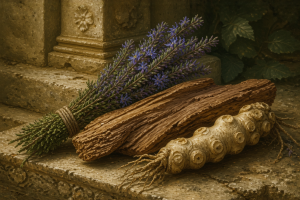
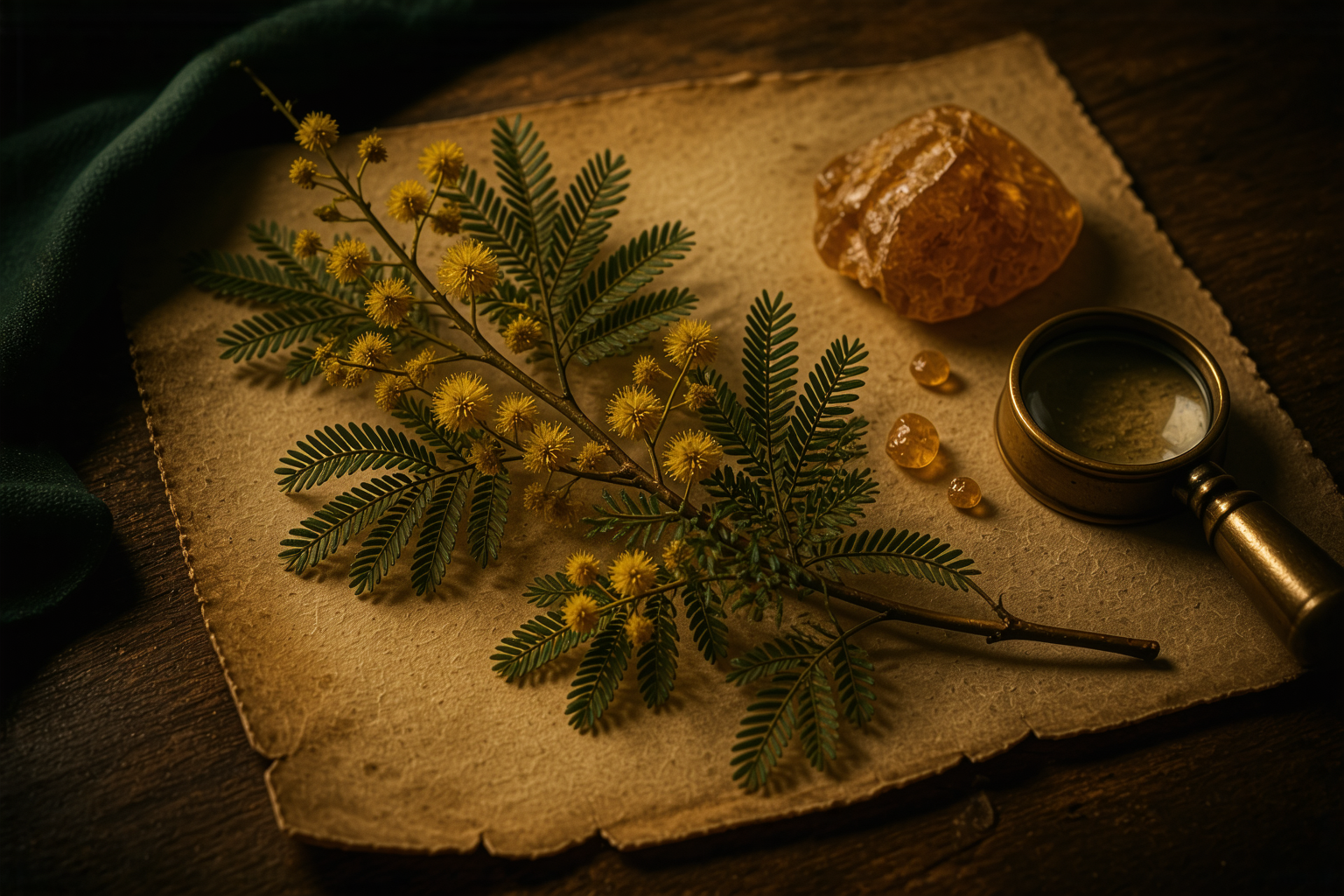
Freemasonry’s best-known plant emblem, as published in every public Masonic reference since the 19th century, is the sprig of acacia — an emblem of immortality and remembrance. I don’t handle emblems for a living; I handle plants. So this essay reads the acacia the way I read any plant that comes across my bench: botany first, then virtue, then signature.
I should say plainly at the start: I’m not a Freemason. I’m a herbalist and plant alchemist. What follows comes from published Masonic literature — Albert Mackey’s Encyclopedia of Freemasonry, openly printed lodge education material, and the historical archive available to anyone who looks. I make no claims about what lodges keep private. That’s their work. This is mine: reading the plants that appear in the public record, and seeing what they have to teach a craftsman of another tradition.
What the Published Record Says
In Mackey’s Encyclopedia and every major public source, the acacia appears as a symbol of immortality of the soul and innocence, with particular association to remembrance of the dead. The sprig itself — the living plant material — carries this weight. I work with living plants and their products, so I respect that assignment. The private ritual context stays private. That’s not my field to plow.
What interests me is whether this symbol landed on the acacia by chance, or whether the plant itself earned the association. To answer that, I have to go where all good reading begins: with what the thing actually is.
The Tree in the Desert
When Exodus commands the building of the Ark of the Covenant in acacia wood — “shittim wood” in the King James — the text points to specific trees of the Sinai and Levant. Modern botanical work identifies these as species within the old genus Acacia, now largely reclassified as Vachellia: chiefly Acacia seyal and Acacia tortilis, though taxonomists still argue the finer points.
These are not gentle trees. They’re desert survivors shaped by extremes: deep root systems that reach toward water the topsoil never holds, thorns that protect against browsers in a landscape where every leaf matters, heartwood so dense and so resistant to rot and insect damage that it was the natural choice for a sacred object meant to endure across centuries. The Ark was built to last. The acacia was built to last. The choice wasn’t poetic accident.
Signature and Symbol: One Reading
Here’s where I shift into the language of my own tradition — the doctrine of signatures, the idea that a plant announces itself through its own structure and behavior. You can read it more fully here, but the principle is simple: plants declare their virtues through what they are.
The acacia declares incorruptibility. Not as doctrine, but as wood: heartwood that resists decay in a climate that breaks down almost everything else. In a desert landscape, a tree that stays structurally sound for centuries reads as immortality without a single word spoken. The early symbol makers — whether Masonic or Biblical or Egyptian before that — didn’t invent this reading. They recognized it. They saw the plant’s own signature and named it.
This is the kind of pre-modern, pre-chemical reading that built both herbalism and symbol systems. You look at the thing in front of you. You notice what it does. You don’t argue about it; you report it. The acacia’s wood outlasts empires. Therefore, the acacia becomes an emblem of what outlasts death. The signature and the symbol are the same event read in two languages.
What the Apothecary Actually Used
But here’s where my reading separates from pure symbolism: I work with the plant’s actual medicinal products, and they tell a different story — or rather, they amplify the first one. The acacia tree produces gum arabic, an exudate collected primarily from Senegalia senegal and Vachellia seyal, and it’s one of the oldest articles in the pharmacy on earth.
Gum arabic is a demulcent. Herbalists have used it for sore throats, coughs, and inflammatory conditions of the mouth and respiratory tract for millennia. But its real work in the old dispensatory was structural: it was the binder and emulsifier that held the entire enterprise together. Pills, troches, lozenges, emulsions — all the solid and semi-solid forms that made pharmacy possible — depended on gum arabic to hold them as one unified substance.
The tree of immortality is also, quite literally, the tree that held the old pharmacy together. You get to enjoy both readings at once. The plant that symbolizes what endures also provides the material that let medicine endure long enough to work. I find that satisfying.
I Work with This Material
On my own bench, gum arabic shows up regularly. The preparation is straightforward: dissolve finely powdered gum arabic in warm water at roughly a 1:2 ratio by weight — one part gum to two parts water — and you have a traditional binding menstruum for hand-rolled herbal pastilles, troches, and lozenges.
The key property: gum arabic dissolves in water but not in alcohol. This means it partners with, rather than replaces, tincture work. If you’re building a medicinal form that needs both water-soluble and alcohol-soluble plant material, you extract separately — as I’ve written elsewhere about extraction methods — and then bind them together with gum arabic. The gum becomes the architecture that lets two different medicines coexist in one solid form.
- Dissolve gum arabic in warm (not hot) water, stirring gently
- Let the solution sit overnight; it thickens as it cools
- Mix into your dried plant powders until the consistency allows hand-rolling
- Roll into small balls or cylinders and let them air-dry completely
- Store in a dry place; the pastilles will harden further as they cure
The pastilles keep for months or years. Gum arabic’s incorruptibility extends to the medicines you bind with it.
At the Mortar
The acacia teaches a lesson I come back to constantly: read the whole plant. Not the symbol apart from the timber. Not the gum apart from the tree. Not the emblem apart from the desert survival story that makes the emblem true. Timber, thorn, exudate, and symbol are one organism making one coherent statement about incorruptibility — whether you’re reading it as a Freemason reading an emblem, a Biblical scholar reading sacred wood, an herbalist reading a demulcent, or a spagyrist reading the mineral and volatile content of a gum.
I respect the Masonic reading. I learn from it. But I read it the way a blacksmith might watch a carpenter work — recognizing that we’re both shaping material according to its own nature, using tools and languages particular to our trades. The acacia was never waiting for either of us to discover its meaning. It was announcing itself all along. We just had to pay attention.
It still is.
Frequently Asked Questions
What tree species are identified as biblical shittim wood?
Modern botanical work identifies the acacia trees commanded for building the Ark of the Covenant as species within the old genus Acacia, now largely reclassified as Vachellia: chiefly Acacia seyal and Acacia tortilis, though taxonomists still debate finer points of classification.
What is gum arabic and where does it come from?
Gum arabic is an exudate produced by acacia trees, collected primarily from Senegalia senegal and Vachellia seyal. In the traditional pharmacy, herbalists used it as a demulcent for sore throats, coughs, and inflammatory conditions, but its chief work was as a binder and emulsifier holding pills, troches, lozenges, and emulsions together as unified substances.
How do you prepare gum arabic as a binder for herbal pastilles?
Dissolve finely powdered gum arabic in warm water at roughly a one-part gum to two-parts water ratio by weight, let it sit overnight to thicken, then mix into dried plant powders until the consistency allows hand-rolling. Roll into small balls or cylinders and air-dry completely; the pastilles keep for months or years.
Why does gum arabic work well with tinctures in one solid form?
Gum arabic dissolves in water but not in alcohol, so it partners with rather than replaces tincture work. You can extract water-soluble and alcohol-soluble plant materials separately, then bind them together with gum arabic, which becomes the architecture letting two different medicines coexist in one solid form.
About This Article

Written by Kyle Bamboo. Kyle Bamboo has spent twelve years following the hermetic tradition of herbalism out of dusty reprints and into a home apothecary — spagyrics, planetary correspondences, and the strange internal logic of plant alchemy. Muddle and Mend takes its name from solve et coagula, dissolve and combine. He writes about the actual tradition, with its history, its vocabulary, and its genuine strangeness, not the Instagram version. More about this site.
Scope and limits. Kyle writes from a personal practice in traditional herbalism, not clinical training. Herbs interact with prescription medications and are not regulated as drugs — check interactions and talk to a pharmacist or clinician before taking anything.
Verify this against a primary source
Specifics change, and your situation may differ from the one described here. These are the authorities worth checking directly:
- NCCIH — herb safety, evidence and known interactions
- MedlinePlus Herbs and Supplements — documented interactions and cautions
- FDA Dietary Supplements — regulatory status and safety alerts